WPC Deck Tiles vs WPC Decking Boards: Which Should You Choose?
WPC deck tiles win on speed, cost, and flexibility, while WPC decking boards win on lifespan, structure, and long-term value. If you have a flat existing surface like a concrete balcony or patio and want a weekend DIY project, choose interlocking WPC deck tiles. If you are building a deck from scratch, want a permanent structure, or plan to live in the home for years, choose WPC decking boards.
The confusing part is that both options are made from the same material. Wood-plastic composite (WPC) combines wood fiber and recycled thermoplastics into a low-maintenance alternative to timber, and it’s one of the fastest-growing outdoor flooring categories on the market. Industry research projects the global WPC market to grow at an 11.0% compound annual rate through 2032, with Asia-Pacific holding more than half of global production.
That material is available in two very different formats, and the format changes everything: what surface you need, how long installation takes, how much you pay upfront versus over 20 years, and even your home’s resale value. Most articles compare WPC boards against ceramic tiles or generic composite products. This guide compares the two WPC formats head-to-head so you can pick the right one for your project.
We’re a trading company based in Linyi, China, one of the world’s largest WPC production hubs. We ship both WPC deck tiles and WPC decking boards to buyers around the world, and we see both formats at every quality level. That factory-floor view is why we can give you a straight comparison instead of a sales pitch.
Key Takeaways
- WPC deck tiles install 5 to 10 times faster and cost roughly $3 to $15 per square foot for DIY, but typically last 8 to 15 years and are a floating, non-permanent surface.
- WPC decking boards cost more upfront ($25 to $54 per square foot installed) because they include a joist substructure, but they last 25 to 30+ years with 25 to 50 year warranties.
- Tiles need a flat, solid base such as concrete or pavers; boards are built with their own frame, so they work on almost any ground.
- The 20-year math often favors boards. A tile deck replaced at year 10 to 12 can end up costing more than boards that last 25 years.
- Choose by your situation, not by price alone: surface, project size, permanence, and budget decide which format is right.
What’s the Real Difference Between WPC Deck Tiles and WPC Decking Boards?
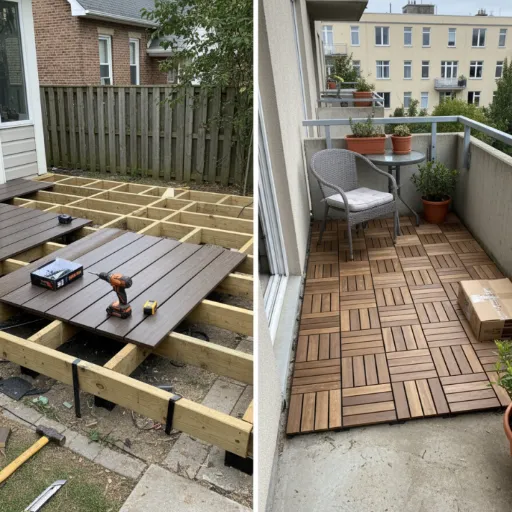
The two products share the same WPC recipe, but they are engineered completely differently.
Same Material, Different Formats
WPC decking boards are long planks, typically 3.6 to 5 meters long, that mount on a frame of joists with hidden clips or visible screws. The joist structure carries the load, and the boards are cut, spaced, and fastened to create a permanent deck surface. This is the classic deck-building process, and it usually involves permits, a substructure, and either professional labor or serious DIY experience.
WPC deck tiles are modular panels, usually 300 x 300 mm or 500 x 500 mm, with a plastic base grid bonded underneath. The grid lifts the tile slightly off the ground, creates a drainage gap, and has interlocking tabs that click the tiles together as a floating floor. No fasteners, no joists, no tools beyond a tape measure and a saw. You lay them directly over any flat, solid surface.
That single difference, a built frame versus a click-together base grid, drives every other difference in this comparison. It determines installation time, cost, what surface you can use, how the floor handles heat and load, and how long the product lasts.
One naming note: WPC decking boards are a type of composite decking, which is why you will sometimes see the decision framed as “deck tiles vs composite decking” rather than the more precise “tiles vs boards.” When you run into that comparison, the same rules below apply, because both WPC formats qualify as composite decking products.
WPC Deck Tiles vs WPC Decking Boards: Installation Differences
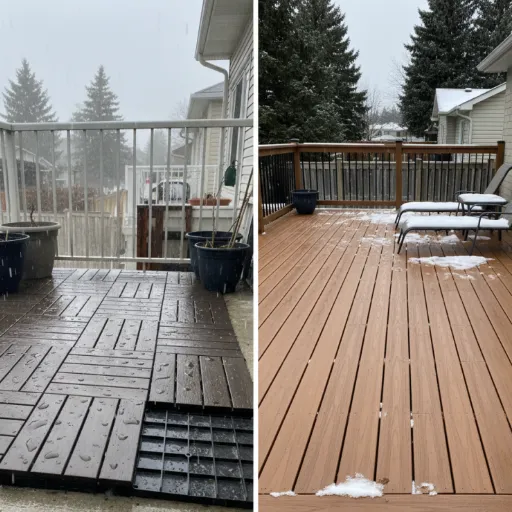
The installation difference is the most obvious. It’s also the reason most people choose tiles without thinking much about the trade-offs.
Interlocking WPC deck tiles go down remarkably fast. A single person can cover roughly 20 square meters in 2 to 4 hours with no prior experience, which makes them 5 to 10 times faster to install than boards. You lay the first tile, clip the next one in, and work across the surface. The process works over concrete, pavers, existing tiles, or compacted gravel, as long as the base is flat and stable. There are no nails, screws, or glue anywhere in the job.
WPC decking boards are a different project entirely. They need a frame of joists and beams, proper fasteners, expansion gaps, and often a building permit. A two-person crew typically needs 2 to 3 days to build a traditional WPC deck for the same area, and most homeowners hire a professional for the substructure work. The result is a permanent, code-compliant structure that becomes part of the property.
The practical question is whether you already have a suitable base. If you have a concrete slab or a paved terrace, tiles are a true weekend project. If you’re starting from bare ground, you’re building a structure either way, and boards make more sense.
Cost Comparison: Upfront vs Long-Term
This is where the comparison gets interesting, because the sticker price tells only part of the story.
Upfront, tiles win clearly. WPC deck tiles run about $3 to $15 per square foot for DIY, with composite tiles around $4 to $10 per square foot fully installed by a homeowner. Because there is no substructure and no labor, a 300 square foot project can be finished for a few thousand dollars, a range retailers confirm across budget and premium options.
WPC decking boards look expensive next to that. Materials alone run $5 to $12 per square foot, and a fully installed board deck lands between $25 and $54 per square foot because the quote includes the joist frame, fasteners, and labor. That 300 square foot deck becomes a $7,500 to $16,000 project before you add railings or stairs. The speed-versus-cost gap is exactly why comparison guides keep coming back to the same question: are you upgrading a surface or building a structure?
The long-term math is where the tables turn. Composite decking boards last 25 to 30+ years and carry 25 to 50 year warranties, with premium PVC decking pushing toward 50. WPC deck tiles typically last 8 to 15 years, and cheap quick tiles can fail within 2 to 5 years.
Because tiles are a floating surface on a plastic grid, the grid and connectors wear out even when the surface looks fine.
Model that replacement cycle and the picture changes. A tile deck replaced at year 10 or 12, with labor and materials at then-current prices, can easily exceed the lifetime cost of a board deck that is still standing at year 25. For a short-term or rental situation, tiles win on cash flow. For a permanent home deck you plan to enjoy for two decades, boards usually win on total cost of ownership.
Lifespan, Durability, and Maintenance
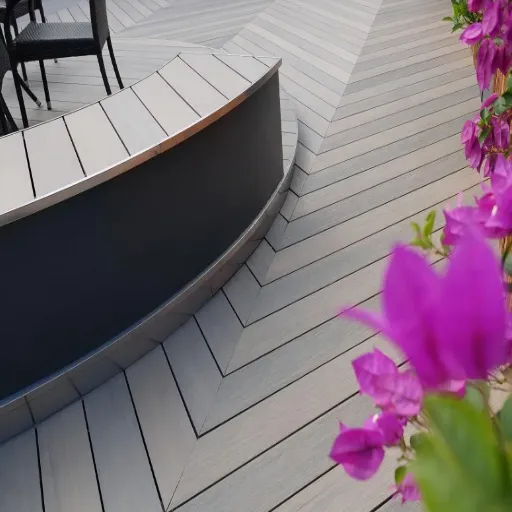
Both formats are marketed as low-maintenance, and both deserve that reputation compared to wood. The maintenance requirements differ in one important way.
WPC decking boards need almost nothing after installation. You wash them with soap and water a few times a year and clear the drainage gaps. The boards themselves are capped or co-extruded to resist moisture, mold, and fading, and individual boards can be replaced if one is ever damaged.
WPC deck tiles are equally low-effort on the surface, but they add one recurring task: lifting and cleaning underneath. The drainage gap under a floating tile floor keeps water moving, but it also collects leaves, dirt, and organic residue. In shaded or damp spots, mold and algae can grow beneath the tiles where you cannot see them. Annual lift-and-clean maintenance is recommended, and the base grid is the component most likely to wear out over time.
Durability follows the same pattern. A well-installed board deck is a rigid structure that resists movement and handles heavy loads for decades. A tile deck is a floating surface, so tiles shift slightly under heavy traffic, connectors wear, and on exposed rooftops, wind lift becomes a real concern.
When you compare deck tiles vs decking lifespan, the gap is the single biggest reason boards win for long-term owners. Tiles are individually replaceable, which is a genuine advantage, but the product as a whole is not built to match the 25 to 30 year service life of a board deck.
Design Flexibility and Appearance
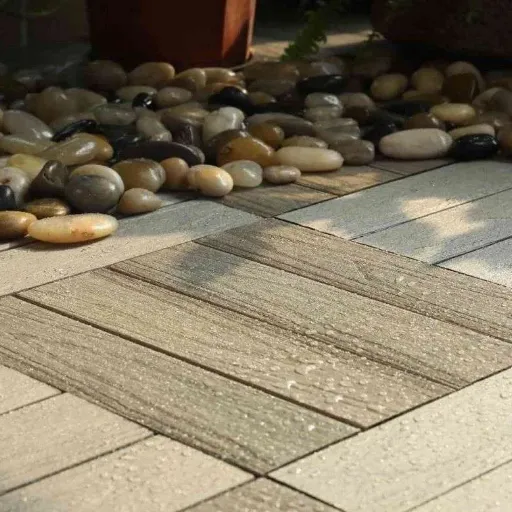
If appearance matters, boards offer more design freedom. Long planks with hidden fasteners create a seamless, polished surface that reads as a permanent, built-in feature of the home. Boards can be cut to follow curves, built across multiple levels, and integrated with stairs, seating, and railings. The color and grain range in quality-capped WPC boards is wide and consistent.
Tiles offer a repeating grid pattern that is visible at the edges and from certain angles. Cutting options are more limited, especially around posts, railings, and curved borders, and the modular look is obvious up close.
That’s not always a drawback. The grid pattern can read as modern and deliberate, and tiles can be mixed in checkerboard or framed layouts that boards cannot achieve. Tiles are also portable, so you can reconfigure the layout or take the floor with you when you move.
Choose tiles for a modern, modular aesthetic and the ability to change your mind. Choose boards for a seamless, polished, permanent look that adds to the home’s character.
Structure, Load, and Safety Considerations
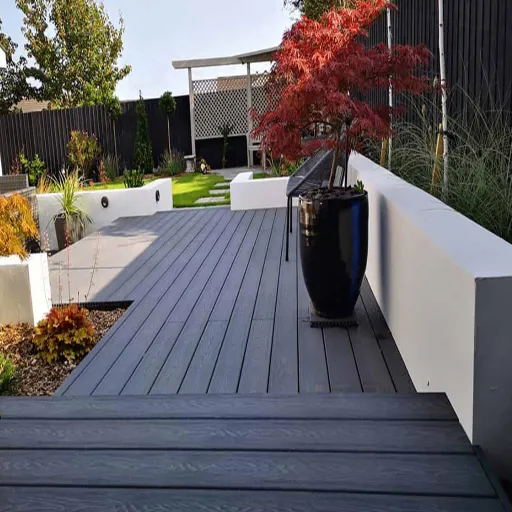
The structural difference matters most on balconies and rooftops, where weight and building codes come into play.
WPC decking boards are a structural addition. They must meet building code requirements for joist spacing, load capacity, and railing attachment, and they add real weight to the structure. On a rooftop or elevated balcony, a board deck typically requires a structural review to confirm the building can carry the load.
WPC deck tiles are lighter and non-structural. They sit on the existing surface, protect the waterproof membrane, and can be lifted for access. That makes them the safer, simpler choice for many rooftop terraces, where a full board deck may be too heavy or may violate height restrictions. The trade-offs are that tiles add about an inch of height, which affects door swings and thresholds, and they can lift in strong wind on exposed rooftops unless the perimeter is secured.
For a ground-level deck, the structural advantage shifts to boards. A properly built board deck carries heavy furniture, crowds, and weather without complaint. A tile floor on uneven ground rocks, sinks, and pulls apart at the joints, so the sub-surface demands are the price you pay for the easy installation.
WPC Deck Tiles vs WPC Decking Boards: Side-by-Side Comparison
Here is the full head-to-head in one table.
| Factor | WPC Deck Tiles | WPC Decking Boards |
|---|---|---|
| Installation time | 2 to 4 hours per 20 m2, DIY | 2 to 3 days with a crew, plus permits |
| Substructure needed | No, needs flat solid base | Yes, joists, beams, and fasteners |
| Upfront cost | 3to3to15/sq ft (DIY) | 25to25to54/sq ft installed |
| Lifespan | 8 to 15 years typical | 25 to 30+ years |
| Warranty | Limited, product only | 25 to 50 years on premium boards |
| Maintenance | Sweep, rinse, lift-and-clean yearly | Wash with soap and water |
| Portability | Fully removable and reusable | Permanent, stays with the home |
| Design flexibility | Grid pattern, limited cutting | Seamless, curves, multi-level |
| Best use cases | Balconies, rooftops, patios, rentals | Ground-up decks, permanent builds |
When to Choose WPC Deck Tiles
The interlocking deck tiles vs decking boards decision tilts toward tiles when any of these describe your situation:
- You already have a flat, solid surface such as concrete, pavers, or an existing deck.
- You rent, or you want a floor you can remove, reconfigure, or take with you.
- Your project is small to medium sized, like a balcony, terrace, or poolside strip.
- You want a weekend DIY job with no permits, no substructure, and no professional labor.
- You need to protect a waterproof membrane on a rooftop without adding structural load.
For balconies and rooftop terraces specifically, the tile format is often the better fit because of its light weight and removability. Our balcony WPC deck tiles guide covers weight limits, wind uplift, and drainage for elevated installations in detail.
Tiles are also the format to choose when you want the honesty of knowing their limitations upfront. They are not permanent, they need a flat base, and they will need replacement sooner than boards. If you understand and accept those trade-offs, the speed and cost savings are real and substantial.
When to Choose WPC Decking Boards
Choose WPC decking boards when you are building a deck from scratch or need a permanent surface:
- You are starting from bare ground and need a substructure regardless.
- You plan to stay in the home long term and want a 25 to 30 year surface.
- Your project is large, multi-level, or includes curves, stairs, or built-in features.
- You want maximum design freedom and a seamless, polished appearance.
- Resale value and a permanent home improvement matter to you.
Boards are the better investment for a ground-level deck because they turn a raw yard into a usable structure. The higher upfront cost buys a permanent addition that carries 25 to 50 year warranties and raises the property’s value. If your budget allows the bigger initial spend, boards give you the longest service life for the money.
There is one rule that applies to both formats: never buy on price alone. Low-grade tiles and hollow-profile boards fail early, and the savings disappear fast. Our how to choose WPC deck tiles checklist walks through the quality specs to demand.
Ready to compare products and pricing for your project? We supply both WPC deck tiles and WPC decking boards in bulk, with samples, test reports, and factory verification. Request a quote and tell us your surface, size, and budget.
Real-World Examples: How the Decision Plays Out
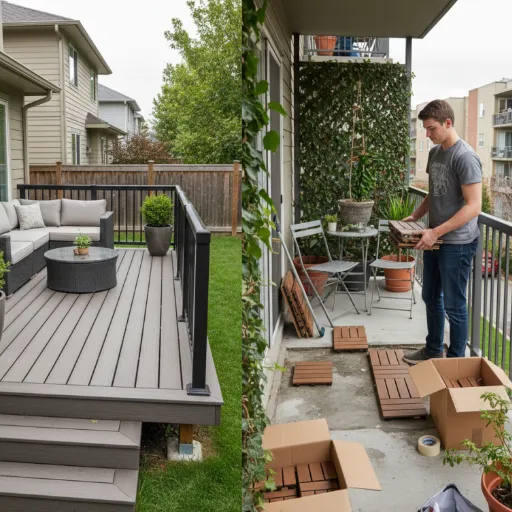
Two projects illustrate the difference better than any table.
Maria rents a third-floor apartment with a 9 square meter concrete balcony. She wanted a warm surface for summer evenings, but she did not want to modify the property or lose her deposit. She chose interlocking WPC deck tiles, installed them with a friend in one afternoon, and when she moved two years later, she lifted the tiles, packed them into her car, and relaid them on her new balcony. The project cost under $400 total.
Tom, by contrast, bought a house with a sloped backyard and wanted a proper outdoor living space. He priced tiles, but the slope meant he needed a leveled base anyway, so he built a 40 square meter WPC board deck on joists instead. The project took three weekends and cost about $11,000. Seven years later, the deck still looks new, and his realtor told him the permanent deck was a deciding factor when buyers toured the property.
Neither choice was wrong. Maria needed flexibility and low cost. Tom needed permanence and resale value. The format matched the situation.
Common Mistakes to Avoid in Either Format
- Skipping base prep for tiles. On an uneven surface, tiles rock, connectors snap, and joints separate. Level the base to about 5 mm per meter before you start.
- Forgetting expansion gaps. Tiles need 10 to 12 mm gaps around walls and fixed structures; boards need manufacturer-specified spacing. Skip this and edges buckle in summer heat.
- Buying the cheapest grid or profile. Recycled base grids and thin hollow boards are where manufacturers cut corners. Verify the material spec before ordering.
- Ignoring wind and weight on rooftops. Secure tile perimeters on exposed roofs, and confirm the structure can carry a board deck’s weight.
- Assuming tiles and boards are interchangeable. They are not. Match the format to the surface, permanence, and budget you actually have.
Sourcing WPC Deck Tiles or Boards from China
If you are importing either format, the sourcing considerations differ slightly because the manufacturing processes differ. Boards are produced by extrusion, a continuous process that forms long planks, while tiles are largely injection-molded into panels with the base grid attached. For the broader supplier landscape, our WPC decking suppliers in China guide covers the main manufacturing clusters and export logistics for boards. That production difference shows up in quality control: extruded boards are checked for density and cap-layer consistency, while molded tiles are checked for grid wall thickness, locking tab strength, and filler ratio.
Demand the same verification in both cases. Request ISO 9001, CE, and ASTM D7032 documentation, ask for SGS or Intertek test reports, and inspect a physical sample before committing to a container. Check the cross-section for filler content, measure the base-grid wall thickness on tiles, and confirm the cap layer on boards.
FAQ
Are WPC deck tiles cheaper than WPC decking boards?
Yes, upfront. Tiles run about $3 to $15 per square foot for a DIY install, while boards cost $25 to $54 per square foot installed because of the substructure and labor. Over 20 years, boards can be cheaper because they last 25 to 30 years while tiles need replacement every 8 to 15 years.
Which lasts longer, deck tiles or decking boards?
Decking boards last much longer. Quality composite boards last 25 to 30+ years with 25 to 50 year warranties, while WPC deck tiles typically last 8 to 15 years, and budget tiles can fail in 2 to 5 years.
Can WPC deck tiles be installed over an existing deck?
Yes, if the surface is flat, solid, and stable. Tiles lay directly over concrete, pavers, existing tiles, or compacted gravel with no fasteners. They do not work on grass, loose sand, or uneven ground.
Do deck tiles need a sub-structure like decking boards?
No. That is the key difference. Tiles have an integrated plastic base grid and sit directly on the existing surface. Boards need a frame of joists and beams to carry the load.
Are deck tiles good for balconies and rooftops?
Usually yes. Tiles are light, protect waterproof membranes, and can be lifted for access, which makes them ideal for elevated installations. Securing the perimeter is important on exposed rooftops because of wind lift.
What’s the difference between WPC deck tiles and WPC decking boards?
WPC deck tiles are modular panels with an interlocking base grid that click together as a floating floor over a flat surface. WPC decking boards are long planks mounted on a joist frame. Tiles win on speed and cost; boards win on lifespan and structural permanence.
Is it worth using deck tiles instead of building a deck?
It depends on your situation. For a rental, small balcony, or existing flat surface, tiles deliver quick results at low cost. For a permanent home deck you want to last decades, a board deck is the better long-term investment.
Conclusion
WPC deck tiles and WPC decking boards are the same material in two different formats, and neither is universally better. Tiles win on installation speed, upfront cost, and flexibility, and they shine on balconies, rooftops, and existing flat surfaces. Boards win on lifespan, structure, and long-term value, and they are the right choice for permanent ground-level decks where resale matters.
Before you decide, answer three questions. Do you have a flat, solid surface already, or do you need to build a structure? Do you want a temporary, removable floor or a permanent home improvement? And is your budget driven by today’s price or by the cost spread across 20 years?
The choice between wpc deck tiles vs wpc decking boards comes down to your surface, your timeline, and how long you plan to stay. If you are still weighing the trade-offs, read our guide on the real WPC deck tiles disadvantages so you know exactly what you are accepting. Then compare it against the complete WPC decking buyer’s guide for the board side.
For a full overview of the modular format and its applications, start with our modular WPC decking guide.
We help buyers source both formats from verified Chinese factories, with samples, certifications, and quality inspection before shipping. Get your free samples today by contacting our team, and we will help you match the right WPC format to your project.
Categories:
Blog
Related Articles