How To Choose WPC Wall Panels For Bathroom: The 2026 Buying Guide
To choose WPC wall panels for a bathroom, match the panel grade to your bathroom zone, pick the right thickness, and verify quality with a simple inspection checklist. The safe formula is a co-extruded (capped) WPC panel, 8- 12 mm thick on walls, with anti-mold additives and verified certifications (CE, ISO 9001). Here is the full step-by-step method.
Two bathrooms, two different WPC panels. Both were installed in the same year. Five years later, one still looks like new, and the other swelled at the edges and picked up black mold in the joints. The difference was not luck. It was how the panels were chosen.
That is exactly why this guide exists. We are Linyi Yuheng International Trading Co., Ltd., a WPC manufacturer with 10+ years of experience, 40+ production lines, and CE, SGS, FSC, and ISO 9001 certification. We have watched buyers make the same mistake hundreds of times, and we want you to avoid it. By the end of this guide, you will know exactly how to choose WPC wall panels for bathroom use, what to check on a sample, and which supplier red flags should send you running.
Key Takeaways
- Choose a co-extruded (capped) WPC panel for bathroom splash zones. It reduces water absorption from 3-5% down to under 0.5%.
- Use 9-12mm panels in the shower, 8-10mm on vanity and dry walls, and 5-6mm on ceilings. Never go below 4mm.
- Check for embossed (not printed) wood grain, anti-mold additives, and a water absorption rate of 1.5% or less per ASTM D570.
- Demand certifications: CE, ISO 9001, and for indoor air safety, an E0 or formaldehyde-free rating.
- Qualify your supplier before ordering. Request samples, verify test reports, and avoid any vendor that claims “100% waterproof” with no data.
Step 1: Confirm WPC Is Right for Your Bathroom Zone
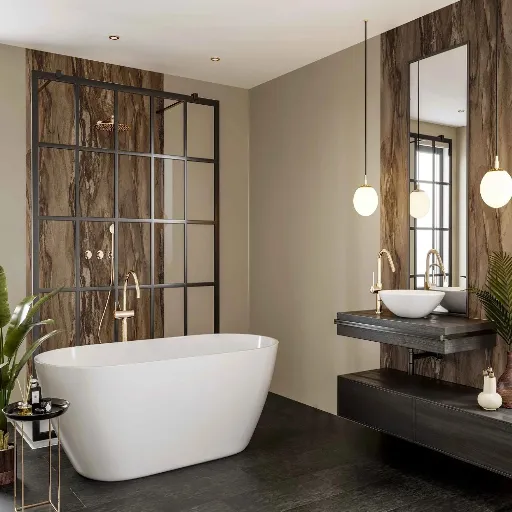
Are WPC wall panels good for bathrooms?
Yes, WPC wall panels are good for bathrooms in most zones, but they are water-resistant, not 100% waterproof. A quality panel absorbs around 1.5% moisture by weight, and a co-extruded (capped) panel absorbs less than 0.5%. That is safe for everyday bathroom humidity and splash. It is not safe for continuous standing water or unsealed direct shower spray without the right grade and installation.
This distinction matters because some sellers claim their WPC is “100% waterproof.” That is marketing, not material science. WPC contains 55-65% wood or bamboo fiber, and wood can absorb moisture if the protective surface is damaged or edges are left unsealed. PVC and SPC panels, by comparison, absorb 0% and are genuinely fully impervious.
Here is a simple way to think about bathroom zones:
- Zone 1, direct shower spray: Use a sealed co-extruded WPC grade, or choose PVC/SPC if you want zero risk.
- Zone 2, bath surrounds and splash areas: Standard to high-density WPC works well, especially with sealed joints.
- Zone 3, vanity, dry walls, feature walls: Standard WPC is more than enough, and it looks better than most alternatives.
Choose WPC if you want a warm wood look, better acoustic dampening than PVC, and a more eco-friendly footprint. Choose PVC or SPC if you are installing inside a shower enclosure or wet room and want absolute water imperviousness.
For a deeper look at wet-zone rules and waterproof claims, read our guide on are WPC wall panels waterproof for bathroom. For the full picture on WPC in bathrooms, start with our complete guide to WPC wall panels for bathroom.
Step 2: Choose the Right WPC Wall Panel Grade
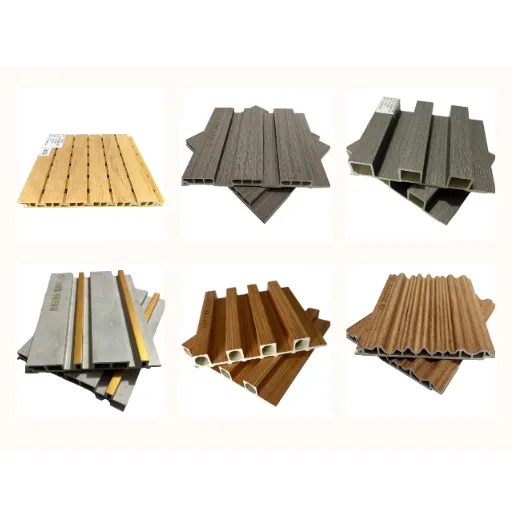
Not all WPC panels are created equal. The grade is the single biggest factor in bathroom performance. There are four grades you will meet in the market:
Standard WPC
- Water absorption: 1.5-3%
- Best for: dry zones, feature walls, low-splash areas
- Note: fine for most of the bathroom, risky for direct shower spray
High-Density WPC
- Water absorption: 0.5-1.5%
- Best for: vanity walls, bath surrounds, moderate splash
- Note: denser core resists moisture better than standard grade
Co-Extruded (Capped) WPC
- Water absorption: under 0.5%
- Best for: shower walls, wet zones, commercial bathrooms
- Note: a protective polymer cap wraps the board, dramatically improving moisture resistance. This is the bathroom-safe default.
Nano-Treated WPC
- Water absorption: under 0.3%
- Best for: high-humidity environments and premium projects
- Note: the newest waterproofing technology, typically at a price premium
| Grade | Water Absorption | Best Bathroom Use | Price Premium |
|---|---|---|---|
| Standard WPC | 1.5-3% | Dry walls, feature walls | Base |
| High-Density WPC | 0.5-1.5% | Vanity, bath surrounds | Moderate |
| Co-Extruded WPC | <0.5% | Shower walls, wet zones | Higher |
| Nano-Treated WPC | <0.3% | High-humidity, premium | Highest |
Choose co-extruded WPC if the panel will face regular splash or sit in a humid bathroom with poor ventilation. The price premium pays for itself by preventing the single most common bathroom failure: edge swelling.
Step 3: Choose WPC Wall Panel Thickness and Construction by Zone
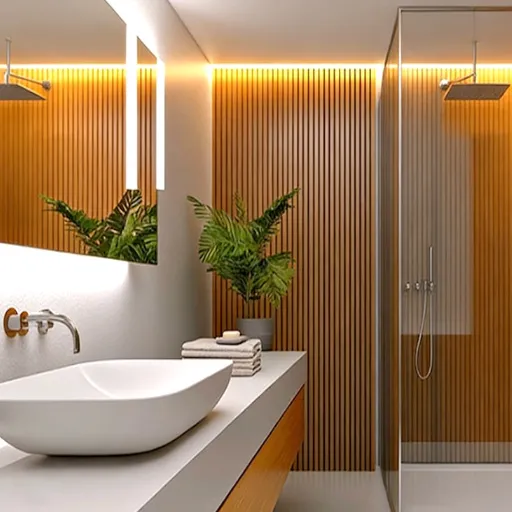
Hollow vs Solid Core Panels
WPC panels come in two constructions:
- Hollow core: lighter and cheaper, but thinner hollow panels puncture easily. Use a minimum of 8mm on walls.
- Solid core (including bamboo charcoal): heavier and stronger, so it can be thinner (5-8mm) and still hold up.
Thickness by Bathroom Zone
| Bathroom Zone | Recommended Thickness | Notes |
|---|---|---|
| Shower / wet zone | 9-12mm | Deeper interlock means a watertight seal |
| Vanity and dry walls | 8-10mm | Balances cost, durability, and hiding wall imperfections |
| Ceiling | 5-6mm | Lighter panels reduce strain on the suspension grid |
| Hollow panels (any wall) | 8mm minimum | Thinner hollow panels puncture during install |
| Solid core panels | 5-8mm is acceptable | High density gives strength at a thin profile |
Avoid anything thinner than 4mm. It will break during installation and deform over time. Thicker panels usually need stainless steel mounting clips, while thinner panels install with high-grab structural adhesive.
Thickness is not just about strength. In a wet zone, a deeper panel profile means a deeper interlock, which creates a more watertight joint between panels. That is why shower walls call for 9-12mm while dry walls are fine at 8-10mm.
For the full installation method, including moisture barriers, joint sealing, and expansion gaps, see our guide on how to install WPC wall panels in bathroom.
Step 4: Verify Panel Quality with a 10-Minute Inspection

Quality varies wildly across the WPC market, especially on budget listings. Here is how to inspect a sample in about ten minutes, using only your hands and a few simple checks.
Material Composition
Quality panels contain 60-70% wood fiber and 30-40% polymer, plus a small amount of additives. Avoid panels heavy on calcium carbonate (CaCO₃) filler. Filler-heavy panels feel chalky, weigh more than they should for their density, and crumble at the edges. If you can scrape material off the edge with a fingernail easily, the filler content is too high.
Embossed vs Printed Wood Grain
Run your fingernail across the surface. A quality panel has wood grain embossed with a 3D mold, so you can actually feel the texture. Cheap products print the grain onto a smooth surface. Printed grain looks flat and eventually peels in humid conditions. The embossed panel is the one you want.
Anti-Mold Additives
Ask whether the panel passed an SGS mold test. Although the WPC substrate resists mold, surface mold can still grow in grooves when dirt and water accumulate. Panels with anti-microbial agents added during production resist this much better in a bathroom.
Water Absorption
Request the test report. For a bathroom, water absorption should be 1.5% or less per ASTM D570, the standard water-absorption test. Co-extruded panels should be under 0.5%. If the supplier cannot produce a test report, treat their waterproof claim with suspicion.
Uniformity of Core
Cut a sample or look at the exposed edge. The core should be uniform with no visible voids or inconsistent density. A panel that is dense in one spot and spongy in another will fail unevenly.
Choose panels that pass all five checks. If a sample fails even one, keep shopping. The ten minutes you spend inspecting a sample is nothing compared to the cost of tearing out a failed bathroom wall.
Step 5: Check the Certifications That Matter
Certifications separate reputable panels from anonymous imports. For bathroom use, focus on these:
- CE: confirms the panel meets European safety and construction standards
- ISO 9001: proves the factory runs a certified quality management system
- ISO 14001: confirms environmental management in production
- FSC: certifies responsible sourcing of the wood fiber
- SGS: third-party inspection, often used to verify mold resistance and product quality
- E0 or formaldehyde-free: critical for indoor air safety in an enclosed bathroom. Poor-quality panels can off-gas formaldehyde.
A factory with all of these certifications is not necessarily the cheapest, but it is the one most likely to deliver panels that perform in a bathroom. For commercial projects, also check fire-rating documentation.
Choose certified panels for any bathroom, and treat missing certifications as a hard stop for commercial work. You cannot verify quality on a boat container, so documentation is your evidence.
Step 6: Qualify the Supplier Before You Order
The panel is only half the decision. The supplier is the other half, and this is where wholesale buyers and contractors often get burned.
Factory vs Trading Company
A factory owns its production lines, so it can control quality, offer better bulk pricing, and usually share real test data. A trading company resells someone else’s panels and often cannot verify the source. For a critical bathroom project, a factory-direct supplier is the safer choice.
Here is a story from our own experience. A distributor we know received a quote that was 30% below the market rate for a container of “waterproof WPC panels.” It looked like a great deal, until they requested samples. The panels were filler-heavy, the grain was printed instead of embossed, and the “certification” was a photocopy with no issuing body. The samples failed every check in Step 4. That distributor avoided a very expensive mistake by simply asking for samples and running the inspection checklist.
Sample Testing Protocol
Always request physical samples before a bulk order. Test three things yourself: scratch the surface with a fingernail, check the water absorption claim, and inspect the edge seal. If the supplier hesitates to send samples, that is a red flag.
MOQ, Lead Times, and Freight
Clarify minimum order quantity, production lead time, and shipping terms (FOB or CIF) up front. A transparent supplier answers these questions immediately. A vague supplier is usually hiding a trading operation.
Supplier Red Flags
- Claims of “100% waterproof” with no test reports
- No certifications or unverifiable documentation
- Only stock photos, no factory or quality-control transparency
- No sample program
- Prices far below market (filler-heavy panels almost always are)
For the complete supplier qualification process, including certification verification and sample testing for bulk orders, read our guide on wpc bathroom wall panels wholesale and our deep dive on how to evaluate WPC manufacturers in China.
Want to see how a factory handles this? As a manufacturer with 40+ production lines and CE, SGS, FSC, and ISO 9001 certification, we provide test reports and free samples on request. Contact us for free bathroom-grade samples.
Common Buying Mistakes to Avoid
Even careful buyers slip up. Here are the mistakes we see most often:
- Choosing the cheapest panel without checking filler content. The savings vanish the first time a panel crumbles or swells.
- Using standard WPC in a direct-shower zone. Without co-extrusion and sealed edges, standard grade is a gamble in Zone 1.
- Ignoring edge sealing and expansion gaps. Most bathroom failures are installation failures, not panel failures. The panel was fine; the install was not.
- Buying on photos without sample testing. A polished website can hide a poor product.
- Skipping certification verification for commercial work. A hotel or apartment developer cannot afford to redo hundreds of bathrooms.
Another story to drive it home. A contractor once used 5mm hollow panels on a full bathroom wall because they were the cheapest option in the catalog. During installation, a worker leaned on the wall and punched straight through a panel. They had to rip out the whole wall and reorder at 8mm minimum. The “savings” on the panels was a fraction of the cost of the rework.
How to Choose WPC Wall Panels for Bathroom: FAQs
What is the best thickness for WPC wall panels in a bathroom?
Use 9-12mm in the shower, 8-10mm on vanity and dry walls, and 5-6mm on ceilings. Hollow panels should never be thinner than 8mm on walls, and nothing should be under 4mm.
Are WPC wall panels good for bathrooms?
Yes, for most bathroom zones. They are water-resistant rather than 100% waterproof, so use a co-extruded grade for splash zones and seal all joints properly.
What is the difference between hollow and solid WPC panels?
Hollow panels are lighter and cheaper but puncture easily below 8mm. Solid panels, including bamboo charcoal cores, are stronger and can be thinner while holding up in wet conditions.
Do I need co-extruded WPC panels for a shower?
Yes, if you want the safest choice. Co-extruded panels have a polymer cap that drops water absorption below 0.5%, which is the recommended protection for direct shower spray.
What certifications should WPC wall panels have?
Look for CE, ISO 9001, ISO 14001, FSC, and SGS, plus an E0 or formaldehyde-free rating for indoor air safety. For commercial projects, also check fire-rating documentation.
Should I buy WPC wall panels from a factory or a trading company?
A factory gives you better quality control, bulk pricing, and real test data. A trading company resells and often cannot verify the source. For a critical bathroom project, factory-direct is safer.
Conclusion
Learning how to choose WPC wall panels for bathroom walls does not have to be a gamble. Match the grade to the zone: co-extruded for splash and standard for dry walls. Pick the right thickness: 9- 12 mm in the shower and 8- 10 mm elsewhere. Run the ten-minute inspection checklist, verify certifications, and qualify your supplier with samples and test reports.
Your next step: if you are sourcing WPC wall panels for a renovation project, a hotel, or a wholesale order, start with free samples and a technical consultation. We will help you pick the right grade for your bathroom and send you panels you can test yourself. Request your free samples today.
The right WPC panel will look great for 15 to 25 years in a bathroom. The wrong one will cost you double in rework. Ten minutes of checking is a small price for that kind of certainty.
Categories:
Blog
Related Articles