Modular Decking System vs Traditional Decking: Which Should You Choose?
A modular decking system wins on speed, cost, and flexibility, while traditional decking wins on permanence, lifespan, and long-term value. If you have a flat existing surface like a concrete balcony or patio and want a weekend DIY upgrade, choose a modular system like interlocking WPC deck tiles. If you are building a deck from scratch, want a structure that becomes part of the property, or plan to stay in the home for years, choose traditional decking built on a joist frame.
Most people pick between these two approaches without realizing they aren’t even the same kind of product. A modular decking system is a prefabricated surface you assemble. Traditional decking is a structure you build. That distinction changes everything downstream, from what surface you need to how long the deck lasts to whether you need a permit.
The timing matters too. The decking tiles segment is growing at roughly 13.9% compound annual growth through 2033, well ahead of traditional board decking, and the global decking market keeps climbing. Buyers are asking the modular-vs-traditional question more than ever, and most of what ranks today is either too thin to trust or written by a single product manufacturer with a horse in the race.
We’re a trading company based in Linyi, China, one of the world’s largest WPC and outdoor flooring production hubs. We supply modular deck tiles, pedestal systems, and traditional decking boards to importers around the world, and we see all of them at every quality level. That factory-floor view lets us give you a straight, data-backed comparison instead of a sales pitch.
Key Takeaways
- Modular decking systems install 5 to 10 times faster and cost $3 to $35 per square foot for surface materials, but most last 5 to 15 years and are a floating, non-permanent surface.
- Traditional decking costs more upfront ($15 to $80+ per square foot installed) because the quote includes framing and labor, but it lasts 15 to 30+ years and adds permanent property value.
- Modular systems need a flat, stable base such as concrete, pavers, or a pedestal substructure; traditional decks are built with their own frame, so they work on almost any ground.
- The long-term math often favors traditional decking. A modular system replaced at year 10 to 12 can end up costing more than a traditional deck that lasts 25 years.
- Choose by your situation, not by price alone: surface, project size, permanence, budget, and application decide which approach is right.
What Is a Modular Decking System?
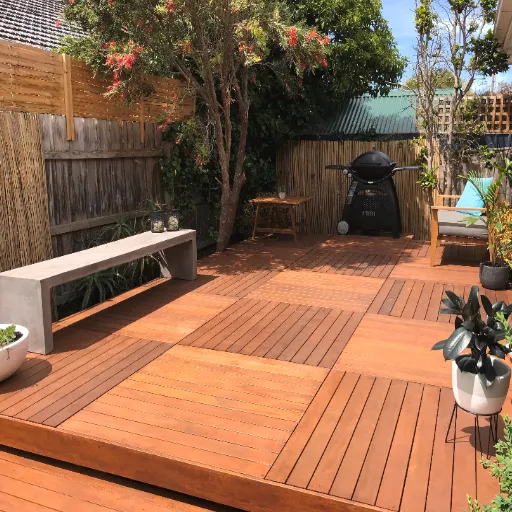
A modular decking system is a set of prefabricated tiles, pavers, or panels that connect together to form an outdoor surface. Each unit comes ready to install from the factory, and the units lock or click together over a prepared base. No joists, no foundations, no wet concrete, and in most cases no fasteners.
The key feature of every modular system is that it sits on top of the existing surface rather than replacing it. A plastic base grid or a set of adjustable pedestals lifts the finished floor slightly off the ground, which creates a drainage gap, promotes airflow, and protects whatever is underneath. That design is why modular systems are so popular on rooftops, balconies, and rented spaces where you can’t modify the building.
Types of Modular Decking Systems
There are four main types, and it helps to know them by name because they serve different projects:
- Interlocking deck tiles (WPC, wood, composite, or plastic) snap together over a flat surface like concrete or pavers. These are the most common DIY option.
- Pedestal-supported paver systems (porcelain, stone, or concrete pavers on adjustable pedestals) level out over slopes and protect waterproof membranes. Premium systems handle very heavy loads.
- Interlocking panel and grid systems (HDPE event decking, structural grids) lock into large reusable panels with high load ratings, often used for events and commercial spaces.
- Modular joist and framing systems (aluminum joist kits) provide a low-height floating structure with hidden fasteners, essentially a prefabricated version of a traditional frame.
For the purposes of this comparison, all four share the same strengths and weaknesses relative to traditional decking, with differences in load capacity and durability. The WPC tile and porcelain pedestal systems are the two you will see most often, so we focus on those. If you are deciding between interlocking deck tiles vs deck boards, the levelness of your base surface and whether you might move the deck later are the two factors that matter most.
What Is Traditional Decking?
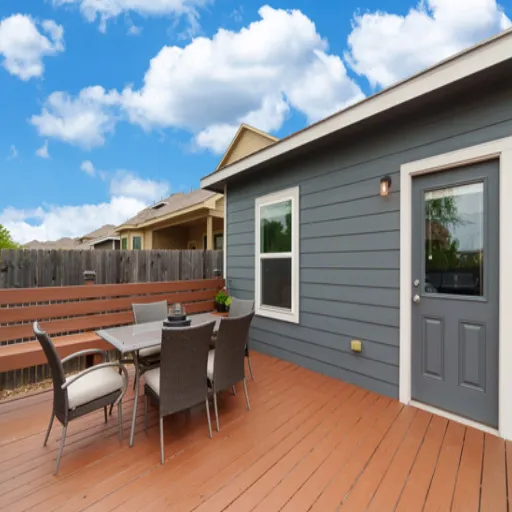
Traditional decking is a built-in structure. A frame of joists and beams rests on posts or foundations, and boards are laid across that frame and fastened down. The deck becomes part of the property, raised off the ground, and designed to building code.
The classic build process involves planning, often a permit, digging or anchoring posts, framing the joists, laying and spacing boards, and finishing the surface. It’s a construction project, not an installation. Materials range from pressure-treated pine on the budget end to cedar, redwood, composite, PVC, and tropical hardwood on the premium end. We cover the composite and wood options in more depth in our composite decking vs wood comparison.
The important point is that traditional decking includes the substructure. That’s why it costs more and takes longer, and it’s also why it’s permanent, load-bearing, and code-compliant in a way a floating tile system isn’t.
Modular Decking System vs Traditional Decking: Side-by-Side Comparison
Here’s the whole comparison in one table. Use it as your quick reference, then read the sections below for the details and the math.
| Factor | Modular Decking System | Traditional Decking |
|---|---|---|
| Installation time | Hours to a day or two | Days to weeks |
| Labor and skill | DIY-friendly, no tools required | Usually professional |
| Sub-surface needed | Flat, stable base (concrete, pavers, or pedestals) | None (frame built on site) |
| Upfront material cost | $3 to $35 per sq ft (surface only) | $3 to $20 per sq ft (materials) |
| Fully installed cost | $4 to $45 per sq ft | $15 to $80+ per sq ft |
| Typical lifespan | 5 to 15+ years | 15 to 30+ years |
| Maintenance | Soap and water, periodic lift-and-clean | Wood needs annual sealing; composite is low |
| Portability | Removable and relocatable | Permanent |
| Permits | Often not required for surface upgrades | Usually required |
| Resale value | Minimal added value | Adds permanent property value |
| Best for | Balconies, rooftops, rentals, quick updates | Ground-up builds, permanent homes, large decks |
That table gives you the shape of the decision. Now let’s walk through each factor with real numbers.
Installation Speed and Complexity
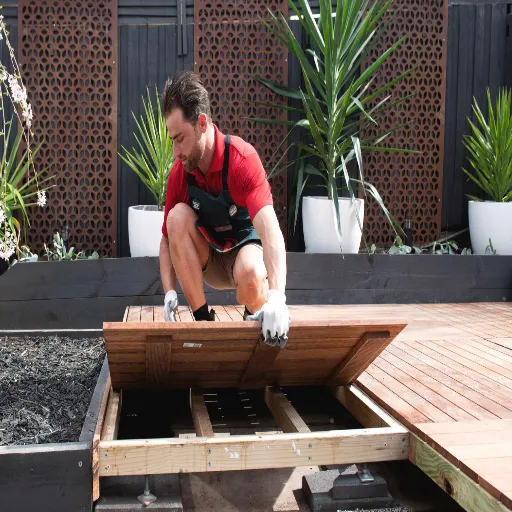
The installation gap is the reason most people discover modular systems in the first place.
Interlocking modular deck tiles go down remarkably fast. A single person can cover roughly 20 square meters in 2 to 4 hours with no prior experience, which makes a modular system 5 to 10 times faster to install than a traditional deck. You lay the first tile, clip the next one in, and work across the surface. There are no nails, screws, or glue anywhere in the job, as this BuildDirect installation walkthrough shows.
Pedestal-supported paver systems are only a little slower, because you level the pedestals first and then drop the pavers into place. Even a rooftop terrace using a pedestal system is typically a multi-day job, not a multi-week one.
Traditional decking is a different project entirely. It needs a frame of joists and beams, proper fasteners, expansion gaps, and often a building permit. A two-person crew typically needs 2 to 3 days to build a traditional composite deck for a 20 square meter area, and most homeowners hire a professional for the substructure work. The result is a permanent, code-compliant structure that becomes part of the property.
One honest caveat: modular systems are only fast when the base is ready. If you’re starting from bare ground, you still need to prepare a flat base, and at that point you’re doing much of the work a traditional deck avoids. If you already have a concrete slab or paved terrace, tiles are a true weekend project.
Consider Marcus, a renter in Toronto who wanted an outdoor space but couldn’t modify his concrete balcony. In one Saturday, he laid 30 square meters of interlocking WPC tiles, added a small border, and was grilling by evening. Two years later, he packed the tiles into boxes and moved them to his new apartment. A traditional deck would have been impossible on a rental balcony, and that flexibility is exactly what modular systems are built for.
Modular Decking Cost per Square Foot vs Traditional Decking
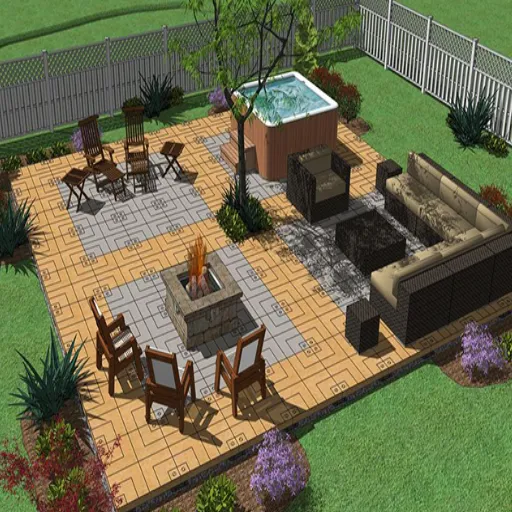
This is where the comparison gets interesting, because the sticker price tells only part of the story.
Upfront, modular wins clearly. Interlocking WPC deck tiles run about $3 to $15 per square foot for materials, with composite tiles around $4 to $10 per square foot installed by a homeowner. Rubber tiles start near $3 per square foot, hardwood tiles run $10 to $25, and porcelain pavers on pedestal systems land at $15 to $35 per square foot. Because there is no substructure and no professional labor, a 30 square meter project can be finished for a few thousand dollars.
Traditional decking looks expensive next to that. Materials alone run $3 to $20 per square foot depending on the board, and a fully installed deck lands between $15 and $80+ per square foot because the quote includes framing, fasteners, and labor. 2026 deck cost guides put the national installed average around $25 to $80 per square foot across materials. That same 30 square meter deck becomes a $10,000 to $25,000 project before you add railings or stairs.
But here’s the part most articles skip: the replacement cycle. A modular system typically lasts 5 to 15 years depending on material and quality, while a traditional composite deck lasts 25 to 30+ years. If your modular deck needs to be replaced at year 10 to 12, you pay for the surface twice, and the total can exceed the lifetime cost of a traditional deck that never needs replacement. The cost-per-square-foot benchmarks reinforce the point: modular is cheaper on day one, traditional is often cheaper over two decades.
The honest summary: modular systems are the cost-effective choice for a fast update over an existing surface, and traditional decking is the cost-effective choice for a permanent deck meant to last decades.
Lifespan, Durability, and Maintenance
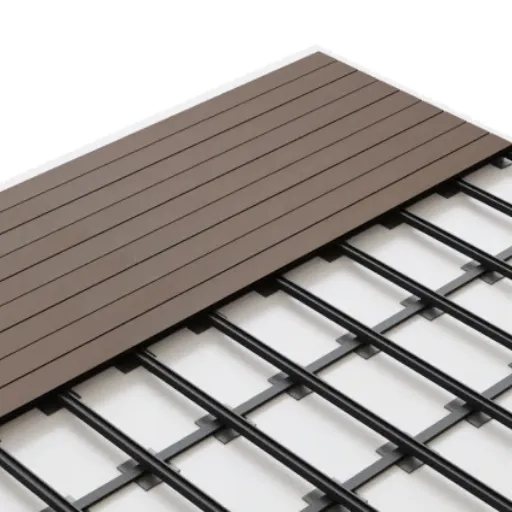
Lifespan is the single biggest difference between the two approaches, and it drives the cost math above.
Modular systems are material-dependent. Budget plastic click tiles can fail within a few years, mid-range composite tiles typically last 8 to 15 years, premium hardwood tiles can reach 20 to 30 years with care, and porcelain pavers on pedestals are effectively permanent. The weak point on most tile systems is the base grid connectors, which wear faster than the surface itself. Individual tiles are replaceable, which is a real advantage, but the whole system has a shorter service life than a well-built frame deck.
Traditional decking lasts longer across the board. Pressure-treated pine reaches 10 to 15 years, cedar and redwood 15 to 20, and composite, PVC, and premium hardwood 25 to 30+ years. Because the frame is structural and built to code, a traditional deck is designed to carry decades of use. The trade-off is maintenance: real wood decks need annual sanding, staining, and sealing, while composite and PVC decks are largely soap-and-water.
Maintenance costs tell the story. Traditional wood decking runs roughly $450 to $850 per year in upkeep materials and labor, while composite and modular WPC surfaces cost about $5 to $15 per year in cleaning supplies. Modular systems do need periodic lift-and-clean under the base grid, where leaves and debris can collect, but that is a minor task compared to refinishing wood.
We cover the honest problems with tile systems in our WPC deck tiles disadvantages guide, including heat in direct sun, sub-surface requirements, and connector wear. The short version: modular systems are low maintenance but shorter-lived, and traditional decks are either high maintenance (wood) or permanent (composite).
Portability, Flexibility, and Reconfigurability
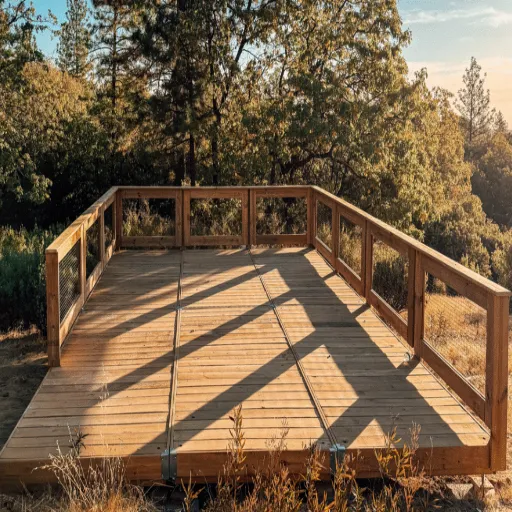
This is where modular systems have an unfair advantage, and it’s the reason renters, condos, and event planners choose them.
A modular decking system is removable. You can lift it, reconfigure it, expand it, or move it to a new property. Renters can take their deck with them. Condo owners can install a rooftop terrace without altering the building envelope. Event companies can reuse HDPE modular panels across dozens of shows instead of building and demolishing wood decking each time.
A traditional deck is permanent. Once built, it stays until it is demolished. That’s a disadvantage if you rent, but it’s exactly why traditional decks add property value: they become a fixed feature of the home, like a garage or a finished basement. Homeowners planning to sell typically recover a meaningful share of a well-built deck’s cost at resale.
Consider Sarah, who runs an outdoor events company in Austin. She used to build temporary wood decking for every wedding and corporate event, then tear it down and pay for disposal. Switching to modular HDPE panels meant her crew now levels the ground, clicks down the panels, and packs them back into the truck the next morning. The panels paid for themselves in two seasons, and she stopped buying splintered, warped wood every month.
Structure, Load, and Safety Considerations
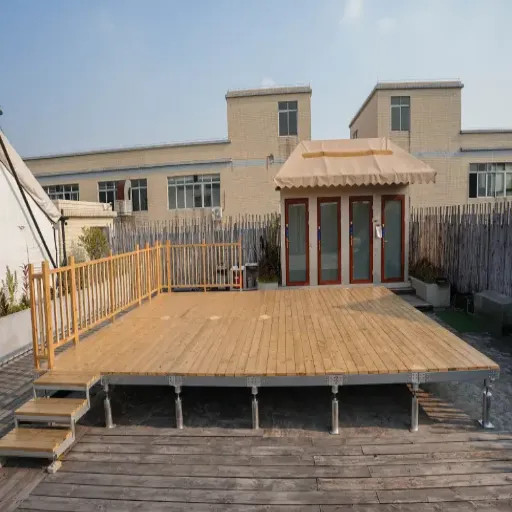
Because traditional decking is structural, it carries heavy loads, meets building code, and is engineered to handle people, furniture, hot tubs, and weather. That permanence comes with requirements: permits, inspections, and proper attachment to the house.
Modular systems are a floating surface, and their load capacity varies by type. Structural HDPE panels carry certified loads in the range of 200 to 600 pounds per square foot. Premium stone and porcelain pedestal systems can support up to 4,000 pounds per pedestal, which is why they are used on commercial rooftops. Interlocking tiles are the lightest-duty option, fine for foot traffic but not for hot tubs or heavy planters.
The safety picture on rooftops and balconies deserves special attention. Modular systems are often the safer choice on an elevated surface because they are lighter and do not penetrate the waterproof membrane. A pedestal system distributes weight through the pedestals and leaves the membrane intact, which is why roofers and pedestal system engineers recommend them over framing that can breach the waterproofing. But you must account for weight limits on balconies and wind uplift on exposed rooftops, and you should secure edges and corners. A traditional deck on a roof is a structural engineering decision that typically requires a professional.
When to Choose a Modular Decking System
A modular decking system is the right call when:
- You have a flat, solid base like concrete, pavers, tiles, or an existing deck
- You rent, live in a condo, or want the option to move or reconfigure the surface
- You’re working on a rooftop or elevated terrace where weight and membrane protection matter
- You want a fast, DIY-friendly upgrade without permits or professional labor
- You need temporary, event, or reconfigurable flooring
- Your budget is better spent on the surface than on a full structure
This is the classic balcony, patio, and rental scenario, and it covers a huge share of real-world projects.
When to Choose Traditional Decking
Traditional decking is the right call when:
- You’re building a deck from scratch on bare ground
- You want a permanent structure that becomes part of the property
- You need a large, multi-level, or custom-designed deck
- You plan to live in the home for years and care about resale value
- You need maximum load capacity for furniture, hot tubs, or gatherings
- You want the long service life and 25 to 30+ year warranties that composite boards offer
If you’re building a new home or a ground-level deck meant to last, traditional decking is usually the better investment.
Sourcing a Modular or Traditional Decking System from China
Whether you choose modular or traditional, most of the world’s WPC decking and deck tiles are manufactured in China, and buying at container scale requires knowing what you are looking at. The global WPC market is projected to grow at 11.0% annually through 2032, with Asia-Pacific holding more than half of production, and China is the largest export hub.
Quality varies enormously by factory, so verify three things before you order:
- Certifications: demand ISO 9001, CE, and where relevant ASTM D7032 or SGS/Intertek test reports
- Material grade: for WPC, check cap-layer thickness, density, and color-fastness; for pedestals and panels, check load ratings
- Samples: always test samples before a container order, and confirm MOQs, lead times, and landed cost
Manufacturing method matters too. Interlocking tiles and panels are mostly injection molded, decking boards are extruded, and pedestals are molded. Each process drives different cost and quality characteristics, and a reliable supplier will explain the difference rather than dodge the question.
Frequently Asked Questions
What is a modular decking system?
A modular decking system is a set of prefabricated tiles, pavers, or panels that connect together over a prepared base to form an outdoor surface. It sits on top of the existing surface rather than replacing it, using a base grid or pedestals to create a drainage gap and protect what is underneath.
Is modular decking cheaper than traditional decking?
Modular decking is cheaper upfront, typically $3 to $35 per square foot for materials versus $15 to $80+ per square foot installed for a traditional deck. But modular systems usually last 5 to 15 years versus 15 to 30+ years for traditional decking, so over two decades a traditional deck is often the lower total cost.
How long does modular decking last compared to traditional decking?
Most modular tile systems last 5 to 15 years depending on material and quality, while premium hardwood and porcelain pedestal systems last longer. Traditional decking lasts 10 to 15 years for pressure-treated wood and 25 to 30+ years for composite, PVC, and premium hardwood.
Can modular decking be installed over concrete or on uneven ground?
Modular decking installs directly over flat, solid concrete, pavers, or an existing deck. On uneven ground, you need to level the base first, either by preparing the surface or using adjustable pedestals.
Does modular decking require a permit like a traditional deck?
Modular surface upgrades over an existing flat base often do not require a permit, while traditional decks typically do because they are structural additions. Always check local building codes, especially for rooftop installations.
Can you build a deck from scratch with modular decking?
Not directly. Modular systems need a flat, prepared base, so building from bare ground means preparing the base first. Traditional decking builds its own frame, which is why it’s the better choice for ground-up construction.
Is modular decking as durable as a traditional deck?
Modular systems are durable for their service life but are generally not as long-lived or load-bearing as a well-built traditional deck. Premium porcelain pedestal systems come closest to traditional durability.
Are modular decks good for rooftops and balconies?
Yes, modular systems are often the best choice for rooftops and balconies because they are lightweight and do not penetrate the waterproof membrane. Use a pedestal system for heavy loads and secure edges to manage wind uplift.
Modular Decking System vs Traditional Decking: Which Is Right for You?
The decision comes down to what you’re starting with and what you want the result to be.
Choose a modular decking system if you have a flat existing surface, want a fast and flexible upgrade, rent, or need a rooftop or balcony solution that protects the building envelope. It’s cheaper on day one, portable, and reconfigurable, and it’s the clear winner for anyone who can’t or doesn’t want to build a permanent structure.
Choose traditional decking if you’re building from the ground up, want a permanent structure that adds property value, or plan to live in the home for years. It costs more upfront and takes longer, but it lasts 15 to 30+ years and is the better long-term investment for ground-level projects.
Whichever approach fits your project, the materials matter more than the marketing. We’re a Linyi-based trading company that supplies both modular decking systems and traditional decking boards to buyers worldwide, and we help customers verify quality, certifications, and samples before they commit to an order.
Linyi Yuheng International Trading Co., Ltd. is an export company based in Shandong, China, specializing in WPC decking, WPC deck tiles, and outdoor building materials. Contact us for wholesale pricing and quality certification support.
Categories:
Blog
Related Articles