PET Felt Acoustic Panels vs Foam: The Eco-Friendly Upgrade
PET felt acoustic panels beat acoustic foam in almost every visible, occupied space. At the same thickness they absorb more sound, emit no formaldehyde, hold a Class A fire rating without chemical treatment, and last three to four times longer. Foam keeps one advantage: the cheapest sticker price in the category. That advantage disappears faster than most buyers expect.
If you compared these materials on price and looks and then stopped, you’re not alone. The question that actually decides the purchase is quieter: what does each absorb, what does it emit into the room, and what does it cost once it lands on site? Here’s what a pet felt acoustic panels vs foam decision looks like with the data in front of you.
Key Takeaways
- PET felt absorbs roughly 1.5 to 2 times more than polyurethane foam at equal thickness in the mid and high bands. Both fall away below 250 Hz without thickness or an air gap.
- NRC by thickness: PET felt runs 0.65-0.80 at 9 mm and 0.90-1.00 at 50 mm. Foam sits at 0.30-0.40 at 25 mm and 0.40-0.60 at 50 mm.
- Specify density, not just thickness. Optimal areal weight is 1350-2200 gsm, about 60-120 kg/m³. Above 2200 gsm you pay more for almost no extra absorption.
- PET felt bonds thermally with no formaldehyde binder and typically reports 0.0 VOC, and every square metre of 24 mm panel recycles 70-90 plastic bottles. Foam recycles nothing.
- Foam is cheap per sheet but bulky and light to ship. PET felt fits far more square metres per container, which can invert the landed cost on export orders.
PET Felt Acoustic Panels vs Foam: The Short Answer
Choose PET felt for any surface people will see or occupy. It absorbs more per millimetre, carries the indoor air quality and recycled content documentation green-building projects require, holds Class A fire performance without sprayed chemicals, and lasts 15 to 20 years. Choose foam for hidden surfaces and hard budget ceilings.
One boundary first, because it saves confusion later. Neither material soundproofs a room. Both are absorbers that reduce echo and reverberation inside the space. If you need to block outside noise, that is a different problem, and our guide to acoustic panels vs soundproofing explains where the line sits. For the wider material comparison, including fiberglass, mineral wool, and wood slat, start with our complete guide to acoustic panels vs acoustic foam.
Ready to compare against your own room? Request free PET felt samples and a specification consultation and we will send the datasheets with the test reports attached.
What Each Material Actually Is
How the two products are built explains everything that follows.
PET felt starts as recycled plastic bottles. They are shredded into flakes, spun into polyester fibre, then pressed and thermally bonded into a rigid board. No glue, no formaldehyde binder, no chemical fire treatment. The result is dense, dimensionally stable, and clean to cut. It ships as tiles, sheets, baffles, ceiling clouds, and thermoformed 3D shapes.
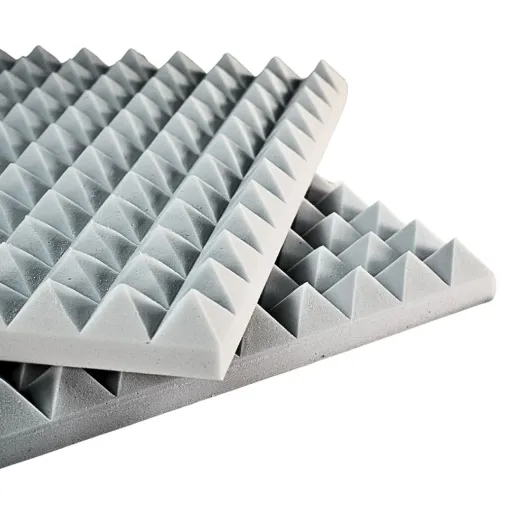
Acoustic foam is open-cell polyurethane. One material does the whole job, which is why it costs so little. It is moulded into wedges and pyramids, weighs almost nothing, and absorbs a narrow high-frequency band well.
The construction difference predicts the performance difference. A dense bonded fibre board absorbs more sound per millimetre and holds its shape for a decade. A light foam tile absorbs less and starts to yellow, sag, and crumble within a couple of years. Melamine foam is a separate, pricier specialty product, so treat it as its own category rather than mixing the numbers.
PET Felt Acoustic Panels vs Foam: NRC by Thickness
Thickness drives NRC more than brand, finish, or colour. Bring this table to a supplier conversation.
| Thickness | PET felt NRC | Polyurethane foam NRC | What it absorbs |
|---|---|---|---|
| 9 mm | 0.65-0.80 | No equivalent | 500 Hz-4 kHz, voice and flutter echo |
| 12 mm | 0.75-0.90 | No equivalent | 400 Hz-4 kHz, speech clarity |
| 25 mm | 0.85-0.95 | 0.30-0.40 | 250 Hz-4 kHz, mid-band speech |
| 50 mm | 0.90-1.00 | 0.40-0.60 | 125 Hz-4 kHz, lower mid-range |
| 50 mm + 50 mm air gap | Behaves like 100 mm | Not applicable | Best low-frequency result PET felt can reach |
An accredited lab test on PET felt at 9, 12, and 24 mm returns NRC values of 0.79, 0.84, and 0.90 to KS F 2805 with type-A mounting. A third-party curve for a roughly 12 mm polyester panel shows coefficients of 0.10, 0.30, 0.60, 0.80, 0.85, and 0.80 across 125 Hz to 4 kHz, giving NRC 0.65. Both are real results describing different densities and mounting, which is why the test report matters more than the brochure.
Now the honest correction. You will see claims that PET panels absorb “three times more than foam.” That number has no measurement behind it. The defensible version is narrower and still decisive: PET felt absorbs roughly 1.5 to 2 times more at equal thickness in the mid and high bands, and the gap shrinks near the top end. Anyone quoting a bigger multiplier without stating thickness, density, mounting, and test standard is not giving you a specification.
Both materials fall away below 250 Hz. A 12 mm panel of any material does very little at 125 Hz. If bass is your problem you need thickness, an air gap, or a dedicated bass trap solution.
Specifying the Density: The Number Nobody Publishes
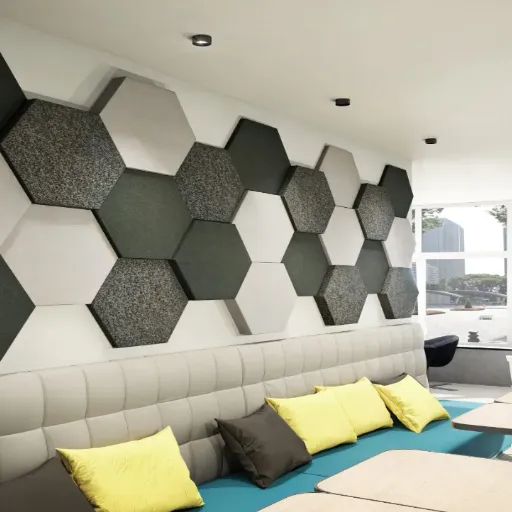
Density is the specification most buyers never write down, and it changes performance more than the logo on the box.
The engineering result is consistent. Optimal areal weight sits at 1350 to 2200 gsm, where absorption coefficient variation stays within about 5 percent. Above roughly 2200 gsm you pay more for almost no additional absorption. Rigid recycled PET board typically measures 60 to 120 kg/m³.
Translate that into practice. A cheap 9 mm felt tile at around 900 gsm performs about like foam. A 12 mm board at 1600 gsm reaches the NRC its datasheet claims. It’s not the logo that decides the result; it’s the weight behind it.
Daniel learned this the expensive way. He found a PET felt tile at a third of the price of the board he had specified and fitted 24 square metres across a home office and a small meeting room. The echo barely changed.
The datasheet he had skimmed listed 900 gsm at 9 mm. The board he should have bought was 12 mm at 1600 gsm with NRC 0.85. Identical thickness class on paper, entirely different product in the room.
Ask suppliers for both figures, and for the thickness the density was measured at. Then put it in one line: “12 mm, 1600 gsm minimum, NRC 0.85 or better to ASTM C423, Class A to ASTM E84.”
Indoor Air Quality and the Certification Chain
This is where PET felt stops being an aesthetic choice and becomes a compliance one.
PET felt is thermally bonded, so there is no formaldehyde binder and emissions are typically reported at 0.0 VOC. It sheds no loose fibres, resists water uptake, and does not sag or grow mould, which matters for humid climates and ceiling clouds. Cheap polyurethane foam can off-gas, and its fire retardants are often sprayed on rather than built in.
Certifications confuse buyers because vendors list them without saying what each one answers. Here is the map.
| Your requirement | Certification to ask for |
|---|---|
| Safe to handle, direct skin contact | OEKO-TEX Standard 100 |
| A verified recycled content claim | GRS, the Global Recycled Standard |
| Indoor air quality and low emissions | CDPH Standard Method v1.2, or an E1 rating |
| Green-building credit documentation | LEED, WELL, an EPD, or Cradle to Cradle Certified |
| Fire performance for the installed build | An ASTM E84 or EN 13501-1 report for that assembly |
Verify certifications directly at OEKO-TEX, and ask your supplier for the GRS certificate and the CDPH test report rather than a marketing line.
Priya found out why this matters. She specified a 12 mm PET felt wall for a 900 m² test preparation centre and chose it mainly for how it looked. The client’s compliance officer removed foam from consideration at the documentation stage: no CDPH v1.2 report, no Class A certificate for the installed assembly. The PET felt wall cleared acoustics, indoor air quality, and fire in a single line item.
The Recycled Content Story
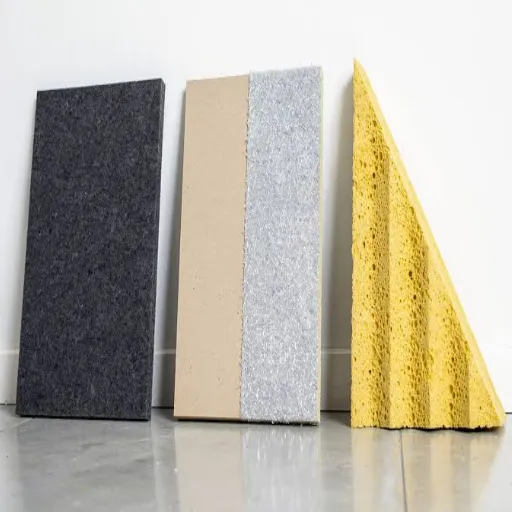
Every square metre of 24 mm PET felt recycles roughly 70 to 90 plastic bottles. At 12 mm the figure is closer to 53 per square metre, and a single typical panel carries about 60.
Scale puts it in perspective. One manufacturer reports recycling 250 tonnes of plastic, roughly 22 million bottles, into acoustic panels. Recycled PET panel production is reported at around 70 percent less energy and 60 percent less water than conventional acoustic panel manufacturing. At the end of a fit-out, PET felt is fully recyclable, while foam goes to landfill.
Be precise about the claims you repeat. “60 percent recycled content” and “70 bottles per square metre” are different statements measured different ways. Put the figure you need into the tender, and ask for the GRS certificate behind it.
Fire Behaviour: What PET Can and Cannot Claim
PET felt is inherently flame-retardant. Polyester fibres melt and self-extinguish rather than feeding a flame, so the material can reach a Class A result without chemical treatment. That is a real advantage over foam, which depends on sprayed-in retardants that can wash out or degrade.
Name the standards when you specify. In North America that is ASTM E84, which measures flame spread and smoke developed. In Europe it is EN 13501-1, where many PET products hold B-s1,d0 and some hold Class A equivalents.
One caveat keeps you out of trouble. Fire performance is assembly-dependent. A certificate for the panel is not a certificate for your wall. Request the classification for the build you are actually installing, never a “fire-retardant” label. For how foam performs in a commercial code review, read our guide to acoustic foam fire rating.
Where Foam Wins, and Where PET Felt Wins
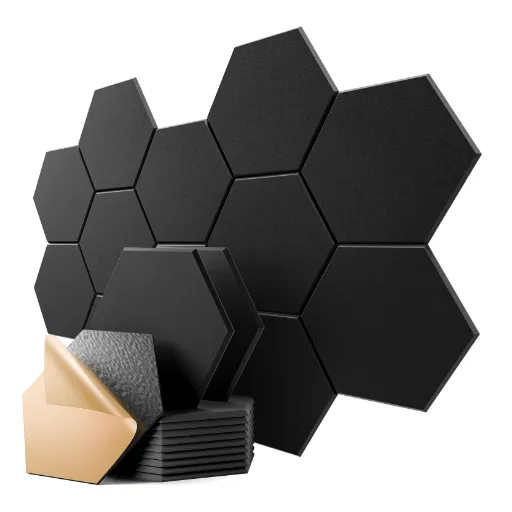
Both materials have a correct application. Being clear about foam’s is what makes the rest of this comparison trustworthy.
When acoustic foam is genuinely the right call
Foam is the correct engineering answer when the surface is never seen: inside a closet, above a rack, in a riser, or behind equipment in a workshop. It is also right when the budget is a hard ceiling, when the install must be temporary or renter-friendly, when weight is a constraint on a light ceiling, or when the room only needs high-frequency flutter control in a voice-only setting.
Its drawbacks deserve stating plainly.
- Foam yellows and crumbles within a few years.
- Its static charge attracts dust, lint, and pet hair.
- Adhesive can tear drywall paper on removal.
- Untreated polyurethane burns fast and emits dense smoke.
The test is simple. If a guest will see it, foam has to be defended. If nobody will ever see it, foam is often correct. For voice-only rooms where foam genuinely works, see our notes on foam for podcast and gaming setups.
Where PET felt wins
PET felt wins on any surface that is seen or occupied. It reaches NRC 0.85 to 0.95 at 25 mm, carries a Class A path plus an indoor air quality story, and holds its appearance for 15 to 20 years. Best-fit spaces include:
- Offices and co-working spaces
- Classrooms and training rooms
- Clinics and waiting areas
- Lobbies, restaurants, and retail
- Home offices and bedrooms
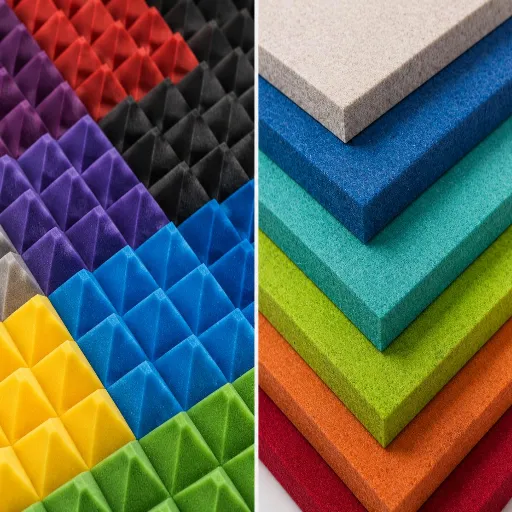
It also wins on design. PET felt comes in dozens of colourways and can be CNC-cut into shapes, V-grooved, thermoformed into 3D tiles, UV-printed, or formed into ceiling baffles and clouds. The treatment reads as interior design rather than studio gear. For a premium wood finish alternative, read wood slat acoustic panels vs foam.
Two honest caveats. PET felt is heavier than foam and needs proper fixings such as Z-clips or impaling clips, and a full-wall installation is a bigger job than pressing tiles into place.
Cost: PET Felt Acoustic Panels vs Foam, Sheet Price vs Landed

The sticker comparison is stark. Foam runs around $1.50 per square foot. PET felt runs closer to $6 per square foot at retail, with 32 square foot sheets priced near $289, $312, and $417 for half-inch, one-inch, and two-inch thicknesses. That is roughly four times the upfront spend.
What the PET number buys is density, thermal bonding, no chemical fire treatment, a 15 to 20 year life, and design freedom. None of that exists in a foam tile. Foam’s two to five year replacement cycle closes most of the gap on a per-year basis, and our acoustic panels vs foam cost breakdown runs the full arithmetic.
Then there is the part almost nobody publishes, and it matters if you buy by the container. Foam is low-density and bulky. A 40-foot high-cube container holds only around 400 sheets of 50 mm board at 1200 by 2400 mm. You are paying freight on air. Dense PET felt stows far more square metres into the same container, so on container-scale orders the landed cost per square metre can invert the retail sticker price.
Tom ran into this ordering 800 sheets of foam for a distributor network. The invoice per square metre looked excellent. The freight bill did not, because the container was mostly empty space. The same order in PET felt would have delivered substantially more treated area for the same shipping cost.
We quote factory-direct pricing as a range rather than a figure, because thickness, density, colourway, backing, and fire treatment all move the number. Request a factory-direct bulk quote and we will price your actual specification.
PET Felt Acoustic Panels vs Foam: The Bottom Line
| Your situation | Choose | Why |
|---|---|---|
| Visible office, classroom, or clinic | PET felt, 12-25 mm | Absorption plus compliance plus appearance |
| Green-building or ESG project | PET felt, 12-25 mm | Recycled content and low-VOC documentation |
| Home office or bedroom feature wall | PET felt, 9-12 mm | Clean, safe to handle, no chemistry |
| Hidden surface or equipment rack | Foam | Cheapest way to control high-frequency flutter |
| Hard budget ceiling under $150 | Foam | The only option at that price point |
| Rental or temporary installation | Foam | Removable adhesive tabs |
| Humid room or ceiling cloud | PET felt, 12-25 mm | No water uptake, no sagging |
PET felt is the upgrade that pays for itself in lifespan, air quality, and appearance. Foam remains a legitimate tool for the jobs where nobody will see the wall.
Frequently Asked Questions
Are PET felt acoustic panels better than acoustic foam?
For visible, occupied spaces, yes. PET felt absorbs more per millimetre, emits no formaldehyde, holds Class A without chemical treatment, and lasts three to four times longer.
What NRC do PET felt acoustic panels have?
NRC runs from 0.65-0.80 at 9 mm to 0.90-1.00 at 50 mm. Ask for the ASTM C423 report for the exact thickness and mounting you are buying.
Do PET acoustic panels emit VOCs or formaldehyde?
No. PET felt is thermally bonded with no formaldehyde binder and typically reports 0.0 VOC. Confirm it with the CDPH Standard Method v1.2 report.
How many recycled bottles are in a PET acoustic panel?
Roughly 70 to 90 per square metre at 24 mm, about 53 per square metre at 12 mm, or around 60 in a single typical panel.
Can PET felt acoustic panels absorb bass?
Not on their own. Like foam, PET felt falls away below 250 Hz. Reaching 125 Hz needs 50 mm thickness or more plus an air gap, or a dedicated bass trap.
The Upgrade That Pays You Back
PET felt acoustic panels and acoustic foam are not equals in a visible room. PET felt absorbs more sound per millimetre, carries the recycled content and low-emission documentation modern projects require, holds a Class A fire result without sprayed chemicals, and looks like interior design rather than studio gear. Foam still earns its place behind equipment and inside the rooms nobody photographs.
Choosing between pet felt acoustic panels vs foam comes down to one honest question: will anyone see this surface, or breathe in this room? If the answer is yes, PET felt is the specification that holds up.
Tell us your room dimensions and the surfaces you are treating, and we will send free samples, the datasheets, and a factory-direct price for the exact thickness and density you need. Get your free sample pack and bulk quote today.
Categories:
Blog
Related Articles