Acoustic Foam vs Bass Traps: Why Foam Can’t Fix Your Low End
Acoustic foam and bass traps aren’t competing products. Foam absorbs high frequencies, bass traps absorb low frequencies, and the low end is where most small rooms go wrong. If your room sounds boomy, a pack of foam corner tiles won’t fix it. At 125 Hz a 50 mm foam wedge absorbs roughly 7% of the sound energy hitting it, while a 4-inch mineral wool bass trap absorbs 65% to 80%.
So the real question isn’t which one is better. It’s which frequency range is ruining your room, and whether the product you bought was built for it.
Marcus learned this the hard way in a converted bedroom in Leeds. He treated all four corners and two walls with 24 foam tiles, spent about $115, and still couldn’t hear the pitch of his kick drum. A sine sweep later showed a 9 dB peak near 70 Hz. Four DIY mineral wool corner traps, about $180 in total, flattened it in an afternoon.
This guide breaks down the physics in plain language: what foam genuinely does, why it fails below 250 Hz, what bass trap thickness and density actually buy you, and how to spend your money in the right order. It draws on published lab comparisons, absorption coefficient data, and our own experience supplying acoustic panels for studios, offices, and homes.
Key Takeaways
- Acoustic foam and bass traps solve different problems. Foam handles flutter echo and bright reflections; bass traps handle room modes and boomy low end.
- Foam absorbs almost no bass. A 50 mm wedge measures about 0.07 at 125 Hz and drops to roughly 0.04 to 0.06 at 80 Hz.
- A 4-inch (100 mm) mineral wool trap measures 0.65 to 0.80 at 125 Hz, roughly five to ten times more low-frequency absorption than thin foam.
- NRC ratings exclude 125 Hz entirely, so a foam panel rated NRC 0.85 can still be useless for bass. Ask for the octave-band chart.
- Corners are pressure zones, so thin foam placed there works at a double disadvantage. Real traps need depth, 4 inches minimum and ideally much more.
- Spend in this order: free placement moves, then thick broadband panels, then corner traps, and foam last for whatever flutter is left.
What Is the Difference Between Acoustic Foam and Bass Traps?
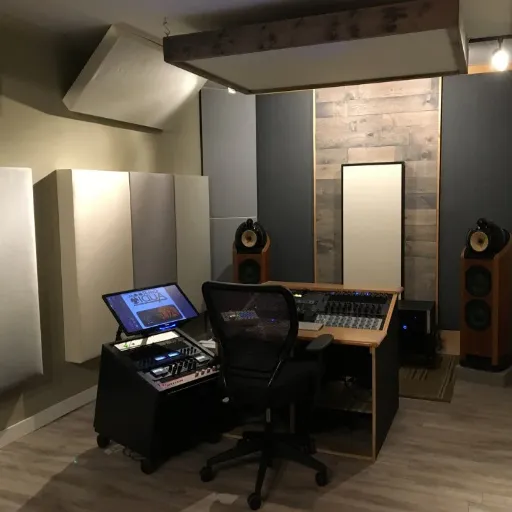
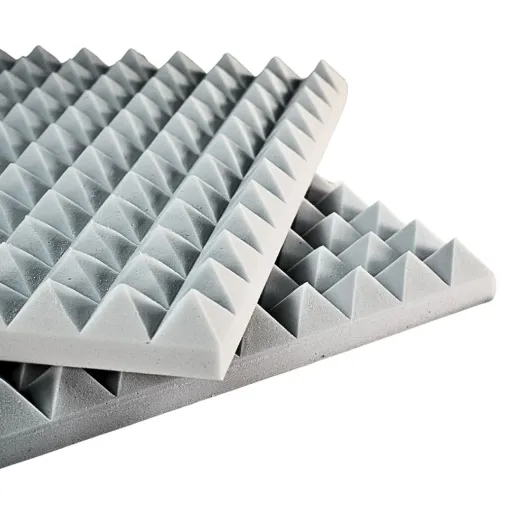
Acoustic foam is a thin, lightweight porous absorber designed to reduce high-frequency reflections. Bass traps are thicker, denser absorbers designed to control low-frequency energy and room modes. Foam is measured in millimetres; bass traps are measured in inches of depth and kilograms per cubic metre of density.
That difference in build is the whole story. A porous absorber only works on a frequency when its depth is a meaningful fraction of that frequency’s wavelength. High frequencies have short wavelengths measured in centimetres, so an inch or two of foam is enough. Low frequencies have wavelengths measured in metres, so foam isn’t in the same conversation.
This is why “which is better” is the wrong framing. Foam is a finishing tool for brightness and echo. A bass trap is a structural tool for the low end. If you want the full side-by-side material comparison, our guide to acoustic panels vs acoustic foam covers cost, materials, and room-by-room recommendations.
Acoustic Foam vs Bass Traps: Why Foam Fails Below 250 Hz
The numbers here aren’t marketing claims. They are octave-band absorption coefficients, the fraction of sound energy a material absorbs at a given frequency. A value of 1.0 means total absorption. A value of 0.07 means almost everything bounces back.
Acoustic foam bass absorption is where the sales copy and the physics part ways.
Here is how common treatments compare at 125 Hz, the first octave band that matters for bass:
| Treatment | Absorption at 125 Hz (α) | Effective range |
|---|---|---|
| 50 mm wedge foam | 0.07 | Highs only |
| 100 mm wedge foam | 0.13 | Highs and upper mids |
| Typical 2-inch foam panel | 0.10 – 0.15 | Highs |
| Generic thin acoustic panel | 0.16 | Highs and mids |
| 100 mm (4-inch) mineral wool trap | 0.65 – 0.80 | Bass and up |
At 80 Hz, foam drops to roughly 0.04 to 0.06. In practical terms, bass is passing through the foam as if it were not there.
The independent lab evidence backs this up. GIK Acoustics ran a measured comparison using sixteen foam wedge “bass traps” against eight rigid trap panels, all corner mounted. The foam traps made very little difference below 250 Hz and had virtually no effect on decay time below 200 Hz. The rigid panels improved response from around 65 Hz upward, with measurable control even at 45 Hz.
Glenn Kuras of GIK put it bluntly in a public forum thread: most foam on the market is far too small to do anything below 400 Hz. That isn’t a knock on foam as a product. It is a knock on foam sold as bass treatment.
The physical reason is airflow resistivity. Dense mineral wool sits around 40,000 to 60,000 Pa·s/m², while foam is typically 3,000 to 8,000 Pa·s/m². Lower resistivity means the material barely slows the air movement that carries low-frequency energy.
The NRC Trap: Why a 0.85 Rating Means Nothing for Bass
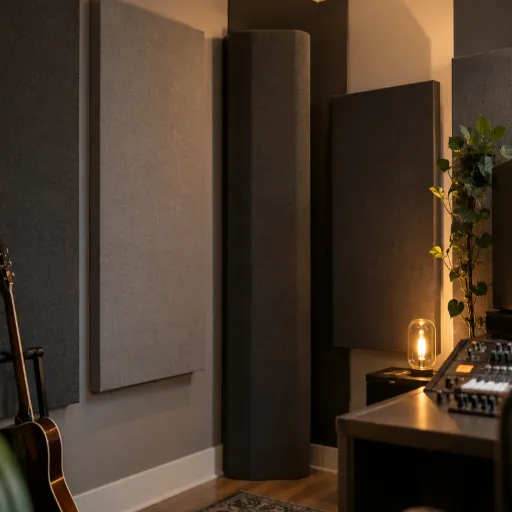
NRC stands for Noise Reduction Coefficient, and it is the single most misleading number in acoustic marketing. NRC is the arithmetic average of a material’s absorption at 250, 500, 1,000, and 2,000 Hz. Those four bands stop at 250 Hz.
NRC excludes 125 Hz and below, which is the exact range you care about.
That means two products can both carry a rating of 0.85 while one absorbs five times more bass energy than the other. A foam panel with a strong 0.85 NRC can post an absorption coefficient of 0.13 at 125 Hz and never mention it.
The fix is simple. Ask for the octave-band absorption chart instead of the NRC. Look at the 125 Hz column. If a spec sheet has no 125 Hz figure, assume it is negligible until the supplier proves otherwise.
This is the same trap that makes cheap comparison shopping so unreliable. If you have already bought foam and want to know exactly what it can and can’t absorb, our breakdown of does acoustic foam work walks through the physics and the honest limits.
Why Corners Are the Wrong Place for Foam
Corners feel like the right place for bass control, because that is where bass seems to gather. The instinct is correct. The product choice usually isn’t. Foam corner bass traps are the single most common wrong purchase in home audio.
Sound pressure is at its maximum in a corner, but particle velocity is near zero right at the boundary. Porous absorbers like foam work by slowing moving air, not by absorbing static pressure. So thin foam in a corner is fighting physics twice over: not enough depth for the wavelength, and not enough air movement to interact with.
Real traps handle this differently. A panel straddled diagonally across a corner is exposed to moving air across its face, and the triangular gap behind it creates an additional depth of air. That geometry is why a mineral wool panel mounted across a corner measures around 0.60 at 125 Hz, while the same panel mounted flat on a wall measures about 0.20.
A typical small room has more than twenty modal resonances below 300 Hz. Those resonances, not the foam, are what make your room sound uneven. Community consensus on the audio forums is blunt about the result: foam and bass traps should not be mentioned in the same sentence.
What a Real Bass Trap Actually Is
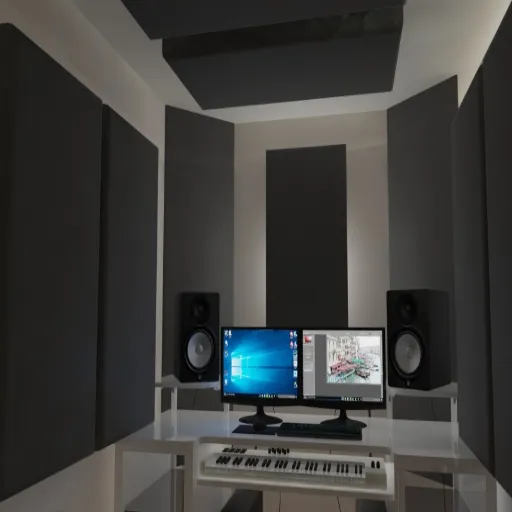
There are three families of bass trap, and they suit different problems.
- Porous or broadband traps. Dense mineral wool or rigid fiberglass, 4 inches thick minimum. The workhorse option, effective from roughly 100 to 125 Hz upward when corner mounted.
- Membrane or diaphragmatic traps. A sealed panel with a flexible face that resonates at low frequencies. Useful when you have one stubborn mode and no floor space.
- Helmholtz resonators. Tuned cavities that target a narrow frequency band, typically the problem modes below 65 Hz that broadband traps struggle with.
For most rooms, porous broadband traps in the corners do the heavy lifting. Density matters, but less than people assume. Hugh Robjohns of Sound on Sound calls 60 kg/m³ the best all-rounder density for broadband absorption, because it is structurally stable and easy to work with. Deeper fills sometimes perform slightly better at 45 kg/m³.
The highest-performing common design is the superchunk: 100 to 150 mm slabs of mineral wool stacked floor to ceiling, filling the corner to a depth of 600 to 900 mm. A 600 mm fill approaches quarter-wavelength performance near 143 Hz, and a rigid backing roughly doubles the effective depth, pushing useful absorption down toward 72 Hz.
If you already know you need traps and want to know where each one goes, our bass trap placement guide covers the priority order corner by corner.
How Thick Is Thick Enough? The Quarter-Wavelength Rule
To absorb a frequency, you need absorption depth on the order of one quarter of its wavelength. Bass wavelengths are long, and the depth requirement scales with them.
- 125 Hz: wavelength about 2.74 m, quarter wavelength about 690 mm
- 100 Hz: quarter wavelength about 850 mm, close to 2.8 feet
- 60 Hz: quarter wavelength about 1.4 m
A 2-inch foam panel is 51 mm. Against the 850 mm figure for 100 Hz, it delivers under 8% of the depth needed for real absorption. This is why “buy thicker foam” is a dead end. You can’t get there with foam at any realistic thickness.
Here is the practical translation, which is also why we recommend a layered approach rather than a single product:
| Thickness and material | Realistic lower limit |
|---|---|
| 2-inch foam | Highs only |
| 4-inch mineral wool | About 125 Hz |
| 6-inch mineral wool with air gap | About 80 – 100 Hz |
| 600 mm corner fill | About 72 Hz |
| Tuned membrane or Helmholtz | Below 65 Hz |
The Fix: How to Treat a Room That Actually Sounds Boomy
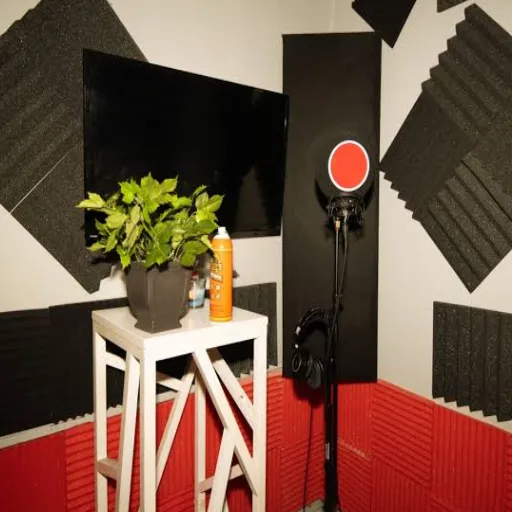
Work through these steps in order. Each one is cheaper and more effective than jumping straight to products.
- Free moves first. Set up your monitors in an equilateral triangle at ear height, keep them symmetrical relative to the side walls, and move your listening position out of the corner and away from the exact centre of the room. The centre of the room is usually a modal null, and it will lie to you about your low end.
- Broadband absorption at first reflection points. 4-inch (100 mm) panels on the side walls and a ceiling cloud. This is the best early win for stereo imaging and low-mid clarity. Our guide to acoustic panel placement shows the mirror trick for finding those points.
- Corner bass traps. Front vertical corners first, then rear corners, then wall-ceiling junctions. Floor to ceiling wherever the budget allows, because a trap that stops halfway up leaves the upper corner untreated.
- Foam last, and only for what is left. Flutter echo between parallel walls, slapback near a recording corner, a bright vocal booth. This is where foam earns its place, and how to install acoustic foam panels covers placement and mounting for that final step.
Budget allocation matters too. Around 30% to 40% of a treatment budget should go toward bass frequencies. Engineers disagree on whether corners or side walls come first, and you’ll find both positions argued at length online. The shared conclusion is the part that counts: thick material beats thin foam in either order.
Not sure how much bass treatment your room needs? Our team can review your room dimensions and recommend trap quantities and panel specifications. Request a technical consultation.
Acoustic Foam vs Bass Traps: A Hybrid Approach for Real Rooms
Here is the constraint that most guides ignore. A 600 mm superchunk in every corner isn’t realistic in a bedroom, a rented flat, or a client-facing room. Priya, a voiceover artist in a converted closet, ran into exactly the other side of this problem.
Her foam killed the flutter echo beautifully, but a boxy tone between 150 and 250 Hz stayed. The answer wasn’t more foam. Two 100 mm broadband panels on the parallel walls fixed the boxiness.
There is a design-led version of this for rooms where looks matter. Put the bulky low-frequency absorption where nobody looks, the corners, and put the visible treatment where everybody looks, the walls.
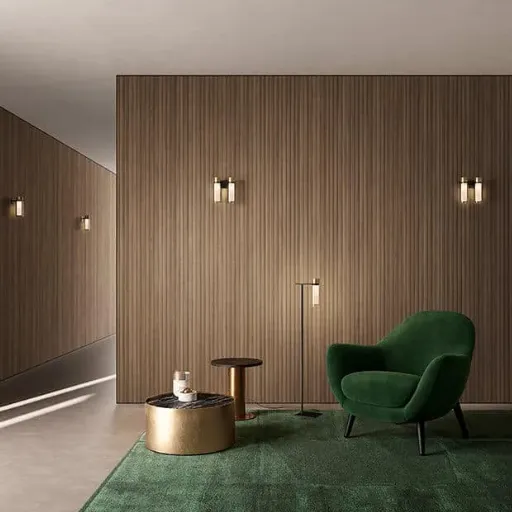
That visible layer is where acoustic panels with a decorative face come in. Wood slat and WPC acoustic panels pair a slatted surface with a felt backing and a controlled air gap. The slats and felt handle mid and high frequencies, and the cavity behind adds low-mid absorption. They look like an interior design decision rather than a studio.
We need to be honest about the limit. Slat and WPC panels are velocity absorbers, and they don’t replace 600 mm of mineral wool below 125 Hz. What they do is cover the visible wall treatment in one product and push absorption lower than thin foam can.
In a commercial lounge project in Linyi, we specified corner traps the client never noticed and WPC slat panels on the walls the client chose from a sample board. The low end tightened and the room still looked designed.
If you want to see how the pieces fit together in a home theater or cinema room, our comparison of acoustic panels vs foam for home theater covers the low-frequency side in detail.
Cost Reality: Foam vs Traps vs DIY
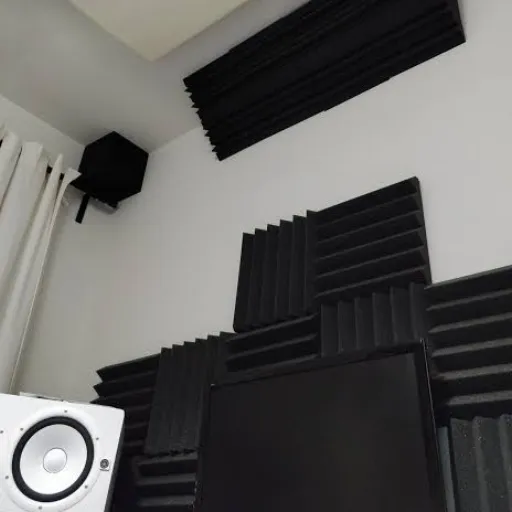
Foam corner packs look cheap per unit and often end up being the most expensive purchase in the room, because the money doesn’t move the problem. Here is how the options actually compare.
- Foam corner packs. Low unit cost, negligible bass result. Fine as a finishing purchase, wrong as a foundation.
- Commercial rigid traps. The fast, verified path. You are buying measured performance and a known density, priced per panel rather than per square foot.
- DIY superchunks. Mineral wool, a timber frame, and acoustically transparent fabric. Builders commonly report around $20 to $30 per trap, with a full four-trap set landing near $140 to $225.
- Factory-direct panels for larger projects. When you are treating multiple rooms, consistent density, fire rating, and freight planning start to matter more than the unit price.
Mineral wool availability varies by market. The 45 and 60 kg/m³ slab grades are the common budget-friendly options, and both perform when thickness is adequate. Buying beats building when you need quantity, documented specifications, or fire-rated and moisture-rated material for a commercial space.
Cost is also where thin foam quietly loses. If you spend $115 on foam, then $180 on traps six months later, the foam wasn’t a saving. It was a detour.
How to Confirm You Actually Have a Bass Problem
Do not buy anything until you have confirmed what your room is doing. This takes about twenty minutes and costs nothing.
- Run a slow sine sweep from 200 Hz down to 40 Hz. Play it at a moderate level and listen. You will hear specific notes boom and specific notes nearly disappear. Those are your modal peaks and nulls.
- Walk the room at each problem frequency. Peaks cluster near boundaries and corners. If a frequency booms hardest in a corner, corner traps will help most.
- Measure if you want precision. Room EQ Wizard (REW) is free, and a basic measurement microphone is inexpensive. Run a REW sweep and look at the waterfall plot. The decay time in the low end is what separates a boomy room from a tight one.
- Check your room dimensions against a mode calculator. If your problem frequency matches a known axial mode, you know it is a room issue and not a gear issue.
A decay plot will show you things marketing copy never will. In particular, it will show whether your low end is too loud, too long, or both. Those need different fixes.
Two more traps to avoid while you are at it. Do not cover every wall in 25 mm foam, because you’ll end up with a dull top end sitting on top of a messy low end. And don’t flush mount a panel against the wall when you wanted bass control. The air gap is doing real work.
Frequently Asked Questions
Do foam bass traps work?
No, not for bass. Foam sold as a bass trap absorbs high frequencies and almost nothing below 250 Hz. A 50 mm foam wedge measures about 0.07 absorption at 125 Hz. Real bass traps use 4-inch or thicker mineral wool or fiberglass and absorb 0.65 to 0.80 at the same frequency.
Can acoustic foam absorb bass at all?
Only marginally. Foam’s absorption at 125 Hz ranges from about 0.07 for 50 mm to 0.13 for 100 mm, and falls to roughly 0.04 to 0.06 at 80 Hz. Practically, bass passes through it and reflects off the wall behind.
How thick does a bass trap need to be?
Four inches (100 mm) is the practical minimum for meaningful absorption down to about 125 Hz. Six inches with an air gap reaches roughly 80 to 100 Hz. For control below 65 Hz you need deep corner fills or tuned membrane and Helmholtz designs.
How many bass traps do I need for a small room?
Most small rooms benefit from four traps, one per vertical corner, installed floor to ceiling where possible. Add wall-ceiling junction traps if the boom persists. Start with the corners closest to your speakers.
Can I put a bass trap in front of the foam in my corner?
Yes, and you should. Remove the foam if it blocks the trap’s face. The trap needs exposure to moving air, and thin foam in front of it adds nothing while costing you the depth.
Is a superchunk better than a flat corner panel?
A superchunk absorbs lower and more evenly, because the triangular fill increases effective depth. A flat panel across a corner is easier to install and cheaper. For problem modes below 100 Hz, the superchunk is the stronger choice.
Do I need bass traps if I only record voice?
Often yes, in a small room. Voice fundamentals run from about 85 to 180 Hz, and small rooms commonly peak right there. That’s the boxy tone people mistake for a microphone problem.
Are bass traps the same as acoustic panels?
No. Panels are usually 1 to 2 inches thick and target mid and high frequencies. Bass traps are 4 inches or deeper and target low frequencies. Some thick broadband panels do both jobs, which is why thickness is the number to check.
The Bottom Line
Acoustic foam and bass traps are different tools for different frequency ranges, and the acoustic foam vs bass traps question has a clear answer once you look at the data. Foam is a finishing product for brightness and flutter echo. Bass traps are the structural fix for boomy, uneven low end.
If your room sounds fine except for a bright slap, foam is a reasonable, inexpensive purchase. If your kick drum is inconsistent, your low end is muddy, or your mixes translate badly, foam won’t help and no amount of it will. Start with placement, add thick broadband panels at first reflections, then put real traps in the corners. Treat foam as the last 10% of the job.
The fastest way to get this right is to confirm your problem frequencies before you spend. Once you know whether you have a 70 Hz peak or a 200 Hz boxiness, the product decision makes itself.
Ready to treat your room properly? We supply acoustic panels, WPC and wood slat panels, and bass trap materials with documented absorption data and honest frequency specifications. Request free samples and a bulk quote, and tell us your room dimensions. We will tell you what will actually fix it.
Categories:
Blog
Related Articles