Acoustic Panels Vs Foam Home Theater: What To Buy
The verdict on acoustic panels vs foam home theater is clear: panels win. Panels absorb the mid-band where dialogue lives and reach down toward bass, while foam only tames high-frequency echo and does almost nothing for voices or low end. If you want clear dialogue and even bass across every seat, panels plus corner bass traps are the right build. Foam is a budget add-on for hidden spots, not the core of a cinema room.
That answer surprises a lot of buyers, because foam is what they see in every “studio” photo online. So let me walk you through why it fails in a cinema, how much treatment your room actually needs, and how to make it look like a media room instead of a sound booth.
Key Takeaways
- For a home theater, panels are the better choice: dialogue energy sits in the 250 Hz to 2 kHz band that thin foam barely touches
- Two-inch foam absorbs only about 0.11 at 125 Hz; rigid panels reach NRC 0.85 to 1.05 and stay effective where speech and low-mid energy sit
- Aim for a controlled decay of about 0.2 to 0.5 seconds (RT60/RdT) and treat 20 to 30% of surfaces at NRC 0.80 or higher
- Foam cannot fix boomy bass or seat-to-seat boom because it is not a bass absorber; you need thick corner traps and smart subwoofer placement
- Wood slat, WPC, and PET felt panels deliver cinema performance with a finished look and last 15 to 20 years versus foam’s 3 to 8
Acoustic Panels vs Acoustic Foam for Home Theater: The Short Answer

If you only read one paragraph, read this one. Acoustic foam absorbs mid and high frequencies, roughly 500 Hz and up, so it reduces echo and bright reflections. Acoustic panels use a dense core that absorbs a much wider range, reaching the speech band and, in thicker sizes, the low-mid and bass region foam ignores. For a home theater, where clear dialogue is the whole point, panels do the job foam cannot.
Both materials do one thing and one thing only: they absorb sound inside the room. Neither blocks sound from leaving or entering, so if your real problem is noise through the walls, that is soundproofing, a separate topic. We cover the full material breakdown in our complete acoustic panels vs foam comparison, and this article focuses on the cinema room specifically.
Why a Home Theater Is Different From a Studio or Office
A recording studio treats a room so a mix translates to other systems. An office treats a room so calls sound clear and noise drops. A home theater is different again, and the difference shapes your buying decision.
The cinema metric is dialogue intelligibility. You need to hear every line over explosions, music, and surround effects. Speech carries most of its energy between roughly 250 Hz and 2 kHz, with male vocal fundamentals down around 85 to 180 Hz. Those are exactly the frequencies thin foam leaves alone.
The geometry is different too. In a 5.1, 7.1, or Atmos room, sound arrives from surrounds and height speakers, not just the front three. That creates reflection paths on side, rear, and ceiling surfaces that a stereo studio never has to manage.
Then there is the room’s second job: a home theater is a living space. It has to look good and, if kids or guests are around, it has to be safe. That’s why foam’s plastic look and fire behavior matter here more than in a treated closet.
What Acoustic Foam Actually Does in a Home Theater

Foam is an open-cell polymer, usually polyurethane or melamine, molded into wedges or pyramids. It works, within limits. It absorbs mid and high frequencies and cuts the flutter echo that makes a bare room sound harsh. If your only complaint is a bright, ringing room, foam will change what you hear.
Here is where it stops. Published data puts typical foam at an NRC of 0.30 to 0.55. At 125 Hz, a two-inch foam tile absorbs only about 0.11, and even a four-inch foam panel reaches just 0.27 at 125 Hz and about 0.50 at 250 Hz. In plain terms, foam is nearly transparent to the bass and lower-mid energy that makes dialogue muddy.
There’s a place for foam in a cinema room. On a hidden rear wall, or in a small secondary media room where you just want to kill echo, a foam kit is honest, cheap, and effective. What it cannot be is the main treatment in a dedicated theater, because it never touches the problem most home theaters actually have.
What Acoustic Panels Do That Foam Can’t
Acoustic panels solve the frequency gap. A panel pairs a rigid, dense core, such as fiberglass, mineral wool, or PET felt, with an acoustically transparent fabric wrap. That core absorbs broadband sound rather than just the top end.
The numbers show the difference. Rigid panels reach NRC 0.85 to 1.05, and thickness controls how low they reach: a two-inch panel is effective to about 250 Hz, while a four-inch panel pushes down to about 125 Hz, as GIK Acoustics thickness data confirms. That is the range where dialogue clarity and low-mid warmth live, and it is the range foam misses.
| What Matters in a Cinema | Acoustic Foam | Acoustic Panels |
|---|---|---|
| Typical NRC | 0.30 to 0.55 | 0.85 to 1.05 |
| Low-frequency reach | Barely below 500 Hz | ~250 Hz at 2 inches, ~125 Hz at 4 inches |
| Dialogue band (250 Hz to 2 kHz) | Weak coverage | Strong coverage |
| Lifespan | 3 to 8 years | 15 to 20+ years |
| Fire rating | Often untreated polymer | Readily Class A |
| Best cinema use | Hidden echo control | Primary room treatment |
If you want the front wall to look designed rather than industrial, wood slat and WPC panels are the premium option, and PET felt panels add color and shape. We compare those finishes head to head in our guide to wood slat acoustic panels vs foam.
Want to see and hear the difference in your own room? Request free samples of our PET felt and wood slat panels and test the finish against your wall before you commit.
The Bass Problem: Subwoofers, Room Modes, and Why Foam Can’t Help

Bass is where the foam-versus-panel choice gets decided, and where most home theaters quietly fail.
Low frequencies, from about 20 to 80 Hz, have long wavelengths that interact with your walls to form standing waves, also called room modes. Those modes create peaks in some seats and deep nulls in others. In an untreated room, bass can vary by up to 20 dB from one seat to the next, so the back row feels boomy while the front row feels thin. Studies suggest roughly 30% of a listener’s experience comes down to bass performance, so this is not a minor detail.
Foam cannot fix this. There’s a common saying in the trade that there’s no such thing as a foam bass trap, and the data backs it up. Bass needs thick, dense absorbers, typically four to six inches or more, packed into corners where low-frequency energy piles up. That is why our dedicated guide to acoustic foam vs bass traps exists: the material and the placement are different from wall treatment entirely.
So budget for bass separately. A foam corner block is decorative at best. A real corner trap, plus multiple subwoofers placed well and tuned with your receiver, is what makes bass even across every seat.
How Much Treatment and Where: A Spec-Ready Plan
Now the practical part. How much panel do you actually need, and where does it go?
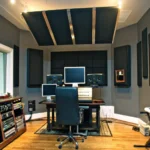
Start with coverage. Most rooms hit a controlled decay at around 20 to 30% of reflective surface area treated with NRC 0.80 or higher material. Hard rooms with big windows and bare floors push closer to 40% of wall area. More is not better: over-treating makes a room sound dead and dull, and a known pitfall is covering walls in thin absorbers that kill the highs while leaving the mids and bass untouched. That unbalances the room.
For a reference target, a well-treated dedicated theater lands around 0.2 to 0.5 seconds of reverberation time, or RT60, according to the CEDIA/CTA-RP22 immersive audio guideline; the Commercial Acoustics RT60 chart shows the recommended decay times by room type. Bare rooms often measure 1.2 to 1.8 seconds, which is why dialogue smears.
Place treatment in this order of impact:
- Side-wall first reflection points. Find them with the mirror trick, then treat the spots where each speaker’s sound bounces to your seat.
- Front-corner bass traps. Thick traps in the corners smooth the boom that foam cannot touch.
- Ceiling cloud. Manage height and Atmos reflections, especially over the front seats.
- Rear wall. Absorb or diffuse the rear reflection so surround sound stays immersive.
- Additional rear corners. Finish the bass picture across the whole room.
Two details trip people up. First, if you have a second row, that row has its own reflection points, so tune the room for both rows, not just the front. Second, mounting matters as much as the panel itself. Our acoustic foam and panel installation guide covers spacing and mounting, and for the full placement walk-through, see our home theater acoustic panel placement guide.
Here is how this plays out in a real room. Daniel finished a two-row basement cinema outside Denver in early 2026. He started with a wall of foam because it was cheap. The back row stayed boomy and dialogue stayed muddy, and a cheap seat-to-seat measurement showed bass swinging by nearly 18 dB. He kept the foam on a hidden rear wall, added four corner traps and eight two-inch panels at the reflection points, then tuned two subwoofers. The bass evened out across both rows, and he finally stopped reaching for the remote to raise the center channel.
Making It Look Like a Media Room (Not a Studio)
Aesthetics decide more home theater buys than most guides admit. Foam reads as studio gear to guests, and it degrades: it yellows and crumbles within five to seven years. A media room is usually the nicest room in the house, so the treatment has to earn its place on the wall.
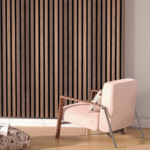
Wood slat and WPC acoustic panels solve the look problem without giving up performance. The acoustic work happens in the backing: sound passes through the gaps between slats, which should cover around 30 to 50% of the surface, and into a felt or mineral-wool backing. A standard 21mm wood slat panel delivers an NRC around 0.80 to 0.85, and you want NRC 0.85 or higher in a dedicated cinema. A one-inch mineral-wool backing reaches 0.80 to 0.95.
For layout, a wood slat feature wall behind the screen or TV anchors the room, with fabric or PET panels flanking it at the first reflection points and corner traps dressed as columns. PET felt panels add color and cut shapes for a softer modern look. Dark oak or charcoal suits a moody dedicated cinema, while walnut or oak suits a brighter living-room media wall. As a factory-direct supplier of PET felt, wood slat, and WPC panels, we build the finish and the acoustic core together, so the look and the performance come from one product.
Fire Safety: A Living-Space Requirement

Fire behavior is not a footnote when the room is inside your home. Untreated polyurethane foam is combustible and gives off dense toxic smoke when it burns. Melamine foam is better and is inherently Class A, but it is the exception, not the rule for cheap foam.
Panels are the safer bet for a cinema. Fiberglass, mineral wool, PET felt, and fire-rated wood slat products are readily available with Class A ratings, and they suit residential code. This matters next to a fireplace or a heat source on a media wall, where clearance and rating both count. Whatever you buy, ask for the actual test certificate, such as an ASTM E84 or EN 13501-1 report, rather than trusting a “fire-retardant” sticker.
Home Theater Acoustic Panels vs Foam: Budget Tiers
Your budget decides how far to go, and honest numbers help you plan once instead of twice.
| Tier | Rough Cost | What You Get | What It Fixes |
|---|---|---|---|
| Starter | $150 to $400 | Foam on hidden surfaces, or a small panel set | High-frequency echo only |
| Sweet spot | $500 to $1,200 | First-reflection panels plus two to four corner traps | Dialogue clarity and much of the bass |
| Full build | $1,500 to $4,000+ | Slat or WPC front wall, panels, ceiling clouds, corner traps | The whole cinema experience |
On a per-square-foot basis, foam runs about 1to1to5 and finished panels about 8to8to15 retail. Foam looks cheaper until you count replacement and coverage. Foam needs replacing every 3 to 8 years and needs roughly twice the area for the same echo control, so the “cheap” option can cost more over a decade. Panels are installed once and hold up for 15 to 20 years.
If you are an integrator or fitting several rooms, buying factory-direct changes the equation. Wood slat and WPC panels that approach $18 per square foot at retail can come in far lower in volume. Ready to spec a project? Send us your room dimensions and we will put together a factory-direct quote and a panel layout.
Acoustic Panels vs Foam for Home Theater: The Bottom Line

On the acoustic panels vs foam home theater question, a dedicated room wants panels and bass traps, and foam only helps in the margins. Match the choice to the room:
- Dedicated cinema: Panels plus corner traps, full treatment, look and safety considered.
- Living-room media wall: Wood slat or WPC panels as the feature wall, panels at reflection points.
- Small secondary media room: Panels at the key spots; foam on hidden surfaces is fine.
- Hidden rear-wall echo fix: Foam is a legitimate budget answer here.
The rule is simple. If a material cannot absorb the frequencies where your dialogue and bass live, buying more of it is money spent twice. Compare panels per year of ownership, not foam per tile, and you will land in the right place.
Frequently Asked Questions
Is acoustic foam or acoustic panels better for a home theater?
Panels are better. They absorb the 250 Hz to 2 kHz band where dialogue lives and reach into the low-mid and bass range foam misses. Foam only handles high-frequency echo, so it works as a supplement, not a full-room solution.
Does acoustic foam work for home theater?
Only partially. Foam reduces high-frequency reflections and flutter echo, which can make a room sound less harsh. It does not fix muddy dialogue or boomy bass, which are the two most common home theater complaints.
Do you need bass traps in a home theater?
Yes, if you have a subwoofer in a normal room. Low frequencies build up in corners and create uneven bass across seats, sometimes varying by 20 dB. Thick corner traps smooth that response so bass sounds the same in every seat.
How much of my home theater walls should be covered?
Treat roughly 20 to 30% of reflective surface area with NRC 0.80 or higher material, or up to 40% in hard rooms. More than that can make the room sound dead, so place panels where reflections actually hit your seats.
Where do I put acoustic panels in a home theater?
Start with side-wall first reflection points, then front-corner bass traps, a ceiling cloud, the rear wall, and rear corners. Our home theater acoustic panel placement guide walks through each zone step by step.
Are wood slat acoustic panels good for home theaters?
Yes. Wood slat and WPC panels deliver an NRC around 0.80 to 0.85 with a backing, look like design rather than equipment, and suit media walls. Choose NRC 0.85 or higher for a dedicated cinema.
Can acoustic foam soundproof a home theater?
No. Foam absorbs sound inside the room, and it cannot block sound from passing through walls. Soundproofing needs mass, sealing, and decoupling, which is a different job entirely.
Conclusion
The acoustic panels vs foam home theater decision comes down to frequency, coverage, and time. Panels absorb the mid-band where dialogue lives and reach toward bass, foam only trims high-frequency echo, and a panel system installed once usually costs less per year than foam you replace every few years. Add thick corner traps for bass, treat the five priority zones, and pick a finish that belongs in a media room.
You don’t have to guess at any of it. As a factory-direct supplier of PET felt, wood slat, and WPC acoustic panels, we help homeowners and integrators spec the right coverage the first time. Request free samples and a sizing consultation and we will help you plan a home theater that sounds as good as it looks.
Categories:
Blog
Related Articles