Restaurant Acoustic Treatment Cost: 2026 Pricing a nd Worked Budgets
Restaurant acoustic treatment cost runs between $3 and $18 per square foot installed, depending on material and coverage. A 60-seat dining room typically lands at $4,000 to $9,300, and most independent operators spend $2,000 to $12,000 on a treatment that works.
That is the honest range. Now here is the problem you probably hit first.
Three suppliers quote the same 2,000 square foot dining room. One says $800. One says $10,000. One says $55,000.
All three are real numbers from pages ranking for this exact search today, and none explains the gap.
The gap isn’t a pricing disagreement. It’s a scope disagreement wearing a price tag. This guide separates the two, then builds a restaurant acoustic treatment cost budget you can defend.
Need a number for your room? Send the dimensions and we will price against your actual layout, not generic square footage. Request a bulk quotation and a sample.
Key Takeaways
- Installed treatment runs $3 to $18 per square foot. Mineral fibre tiles sit at the bottom, perforated timber at the top. Installation adds 30 to 60 percent to material.
- The 20x spread in published quotes is scope, not price. Supply-only partial coverage and full-coverage installed premium work are different products with the same name.
- Cost per decibel of RT60 reduction is the only comparable unit. Square footage and panel counts mislead, because materials absorb different amounts per dollar.
- A quote omitting HVAC, masking, testing and contingency isn’t cheaper. It’s a smaller scope with a surprise attached.
- Nobody can promise a revenue lift. Louder rooms raise spend up to a point, then the curve reverses.
Why Two Quotes for the Same Dining Room Differ by 20x
Start with the three published numbers, because they are the reason this page exists.
| Source | Published range | Room specified |
|---|---|---|
| Acoustic Sound Panels | $800 to $3,500 | 1,500 to 3,000 sq ft hard-surface restaurant |
| Performance Acoustics | $10,000 to $25,000 | 1,500 to 3,000 sq ft dining room |
| AcousPlan | $15,000 to $55,000 | 1,500 to 4,000 sq ft restaurant or bar |
Entry price to entry price, that’s a 19x spread. Take the outer extremes and it reaches 69x. Same brief, same room size, four vendors, and no page acknowledges the others exist.
Scope, Not Price, Is the Variable
Four things move a restaurant acoustic treatment cost quote, and price per panel is the least of them.
How much of the room you treat. Zone-targeted work covers the ceiling over the loudest areas. Full-room work covers every hard surface, which can be three times the material.
Which material you specify. Mineral fibre tiles start near $1 per square foot supply. Perforated timber starts near $13. That is a 13x spread before anyone touches labour.
Access. A clear ceiling void and a scissor lift is a different job from scaffold over a mezzanine. Access can move a quote more than material does.
When the work happens. Out-of-hours installation protects your trading week and costs more. Most suppliers don’t price it until you ask.
The $800 quote is supply-only, cheapest material, partial coverage, self-installed. The $55,000 quote is full coverage, premium product, installed, metro labour, out of hours. Both are honest. Neither is comparable.
Still deciding what to treat rather than what to spend? Start with how to reduce noise in a restaurant.
Cost per Decibel Is the Only Comparable Number
Panels aren’t a unit. Square footage isn’t either, because a square foot of mineral wool and a square foot of slatted timber do not absorb the same amount of sound.
The unit that works is dollars per second of RT60 reduction. RT60 is the time a sound takes to fade by 60 decibels. Drop it from 1.6 seconds to 0.8 and conversation stops fighting the room.
Measure room volume, work out the absorption you need using Sabine’s formula (A = 0.161 x V / target RT60), subtract what the room already absorbs, then price the difference. Run that on two materials for the same room and the ranking often flips. Our free RT60 calculator does the arithmetic in two minutes.
Restaurant Acoustic Treatment Cost per Square Foot
Restaurant acoustic treatment cost per square foot, material by material. This is the table most suppliers won’t publish, running from mineral fibre acoustic ceiling tiles for restaurants up to perforated timber. These are planning ranges, not a quotation.
Price by Material and Mounting
| Material | Supply only | Installed |
|---|---|---|
| Mineral fibre ceiling tiles | $1.00 to $2.00 | $2.50 to $4.50 |
| Rigid fiberglass panels | $2.50 to $4.50 | $5.00 to $8.00 |
| PET felt panels | $3.00 to $6.00 | $5.50 to $10.00 |
| Fabric-wrapped panels | $4.00 to $9.00 | $8.00 to $15.00 |
| Wood slat panels | $5.00 to $12.00 | $9.00 to $18.00 |
| Perforated timber | $13.00 to $24.00 | $18.00 to $30.00 |
| Suspended baffles | $30 to $90 per unit | $60 to $160 per unit |
Three notes matter more than the numbers.
Mounting changes both price and performance. A wood slat panel direct-mounted absorbs at NRC 0.45 or better. The same panel on 45 mm battens reaches 0.85 or better. On battens with mineral wool behind it, 0.95 or better. You pay more for the battens and get roughly double the absorption, which is usually the best value on the page.
Baffles are priced per unit, not per square foot. A 1,200 by 600 mm baffle covers 0.72 square metres but exposes two faces, so it absorbs like more. Our guide to restaurant acoustic ceiling baffles walks through the count.
Thickness adds 20 to 30 percent per increment. Often worth it. Thin panels handle speech and leave the low end alone, which is the muddiness that makes a dining room tiring.
Why Installed Costs Two to Four Times Supply
Installation adds 30 to 60 percent to material on a clean job. For restaurants it runs higher, for two reasons.
Out-of-hours working is the first. Nobody installs over a full dining room at eight on a Saturday, and that premium isn’t negotiable if you want to keep trading.
Access is the second. A clear void and a lift is cheap. Scaffold over a mezzanine, or work around live services and grease ducts, is not.
Ask for an access survey before you accept any quote. For material-level economics across foam and panels, our acoustic panel versus foam cost breakdown goes deeper.
Regional and Currency Multipliers
Published US figures assume a national average. AcousPlan puts the spread at 1.35 to 1.55 for New York City and 0.80 to 0.90 for the Midwest, so a $20,000 project runs about $27,000 to $31,000 in Manhattan and $16,000 to $18,000 in Atlanta.
Buying across a border, confirm whether the quote is FOB or CIF, because freight and duty can add 15 to 25 percent. Then confirm the fire certification is recognised in your jurisdiction, covered in the fire rated acoustic panels for restaurants guide.
How to Build a Real Restaurant Acoustic Treatment Cost Budget
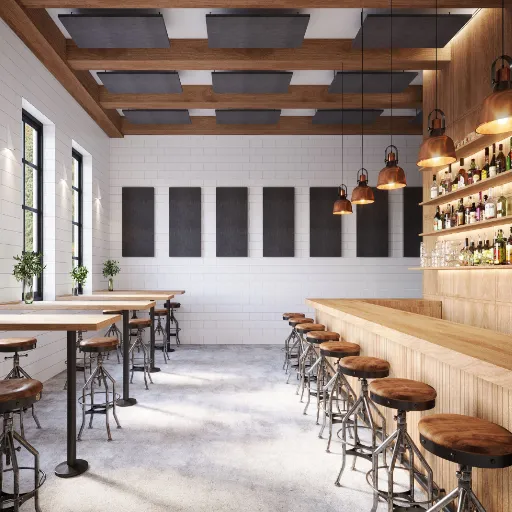
A budget you can defend has three steps and one list of things people forget.
Step 1: Measure Treatable Area, Not Floor Plate
The most common and most expensive error. Operators budget the whole floor plate, then discover only part of it is treatable.
Count the dining area and the hard surfaces. Then apply a coverage target of 25 to 40 percent of the ceiling at NRC 0.85 or higher. The ceiling carries most of the absorption because it is the largest uninterrupted reflective surface. For the framework by room type, see acoustic panel coverage percentage.
Step 2: Set Coverage and Material Together
Material and coverage are one decision. A material that absorbs less needs more of it.
Against a fiberglass baseline, PET felt needs 10 to 15 percent more coverage, wood slat 20 to 30 percent more, WPC perforated 25 to 30 percent more. That’s why the cheap material isn’t automatically the cheap answer. Price labour as a percentage of material, then use 10 percent contingency on a straightforward job and 15 percent on occupied premises.
The Line Items Suppliers Leave Out
These turn a $9,000 quote into a $14,000 invoice. None are optional if you need the room to work.
- HVAC noise control. AcousPlan puts this at $5,000 to $20,000. If the roar comes from the diffusers, absorption panels will not touch it.
- Sound masking. Around $2 to $5 per square metre. Sometimes the cheapest fix in the building.
- Post-install acoustic testing. $600 to $1,500 per room in the US.
- Design or consultancy fee, plus permits and any inspection re-test.
A quote that omits these isn’t cheaper. It’s a smaller scope with a surprise attached. Our acoustic panel specification template is a CSI three-part clause you can hand a contractor, fixing absorption rating, fire class and mounting condition in writing so the restaurant acoustic treatment cost you agree cannot drift after you sign.
Three Worked Budgets
Worked examples built from the coverage method and price table above. They are not client case studies. Run your own dimensions through the same arithmetic and you will land close.
A 40-Seat Café: 60 m² (645 sq ft), 2.8 m Ceiling
Priya runs a café with a low ceiling, a hard floor and an espresso grinder that cuts through every conversation. Her budget is tight and her instinct is the cheapest tiles available.
At 25 percent ceiling coverage she needs 15 square metres. At 0.36 square metres per 600 by 600 PET panel that is 42 panels, or 46 with waste.
- Supply at $3.00 to $6.00 per square foot: $480 to $970
- Installed at $5.50 to $10.00 per square foot: $890 to $1,620
- With 10 percent contingency: $980 to $1,780
The honest advice for Priya is that soft furnishings may deliver more per dollar at this size. Banquettes, a rug and felt pads under the chairs are cheaper and they work.
A 60-Seat Casual Restaurant: 90 m² (970 sq ft), Exposed Ceiling
Marco has exposed services, a tile floor and a room that fills to 80 decibels by nine o’clock. He has two quotes and can’t tell which is real.
At 30 percent ceiling coverage he needs 27 square metres, which is 37.5 baffles at 0.72 square metres each, or 42 with waste. Wall treatment at 25 percent of 120 square metres after glazing is 30 square metres, or 23 panels.
- Supply: 42 baffles at $30 to $90 plus 323 square feet of wall panels at $2.50 to $4.50 = $2,070 to $5,230
- Installed: 42 baffles at $60 to $160 plus 323 square feet at $5.00 to $8.00 = $4,140 to $9,300
- Mid-point with contingency: about $7,400
Marco is squarely in the $2,000 to $12,000 tier, where most independents land. If either quote sits far outside that band, ask what scope it assumes.
Comparing quotes right now? Send both and we will tell you what each covers and what it leaves out. Get a specification review.
A 120-Seat Bar-Restaurant: 180 m² (1,940 sq ft), Exposed Ceiling
Dan’s room splits into three zones. The dining area needs conversation, the bar needs energy, the pass needs containment.
Zone by zone before waste: dining 30 percent gives 46 baffles, bar 40 percent gives 28, pass 20 percent gives 6. That is 80 baffles, or 87 with waste. Add a 20 square metre slat feature wall behind the bar, which is 215 square feet.
- Supply: 80 baffles at $30 to $90 plus 215 square feet of slat at $5 to $12 = $3,480 to $9,780
- Installed: 80 baffles at $60 to $160 plus 215 square feet at $9 to $18 = $6,740 to $16,680
Dan sits between the working and full-treatment tiers, and his number lands well below the $15,000 to $55,000 published for restaurants this size. That isn’t a discrepancy. The published range assumes full-room coverage, and zone targeting usually is the better buy. For the design-led option, see wood slat acoustic panels for restaurants.
What Drives Restaurant Acoustic Treatment Cost Up
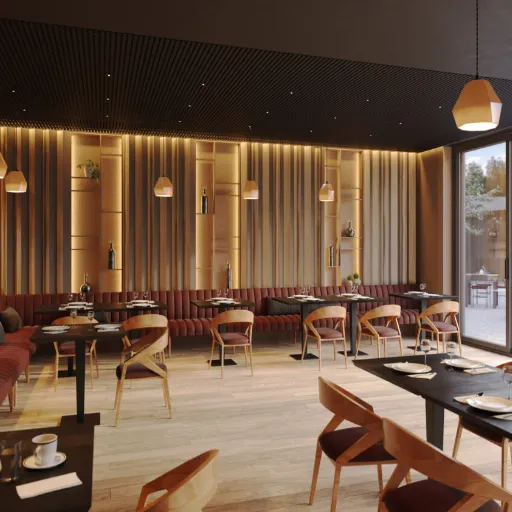
Knowing which lines to defend beats shopping for a discount.
Unavoidable: access and height, live services, restricted hours, out-of-hours installation, bespoke finishes, thickness at 20 to 30 percent per increment, curved or raked surfaces, heritage constraints.
Safe to cut: wall treatment before the ceiling is done. The ceiling returns 40 to 60 percent RT60 reduction alone, against 15 to 25 percent for walls. Premium finishes on surfaces nobody sees. Full-room coverage where zone targeting will do.
Not safe to cut: ceiling coverage below target, NRC below 0.85 on the main absorptive surface, fire compliance, and the contingency. Our comparison of ceiling versus wall acoustic panels explains why the ceiling deserves the first budget line.
Supply-Only, Installed, or Factory-Direct
Three ways to buy the same treatment, differing by more than price.
| Route | What it covers | Typical premium over material |
|---|---|---|
| Supply-only | Material only, you install | None, but you carry the execution risk |
| Contractor installed | Material, labour, margin, coordination | 30 to 60 percent, higher with difficult access |
| Factory-direct plus local installer | Material at source, labour priced separately | Material saving plus local labour rate |
Supply-only. You buy material and arrange installation. Lowest material cost, highest execution risk, and the risk stays with you if the room doesn’t perform.
Installed through a contractor. Labour plus margin, and risk transfers. Worth it when access is difficult or the work must pass inspection.
Factory-direct plus a local installer. Buy from the manufacturer, hire installation locally. This is the route most commercial buyers should price, because it separates two costs contractors bundle. Ask for material and labour lines separately on every quote.
When DIY Is Viable, and When It Is Not
DIY works for drop-grid tile swaps and direct-mount panels on flat walls at reachable height. It doesn’t work for suspended baffles at height, engineered fixings, or work that must pass inspection.
One warning that costs people real money. In a commercial kitchen, a DIY install can void the certification the inspector wants to see. Fire ratings are tested on an assembly, including the fixing method, so a report for a direct-mounted panel doesn’t cover a batten-mounted install. Read the fire rated panels guidance and request the original lab report.
Is Acoustic Treatment Worth the Money?
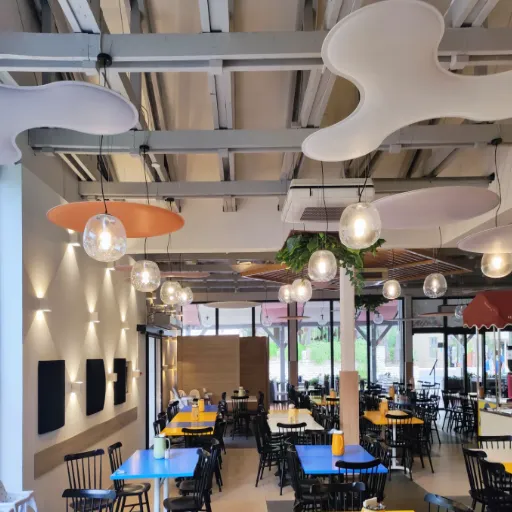
This is where most suppliers promise things nobody can deliver. Here is what the research supports.
A 2021 study by Tarlao, Fernandez, Frissen and Guastavino tracked 247 diners over four consecutive weeks in a Montreal restaurant (Applied Acoustics 174:107772). For every 1 decibel increase in ambient sound, diners spent 3.3 minutes longer and CA$2.20 more. Satisfaction did not fall. Perceived chaos and unpleasantness actually dropped as the room got louder.
Read that carefully, because it doesn’t say what most articles claim. It says louder rooms can earn more, up to a point. The point is where conversation breaks down.
Gregory Scott’s 2018 survey of 2,376 New York restaurants and bars (Open Journal of Social Sciences 6:64-84) found an average of 77 dBA, with 25 percent measuring 81 dBA or higher, where talking across a table becomes work. The spend you gained at 74 dBA is gone at 82, along with the diners who will not shout.
So treatment isn’t about making a restaurant quiet. It’s about putting the room deliberately on the right side of that curve instead of landing there by accident.
What you can honestly expect: fewer complaints, a room that holds conversation at peak, staff who are not shouting for eight hours, and a measured RT60 you can show a landlord. What nobody can promise is a revenue lift.
As a sanity check, full treatment typically lands at 2 to 3 percent of a restaurant fit-out budget. For the full picture on targets and compliance, see our complete guide to acoustic panels for restaurants.
Frequently Asked Questions
How much does it cost to soundproof a restaurant?
Soundproofing and acoustic treatment are different products at different magnitudes. Treatment absorbs sound inside the room and costs $3 to $18 per square foot. Soundproofing blocks transmission to neighbours, meaning construction work: added mass, decoupled walls, sealed penetrations. Expect several times the cost.
How much does restaurant acoustic treatment cost per square foot?
Installed costs run $2.50 to $4.50 for mineral fibre ceiling tiles, $5.50 to $10.00 for PET felt, $8.00 to $15.00 for fabric-wrapped panels, and $9.00 to $18.00 for wood slat. Perforated timber reaches $18 to $30. Baffles run $60 to $160 per unit installed.
Why do acoustic treatment quotes vary so much?
Scope, not price. Coverage percentage, material class, access, and whether work happens during service account for almost all of the spread. Two quotes only compare once you confirm they treat the same area, at the same NRC, under the same access conditions.
Is acoustic treatment worth it for a restaurant?
It’s worth it when noise costs you something measurable: complaints, lost bookings, staff turnover, or a room that empties early. It’s harder to justify as a pure revenue play, because the research doesn’t support a simple “quieter earns more” claim.
Can I install acoustic panels myself in a restaurant?
Yes for drop-grid tile swaps and direct-mount panels on flat walls at reachable height. No for suspended baffles at height, engineered fixings, or anything that must pass a fire inspection.
Will acoustic panels stop noise complaints from neighbours?
No. Absorption controls reverberation inside your room. Transmission to the flat above is a different problem measured by a different rating. If the complaint comes from outside, you need isolation work.
Conclusion and Next Steps
Restaurant acoustic treatment cost has a straight answer once you separate scope from price. Expect $3 to $18 per square foot installed, expect most independent operators to land between $2,000 and $12,000, and expect any quote far outside that band to be describing a different scope rather than a better deal.
Five things to do before you sign anything:
- Measure treatable area, not floor plate
- Price in cost per decibel, not per panel
- Add the exclusions: HVAC, masking, testing, design, permits
- Hold 10 to 15 percent contingency
- Get material and labour lines separated on every quote
Then phase it. Treat the loudest zone, measure, and let evidence decide the rest of the budget. That approach survives a partner meeting and a contractor who quotes high.
Ready to price your room properly? Send the dimensions, the ceiling type and your target RT60. We will come back with a bulk quotation, a material recommendation per zone, and a sample for your designer. Start with a free quotation.
For the complete technical picture, read the acoustic panels for restaurants guide. If you’re still working out how much material you need before you can price it, start with how many acoustic panels a restaurant needs.
Categories:
Blog
Related Articles