WPC Decking vs PVC Decking: A Technical Comparison for Buyers (2026)
WPC decking and PVC decking solve different outdoor problems. WPC contains wood fibers, so it feels more natural and costs less, but it needs a quality cap layer to stay waterproof. PVC is 100% synthetic, fully waterproof, and lower maintenance, yet it costs more upfront and can get hotter underfoot in direct sun.
A hotel developer in Florida made the wrong choice twice. In 2022, he installed budget-uncapped WPC around a rooftop pool to save on material costs. Within 14 months, the cut ends swelled, and the surface faded. In 2024, he switched to dark PVC decking without heat testing. Guests complained that the boards were too hot to walk on barefoot in July. He finally settled on light-colored capped WPC with SS316 fasteners and proper ventilation. The third installation performed the way he expected the first one to.
We source WPC decking from Linyi, one of China’s largest WPC manufacturing clusters, and we talk to buyers every week who are trying to decide between WPC and PVC. This guide compares the two materials on composition, performance, cost, and best use cases. It also explains how to verify quality when sourcing from China. For a broader overview of WPC decking types and applications, start with our complete WPC decking buyer’s guide.
Key Takeaways
- WPC decking blends wood fibers with plastic; PVC decking is 100% synthetic polyvinyl chloride.
- Capped WPC absorbs less than 0.5% water; PVC absorbs essentially zero water.
- WPC usually costs $8–32/m² FOB China; PVC typically runs $18–50+/m² FOB China.
- WPC suits natural-look decks, structural spans, and budget-conscious projects; PVC suits pools, marinas, and premium low-maintenance installs.
- Request ASTM/EN test reports, CE marking, ISO 9001, and third-party SGS or Intertek reports before ordering.
What Is WPC Decking?
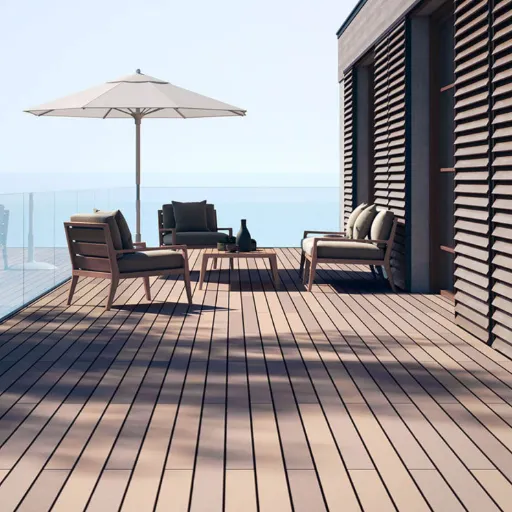
WPC decking stands for wood-plastic composite decking. It is often grouped with composite decking because both combine wood fibers with plastic. For a full comparison with traditional timber, see our guide on composite decking vs wood decking.
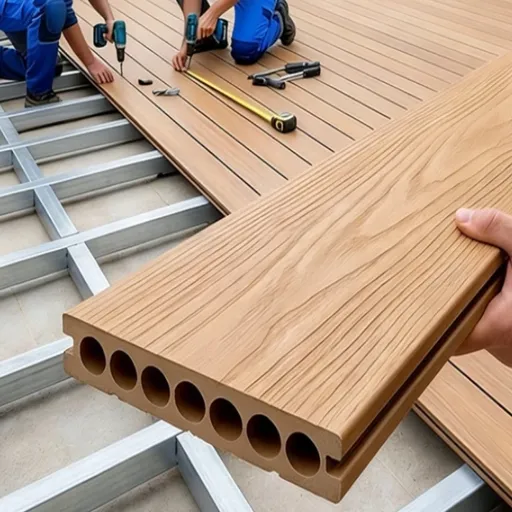
It combines wood fibers or flour with thermoplastic polymers such as HDPE or PP, plus additives for UV resistance, color stability, and fungal protection. The mixture is extruded into boards with solid, hollow, or grooved profiles.
Most WPC boards fall into one of two generations:
- First-generation (uncapped) WPC: The wood-plastic core is exposed. It costs less but absorbs 3–8% water after 24 hours of immersion and is more vulnerable to fading, staining, and mold.
- Second-generation (capped or co-extruded) WPC: A polymer shell surrounds the core. Capped WPC absorbs less than 0.5% water and resists UV, scratches, and stains far better.
The board profile also matters. Hollow boards are lighter and cheaper. Solid boards carry more load and hold fasteners better. For a detailed comparison of load capacity, weight, and applications, see our guide on solid vs hollow WPC decking.
Typical capped WPC lifespan ranges from 25 to 30 years when installed and maintained correctly.
What Is PVC Decking?
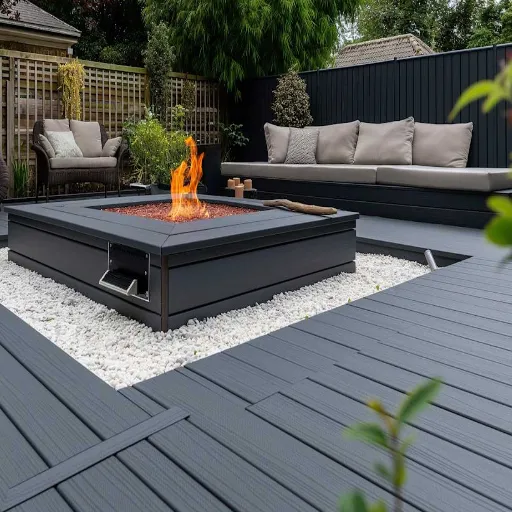
PVC decking is made from 100% synthetic polyvinyl chloride. It contains no wood fibers. Many premium PVC boards also have an ASA (acrylic-styrene-acrylonitrile) cap layer for extra UV and scratch resistance.
Because PVC has no organic content, it is fully waterproof and highly resistant to mold, mildew, rot, and insect damage. It is also lighter than WPC and often easier to handle on site. The surface is non-porous, so spills wipe off easily.
PVC decking usually lasts 30 years or more. Some premium lines carry 50-year structural warranties. The trade-offs are higher upfront cost, a less natural feel underfoot, and greater thermal expansion that must be managed with correct installation.
WPC Decking vs PVC Decking: Head-to-Head Comparison
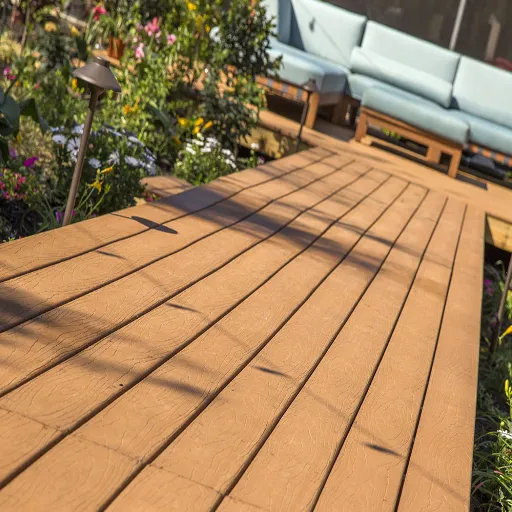
This section covers the differences that matter most when comparing WPC decking vs PVC decking for a real project.
Material Composition and Feel
WPC decking feels closer to natural wood. The wood fibers give it a warmer, slightly textured surface that many homeowners and designers prefer. It is heavier and more rigid than PVC, which helps with structural stability.
PVC decking feels smoother and more uniform. Modern ASA-capped PVC can mimic wood grain, but it still has a more plastic-like appearance and a cooler, harder feel underfoot.
Bottom line: Choose WPC if the natural wood aesthetic matters. Choose PVC if a sleek, modern look is acceptable.
Waterproofing and Moisture Resistance
Water resistance is the biggest functional difference between the two materials.
| Board Type | 24h Water Absorption | Best Use |
|---|---|---|
| Uncapped WPC | 3–8% | Covered areas, dry climates, temporary installs |
| Capped / co-extruded WPC | <0.5% | Pools, docks, patios, wet climates |
| PVC decking | <0.2% | Pools, marinas, food-service areas, maximum moisture resistance |
PVC wins on waterproofing because it has no wood fibers to absorb moisture. Capped WPC is highly water-resistant but still depends on the integrity of the cap layer. Any cut end, fastener hole, or surface damage can expose the core.
For wet-environment projects, capped WPC is the minimum standard. PVC is the safer choice when the deck will be constantly wet or exposed to salt, chlorine, or chemicals.
Durability, Scratch, and Fade Resistance
Both materials outperform timber, but they behave differently under stress.
- Scratch resistance: PVC is generally harder and more scratch-resistant than WPC. This matters in high-traffic commercial spaces or areas with outdoor furniture.
- Fade resistance: Both capped WPC and ASA-capped PVC hold color well. Uncapped WPC fades faster.
- Stain resistance: PVC’s non-porous surface resists wine, oil, grease, and food stains better than WPC.
- Impact resistance: WPC’s wood-fiber core can absorb impacts better than rigid PVC, though this depends on density and formulation.
Heat Retention and Thermal Expansion
This is where many buyers are surprised.
WPC decking usually stays cooler underfoot than PVC, especially in lighter colors. The wood fibers absorb less heat than pure plastic. PVC, particularly dark colors, can become uncomfortably hot in direct summer sun.
Thermal expansion is also different. PVC expands and contracts more than WPC with temperature changes. Installers must follow manufacturer guidelines for expansion gaps, board orientation, and fastening. Dark PVC in hot climates needs the most careful installation.
A contractor in Arizona learned this when he installed dark brown PVC decking on a south-facing terrace. The boards expanded enough to push against the fascia, and the surface temperature reached 65°C in July. He later replaced it with light-colored capped WPC and increased the expansion gaps. Summer comfort improved immediately.
Structural Performance
WPC decking is typically stronger and stiffer than PVC. It handles longer joist spans, heavier loads, and commercial foot traffic better. Solid WPC boards can support 2,000–3,000 N/m² or more, depending on thickness and formulation.
PVC decking is lighter and easier to carry, but some profiles require closer joist spacing to prevent flexing. Always check the manufacturer’s load tables and span ratings before designing the substructure.
Installation and Fastening
Both materials use similar installation methods: hidden clips, face screws, or starter fasteners. The main differences are expansion gap requirements and fastener choice.
- WPC: Follow standard expansion gaps of 3–6mm end-to-end, depending on temperature range and board length. Stainless steel or coated screws work well.
- PVC: Requires larger expansion gaps because it moves more with temperature. Some manufacturers require specific hidden clip systems designed for PVC movement.
For pool, dock, and marina installs, SS316 fasteners are essential for both materials to resist salt and chlorine corrosion. For full installation guidance, see our WPC decking installation guide.
Cost Comparison: WPC Decking vs PVC Decking (2026)
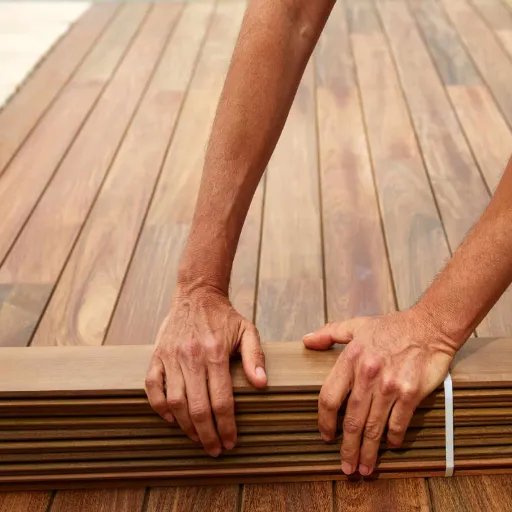
Price is often the first filter buyers apply when comparing WPC decking vs PVC decking.
Factory pricing from China gives buyers a clear cost picture before freight, duties, and local installation are added.
| Product Tier | WPC (USD/m²) | PVC (USD/m²) |
|---|---|---|
| Entry-level | $8–13 | $18–25 |
| Mid-range | $13–22 | $25–35 |
| Premium / Capped | $18–32 | $35–50+ |
PVC decking costs roughly 50–100% more than equivalent WPC at the factory level. The price gap narrows in retail markets, where brand premiums and installation labor make up a larger share of the total cost.
WPC price growth in 2026 has moderated to roughly 3–5% annually, while co-extrusion and deep-embossed WPC segments are rising 6–8% as demand for higher-quality surfaces increases.
Installed Cost and Total Cost of Ownership
In North America and Europe, installed costs are much higher than FOB China prices because they include freight, import duties, VAT, inland delivery, labor, and accessories.
A simple 25-year ownership comparison for WPC decking vs PVC decking might look like this:
- Entry WPC: low upfront cost, moderate cleaning, possible board replacement after 10–15 years in harsh climates.
- Capped WPC: moderate upfront cost, minimal maintenance, 25–30-year lifespan.
- PVC: high upfront cost, very low maintenance, 30–50-year lifespan.
For budget-sensitive projects with good drainage and moderate sun exposure, capped WPC usually delivers the best value. For wet, high-stain, or premium low-maintenance projects, PVC can be cheaper over the full lifecycle.
For a deeper cost breakdown, see our WPC decking cost guide.
Environmental Impact and Sustainability
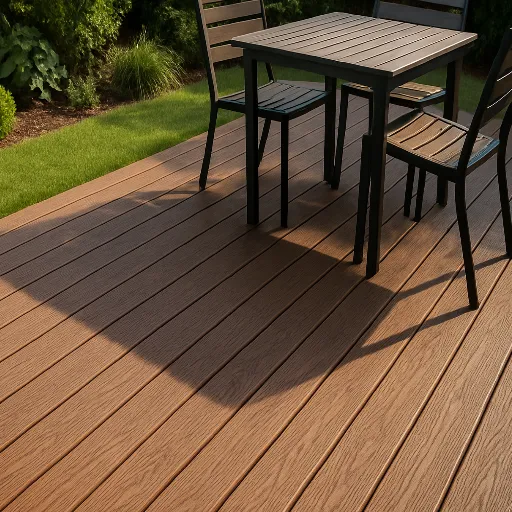
WPC decking is usually marketed as the greener option. It uses recycled wood fibers and recycled plastics, and some suppliers offer FSC-certified wood content. The material reduces landfill waste and can reduce demand for tropical hardwood.
PVC decking is petroleum-based. Manufacturing PVC releases more carbon than WPC, and end-of-life recycling infrastructure for PVC decking is less developed. Some manufacturers now offer recycled PVC content, but it is not yet standard.
If sustainability is a project requirement, ask for:
- FSC certification for wood fibers in WPC
- Recycled-content percentages for both materials
- ISO 14001 environmental management certification for the factory
- REACH or RoHS compliance for chemical safety
Best Applications: When to Choose WPC vs PVC Decking
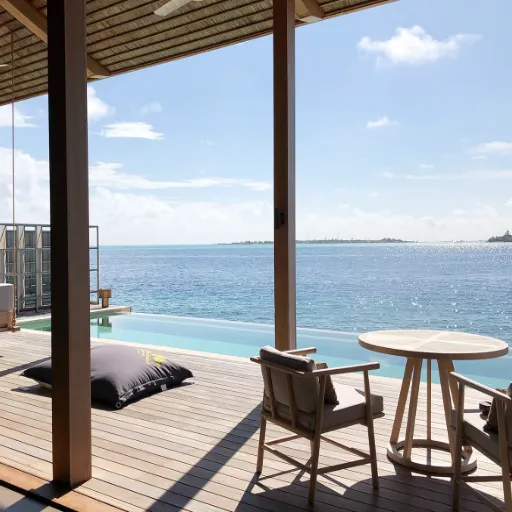
The right choice between WPC decking vs PVC decking depends on climate, traffic, moisture exposure, and design goals.
- You want a natural wood look and a warmer feel underfoot.
- The project needs strong structural performance or longer joist spans.
- Budget is a primary concern.
- The climate is moderate, or you select capped boards for wet areas.
- You value recycled-content and FSC-certified options.
Choose PVC Decking When:
- The deck will be constantly wet (pool surround, marina, dock, hot tub).
- Stain, mold, and chemical resistance are critical (outdoor kitchens, restaurants, hospitals).
- You want the lowest long-term maintenance.
- You prefer a modern, uniform appearance.
- You can manage thermal expansion and heat retention with color and installation details.
A landscape architect in Dubai chose PVC for a beachfront hotel pool deck because the salt air, chlorine, and daily washing required maximum moisture and chemical resistance. For the same client’s rooftop bar with a shaded seating and wood-grain design brief, she specified capped WPC to balance cost and aesthetics.
How to Verify Quality When Sourcing from China
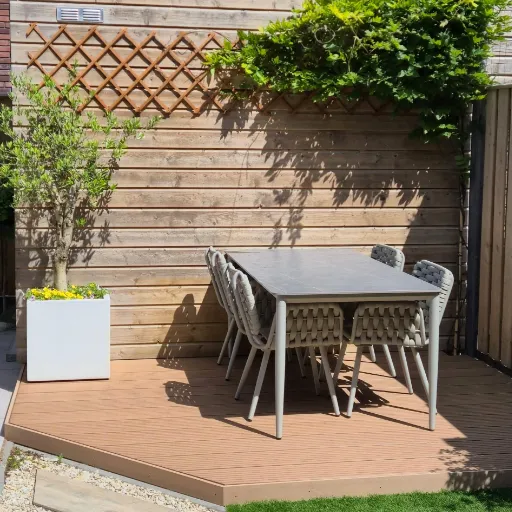
Whether you choose WPC or PVC, the supplier matters more than the material name on the label. Here is what to request before placing an order.
Certifications and Standards
| Certification / Standard | What It Covers | Why It Matters |
|---|---|---|
| CE Marking / EN 15534 | European WPC standard | Required for EU markets |
| ASTM D7032 | Structural performance | Required for US and Canadian building code compliance |
| ASTM D7031 | Physical and mechanical properties | Broader strength and durability framework |
| EN 13501-1 | Fire classification | Important for commercial and multi-story projects |
| ISO 9001 | Quality management | Indicates consistent production processes |
| FSC Certification | Responsible wood sourcing | Sustainability credential |
| SGS / Intertek / TÜV Reports | Independent third-party testing | Verification beyond manufacturer claims |
Test Reports to Request
- Water absorption (24h immersion)
- UV aging/color change
- Slip resistance (DIN 51130 or EN 16165)
- Fire rating
- Load / flexural strength
- Thermal expansion coefficient (especially for PVC)
Supplier Verification
- Confirm business license and export license.
- Ask for a factory video, a virtual tour, or a third-party audit report.
- Request export references in your target market.
- Clarify MOQ, lead time, payment terms, and warranty conditions.
- Order samples and run your own simple tests: water soak, scratch, and heat exposure.
For a full sourcing checklist, see our guide to WPC decking suppliers in China.
Common Mistakes Buyers Make
Even experienced buyers make these errors when comparing WPC decking vs PVC decking:
- Assuming all WPC is waterproof. Only capped or co-extruded WPC belongs in wet environments.
- Ignoring thermal expansion with PVC. Dark PVC in hot climates needs larger gaps and careful fastening.
- Choosing dark colors without heat testing. Dark PVC can reach temperatures that are uncomfortable or even unsafe for barefoot traffic.
- Buying on FOB price alone. Freight, duties, installation, maintenance, and replacement affect total cost far more than the factory price.
- Not verifying test reports. A certificate image is not proof. Check certificate numbers with the issuing body.
- Skipping samples. A small water-soak test on a sample can reveal more than a glossy catalog.
For more pitfalls, read our article on WPC decking disadvantages.
FAQ
Is WPC decking better than PVC decking?
Neither is universally better. WPC decking is better for natural aesthetics, structural rigidity, and budget. PVC decking is better for waterproofing, stain resistance, and minimal maintenance. The right choice depends on the project climate, traffic, and budget.
Is PVC decking more expensive than WPC?
Yes, usually. PVC decking costs roughly $18–50+/m² FOB China, while WPC ranges from $8–32/m². The gap narrows after installation, but PVC still commands a premium.
Which decking is best around swimming pools?
PVC decking is the safest choice for constant wet conditions. Capped or co-extruded WPC is also suitable if it has verified low water absorption and the right slip-resistance rating.
Does PVC decking get hotter than WPC?
Generally, yes, especially in dark colors. PVC retains more heat than WPC because it contains no wood fibers. Light colors and shaded locations reduce the difference.
Is WPC more eco-friendly than PVC?
Usually yes. WPC uses recycled wood fibers and plastics and can be FSC-certified. PVC is petroleum-based and harder to recycle at the end of its life. Ask suppliers for specific certifications and recycled-content percentages.
How long does each material last?
Quality-capped WPC lasts 25–30 years. PVC decking lasts 30+ years, with some premium products rated for 50 years.
Can PVC decking be recycled?
PVC can be recycled, but infrastructure for post-consumer PVC decking is limited. Some manufacturers offer take-back programs or use recycled PVC content in new boards.
What certifications should I request from a Chinese supplier?
Request CE/EN 15534 or ASTM D7032, ISO 9001, and third-party test reports from SGS, Intertek, or TÜV. For sustainability, add FSC and ISO 14001.
Conclusion
The WPC decking vs PVC decking decision comes down to matching the material to the project. WPC gives you a natural wood feel, a stronger structure, and a lower upfront cost. PVC gives you maximum waterproofing, stain resistance, and the longest lifespan.
For most residential and commercial decks in moderate climates, capped WPC is the practical choice. For pool decks, marinas, outdoor kitchens, and premium low-maintenance projects, PVC is worth the extra investment.
Whichever material you choose, verify cap-layer quality, request third-party test reports, and confirm that your supplier can deliver consistent boards on schedule. The cheapest quote rarely survives the first rainy season.
Ready to compare WPC and PVC decking samples for your project? Contact our team to request samples, review test reports, or get a competitive FOB China quote based on your target quantity.
Categories:
Blog
Related Articles