Ceiling vs Wall Acoustic Panels: Where to Treat First
The short answer is: treat walls first in small listening rooms, and treat the ceiling first in large open spaces. In most cases, the best result comes from a combination of both. Wall panels control side-to-side reflections and flutter echo. Ceiling panels, clouds, and baffles control the vertical reflections that create ambient noise in open offices, restaurants, and auditoriums.
If you’re standing in a room right now wondering where to mount that first panel, the decision should be based on your ceiling height, room shape, noise source, and budget. It should not be based on which product looks best in the catalog. In this guide, we’ll break down the physics, compare performance, and show you how to choose between wall and ceiling treatment for every common space. For the complete strategy, see our full acoustic panel placement guide.
Key Takeaways
- Wall panels work best for lateral reflections, flutter echo, and critical listening rooms.
- Ceiling baffles and clouds excel in open spaces with high ceilings because they absorb sound from both sides.
- A hybrid approach typically outperforms either surface alone.
- Coverage targets: 20–30% of wall area, or 30–50% of ceiling area, depending on the room.
- WPC slat panels mounted with an air gap can raise effective NRC from ~0.55 to 0.85+ while adding a design feature.
Why the Surface Matters More Than the Product
Sound reflects off every hard surface in a room. It bounces from wall to wall, floor to ceiling, and corner to corner until the energy dissipates. The problem isn’t the panel itself. It’s the reflection path you’re trying to interrupt.
Wall panels sit at ear level and catch the sound that travels horizontally. That’s why they’re the first choice for home studios, home theaters, and conference rooms. When you clap in a narrow room and hear a fluttering echo, that’s a wall-to-wall reflection. A panel on one of those walls breaks the ping-pong effect.
Ceiling panels hang above the noise. In an open office with a hard plaster ceiling, sound from dozens of conversations hits the ceiling and reflects down, mixing into a constant hum. A ceiling baffle or cloud absorbs that vertical energy before it can return to the workspace.
Because baffles are suspended, sound reaches both the front and back faces. That often gives them a higher effective Noise Reduction Coefficient (NRC) than a flat wall panel.
Many buyers make the mistake of choosing based on aesthetics alone. They install a beautiful wall feature in a high-ceiling atrium and wonder why the room still sounds like a gym. The product was fine. The surface was wrong.
How Wall Acoustic Panels Work
Wall panels are the most common starting point because they’re easy to install, easy to understand, and directly address the reflections we notice first.
First Reflection Points
The highest-priority wall locations are the first reflection points. These are the spots where sound from a speaker or talker bounces once before reaching the listener.
In a home studio, these sit on the side walls roughly midway between the speakers and the listening position. You can find them with the mirror trick. Sit in the listening chair and have someone slide a mirror along the wall until you see the speaker reflected. That’s where a panel belongs.
For more details on this technique, see our guide on first reflection points for acoustic panels.
Flutter Echo Control
Flutter echo happens when sound bounces rapidly between two parallel hard surfaces. Narrow rooms, hallways, and conference rooms with glass walls are common culprits. Wall panels on one or both parallel surfaces scatter and absorb those reflections, which makes speech easier to understand and reduces listener fatigue.
Typical NRC and Placement
Fabric-wrapped fiberglass wall panels typically range from NRC 0.70 to 0.95, depending on thickness and density. A 2-inch panel against the wall performs well for speech frequencies. Move it an inch or two off the wall with spacers, and low-frequency absorption improves without changing the visible product.
WPC slat panels work differently. The visible slats are mostly decorative and reflective, but the acoustic felt backing behind them does the absorption. With a proper air gap, they become a genuine acoustic treatment. We’ll cover that in detail later.
How Ceiling Acoustic Panels Work
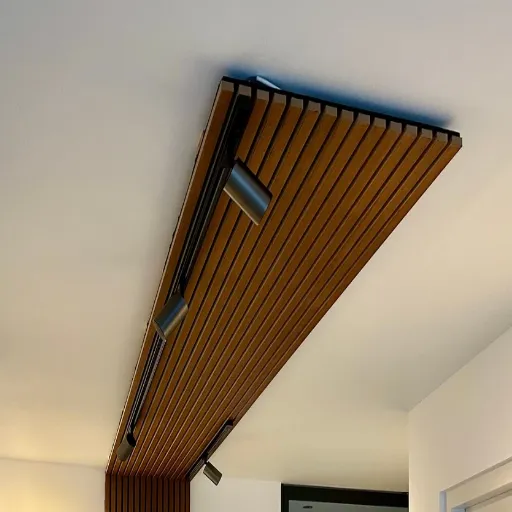
Ceiling treatment comes in three main forms: panels mounted flat against the ceiling, clouds suspended horizontally below the ceiling, and baffles hung vertically in rows. Each has its own strengths.
Ceiling Panels and Clouds
Flat ceiling panels or suspended clouds are effective when the ceiling is the largest untreated reflective surface. In open offices, restaurants, and classrooms, the ceiling often reflects the majority of ambient sound.
Treating 30–50% of the ceiling area with panels rated NRC 0.85 or higher can reduce reverberation time by 40–60%. That translates to a quieter, calmer space.
Clouds have an added advantage: because they’re suspended, sound can reach the top surface too. That effectively doubles the absorption area compared to a flat wall panel of the same dimensions.
Ceiling Baffles
Baffles are vertical panels hung in rows. They absorb from both sides. They’re ideal for rooms with high ceilings where wall space is limited or expensive to treat. Gyms, atriums, and large lobbies often use baffles because they cover a lot of area without requiring wall access.
Typical NRC ratings for ceiling baffles range from 0.80 to 1.10+ in lab testing. Real-world performance depends on coverage density, mounting height, and room geometry. The starting point is strong.
When the Ceiling Is the Right First Choice
If your space has a ceiling higher than 12 feet, limited wall area, or lots of hard vertical surfaces like glass and concrete, start with the ceiling. Wall panels in those conditions are still useful. They won’t control the vertical reflection path that dominates the room’s sound.
Ceiling vs Wall Panels: Side-by-Side Comparison
| Factor | Wall Panels | Ceiling Panels / Clouds / Baffles |
|---|---|---|
| Best reflection path | Horizontal/lateral | Vertical / floor-to-ceiling |
| Typical NRC range | 0.60–0.95 | 0.75–1.10+ (baffles often highest) |
| Best room size | Small to medium | Medium to large/open plan |
| Installation | Surface mount, simpler | Suspension or grid, more complex |
| Cost per unit | Usually lower | Usually higher |
| Design role | Feature wall, visual anchor | Architectural ceiling element |
| Coverage target | 20–30% of wall area | 30–50% of the ceiling area |
This table is a useful starting point, but the real answer is usually a mix. The next section explains how to decide for your specific room.
Room-by-Room Guide: Wall or Ceiling First?
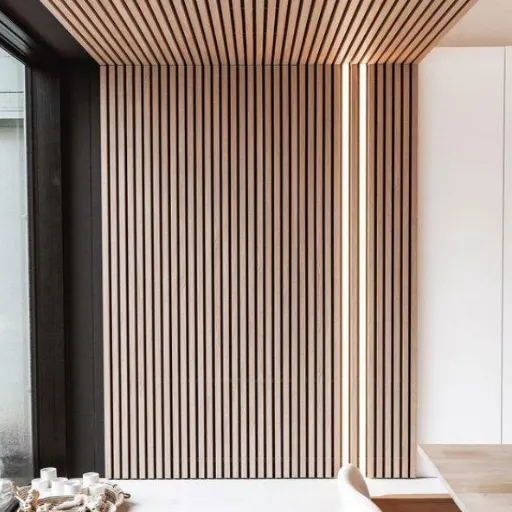
Home Recording Studio
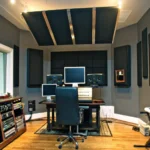
Treat the walls first. Start with panels at the first reflection points on the side walls, then add absorption to the rear wall to reduce slap-back. Add a ceiling cloud above the listening position only after the walls are handled. Finally, place bass traps in the corners for low-frequency control.
Home Theater
The goal is immersive sound without harsh reflections. Side-wall first reflection panels are essential. The ceiling above the seating area should be treated next, especially if it’s a hard drywall surface.
The rear wall can be left slightly reflective in some cases. Treat it if the echo is noticeable.
Open-Plan Office
Start with the ceiling. Open offices generate ambient noise from many simultaneous conversations. That sound reflects off the ceiling back into the workspace.
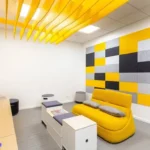
Ceiling baffles or clouds covering 40–50% of the ceiling area are usually the most effective first step. Add wall panels near collaboration zones, phone booths, and circulation paths for targeted speech clarity.
Our office acoustic panel placement guide explains spacing and layout in more detail.
Conference Room
Aim for a balance. Treat two adjacent walls and the ceiling above the table. Conference rooms are smaller than open offices, so wall reflections are significant. The table surface and ceiling create a strong vertical reflection path, too.
A combination of wall panels and a small ceiling cloud usually solves the problem.
Restaurant / Café
High ceilings and hard surfaces make restaurants noisy. Ceiling baffles or clouds are usually the priority. They cover a large area without taking up wall space needed for windows, art, or seating.
Accent wall panels can be added for design and additional absorption, especially near the kitchen or bar.
Classroom
Start with the ceiling. Then add wall panels at the front and side walls near the teacher’s speaking area. Classrooms need clear speech intelligibility across the whole room. A treated ceiling reduces the overall reverberation that makes teachers strain their voices.
Hallways and Narrow Rooms
Treat the walls. Flutter echo between parallel walls is the main problem, and ceiling treatment won’t fix it. Even a few strategically placed wall panels can make a long corridor feel much less hollow.
WPC Slat Panels: A Wall-First Solution That Performs and Looks Good
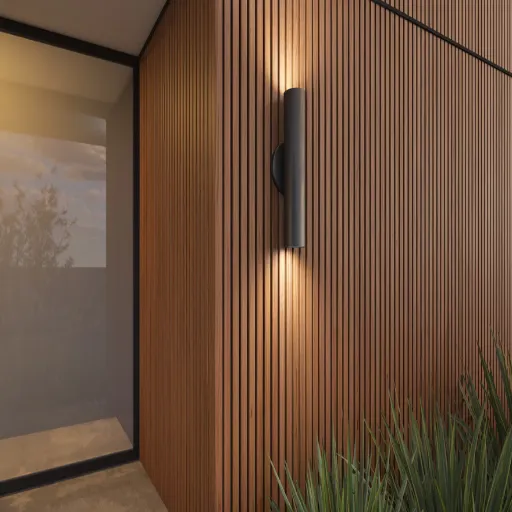
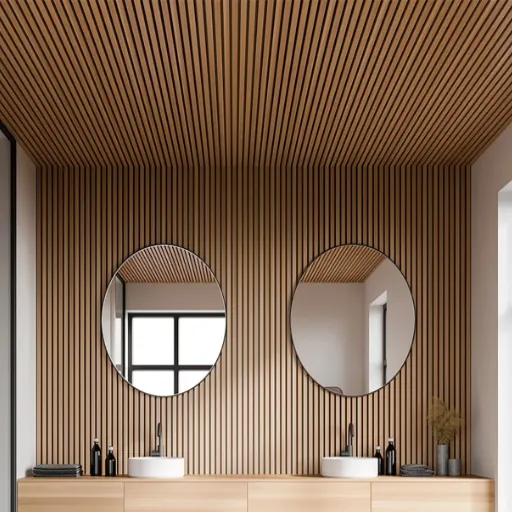
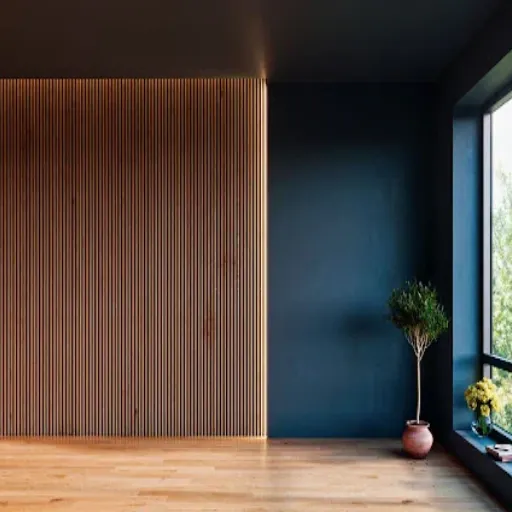
WPC slat panels are becoming popular because they combine acoustic function with interior design. The visible wood-plastic composite slats give a clean, modern look. The felt backing absorbs sound.
They work best when mounted with an air gap behind them. Direct mounting typically gives an NRC around 0.55. With a 25–50mm air gap, which can rise to 0.70–0.85. Add acoustic insulation in the cavity, and some configurations reach 0.95 or higher.
This makes them a strong candidate for feature walls in offices, restaurants, home theaters, and studios. They don’t replace thick fabric panels in a critical mixing room. For most commercial and residential projects, however, they offer an excellent balance of performance and aesthetics.
Best Wall Locations for WPC Slat Panels
WPC slat panels work best in visible, high-traffic wall locations where they can serve as both design feature and acoustic treatment. Common placements include:
- Behind a reception desk or branding wall
- On the rear wall of a conference room
- As an accent wall in a home theater
- Along circulation paths in an open office
- Behind seating in a restaurant or lounge
For installation details, including how to maintain the air gap, see our installation best practices.
Common Mistakes When Choosing Ceiling vs Wall Panels
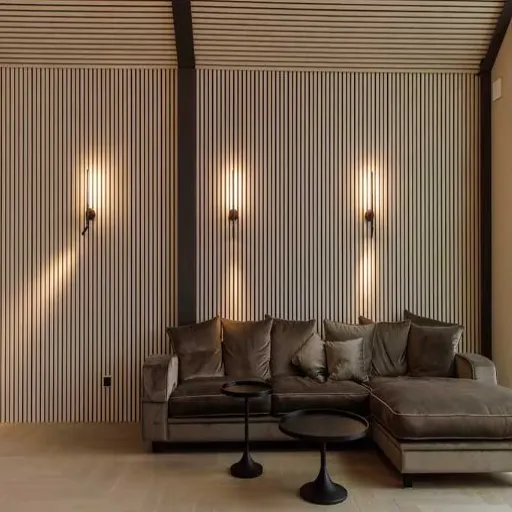
Treating Only Walls in a High-Ceiling Space
An open office with 14-foot ceilings and hard concrete will not be fixed by wall panels alone. The vertical reflection path dominates. Ceiling treatment is essential.
Treating Only the Ceiling in a Small Listening Room
A home studio with untreated side walls will still have flutter echo and poor stereo imaging. Wall treatment at reflection points is non-negotiable for accurate sound.
Using Thin Foam Tiles
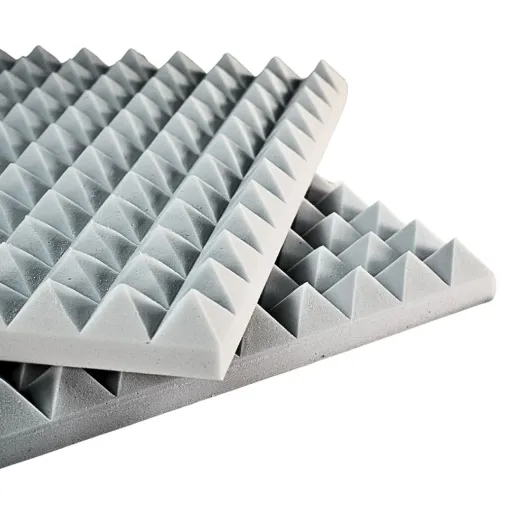
Thin foam panels are popular because they’re cheap, but they absorb mostly high frequencies. They won’t control midrange reflections or bass buildup. For real results, use panels with real mass and absorption material.
Ignoring Coverage Targets
A few scattered panels may look nice, but they won’t change the room’s acoustics meaningfully. Aim for the coverage percentages in the comparison table above. For spacing guidance, our article on how far apart should acoustic panels be spaced explains how to distribute them.
Forgetting About Corners
Low frequencies collect in corners. No amount of wall or ceiling paneling will fully address the room’s boom if the corners are left empty. Add bass traps in vertical and tri-corner junctions. Our bass trap placement guide covers this in depth.
How Much Coverage Do You Need?

The right amount of coverage depends on the room’s existing surfaces and your goals. If you’re unsure how many panels your office needs, our guide on how many acoustic panels do I need for an office walks through the calculation. Here are practical starting points for any space:
- Wall panels only: 20–30% of total wall surface area
- Ceiling panels/clouds only: 30–40% of ceiling area
- Ceiling baffles in open offices: 40–50% of ceiling area
- Hybrid wall + ceiling: 60% ceiling / 40% wall coverage ratio as a starting rule for open spaces
- Critical listening rooms: 25–35% of total surface area, including walls, ceiling, and corners
These are guidelines, not rigid rules. A room with lots of soft furniture and carpet needs less treatment than a room with glass, concrete, and hardwood.
Cost and Installation Considerations
Wall panels are generally less expensive per unit and easier to install. Surface-mounted panels can be screwed or adhered directly to the wall.
Suspended ceiling clouds and baffles require hardware, rigging, and often a professional installer. However, in large spaces, ceiling baffles can be more cost-effective overall because they cover more area with fewer total panels. A single baffle absorbs from both sides, so you need less material to achieve the same acoustic result.
When budgeting, include installation labor, mounting hardware, and any structural assessment for ceiling loads. A wall panel that looks cheap on paper can become expensive if it requires custom framing or finishes.
Conclusion
Ceiling vs wall acoustic panels is not a contest with one winner. Wall panels win for lateral reflections, small rooms, and critical listening. Ceiling panels, clouds, and baffles work well for vertical reflections, high ceilings, and open spaces. Most well-treated rooms use both.
Start by identifying your room’s biggest reflection path. Is the noise coming from side-to-side echo, or from sound bouncing off a hard ceiling? Match your treatment to that path, hit reasonable coverage targets, and don’t forget the corners.
If you’re planning a project with WPC slat panels, ceiling baffles, or a full acoustic layout, contact our team for guidance. For the complete picture on placement strategy, return to our full acoustic panel placement guide.
Categories:
Blog
Related Articles