WPC Wall Panels for Living Room: Design Ideas & Guide 2026
Yes, WPC wall panels are a strong choice for a living room. They resist moisture and termites, wipe clean without repainting, hold a wood grain finish convincingly, and last 15 to 25 years indoors. They do not soundproof a room, and they cost more upfront than paint. The right panel depends on your wall, your light, and your ceiling height.
That is the short answer. The longer answer is where most guides stop short.
Walk into any showroom and the panels look flawless. Walk into a finished living room six months later and the same panels can look wrong: a colour that pulls too red against the sofa, a deep-slat wall that swallowed a small room, an LED strip glowing from the wrong place because nobody planned the wiring before the wall closed. The material was fine. The planning was not.
This guide covers WPC wall panels for living rooms from both ends. Design ideas first, because that is what you came for. Then the parts that decide whether the design actually works: profile depth, colour consistency, real costs per square metre, installation over your existing wall, cable routing, and an honest answer on acoustics.
Key Takeaways
- WPC wall panels suit living rooms because they combine wood aesthetics with moisture resistance, wipe-clean maintenance, and a 15 to 25 year indoor lifespan. They are not a soundproofing product.
- Fluted and slat panels change how tall and how wide a room feels. Groove depth and orientation matter more than the colour you choose.
- Budget per m² sits well above paint and wallpaper but below solid wood. Add 12 to 18 percent for trims, plus 10 to 15 percent for cutting waste.
- Colour mismatch between batches is the single most common buyer complaint. Specify a ΔE tolerance of 1.5 or lower and order your full quantity in one production batch.
- Decorative fluted panels carry little to no acoustic rating. If you need genuine sound control, specify a felt-backed slat system, not a decorative profile.
Why WPC Wall Panels Are Transforming Living Room Interiors in 2026
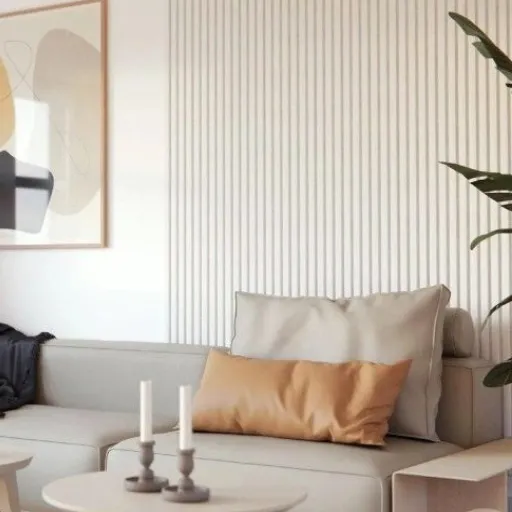
Ten years ago, a feature wall meant paint, wallpaper, or real timber. All three still work. All three have limits: paint looks flat, wallpaper peels in humid rooms, and solid wood needs recoating every few years and costs several times more than a composite panel.
WPC, short for wood-plastic composite, sits between those options. It blends wood fibre with a thermoplastic polymer, usually HDPE or polypropylene, plus additives for colour and UV stability. The result looks like timber, behaves like a polymer, and installs like a panel system rather than a joinery project.
The market response has been sharp. The global WPC market was valued at USD 8.91 billion in 2025 and is projected to reach USD 9.67 billion in 2026, growing at roughly 8.49 percent annually toward USD 14.54 billion by 2031, according to Mordor Intelligence. Asia-Pacific held about 54.6 percent of that market in 2025. Interior wall panels and ceiling systems are the fastest-moving segment, with demand growing around 11.8 percent year on year.
Two product shifts matter for anyone buying in 2026. Co-extruded panels, where a protective polymer skin is extruded over the core, now account for the majority of new WPC wall panel production. Fire-rated B1 specification has also moved from a premium option to a routine requirement on institutional and commercial interiors.
Both shifts favour buyers. Better finishes. Better fire performance. Longer service life.
Where WPC fits in a living room: feature walls, TV walls, floor-to-ceiling fluted walls, wainscoting, partitions, and ceiling accents. Where it does not: continuously wet zones and direct steam. Wood fibre in the core means a shower enclosure is the wrong application. A powder room, a kitchen backsplash splash zone, or a humid ground-floor flat are all fine.
If you are new to the material, start with our complete buyer’s guide to WPC wall panels before you get into design detail.
Are WPC Wall Panels a Good Choice for a Living Room?
WPC wall panels are a good choice for a living room if you want wood aesthetics with low maintenance. They resist moisture and termites, wipe clean with a damp cloth, need no painting or sanding, and typically last 15 to 25 years indoors. The main trade-offs are a higher upfront cost than paint or wallpaper, a heavier panel than PVC, and no meaningful soundproofing.
If that paragraph answered your question, the rest of this section is the detail behind it.
What WPC genuinely delivers in a living room:
- Durability. Higher density than PVC gives better impact and scratch resistance. A living room wall takes furniture bumps, vacuum cleaners, and the occasional thrown toy.
- Moisture and termite resistance. Water absorption of 0.5 to 1 percent after 24 hours of immersion is typical for a good panel. MDF, by contrast, can swell around 30 percent after two hours of moisture exposure. In a humid climate or a ground-floor flat this is the deciding factor.
- Wipe-clean maintenance. No repainting cycle. No sanding. No annual sealing.
- Colour and finish consistency at the factory. A co-extruded finish holds its tone far better than a printed film.
- Fire-rated options. B1 rated panels are widely available and increasingly standard, not premium.
What WPC does not do:
- It does not soundproof. Panels reduce echo inside a room. They do not stop sound travelling between rooms. More on this further down.
- It is not cheaper than paint. Upfront cost is higher. The break-even comes from lifespan and maintenance, not from day-one price.
- It is heavier than PVC. Battens and fixings need to carry more load, particularly on ceilings.
- It contains polymer. WPC is a composite, not a bio-based board. Recycled content varies by producer and should be verified, not assumed.
- Accessory quality varies enormously. Cheap trims and adhesives undo a good panel. Ask what the supplier actually ships with the order.
Our honest pros and cons breakdown for living rooms goes deeper on the decision, including the cases where paint, MDF, or timber is genuinely the better answer.
WPC Wall Panels for Living Room: 8 Design Ideas

Panel style and placement do most of the visual work. Here are the applications that hold up in practice, each with the installation implication that decides whether it looks right.
Feature and Accent Walls
The most common application, and the easiest to get wrong by over-filling it. A single wall behind the sofa or opposite the window gives the room a focal point without closing it in. Panelling every wall in the same profile flattens the effect and makes a room feel smaller. If you want panels on more than one wall, change the profile or the tone between them.
Installation implication: one wall is a straightforward batten grid. Two or more walls means planning the corner detail before you order. Corners are where cheap trims show.
TV and Media Walls
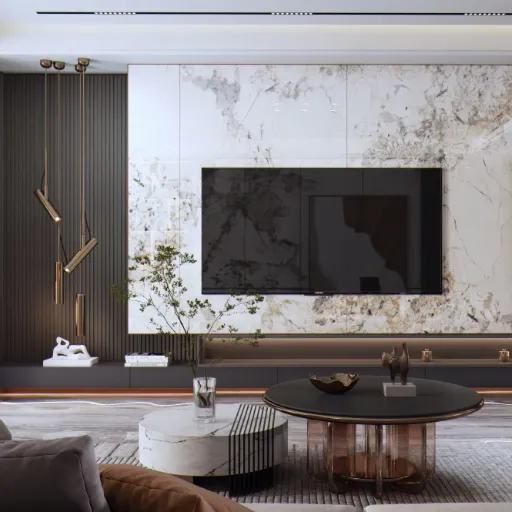
The highest-demand application in the category. Two approaches dominate: full floor-to-ceiling panelling for maximum impact, or framing just the television area, which suits smaller rooms better. Fluted panels behind a TV with a floating console and hidden cable channels look deliberate. Panels with cables running down the front do not.
Installation implication: all sockets, HDMI routes, and power for the TV and any LED strips must be planned and pulled before the panels go up. This is the single most common cause of a failed media wall.
Our WPC TV and media wall guide covers layouts, console detailing, and LED placement in full.
Floor-to-Ceiling Fluted Walls
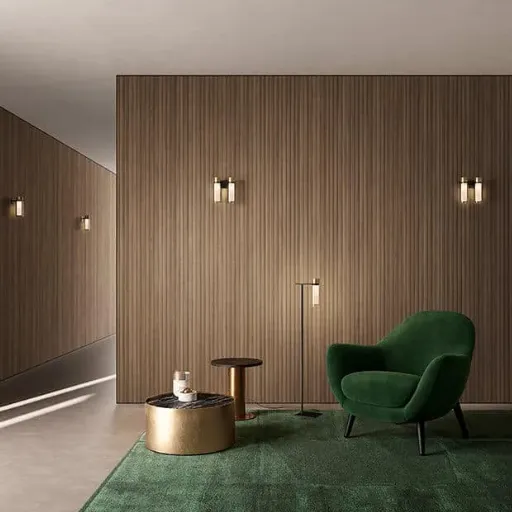
Vertical fluting stretched floor to ceiling is the defining look of the current design cycle. It reads as height. It hides an imperfect wall. It also needs more panels than you expect, because the vertical lines make any misalignment obvious.
Installation implication: floor-to-ceiling panels need a level starting point. If the ceiling line is out, the top gap will show it. Plan a trim detail at the ceiling rather than trying to cut a perfect line by eye.
Two-Tone and Colour-Blocking Walls
Panels on the lower two-thirds in walnut with a lighter tone above, or a vertical split where a media wall meets a seating area. Colour blocking is how you get a designer look without a designer budget.
Installation implication: two tones usually mean two batches. Order both from the same production run or accept a visible shade difference. This is exactly where colour consistency bites.
3D and Sculptural Profiles
Raised geometric patterns and wave profiles catch light and create movement across the wall through the day. They suit a statement living room and larger rooms particularly well.
Installation implication: deep profiles need depth clearance behind furniture and around light switches. Check the profile depth against your switch plates before ordering.
Our 3D slat and fluted WPC panel options show how the different profile depths compare in a real room.
Wainscoting and Half-Height Panelling
A panelled lower wall with a slim transition trim and painted wall above. Warm, traditional, and far cheaper than full-height panelling because you use roughly half the material.
Installation implication: the transition trim is the detail that makes or breaks this look. Specify it with the panels, not after.
Slat Partitions and Open-Plan Zoning
Freestanding slat screens that separate a living area from a dining or work zone without blocking light. This is one of the few applications where WPC clearly outperforms fabric or paper screens, because it holds a straight line and does not sag.
Installation implication: floor and ceiling fixings are needed for stability. A slat screen that flexes reads as cheap.
Curved and Column Wraps
Rigid panels will not follow a tight radius. If you want a curve, specify a bendable profile or segment the curve into short straight runs with a mitred joint.
Installation implication: ask the supplier for the minimum bend radius before you order. Guessing here means wasted material.
If you want the full visual library rather than the shortlist, our collection of 25+ WPC feature wall and accent wall ideas includes annotated layouts, and the wall panel ideas for small living rooms piece covers compact-room constraints.
For a coordinated scheme, the same profile family works on the WPC ceiling panels above.
Choosing the Right WPC Panel Profile
Profile selection matters more than most buyers expect. It changes the perceived proportions of the room before colour, furniture, or lighting enters the conversation.
Flat, Fluted, Slat, 3D and Curved
- Flat panels are the quietest option. Best for a restrained room or as a backing surface to a feature element.
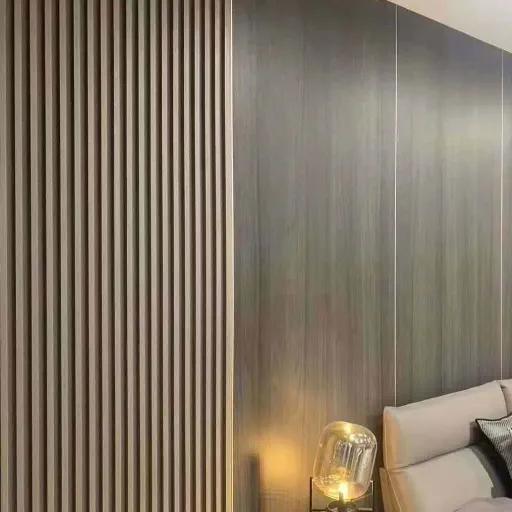
- Fluted panels have one continuous face with shallow grooves, typically 2 to 8 mm deep. Vertical fluting adds perceived height. Horizontal fluting widens a narrow room.
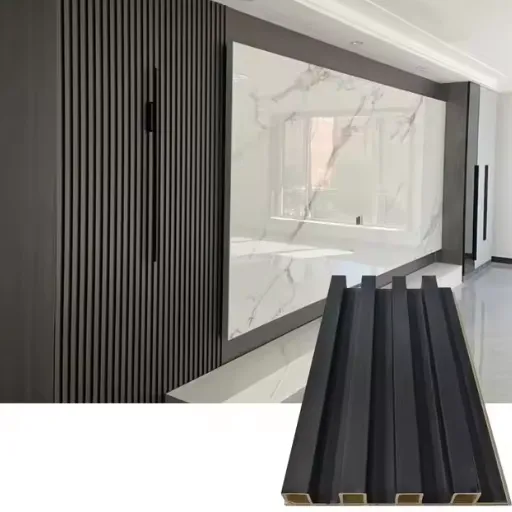
- Slat panels use separate raised strips with gaps between them. The shadow lines are stronger and the surface reads as more architectural.
- 3D and sculptural profiles create the strongest shadow play and suit larger rooms.
- Curved profiles are a specialist specification. Confirm the bend radius.
Groove Depth, Shadow and Perceived Ceiling Height
A deeper groove casts a stronger shadow, which reads as more texture and more height. A shallow groove reads as a subtle line. In a low-ceilinged room, vertical fluting with a moderate groove (4 to 6 mm) adds height without overwhelming the space. Very deep grooves in a small room add visual weight where you want light.
Matching Profile Depth to Room Size and Light
Small rooms and north-facing rooms benefit from lighter tones and shallower profiles. Larger, well-lit rooms can carry deep slats and darker tones. If your room is under about 15 square metres, keep the profile shallow and the tone light, and use dark grooved panels only as a framing device at the edges.
Continuous-Face Versus Separate-Slat Construction
This is the check buyers miss. Fluted panels have one continuous face with grooves cut or extruded into it. Slat panels have genuinely separate strips with real gaps.
Both are valid, but they perform differently. Separate slats with a felt backing can be an acoustic product. A continuous fluted face is decorative. If a supplier describes a fluted panel as acoustic, ask for the test report.
If fluted or slat is your shortlist, the WPC fluted wall panel profile guide covers groove depth, construction differences, and how to verify you are not buying a printed imitation. For specific series options, see our WPC slat wall panel range.
Colours, Wood Grains and Finishes for Living Rooms
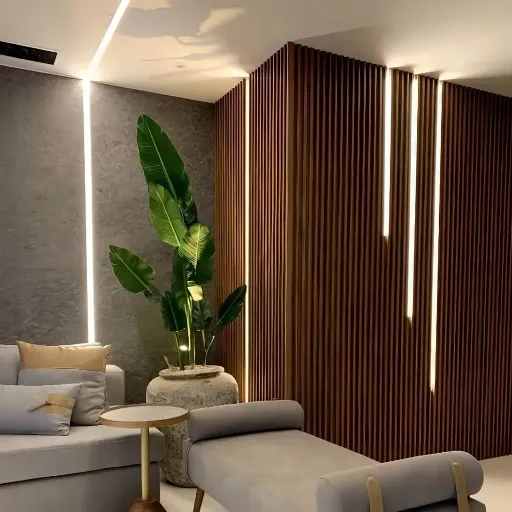
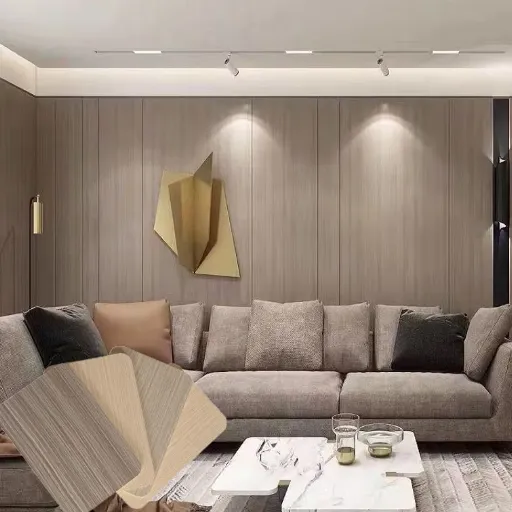
Start from the mood you want, not from a swatch fan. Mood determines the family; the swatch determines the tone within it.
Mood-Based Colour Schemes
- Calm and restful: soft blue-grey or off-white panels with warm white lighting around 2700K. Light oak works if you want a touch of wood grain without warmth dominating.
- Warm and intimate: walnut or a deep cream with brass or bronze accents. Best in rooms where you spend evenings.
- Bold and dramatic: charcoal or near-black. Use it in rooms above roughly 15 square metres. Below that it closes the space in.
- Energetic and social: a light oak or pale ash base, with colour introduced through textiles, art, and lighting rather than the panel itself.
- Refined and quiet: taupe and greige. The safest choice if you expect to change furniture in a few years.
Co-Extruded Versus Printed Finishes
A printed film sits on the surface and is the first thing to fade, scuff, or peel. A co-extruded finish is a polymer skin extruded as part of the panel, so the colour and texture run through the outer layer. If you are specifying for a room that gets direct sun, co-extruded is worth the price difference. Ask which process your supplier uses, in writing.
Colour Consistency: ΔE Tolerance and Why Mismatches Happen
This is the complaint that shows up most often in verified buyer reviews: a walnut panel arriving noticeably redder or more orange than the sample.
The cause is production batch variation. Wood grain effect depends on pigment dispersion, and no two batches are identical. Colour difference is measured as ΔE. A tolerance of 1.5 or lower is effectively invisible to the eye in normal room lighting.
Two practical mitigations, both worth insisting on:
- Request physical samples before committing. Screens misrepresent wood tones, and so do printed catalogues.
- Order the full quantity in a single production batch. This is the strongest argument for buying factory-direct rather than topping up from a distributor later.
Our WPC wall panel colour and finish guide covers fade performance, grain direction, and how to match panels to existing joinery.
Planning a feature wall and want to see the finish in your actual light? Request physical samples from current production and we will send swatches from the batches we are running now.
What Do WPC Wall Panels for Living Room Cost?
Cost per m² depends on grade, thickness, finish process, and quantity. Factory-direct pricing sits well below retail, which is why the numbers below are lower than what a home improvement store will quote you.
Cost Per m² by Material
| Material | Typical range (material only, per m²) | Indoor lifespan | Moisture behaviour |
|---|---|---|---|
| PVC panel (budget) | USD 3 to 5 | 8 to 15 years | Very good, but lower density |
| WPC hollow-core (budget) | USD 5 to 9 | 10 to 18 years | Water absorption 0.5 to 1% |
| WPC mid-range | USD 9 to 18 | 15 to 25 years | Water absorption under 1% |
| WPC co-extruded / premium | USD 18 to 35+ | 20 to 25+ years | Best finish durability |
| Acoustic slat panel (felt-backed) | USD 17 to 30 | 15 to 25 years | Good, check backing |
| MDF panelling | USD 6 to 20 | 8 to 12 years | Poor, swells with moisture |
| Solid wood panelling | USD 40 to 200+ | 20 to 35 years | Moderate, needs sealing |
Ranges reflect ex-works pricing across supplier markets and will move with specification, quantity, and shipping terms. Retail and installed prices in North America and Western Europe run roughly two to three times these figures.
The Costs Nobody Quotes You
Panel price is rarely the final number. A working budget for a feature wall needs:
- Battens or framing. Allow for a full batten grid on plasterboard or uneven walls.
- Construction adhesive. Roughly one tube per 3 to 4 m² of panel.
- Trims and edge profiles. Budget 12 to 18 percent on top of material cost. Corners, reveals, and transition details are where cheap builds fail.
- Cutting waste. Order 5 to 8 percent extra for simple layouts, 10 to 15 percent for complex patterns or diagonal detail.
- LED strips and drivers. A 5 m strip with a driver is inexpensive; the labour is not.
- Labour. The largest variable. A flat, prepared wall is a fast install. An out-of-level wall is a plastering job plus a panelling job.
Worked Example: 12 m² Living Room Feature Wall
A straightforward floor-to-ceiling fluted wall, mid-range co-extruded panels, single colour, one LED strip, professional installation:
| Line item | Cost (USD) |
|---|---|
| Panels, 12 m² at USD 14/m² | 168 |
| Waste allowance, 10% | 17 |
| Battens and fixings | 45 |
| Adhesive | 20 |
| Trims and edging | 35 |
| LED strip and driver | 55 |
| Labour, 1 day | 250 to 400 |
| Total | 590 to 740 |
That works out to roughly USD 49 to 62 per m² installed. Panel material is around a quarter of the total.
Break-Even Versus Paint and Wallpaper
Paint needs refreshing every 3 to 5 years. Wallpaper lasts roughly 5 to 8 years and struggles in humid rooms. WPC runs 15 to 25 years with spot cleaning and no recoating. On a total-cost-of-ownership basis, the break-even against repeated decorating typically lands between 5 and 7 years, after which the panelled wall is cheaper to keep.
For a full itemised breakdown, see our living room wall panelling cost comparison and the WPC wall panel price breakdown by grade.
If you are weighing panels against the two finishes you already know, the wall panels vs wallpaper vs paint comparison is the practical version.
Installing WPC Panels on a Living Room Feature Wall
Overview only. The full sequence, including cutting, tolerance figures, and troubleshooting, lives in our step-by-step how to install WPC wall panels on a wall guide.
Substrate Preparation and Flatness Tolerance
Panels telegraph the wall behind them. A small dip becomes a visible wave across a flat panel face.
Check flatness with a straight edge before you start. If the wall is out by more than a few millimetres over a metre, batten it out or level it first. This single step decides the quality of the finish.
Battens Versus Adhesive Versus Clip Systems
- Battens: the default for anything larger than a small accent panel, and the only sensible choice for uneven or damp-prone walls. Battens create a cavity that also gives you somewhere to run cables.
- Adhesive: fast and thin, suitable for small panels on genuinely flat, dry, sound substrates. Not suitable over wallpaper.
- Clip systems: the cleanest result and the easiest to disassemble later. Best specified at the design stage, not retrofitted.
Acclimation and Expansion Gaps
Let panels acclimatise in the room for 24 to 48 hours before installation. Composite material moves with temperature and humidity, and indoor installations still need allowance. Leave 5 to 7 mm between panel ends and a perimeter gap at the ceiling and corners, covered by trim. Panels installed tight will buckle.
Installing Over Existing Paint or Tile
Over sound, flat paint: yes, generally with battens or a suitable adhesive. Over peeling or flaking paint: no, strip it first. Over tile: yes, with battens, provided the tiles are sound and firmly bonded. Do not bond directly to glossy tile.
Cutting Around Sockets, Switches and Cable Outlets
Isolate the circuit first. Measure twice and cut from the back face. A clean cut around a switch plate is the detail people notice. If the switch sits proud of the panel, fit a spacer or extend the plate.
Trims, Corners and Sealant
Use matching trims at corners, reveals, and transitions. Silicone at the floor line is good practice in humid rooms. Avoid cheap PVC trims next to a premium panel; the colour and gloss mismatch is obvious.
The Four Most Common Mistakes
- Ignoring wall flatness. The most frequent cause of a wavy finished wall.
- Using too little or the wrong adhesive. Cheap adhesive fails behind a warm west-facing wall.
- Screwing or fixing too tight. Over-compressing the panel removes the expansion allowance.
- Cutting from the wrong face. Cut from the back to avoid chipping the visible finish.
A competent DIY installer can complete a single feature wall in roughly two to three hours once the wall is prepared. For the general method across all substrates and both interior and exterior applications, see the general WPC wall panel installation methods.
Lighting, Cables and Media Walls
Lighting is what separates a panelled wall from a designed one. It is also the part most often planned too late.
LED Temperature: 2700 to 3000K for Warm Wood Tones
Match the light to the panel. Wood-grain and walnut tones look warm and cohesive at 2700 to 3000K. Cooler light at 4000K and above makes wood-effect panels read as plastic. If the room already has warm lighting, keep the feature wall in the same family.
Hiding the Light Source in Grooves and Cove Details
The trick is never seeing the strip, only the glow. Deep grooves and a small cove above the panel give you somewhere to hide it. Direct line of sight to an LED strip destroys the effect.
Planning Sockets, HDMI and Power Before the Wall Closes
Decide where the television, console, and any future soundbar will sit. Pull power and signal to that point. If you might wall-mount later, pull a spare conduit now. This costs almost nothing during installation and a great deal afterwards.
Access Panels for Future Changes
If cables run behind the panels, fit an access panel. Panelled walls get opened again eventually, and cutting into a finished wall to reach a failed HDMI cable is a bad afternoon.
Cable planning is the number one reason media walls disappoint. Marcus, a homeowner in Manchester, installed his fluted TV wall in April last year without routing a conduit.
When he upgraded to a larger television ten months later, the new set’s power lead did not reach the nearest socket. Reopening the wall cost him a full day of the installer’s time and a replacement panel section. A conduit would have cost under USD 10.
Planned properly, a media wall is the strongest application in the category. Our guide to media wall layouts, console spacing and LED placement walks through the full sequence.
Do WPC Wall Panels Reduce Echo or Soundproof a Room?
WPC wall panels reduce echo inside a room. They do not soundproof it. Panels absorb and scatter some reflected sound energy, which makes a hard room feel calmer. They do not block sound transmission from an adjacent room, a corridor, or outdoors.
The distinction is technical and worth understanding before you buy.
Absorption versus transmission. Absorption is measured as NRC, the Noise Reduction Coefficient, and describes how much sound energy a surface soaks up inside the room. Transmission loss is measured as STC, Sound Transmission Class, and describes how much sound a wall assembly blocks from passing through. A surface panel can affect the first. Blocking transmission needs mass, decoupling, and sealing, which are wall-construction decisions, not decor decisions.
What WPC actually does. Grooved and slat faces scatter higher frequencies and break up flutter echo. The perceived improvement in a bare room is real. It is also modest. A panel on one wall will not transform a live room.
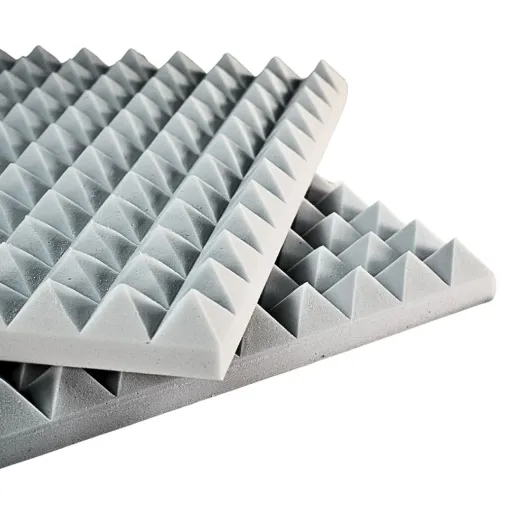
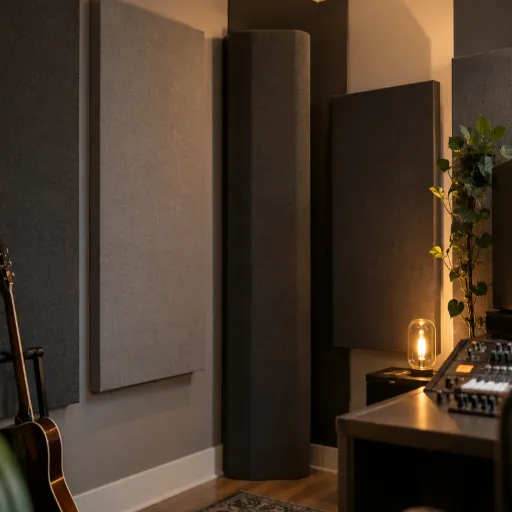
What genuinely absorbs. Felt-backed slat assemblies reach NRC values of roughly 0.5 to 0.95, depending on backing density, slat spacing, and mounting method. Decorative fluted panels, by contrast, carry little to no real absorption rating. Several marketplace listings market fluted WPC as “soundproof.” That claim does not survive a test report.
What to specify if acoustics matter. If you need genuine sound control, specify an engineered acoustic system with published test data, not a decorative profile. And measure the right thing: absorption for echo inside the room, transmission loss for noise coming through the wall.
The WPC fluted panels vs wood slat acoustic panels comparison runs the two side by side on cost, moisture, colour consistency, and actual acoustic performance. For commercial-grade acoustic requirements, see our WPC acoustic panels for commercial spaces.
Need the acoustic numbers before you specify? Talk to our technical team about acoustic test data and we will share the report for the specific panel you are considering.
WPC vs Alternative Living Room Wall Finishes
A like-for-like comparison across the finishes a living room renovation actually considers.
| Finish | Material cost per m² | Lifespan | Moisture | Acoustic | Maintenance |
|---|---|---|---|---|---|
| WPC (co-extruded) | USD 18 to 35 | 20 to 25+ yrs | Water absorption under 1% | Echo reduction only | Wipe clean, no recoating |
| WPC (mid-range) | USD 9 to 18 | 15 to 25 yrs | Water absorption 0.5 to 1% | Echo reduction only | Wipe clean, no recoating |
| MDF panelling | USD 6 to 20 | 8 to 12 yrs | Poor, swells ~30% in 2 hrs | Negligible | Repaint; replace if wet |
| Solid wood | USD 40 to 200+ | 20 to 35 yrs | Moderate, needs sealing | Minimal without treatment | Recoat every 3 to 5 yrs |
| PVC panel | USD 3 to 5 | 8 to 15 yrs | Very good | Negligible | Wipe clean |
| Wallpaper | USD 3 to 12 | 5 to 8 yrs | Poor in humid rooms | Negligible | Replace on damage |
| Paint | USD 2 to 6 | 3 to 5 yrs | Moderate | Negligible | Repaint every 3 to 5 yrs |
How to read this table. MDF wins on upfront price and is genuinely fine in a dry, warm living room. It is the wrong choice in a humid climate, a ground-floor flat, or anywhere moisture reaches the wall. Solid wood wins on resale appeal and genuine grain, and loses on cost and upkeep. PVC is the wet-zone budget option and reads less convincingly as timber. Paint and wallpaper are the baseline you are comparing against, and both cost less on day one.
The hybrid most designers specify. Panels on the feature wall, paint on the remaining three. You get the focal point and the durability where it shows, and you keep the project budget in a sensible place. Very few living rooms need four panelled walls.
For the material head-to-heads, see WPC vs solid wood wall panels in detail and how WPC wall panels compare with PVC.
The guide to how fluted profiles compare with felt-backed slat panels on acoustics covers the decision within decorative profiles.
Specifying WPC Panels for Hotels, Restaurants and Developer Projects
The residential living-room aesthetic translates directly into hospitality and developer interiors. The specification package is what changes.
What gets approved:
- Fire performance. B1 rating to BS EN 13501-1:2018, typically Class B-s1,d0, with the certificate available on request. Commercial specification has moved fast here: B1-rated WPC went from about 12 percent of the market in 2022 to 47 percent in 2026.
- Emissions. Low-VOC and E0 formaldehyde data. Hospitality projects increasingly require the report at tender stage.
- Water absorption. 0.5 to 1 percent maximum after 24-hour immersion, tested.
- Colour tolerance. ΔE of 1.5 or lower, with batch traceability. On a 150-room rollout, one mismatched batch is a visible defect across a floor.
- Acoustic contribution. Relevant for dining rooms, lobbies, and open-plan lounges. Specify by test data, not by description.
- MOQ and lead times. Standard profiles move quickly. Custom colours typically add 7 to 15 days.
- Documentation. Factory audit records, batch traceability, and warranty terms. This is where a factory and a trading company diverge.
Why batch traceability is the whole game. Fatima manages procurement for a 180-room hotel refurbishment in Dubai. Her specification called for a walnut co-extruded finish across lobby, restaurant, and corridor walls. Her first supplier delivered three container loads from three different production batches. Under lobby lighting the wall read as two different woods, and the client rejected 40 percent of the installed corridor panelling. A factory-direct supplier running the full order as one batch, with a documented ΔE tolerance, would have removed that risk entirely.
See the fire-rated WPC panel compliance guide for certification detail, and the full commercial specification guide for the tender-stage package.
For factory selection and quality control, our guide to evaluating WPC manufacturers in China covers what to look for and what to verify.
Maintenance and Longevity in Living Rooms
WPC panels need far less attention than timber. They need more than most sales pages admit.
Dust Accumulates in Grooves
The one maintenance reality nobody mentions. Deep fluted and slat profiles collect dust in the channels. Use a vacuum with a soft brush attachment rather than a wet cloth, which pushes dust into the groove floor and leaves streaks. Once or twice a month in a normal living room is enough.
Spot Cleaning, Scuffs and Scratches
A damp cloth with mild soap handles most marks. Pencil and crayon come off with a soft eraser. Light scuffs on a co-extruded finish usually wipe away. Deep scratches into the core are not repairable; that panel section needs replacing, which is a strong argument for ordering spare material at the start.
Panel Replacement and Colour Matching
Panels are replaceable individually if you used a clip system or a batten layout with accessible fixings. Match the colour by ordering spares from the same production batch at the time of the original order. Buying a replacement two years later guarantees a shade difference.
Realistic Lifespan Indoors
15 to 25 years under normal residential conditions, with premium co-extruded grades at the top of that range. What shortens it: prolonged direct sun on a printed finish, abrasion from furniture in a tight room, and standing moisture at the floor line. Most of these are preventable at the specification stage.
For routines by surface type, see the WPC wall panel maintenance guide and how to clean WPC wall panels properly.
Sourcing Panels for Your Project: Samples, MOQs and Certification
The last mile, and where projects most often go wrong.
Order physical samples first. Always. Screens misrepresent wood tones and so do printed catalogues. Ask for samples from current production, not a marketing set, and view them in the actual room under the actual lighting.
Measure the wall, not the room. Panels cover walls, not floor area. Measure each wall you intend to panel, including window and door reveals, then add your waste allowance: 5 to 8 percent for simple layouts, 10 to 15 percent for complex patterns.
Understand MOQ and lead times. Standard profiles can often ship in small quantities. Custom colours and profiles carry a minimum order quantity and add 7 to 15 days to production. Plan accordingly against your renovation or project schedule.
Request the documentation. Fire rating certificate, VOC and E0 emission report, water absorption test data, batch traceability records, and written warranty terms. A supplier who cannot produce these is not a factory partner.
Factory versus trader. Both can supply. Only one can give you the same production batch across your full order, verified test data, and documentation that satisfies a commercial specifier. Ask how many production lines they run and request a video walkthrough of the actual facility.
Browse our interior WPC wall panels to see available profiles and finishes, or go straight to the EN 13501-1 certification and B1 test documentation if you are specifying commercially.
Frequently Asked Questions
Are WPC wall panels good for a living room?
Yes. WPC panels resist moisture and termites, wipe clean without repainting, and last 15 to 25 years indoors. The trade-offs are a higher upfront cost than paint or wallpaper, a heavier panel than PVC, and no meaningful soundproofing. They suit feature walls, TV walls, and full-height fluted designs.
Are WPC wall panels soundproof?
No. WPC panels reduce echo inside a room by scattering reflected sound. They do not block sound transmission from adjacent rooms.
Decorative fluted panels carry little to no absorption rating. Felt-backed slat assemblies reach NRC values of roughly 0.5 to 0.95, which is a different product category.
How much do WPC wall panels cost for a living room?
Mid-range panels run about USD 9 to 18 per m² factory-direct, with co-extruded premium grades at USD 18 to 35 and above. A 12 m² feature wall typically lands between USD 590 and 740 installed once battens, adhesive, trims, waste, LED, and labour are included.
How long do WPC wall panels last indoors?
15 to 25 years under normal residential conditions, with premium co-extruded grades reaching the top of that range. Prolonged direct sun on a printed finish, abrasion in tight spaces, and standing moisture at floor level shorten service life.
Do WPC wall panels look cheap?
Not if the specification is right. Co-extruded finishes with genuine grain texture read as timber. Printed imitations with shallow detail read as plastic. The visible difference is usually the trim quality and the consistency of the colour across panels.
Can WPC panels be installed over paint?
Over sound, flat paint, yes, using battens or a suitable construction adhesive. Over peeling or flaking paint, no. Strip it first. Do not bond directly to glossy tile; use battens over sound tile instead.
What is the difference between WPC and PVC wall panels?
WPC contains wood fibre blended with polymer, giving higher density, better impact resistance, a more convincing wood feel, and better acoustic and thermal behaviour. PVC contains no wood fibre, costs less, and feels cooler and harder. WPC is the better living-room product; PVC is the cheaper wet-zone option.
Which WPC panel style is best for a living room?
Vertical fluted panels suit most living rooms because they add perceived height without visual weight. Slat profiles give stronger shadow lines and more architectural feel. Keep profiles shallow and tones light in rooms under about 15 square metres.
Are WPC wall panels fire rated?
Many are. B1 rating to EN 13501-1, commonly Class B-s1,d0, is widely available and increasingly standard. Always request the certificate, and check that the classification applies to the thickness and finish you are ordering rather than to the panel family in general.
Can you paint WPC wall panels?
Technically yes, with a suitable primer and a paint rated for polymer substrates. In practice it removes the reason you bought a wood-grain finish. If you want a painted look, a flat panel is the cheaper starting point.
Do WPC wall panels need expansion gaps indoors?
Yes. Leave 5 to 7 mm between panel ends and a perimeter gap at ceilings and corners, covered by trim. Acclimatise panels in the room for 24 to 48 hours before installation. Panels installed tight will buckle.
Are WPC wall panels eco-friendly?
Partly. Many formulations use recycled polymer and wood waste, and low-VOC panels with E0 formaldehyde ratings are widely available. The polymer content is not biodegradable, and recycled content varies by producer. Ask for the actual composition data rather than accepting a general sustainability claim.
Conclusion
Choosing WPC wall panels for a living room comes down to five decisions, and none of them is the colour.
Decide the wall or walls you are panelling, and do not over-fill the room. Choose a profile depth that matches your ceiling height and available light, which for most living rooms means vertical fluting with a moderate groove.
Fix the colour family from the mood you want, and specify a ΔE tolerance of 1.5 or lower with a single production batch. Plan the cables, sockets, and lighting before the panels go up, because that is where media walls fail. Budget honestly, including trims, waste, and labour, rather than comparing the panel price to the price of paint.
Get those five right and the material performs exactly as promised: a warm, wood-grained living room wall that still looks right in a decade, cleaned with a damp cloth and never repainted. Get them wrong and the panels will be blamed for a planning problem.
We supply WPC interior wall panels factory-direct, with co-extruded finishes, B1 fire-rated options, documented colour tolerance, and physical samples from current production. If you are planning a living room feature wall, a multi-room residential project, or a hotel and hospitality rollout, our team can work from your drawings or your wall measurements.
Request a free sample kit or get a bulk quote →
Categories:
Blog
Related Articles