WPC vs PVC Wall Panels: A Commercial Buyer’s Comparison (2026)
For commercial projects, from the perspective of WPC vs PVC wall panels, the answer is this: WPC is for durability, aesthetics, and lifecycle cost, whereas PVC is best for waterproofing, value upfront, and ease of installation. The best choice depends on the project environment, budget timeline, and performance requirements.
A Dubai contractor had specified WPC for 80 hotel bathrooms in 2023. He treated WPC as if it were made of PVC, entirely waterproof. But within 18 months, swelling appeared in panels adjacent to the shower. It cost $18,000 to replace a portion of it. Had he known clearly what each material really did, that blunder would have been avoided.
Most of the online comparison guides are crafted for DIY homeowners who are renovating a single room, really not for an architect, contractor, or a procurement manager specifying materials for multi-unit hotels, office buildings, or retail chains. Very different level of detail- you want test data, lifecycle costs, and specification guidance that will hold up under real project pressure.
It is precisely what this guide offers. We will be covering what exactly WPC and PVC are doing on the basis of at least 10 technical areas, show you actual costs over an ownership window of 10 years, and spell out when and where to specify each material. No forced winner, no vague claims, just the data you need to have to make the right call.
Key Takeaways
- WPC panels last longer indoors for 20 to 30 years, and they tolerate impacts very well, though they are moisture-resistant rather than completely waterproof-PVC.
- PVC panels will be 20-30 percent cheaper to buy and will install quickly than WPC-panels at 20-30% greater cost than PVC-panels but will fade with UV rays and get damaged by heavy impact.
- Choose PVC instead for wet areas like showers and WPC for corridors, facades, and high-traffic areas.
- In a 10-year cycle, WPC appears to be cheaper in the long run due to lesser wear-out with time and reduced maintenance costs compared to other materials.
- Your choice will typically depend on minimum haulage: WPC is heavier and giant, but the replacement may be lower; PVC is lighter and easier to ship and hence has an early need for a refresh cycle.
What Are WPC and PVC Wall Panels?
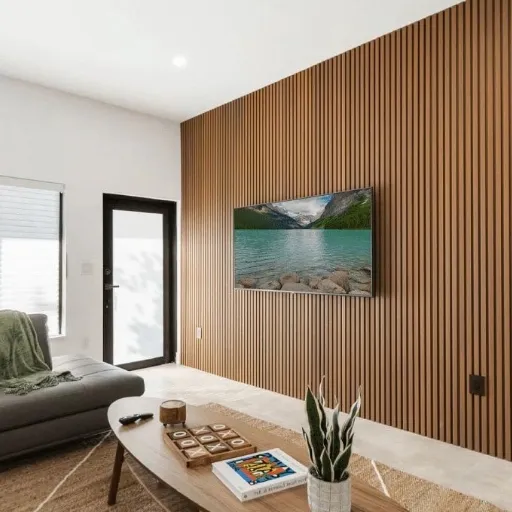
Before we compare performance, it helps to understand what these materials actually are. They look similar on a showroom wall, but their composition drives every difference that matters on a job site.
WPC (Wood-Plastic Composite)
WPC panels are extruded with a mix that varies from 55% to 65% of wood, 30% to 35% of HDPE or PP polymer, and 5% to 10% other additives, like coupling agents, UV stabilizers, and colorants. Now, the wood fiber imparts a warm, characteristic look to WPC and makes the product look more natural. The polymer provides moisture protection and bonds the entire system.
This creates a material that somehow feels and looks like true, genuine wood while showing superior resistance to rot, insects or any deformity as compared with hardwood. To make a thorough comparison between WPC and solid wood, see our article: How WPC compares to solid wood. Some of the very high-end WPC products are co-extruded (capped) and come with a dense polymer shell that encapsulates the core with even greater UV and moisture security. For a more detailed analysis of WPC composition and many specs, a complete guide to WPC wall panels.
PVC (Polyvinyl Chloride)
PVC wall panels are made of 100% synthetic polyvinyl chloride polymer, extruded or calendered into solid sheets. Because these materials do not contain any organic fiber, they are inherently non-porous and fully waterproof in such manufacturing.
PVC wall panels are both lighter and more flexible, while also being easier to handle for on-site cutting. Bathrooms, kitchens, and any other direct exposure to water speak for their most common applications. But pure PVC panels are not very impact-resistant, and they become very brittle with time, especially in cold climates or under long-term UV exposure.
Head-to-Head Comparison Matrix
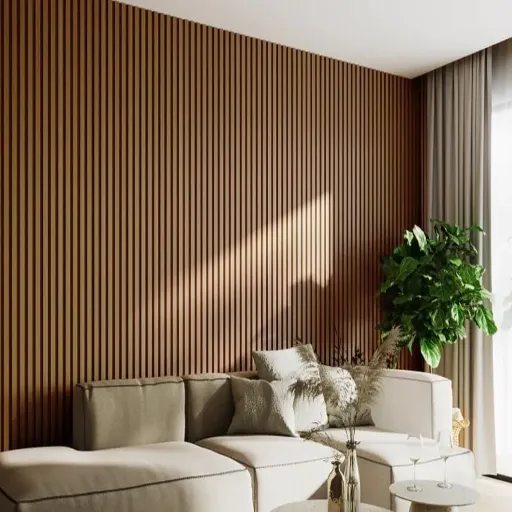
The table below summarizes how WPC and PVC stack up across the criteria that matter most for commercial specification decisions.
| Criteria | WPC Wall Panels | PVC Wall Panels |
|---|---|---|
| Composition | 55-65% wood fiber + 30-35% polymer | 100% synthetic PVC polymer |
| Density | 1.15-1.4 g/cm³ | 1.3-1.5 g/cm³ |
| Weight | Heavier (~6-9 kg/m²) | Lighter (~3-5 kg/m²) |
| Water Absorption | 0.5-1.2% (ASTM D570) | 0.1-0.5% |
| Fire Rating | B-s3,d0 (premium grades) | D-s2,d0 (standard exterior) |
| UV Resistance | Excellent (co-extruded) | Moderate; fades/chalks over time |
| Impact Resistance | High; resists dents and cracking | Moderate; cracks under heavy impact |
| Scratch Resistance | Good; surface can be sanded/repaired | Moderate; surface damage is permanent |
| Thermal Expansion | Lower, more dimensionally stable | Higher; requires expansion gaps |
| Acoustic Performance | Better sound dampening (denser core) | Higher reflectivity; noisier |
| Installation | Clip/screw systems; slightly slower | Adhesive or tongue-and-groove; faster |
| Lifespan (indoor) | 20-30 years | 10-20 years |
| Warranty (typical) | 10-25 years | 5-10 years |
| Upfront Cost | $2.50-4.00/sq ft | $1.80-3.20/sq ft |
This table alone answers about 60% of specification questions we hear from buyers. If you need waterproofing above all else, PVC has a clear edge. If you need longevity, impact resistance, and a wood-like finish that holds up in high-traffic spaces, WPC is the better specification.
Want to see how these numbers translate to your specific project? Request a side-by-side sample pack with both WPC and PVC panels for direct evaluation.
Performance Deep Dive by Category
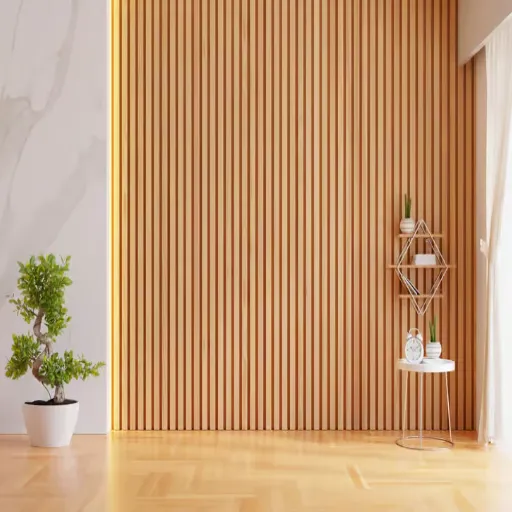
Durability and Impact Resistance
WPC panels cushion impact better than PVC because the wood fiber core has a natural give. In a busy hotel corridor or office lobby where luggage, carts, and furniture contact walls regularly, that difference is crucial.
An administrator in Riyadh kept track of two similar office buildings for five years. One made use of WPC panels in the lobby. The other used PVC. After the sixty-month period, the WPC lobby manifested some minor scuffing but cleaned right up with standard maintenance. The PVC one had to replace 12% of the panels because of cracking and impact damage from furniture moves. The labor cost for replacement actually canceled out all PVC’s initial savings.
PVC panels are prone to cracking or denting when struck with force. WPC panels, when scratched, can generally be repaired because the damage is generally confined to the surface of the panel and can generally be sanded or buffed out on solid-core products.
Waterproofing and Moisture Management
The winner here is PVC by far. Because it is made from 100% recycled plastic and is non-porous, PVC panels do not soak any amount of water at all, so they can be directly installed inside a toilet shower stall, around a commercial kitchen sink, or in an indoor pool area.
WPC panels are deemed moisture-proof, not waterproof. The erstwhile WPC absorbs water under standard D570 test conditions by 0.5-1.2% in weight after 24 hours of immersion. In comparison to wood products, that is an excellent performance; however, not the superlative performance to Sido. This is so because, on standing water, the wood fiber element may well expand, delaminate, or sustain mold growth in the section of the seal along the wet area.
Co-extruded (capped) WPC has impressive results associated with its generally improved performance. This is because the polymer shell encapsulates the core and actually reduces water uptake to near-PVC levels. However, the cut edges and any fastener holes will expose the raw material. In wet applications, PVC remains a safer specification.
Fire Resistance and Code Compliance
The fire rating is a selling feature for WPC in commercial settings in regulated markets. The top-notch WPC boards achieve a European Class B-s3,d0 rating according to EN 13501-1 based on the consideration of limited combustibility, low smoke production, and the absence of burning droplets.
Co-extruded WPC cladding generally falls under Class D-s2,d0 ratings. Standard PVC panels register higher, acting as fuel and producing smoke more easily. Some internal PVC wall panels are self-extinguishing, but they do not compare to the fire resistance of a properly formulated WPC that features flame-retardant chemicals inserted properly as an incorporated additive.
WPC often becomes the only possible choice when the local code, as in the case of hotels, high-rise office buildings, and public spaces, demands the use of Class B materials between the two.
UV Stability and Color Stability
In short, WPC co-extrusion capping performs excellently under UV exposure. It is a pure polymer extruded layer integrated with quality UV stabilizers, and this cap only guarantees 15 to 25 years of surface resistance when placed outside, depending on the climatic conditions.
PVC panels deteriorate, become chalky, and become brittle when exposed to direct sunlight without specific UV stabilizers. A developer in Miami learned this the hard way. He chose a PVC facade for a coastal restaurant to save 15% on material cost. Barely giving it three years, the panels had discoloration and a powder-coating-like surface. Once seen, the co-extruded WPC panels on the adjacent structure looked untouched. The restaurant paid to replace the entire facade for triple the cost of the original material.
With all outdoor applications, insist on clad WPC or UV-stabilized PVC. Uncapped PVC will not cope with five years working under most freestanding sun environments.
Thermal and Acoustic Properties
The denser core of WPC, filled with wood fiber, helps dampen sound more effectively compared to hollow PVC panels. In commercial buildings such as hotels, auditoriums, schools, and multi-family buildings where acoustic comfort is essential, WPC contributes to a more peaceful environment. The hard, reflective surfaces of PVC, on the other hand, are better known for reflecting sound and causing sound amplification in sound-reflective corridors.
Thermally, WPC is significantly less susceptible to expansion and contraction compared to PVC and thus requires fewer gaps for expansion, less seasonal movement, and less hindrance to clean long-term aesthetics. PVC requires the extravagant gap allowance and gymnastics in climate places with substantial temperature ranges.
Cost Analysis: Upfront vs. Lifecycle

Initial Material Cost
PVC panels typically cost 20-30% less per square foot than WPC at the point of purchase. For a budget-sensitive project where upfront capital is the main constraint, that difference is meaningful.
| Cost Component | WPC | PVC |
|---|---|---|
| Material (per sq ft) | $2.50-4.00 | $1.80-3.20 |
| Installation labor (per sq ft) | $1.50-2.50 | $1.00-1.80 |
| Accessories (clips, adhesives, trim) | $0.30-0.50 | $0.20-0.40 |
| Total installed (per sq ft) | $4.30-7.00 | $3.00-5.40 |
Installation Labor Cost
PVC installs faster. It is lighter, easier to cut, and often uses simple adhesive or tongue-and-groove systems. On average, a skilled crew installs PVC 20-30% faster than WPC, which typically uses clip or screw systems requiring more precise alignment.
10-Year Total Cost of Ownership
Here is where the math flips. WPC panels last roughly twice as long as PVC in commercial environments. They also require less frequent replacement and repair.
| Cost Over 10 Years | WPC | PVC |
|---|---|---|
| Initial installation (1,000 sq ft) | $5,500 | $4,200 |
| Replacement panels (10-year rate) | ~$200 | ~$1,200 |
| Repair labor | ~$300 | ~$800 |
| Maintenance (cleaning, touch-ups) | ~$500 | ~$700 |
| 10-Year TCO (per 1,000 sq ft) | ~$6,500 | ~$6,900 |
Over a full decade, WPC often costs less despite the higher upfront price. The gap widens in high-traffic or exterior applications where PVC replacement rates climb even higher.
Application-Specific Recommendations
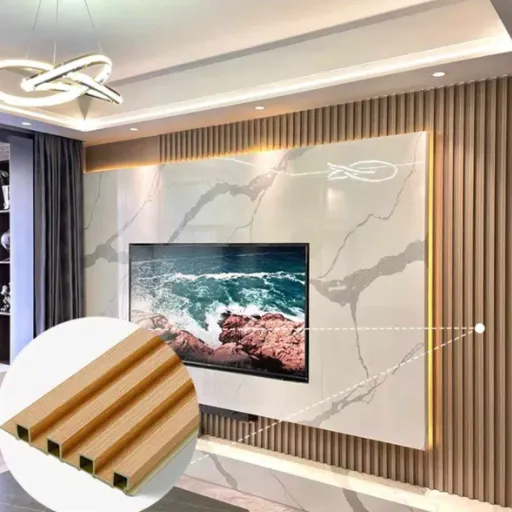
When to Specify WPC
- Hotel lobbies and corridors: heavy traffic, luggage being moved, high aesthetics required
- Exterior facades and cladding: UV exposure, large temperature deltas, long service life
- Office reception areas: Great aesthetics, acoustical comfort, low maintenance
- Retail storefronts: Branding, color consistency, and high customer traffic
- Fire-regulated buildings: For buildings with a Class B FGPI rating and an ASTM E 84 Class A fire resistance rating
For UV protection in exterior applications, WPC offers the best UV and thermal stability. Consult our product page for exterior cladding specifications.
When to Specify PVC
- Bathrooms and showers: Direct water exposure, must be 100% waterproof
- Commercial kitchens or restaurants: Grease, steam, and frequent wash-downs
- Indoor pool enclosures: Always wet; chlorine exposure is constant
- Temporary or budget installations: For the short term or when the budget is very tight
- Lightweight retrofit jobs: For projects with restricted wall load capacity
Climate-Specific Guidance
Coastal / High-Humidity: WPC with co-extruded cap performs well, but ensure all cut edges are sealed. PVC is safer for direct wet areas. Salt air accelerates UV degradation on uncapped PVC.
Desert / High-UV: Capped WPC is strongly preferred. Standard PVC fades and becomes brittle within 3-5 years under intense sun.
Cold / Freeze-Thaw: WPC handles thermal cycling better. PVC can become brittle in sub-zero temperatures and crack under impact.
Tropical / Monsoon: PVC for wet-season exposure areas; capped WPC for covered exterior walls with proper drainage gaps.
Bulk Procurement Considerations
If you are ordering by the container, material choice affects logistics. WPC is heavier and denser, so you will fit fewer square meters per container. PVC ships more efficiently by volume. However, WPC’s lower replacement rate means fewer re-order cycles over the life of a property portfolio.
For hotel chains and developers managing 50+ units, that logistics difference matters. We have seen clients save more on reduced maintenance trips than they spent on the heavier initial shipment.
Common Myths and Misconceptions
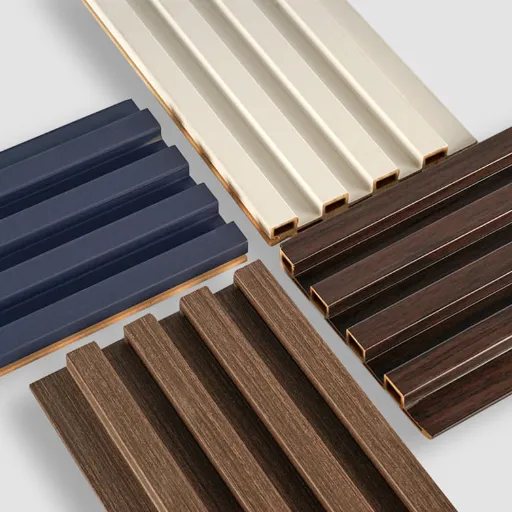
Myth 1: WPC is totally waterproof like PVC.
The fact is, WPC is highly resistant to moisture, but the wood-fiber core absorbs water at the cut edge or through surface damage. PVC is still the best choice for shower enclosures or direct-spray applications. A cap on WPC somewhat mitigates these unfamiliarities but does not eliminate them whatsoever.
Myth 2: PVC is always cheaper.
Initially, yes. But not usually over 10 years. In terms of replacement costs, labor during repair, and revisits sooner, WPC frequently wins with respect to total ownership cost in commercial settings.
Myth 3: WPC is always more eco-friendly.
WPCs contain recycled wood fibers and recycled polymers. But no two WPCs are the same, though. Rather, some manufacturers use virgin plastics and a chemical pretreatment of the wood. Also, PVC panels contain a high percentage of recycled content. Be assured that when being apportioned by the project certification, and with an FSC or ISO 14001, your supplier will give real percentages. Do not overlook that material labeling does not tell everything.
Myth 4: Fire resistance is the same for both materials.
It is not. Premium WPC with fire-retardant additives achieves significantly better fire ratings than standard PVC. For code-regulated commercial projects, this difference can be the deciding factor.
Frequently Asked Questions
Which is better, WPC vs PVC wall panels?
No best material applies to everything. WPC is better for durability, while PVC is better in waterproofing, aesthetics, and other areas. Match the material to the work.
Is the WPC panel completely waterproof?
No. WPC has good moisture resistance but is not completely waterproof like PVC. In case of a shower and water tank, do not use standard WPC. Water resistance is enhanced slightly by capped WPC, but leaves the edge problem.
What are the disadvantages of PVC wall panels?
Low-impact resistance, long lifespan (10-20 years), lower fire ratings in standard grades, and poorer UV stability without specialized additives. Furthermore, PVC can look and feel more “plastic” than WPC, matters that are considered in premium interiors.
What are the disadvantages of WPC wall panels?
The WPC’s price is higher in the beginning, it is a heavier product (adding to the shipping cost), more difficult to install, and is not completely waterproof. Lower-grade WPC might even suffer from inconsistent batch-to-batch color matches when suppliers lack stringent QC processes.
How many years will WPC Wall Panels last?
A high-quality WPC indoor panel lasts 30 years outside, while a standard of 20 years combined with a correct installation. Equally, co-extruded products with optimal UV stabilizers can give the longest years of life. Maintenance tips will further enhance the life of the panels, as outlined in our WPC maintenance requirements.
Which panel is more scratch-resistant?
In general, a WPC material is more scratch-resistant. In the case of solid-core WPCs, a scratch on the surface can be generally sanded out. PVC, on the other hand, usually has permanent scratches. Any material in a high-contact position might be better protected by adding trim and using practicality.
Can I use WPC in bathrooms?
Of course, in many bathroom settings. WPC works well on walls away from direct water spray. But for shower enclosures and tub surrounds, PVC should be chosen or capped WPC with fully sealed edges and a waterproof membrane to be used behind the panels.
Are WPC panels more eco-friendly than PVC?
Most of the time, but not certainly so. WPC contains natural wood fiber and has the potential to incorporate recycled content, reducing petroleum dependency. However, the manufacturing impacts differ per supplier. Make sure to check with a specific certification regarding recycled content and not rely on general material claims.
Which looks more like real wood?
WPC would. Due to the presence of wood fibers, its attractive grain patterns and organic textural variations look better, and its warm color tones are more authentic; even if PVC can closely mimic the look of wood, it cannot replicate the tactile depth and natural variations of WPC.
Does PVC sheeting resist fire?
Typical interior PVC sheets are self-extinguishing materials that do not have high fire-resistance ratings. They often rank Class D or lower under European classifications. To build fire-rated walls requiring Class B compliance or ASTM E84 Class A compliance, you would order the fire-rated WPC option.
Conclusion
Choosing between wpc vs pvc wall panels cannot be reduced to picking a clear winner. It is all about matching the required material performances to specific project demands.
Decide on WPC when durability, top-quality wood-like finish, fire compliance, and long-term economic benefits are desired. Specify PVC when watertightness is an absolute requirement, at the expense of novelty, whether in luxury or even in haste due to tight deadlines.
In many instances, for those with commercial considerations, such as managing multiple properties or developing larger projects, the WPC product has the upper hand in total cost of ownership over 10 years, even though heavy on the upfront cost. This is due to its higher replacement rate, greater resistance impact, and best UV protection, which will mean fewer maintenance problems and decreased overall spending.
If you are still unsure which material fits your project, the most reliable next step is simple: evaluate both in person. Request complimentary samples of WPC and PVC panels from our factory, shipped directly to your office for side-by-side comparison. Seeing the weight, texture, and finish differences firsthand will give you more confidence than any comparison table can provide.
Categories:
Blog
Related Articles