How to Choose WPC Deck Tiles That Actually Last
When you are standing in front of a dozen WPC tile samples that all look nearly identical, here is the truth: the differences that determine whether your deck still looks great in five years are mostly invisible. Learning how to choose WPC deck tiles comes down to understanding what is beneath the surface.
Last spring, a property manager named David ordered 200 square meters of interlocking WPC deck tiles for a rooftop terrace project in Singapore. The samples looked fine, the price was right, and the supplier promised quick delivery. Eighteen months later, the tiles had faded to a chalky gray, the plastic base grids had started cracking, and water was pooling underneath. David’s “bargain” ended up costing his company twice the original budget in replacement labor alone.
The problem was not that David bought a bad product. It was that nobody told him what to actually check before placing an order. That is exactly what this guide will walk you through, one factor at a time, so you know what matters and what does not when you are evaluating WPC deck tiles for your project.
Key Takeaways
- Choose capped co-extruded tiles over uncapped. The price difference pays itself back within 3 to 5 years through reduced fading and surface damage.
- Verify the plastic base grid quality just as carefully as the tile surface. Cheap recycled PP bases are the number one failure point.
- Check the water absorption rate. Anything above 0.5% will cause swelling and cracking in freeze-thaw or humid climates.
- Confirm third-party certifications (SGS, Intertek, TUV) instead of taking a supplier’s word for quality. Test reports do not lie.
- Look past the per-square-foot price and calculate total cost of ownership. A quality tile that lasts 20 years is cheaper than a budget tile replaced after 5.
Understanding WPC Deck Tiles: What You Are Actually Buying
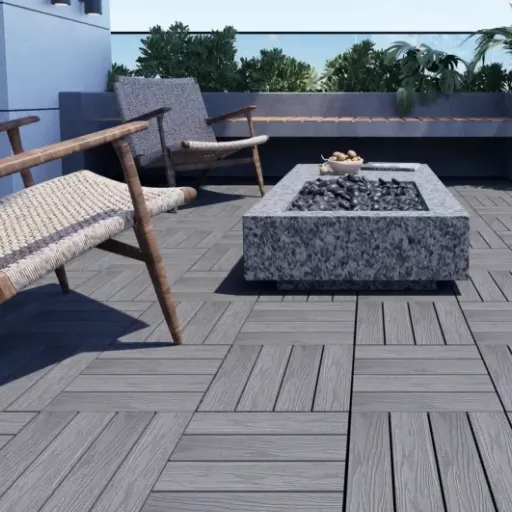
This WPC deck tiles buying guide focuses on one thing: making sure you know what to check before any money leaves your account. Before you can evaluate WPC deck tiles, you need to know what goes into them. If you are new to modular outdoor flooring, start with our what is modular WPC decking guide for a full breakdown of how these systems work.
What WPC Deck Tiles Are Made Of
WPC stands for wood-plastic composite. A quality WPC deck tile blends wood fiber and polymer at a ratio typically between 50:50 and 60:40. WPC deck tiles quality starts right here, at the material level. The wood component gives the tile its natural look and feel. The polymer, usually HDPE or polypropylene, provides moisture resistance and structural integrity.
But the raw ratio is only part of the story. The type of polymer matters. Virgin HDPE delivers consistent strength and predictable expansion behavior. Recycled polymer, while more affordable and eco-friendly, can vary in quality from batch to batch unless the manufacturer enforces strict incoming material standards. The wood fiber source matters too. Hardwood flour produces a denser, more stable tile than softwood alternatives.
WPC Deck Tiles vs. WPC Decking Boards
If you are trying to decide between tile format and plank format, our WPC deck tiles vs WPC decking boards comparison covers the trade-offs in detail. The short version: tiles are modular, DIY-friendly, and ideal for covering existing surfaces like concrete balconies or rooftop terraces. Planks require a substructure but give you a more traditional deckboard look. For a complete overview of the modular category, see our modular WPC decking buyer’s guide.
8 Critical Factors for Choosing WPC Deck Tiles
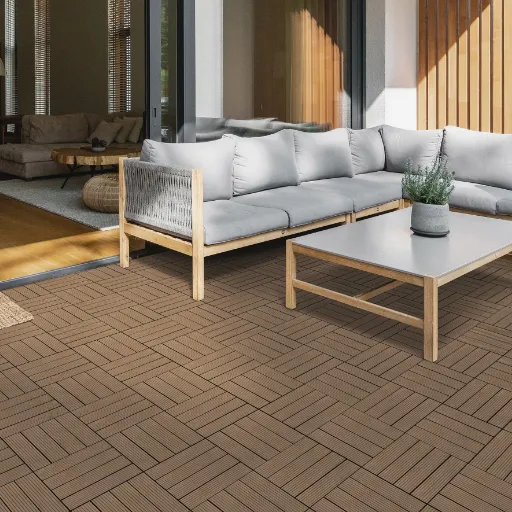
1. Capped vs. Uncapped: The Decision That Determines Longevity
This is the single most important choice you will make when evaluating how to choose WPC deck tiles. A co-extruded capped tile has a protective polymer shell bonded around its core during manufacturing. This shell is not a separate layer that can peel off. It is fused at the molecular level.
The cap does three things that uncapped tiles cannot match. It blocks UV radiation, which prevents the color from bleaching out. It seals the wood-fiber core against moisture, reducing the risk of swelling and mold. And it provides a harder surface that resists scratches from furniture, dropped objects, and foot traffic.
In accelerated weathering tests that simulate years of sun exposure, capped WPC tiles retain their original color significantly longer than uncapped alternatives. Uncapped tiles, even with added UV stabilizers in the formulation, begin showing noticeable fading within the first 6 to 12 months in direct sun.
The price difference is real, typically 20 to 30 percent more for capped products. But consider the alternative. When David’s uncapped tiles faded and warped, the removal and replacement cost far exceeded whatever he saved on the initial order. For any project you expect to last more than five years, capped tiles are the standard.
How to check: Ask the supplier for a cross-section sample. A capped tile shows a clear, distinct outer layer, usually 0.3 to 0.5 mm thick, with a slightly different sheen than the core material.
2. Core Structure: Hollow, Solid, and the Minimums That Matter
WPC deck tiles come in two core configurations.
Hollow-core tiles have internal channels running through them. These channels reduce weight, improve drainage, and lower material cost. For residential balconies, patios, and most light-traffic areas, hollow-core tiles work well, provided they meet minimum wall thickness standards. A quality hollow tile should be at least 22 mm thick with outer walls no thinner than 5 mm.
Solid-core tiles are exactly what they sound like. Dense, heavy, and resistant to denting under concentrated loads. If your project involves heavy outdoor furniture, commercial foot traffic, or anywhere a high heel or table leg might punch through, solid-core is the safer choice. They also handle freeze-thaw cycles better because there is less internal space for water to collect and expand.
A maintenance supervisor named Priya manages a pool deck at a resort in Goa. She switched from hollow-core to solid-core WPC tiles after the original installation developed dips and cracks around the lounge chairs within two seasons. The solid tiles cost about 30 percent more but have handled three monsoon seasons without a single replacement.
3. Surface Texture and Slip Resistance
When learning how to choose WPC deck tiles, surface texture is the factor that determines safety, not just appearance.
Smooth-finished tiles look sleek in product photos but become hazardous when wet. If your WPC deck tiles will be installed anywhere exposed to rain, pool splash, or high humidity, choose a grooved or 3D embossed surface that channels water away from the walking surface.
The industry benchmark for slip resistance is the coefficient of friction, or COF. Under ASTM D2047, a COF of 0.6 or higher is the accepted threshold for safe flooring in wet conditions. Reputable manufacturers publish their COF test results. If a supplier cannot produce a slip-resistance test report, treat that as a meaningful red flag.
Different surface profiles suit different settings. A deep wood-grain embossing looks natural on a balcony but might trap dirt in high-traffic commercial areas where a shallower ribbed profile is easier to sweep and hose down. Think about the maintenance routine, not just how the tile looks on day one.
4. Water Absorption and Weather Resistance
WPC is not waterproof in the way that pure PVC is. The wood fibers in the composite will absorb moisture if the material is not properly formulated and capped. The difference between a good tile and a bad one shows up most clearly in the water absorption number.
The target specification is below 0.5 percent water absorption when tested to ASTM D570. Tiles that absorb more than that will swell, crack, and support mold growth over time, especially in climates with freeze-thaw cycles or persistent humidity.
UV resistance is measured separately through color fastness testing. Look for a minimum of Grade 4 on the Blue Wool Scale (ISO 105-B02), which indicates the tile will hold its color through extended sun exposure without turning chalky or uneven.
If your project is in a coastal area where salt spray is a factor, confirm that the tile’s hardware uses 316 stainless steel screws rather than 304. The extra corrosion resistance matters when salt is in the air every day.
5. The Interlocking Base Grid: The Part Nobody Talks About
Ask ten buyers how to choose WPC deck tiles, and nine of them will focus entirely on the surface. But the plastic base grid underneath is where most failures begin. Interlocking WPC deck tiles selection must include a hard look at the base grid quality because this component takes all the structural stress.
The base grid provides the snap-lock connection that holds modular tiles together. Quality bases are made from virgin polypropylene with UV stabilizers added to prevent brittleness. Cheap bases use recycled PP with minimal or no stabilizers. After two or three years of thermal cycling, those cheap bases become brittle and the locking tabs snap off.
Here is what to check on the base grid:
- Material: Virgin PP with UV-302 or UV-326 stabilizers. Not recycled PP.
- Wall thickness: Locking tabs should be 2 to 3 mm thick at minimum. Thin tabs fail first.
- Screws: 304 stainless steel for general outdoor use. 316 stainless for coastal or poolside installations.
- Height: The base should lift tiles 15 to 25 mm above the subfloor to allow drainage and airflow.
A simple test: hold two tiles and snap them together. The connection should feel firm and require deliberate force to disconnect. If tiles rattle or come apart with light pressure, pass on that product.
6. Thickness, Size, and Dimensional Consistency
Standard WPC deck tiles measure 300 x 300 mm, with larger 300 x 600 mm formats available for some product lines. The 300 x 300 format is the most common and gives you the most supplier options. It also makes replacement easy since any damaged tile can be swapped out in seconds.
Thickness matters. The industry standard for quality hollow-core tiles starts at 22 mm. Tiles thinner than 20 mm, especially those with hollow cores, will flex underfoot and develop stress cracks at the interlocking points.
Dimensional consistency is equally important. Measure several tiles from the same batch. The length and width should vary by no more than 1 mm between tiles. Larger variation creates uneven gaps during installation that get worse as the tiles expand and contract with temperature.
Order 8 to 10 percent more tiles than your calculated square footage. You will need spares for edge cuts, irregular corners, and future damage replacement. Tiles from the same production batch will match in color. Tiles ordered six months later may not.
7. Certifications: Your Quality Shortcut
The best WPC deck tiles on the market share one common denominator: independently verified test reports. Certifications are the fastest way to confirm that a supplier’s quality claims are real. You should expect to see:
| Certification | What It Verifies |
|---|---|
| ISO 9001 | Quality management system at the factory level |
| ISO 14001 | Environmental management practices |
| ASTM D7032 | Mechanical performance including load-bearing capacity |
| ASTM G154 | UV accelerated weathering and color retention |
| ASTM D2047 | Slip resistance (COF rating) |
| SGS / Intertek / TUV reports | Third-party validation of material composition and performance |
| CE marking | Compliance with EU health, safety, and environmental standards |
| FSC certification | Sustainable sourcing of the wood fiber component |
A supplier that offers co-extruded WPC tiles with full ASTM and SGS documentation is operating at a different quality level than one that cannot produce any test reports. If you are sourcing from China, our guide on WPC deck tile manufacturers in China walks through how to verify claims before committing to an order.
8. Warranty and Realistic Lifespan Expectations
A strong warranty signals manufacturer confidence. For capped WPC deck tiles, expect a warranty of 10 to 25 years covering fading, staining, cracking, and structural failure. Read the fine print carefully. Some warranties only cover the original purchaser. Others exclude commercial installations or require professional installation to remain valid.
Real-world lifespan for quality WPC tiles runs between 15 and 30 years for residential applications. Commercial installations with heavy traffic trend toward the lower end of that range. The key variables are UV exposure, freeze-thaw cycling, and how consistently the tiles are maintained.
If a supplier offers only a 2-year or 5-year warranty, that is not necessarily a dealbreaker. But it should prompt you to dig deeper into their test documentation and ask for installation references you can verify.
How to Spot Low-Quality WPC Deck Tiles Before You Buy
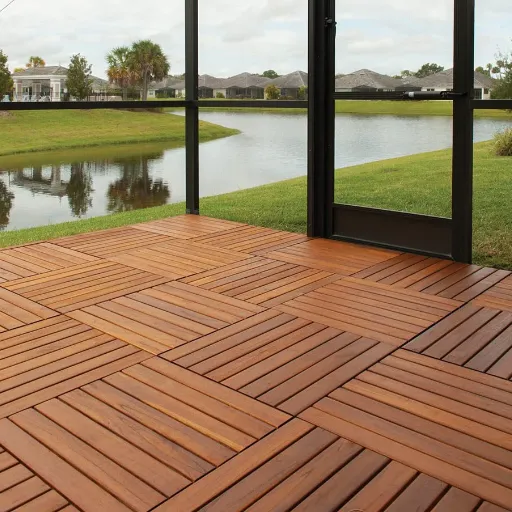
When you know how to choose WPC deck tiles properly, spotting the low-grade products becomes straightforward. You do not need a laboratory to identify most quality problems. A few simple checks will reveal the difference.
The weight test. Pick up two tiles of the same stated size from different suppliers. The lighter one almost certainly has thinner walls, lower density, or both. Density correlates directly with durability.
The cross-section inspection. Turn a sample tile over and look at the cut edges. Consistent color and material distribution throughout the thickness is what you want. Visible fillers, inconsistent texture, or obvious layers that do not look bonded suggest poor manufacturing control.
The scratch test. Run a key or coin firmly across the surface. A capped tile will show minimal marking. An uncapped or poorly capped tile will leave a visible groove. This is exactly what furniture legs and dropped objects will do over years of use.
The documentation check. If a supplier cannot produce a current SGS or equivalent test report with their name and date on it, the claims about material composition and performance are unverified. Full stop.
The price that seems too good. At current FOB China pricing, quality-capped WPC deck tiles wholesale between $2.80 and $3.50 per square foot. Tiles priced below $2.00 per square foot are almost certainly uncapped, use recycled base grid material, or both. For a detailed breakdown of what drives pricing, see our modular WPC decking cost guide.
Matching Tile Selection to Your Climate
The right tile for a rooftop terrace in Dubai is not the same as the right tile for a balcony in Vancouver. Climate should drive several of your specifications.
Hot, sunny climates demand tiles with UV Grade 4 or better ratings and co-extruded capping as a hard requirement. Choose lighter colors. Dark WPC tiles can reach surface temperatures above 70 degrees Celsius in direct desert sun, making them unusable barefoot.
Coastal and humid environments require the lowest possible water absorption, ideally below 0.3 percent, and 316 stainless hardware throughout. Salt air corrodes 304 stainless faster than most buyers expect.
Freeze-thaw regions need tiles with proven cold-temperature performance down to minus 40 degrees Celsius. Solid-core or thick-walled hollow tiles with good drainage clearance handle freeze-thaw cycling better than thin budget alternatives. The key is preventing water from pooling inside the tile structure where it can freeze and expand.
Covered vs. exposed installations also matter. A covered balcony with limited direct sun can get away with uncapped tiles if budget is the priority, though you sacrifice long-term color retention. Any fully exposed installation should use capped tiles regardless of climate.
Design Considerations When Choosing WPC Deck Tiles
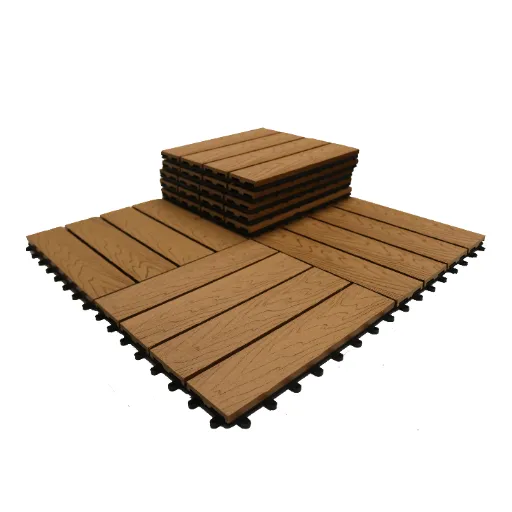
Choosing your WPC deck tiles is also about how they will look once installed. Tile color, pattern, and layout direction all affect the final aesthetic.
Color selection should account for sun exposure. Light gray, silver, and tan reflect heat and stay cooler. Dark brown and charcoal create a richer look but absorb significantly more solar energy. Some buyers mix two colors in a checkerboard or border pattern for visual interest.
Installation pattern affects material waste. A simple grid layout is the most efficient. Diagonal installations at 45 degrees look dynamic but generate more edge cuts, so factor in a higher waste allowance. Herringbone and basket-weave patterns with smaller-format tiles create a premium look at the cost of additional labor and material.
For more inspiration on creative outdoor flooring layouts, browse our WPC deck tile design ideas collection.
Once you have selected your tiles, the installation is straightforward. Most interlocking WPC deck tiles go down over a flat, solid surface with no adhesive or specialized tools required. For a step-by-step walkthrough, see our how to install WPC deck tiles guide.
FAQ: Common Questions About Choosing WPC Deck Tiles
Are WPC deck tiles truly waterproof?
WPC deck tiles are water-resistant, not fully waterproof like pure PVC. The wood fibers in the composite can absorb moisture if the tile is not properly capped. Quality capped tiles with water absorption below 0.5 percent (ASTM D570) perform well in wet environments, but they should not be submerged in standing water for extended periods.
How long do quality WPC deck tiles last?
Capped WPC deck tiles typically last 15 to 30 years in residential applications and 10 to 20 years in commercial settings. The main variables are UV exposure, freeze-thaw cycles, and whether the installation maintains proper drainage. Most manufacturers back capped tiles with 10 to 25-year warranties.
Can you install WPC deck tiles over an existing concrete surface?
Yes. One of the main advantages of interlocking WPC deck tiles is that they install directly over flat, solid surfaces like concrete, existing tile, or compacted gravel. No adhesive, screws, or substructure is required. The surface needs to be reasonably level, and you should leave 10 to 12 mm expansion gaps around the perimeter.
Do WPC deck tiles get too hot in direct sunlight?
They can. Dark-colored WPC tiles in direct sun can reach surface temperatures uncomfortable for bare feet. Choosing lighter colors (gray, silver, tan) and ensuring the tiles are capped with UV-reflective additives both help reduce heat retention. For pool decks or sunny rooftop terraces, light color selection is a practical safety consideration.
What is the difference between capped and uncapped WPC deck tiles?
Capped tiles have a co-extruded protective polymer shell fused around the wood-fiber core. This cap blocks UV radiation, seals against moisture, and provides a harder scratch-resistant surface. Uncapped tiles lack this protective layer, which means they fade faster, absorb more moisture, and show wear sooner. The price difference is typically 20 to 30 percent, which pays for itself within 3 to 5 years through avoided replacement costs.
How do you clean and maintain WPC deck tiles?
Maintenance is straightforward. Sweep debris from the surface and gaps monthly to prevent mold buildup. Rinse with a garden hose or low-pressure power washer (under 1,500 PSI) seasonally. Use mild soap for stubborn stains but avoid bleach or harsh solvents. Once a year, check that interlocking connectors have not cracked or shifted, especially in freeze-thaw climates.
Making the Final Decision: How to Choose WPC Deck Tiles Confidently
At the end of the process, knowing how to choose WPC deck tiles should come down to a short evidence-based checklist, not guesswork.
First, confirm the tile is co-extruded and capped. This alone eliminates most long-term durability issues. Second, verify the base grid material and hardware grade. A good surface on a bad base still fails. Third, walk through the certification stack. If the test reports exist and the numbers check out, the tile will perform as advertised. Fourth, calculate your total cost of ownership, not just the per-square-foot price. A tile that lasts 20 years at $3.50 per square foot costs far less over the life of the project than one that needs replacement after 5 years at $2.00 per square foot.
The market for WPC deck tiles is full of products that look identical in photographs but perform very differently in the real world. The factors that determine quality, capping, core structure, base grid engineering, and independent test verification, are mostly invisible to the naked eye on day one. But they are visible by year three, and by year five, they are impossible to hide.
Whether you are a contractor sourcing for a commercial installation or a homeowner upgrading a balcony, the same principles apply. Look past the surface. Verify the specs. Buy samples before you commit to an order. And when you are ready to compare options, contact our team for a tailored quote, free samples, or guidance on the right tile grade for your specific application.
Categories:
Blog
Related Articles