WPC Deck Tile Manufacturers in China: How to Source Interlocking Composite Tiles
The best WPC deck tile manufacturers China offers combine large-scale extrusion capacity, verified certifications, and reliable export experience. Leading clusters are in Linyi (Shandong), Anhui, Zhejiang, Guangdong, and Jiangsu. Prices range from about $0.92 to $3.67 per 300 × 300 mm tile depending on grade, finish, and order volume.
But a glossy catalog and a low price per tile won’t protect you from warping clips, uneven color, or water absorption after the first rainy season. We have seen buyers celebrate a “great deal” in March and absorb complaints, replacements, and lost reputation by September. Others use a simple tile-specific checklist and receive durable, consistent product for 10–25 years. This guide gives you that checklist, plus a region-by-region manufacturer map and a step-by-step import roadmap.
Key Takeaways
- Linyi/Shandong, Anhui, Zhejiang, Guangdong, and Jiangsu each specialize in different WPC deck tile grades and buyer needs.
- Leading tile-capable manufacturers include LvsenWood, Sentai WPC Group, Unifloor, Guofeng, Hosung, Hanming, Sanjin, GreenCovering, BOHAI Woods, and Zhengyuan WPC.
- Standard 300 × 300 mm tiles typically cost $0.92–$3.67 per piece; per-m² pricing ranges from $2.75 to $22.50 depending on cap layer, finish, and volume.
- Verify business licenses, factory video tours, certifications (CE, ASTM, ISO, FSC, SGS), and sample quality before placing a deposit.
- Trading companies can offer smaller MOQs, consolidated sourcing, and multilingual support; factories suit buyers with large volume and customization needs.
What Are WPC Deck Tiles?
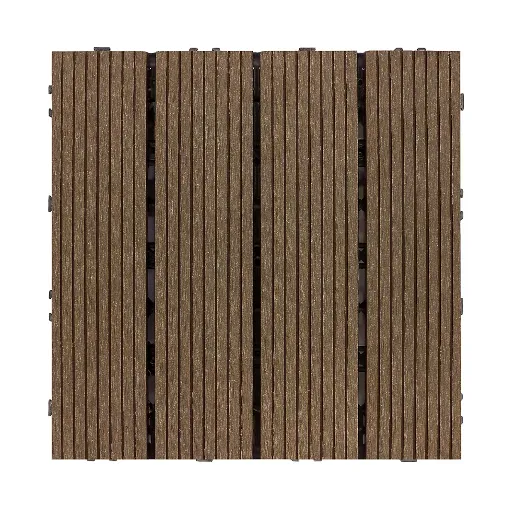
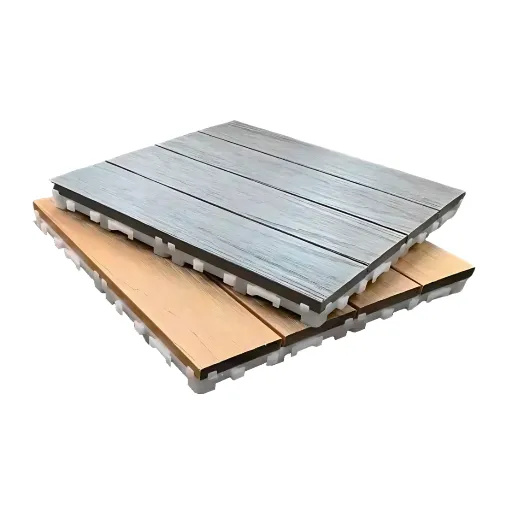
WPC deck tiles are modular, interlocking outdoor flooring panels made from wood-plastic composite. A typical tile blends 50–60% recycled wood fiber with 30–40% HDPE plastic and small amounts of UV stabilizers, coupling agents, and colorants. The most common size is 300 × 300 mm. Thickness is usually 21–22 mm, though larger formats exist.
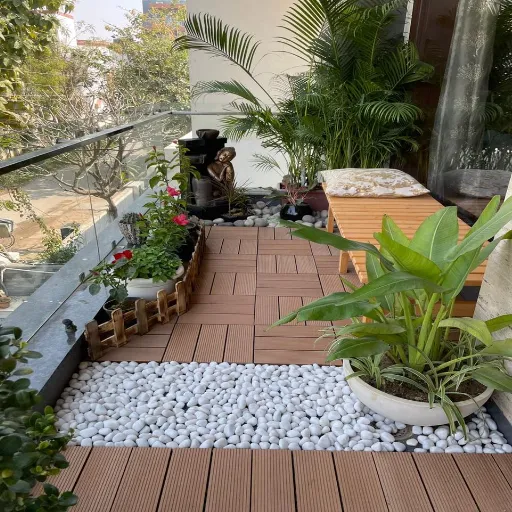
Each tile connects to its neighbors through a built-in plastic grid, dovetail tabs, or click-together base. That design lets you install a floating floor over concrete, existing decking, compacted gravel, or even rooftop membranes. You don’t need battens, screws, or professional tools. Common applications include balconies, terraces, rooftops, poolside areas, patios, garden pathways, and temporary event flooring.
If you want a broader overview of modular systems, see our guide to modular WPC decking.
Why Source WPC Deck Tiles from China?
China dominates global WPC production for several practical reasons. First, the country has a complete supply chain for raw materials. Second, most established factories understand CE, ASTM, and FSC requirements for Western markets. Third, competitive labor and energy costs keep per-tile pricing attractive without forcing buyers into massive single-item orders.
Chinese suppliers also offer wide customization. You can often choose colors, surface textures, cap layers, packaging, and even mold sizes. Many manufacturers support private-label cartons and instruction sheets.
That flexibility is why a German distributor we worked with was able to source balcony tiles from a Linyi factory, start with a 500-piece sample order, and scale to two containers per quarter once third-party inspections passed consistently.
Major WPC Deck Tile Manufacturing Regions in China
Not every region produces the same type of tile. Knowing the cluster strengths helps you shortlist faster and negotiate from a position of knowledge.
| Region | Strengths | Best For |
|---|---|---|
| Linyi, Shandong | Cost-competitive, high volume, fast sampling, strong trade infrastructure | Budget to mid-range bulk buyers |
| Anhui | R&D focus, bamboo-plastic composites, strong testing labs | Buyers needing innovation or technical documentation |
| Zhejiang | Export-oriented, better QC, stronger English support | Buyers prioritizing quality and communication |
| Guangdong | Premium co-extrusion tiles, mature supply chains | High-end residential and hospitality projects |
| Jiangsu | Large-scale automation and diverse finishes | Buyers needing consistent batch quality |
Linyi and Shandong remain the most accessible hub for first-time importers. Factory density is high. Tooling costs are lower. Many trading companies bridge language and logistics gaps.
Anhui suppliers often lead in technical innovation and formal lab testing. Zhejiang and Guangdong tend to deliver higher-end finishes and better documentation but at slightly higher prices.
Top WPC Deck Tile Manufacturers China Buyers Should Know
The following manufacturers frequently appear in industry lists and buyer searches for WPC deck tiles. Rankings change depending on whether you need budget DIY tiles, co-extrusion premium tiles, or large-format commercial tiles.
LvsenWood (Shandong)
LvsenWood operates 60+ production lines with an annual capacity above 50,000 tons. The company holds ISO 9001, CE, and ENF-level environmental certifications and exports to more than 50 countries. Its product range includes WPC decking, wall cladding, fences, and outdoor furniture.
Sentai WPC Group (Anhui)
Sentai has 15+ years of experience and brands such as Wondertech, Kindwood, and EVA-LAST. It runs a CNAS-certified lab and offers WPC/BPC decking, wall panels, fences, integrated houses, and capped composites.
Unifloor (Shanghai/Zhejiang)
Unifloor runs an 8,000 m² factory with 63 extrusion machines and offers a 15-year warranty. It specializes in eco-friendly hollow decking and WPC deck tiles, with CE, SGS, and FSC certifications.
Guofeng New Materials (Jiangsu)
Founded in 2002 in Nanjing, Guofeng produces WPC decking, fences, and planter boxes. It has supplied major exhibitions including the Shanghai World Expo and Xi’an World Expo.
Hosung / Feelingwood (Anhui)
Hosung focuses on 3D deep-embossed decking, cladding, and pergolas. It holds ISO 9001, ISO 14001, CE, and SGS certifications and offers premium co-extrusion options.
Hanming (Zhejiang)
Established in 2016, Hanming specializes in capped WPC decking and scratch-resistant products, exporting to 30+ countries including South Africa, India, and Australia.
Sanjin WPC (Guangdong)
Sanjin uses up to 60% reclaimed materials and produces fireproof, waterproof WPC decking with lifespans up to 25 years.
GreenCovering (Factory Direct)
GreenCovering reports 16 years of WPC manufacturing, a 70,000 m² factory, 30+ extrusion lines, and CE, ISO 9001, Intertek, and FSC certifications. It offers OEM/ODM services and exports to 70+ countries.
BOHAI Woods (Tile Specialist)
BOHAI Woods markets composite deck tiles made from 95% recycled wood-plastic composite, emphasizing splinter-free, mold-resistant, low-maintenance click-system installation.
Anji Zhengyuan WPC (Tile-Focused)
Zhengyuan supplies swimming pool waterproof anti-slip WPC interlocking floor tiles. It reports 10+ years of experience, 30+ extrusion lines, and capacity for 100+ containers per month.
For a broader look at WPC decking suppliers beyond tile specialists, read our guide to WPC decking suppliers in China.
Factory vs. Trading Company: Which Should You Choose for Deck Tiles?
Factories and trading companies both play important roles in Chinese exports. The right choice depends on your order size, technical needs, and risk tolerance.
Factory advantages
- Direct pricing without intermediary margin
- Full control over customization, molds, and production scheduling
- Easier access to technical staff and production floor visits
- Better suited to large, repeat orders
Trading company advantages
- Smaller MOQs because they consolidate orders across multiple factories
- Multilingual support and export documentation
- Quality consolidation across several product lines
- Faster problem resolution when issues arise
A trading company based in Linyi can be especially useful if you want the cost advantages of the Shandong production hub without managing five different factories yourself. That is the model Linyi Yuheng uses. We source from vetted manufacturers, consolidate shipments, and handle export documentation so buyers receive consistent product.
How to Find Reliable WPC Deck Tile Manufacturers in China
Start with a multi-channel approach. Relying on one directory increases the chance of missing better options or falling into a filtered list.
B2B platforms. Alibaba, Made-in-China, and Global Sources list thousands of WPC deck tile suppliers. Filter by business type (manufacturer vs. trading company), certifications, export markets, and years in operation. Look for suppliers with trade assurance or verified badges, but treat badges as a starting point, not proof of quality.
Industry exhibitions. The Canton Fair in Guangzhou, DOMOTEX asia / CHINAFLOOR in Shanghai, and the Linyi Wood Expo let you see tiles, test samples, and meet suppliers face-to-face. Even one visit can save months of back-and-forth email negotiation. According to industry lists from China Yansir, tile-specialist suppliers are concentrated in these production hubs.
Customs and export data. Tools like Volza and Panjiva show real export records. If a supplier claims large volumes but customs data shows no recent shipments, ask for clarification.
Referrals. Other importers in your market are often the best source of honest feedback. Join industry groups, attend trade shows, and ask suppliers for references in your region.
Supplier Verification Checklist for WPC Deck Tiles
Before sending a deposit, verify the basics. A legitimate, capable supplier will not resist reasonable checks.
- Business license and export license
- Factory address and video tour or in-person audit
- Certifications relevant to your market: CE, ASTM D7032, FSC, ISO 9001, SGS, REACH
- Production capacity: number of extrusion lines, monthly output, typical lead times
- In-house lab or third-party test reports
- Export references in your region
- Sample quality that matches quoted specifications
- Clear payment terms (30% deposit / 70% against bill of lading copy is common)
A hotel developer in Southeast Asia avoided months of callbacks by specifying ASTM D7032 test reports and slip-resistance data before placing a rooftop lounge order. The upfront diligence cost a few days; the avoided rework was worth far more.
How to Evaluate WPC Deck Tile Quality
Two tiles can look identical in photos but perform very differently outdoors. Focus on these criteria.
Thickness and load capacity. Standard residential tiles are 21–22 mm thick. Heavy-duty commercial applications may need 25 mm or more. Ask for load-deflection data if the tiles will support furniture, planters, or foot traffic in hospitality settings.
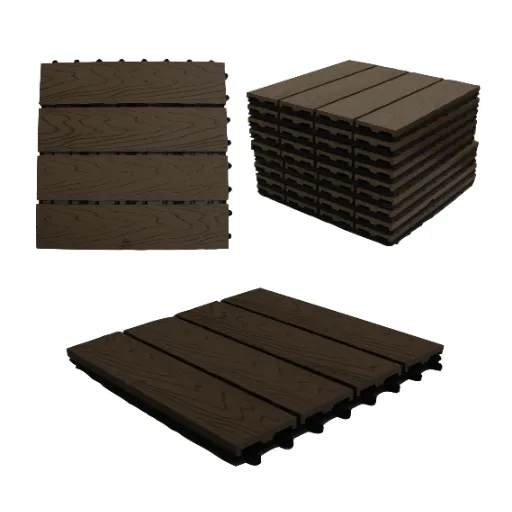
Interlocking mechanism strength. Plastic clips or dovetail tabs should snap firmly without cracking. Weak clips loosen over time and create trip hazards. Test samples by connecting and disconnecting them repeatedly.
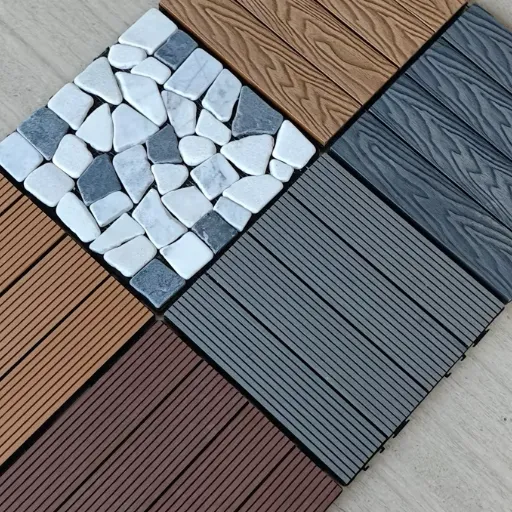
Surface treatment. Sanded, brushed, and 3D embossed finishes each give a different look and feel. 3D embossing tends to hide scratches better but may collect dirt more easily.
Cap layer / co-extrusion. Capped tiles have a protective polymer shell that resists UV, stains, and moisture better than uncapped tiles. They cost more but last longer and need less maintenance.
Water absorption and UV resistance. WPC water absorption is roughly 1.5% compared with about 20% for ordinary wood. Ask for test data, especially for poolside or wet climates.
Color consistency and edge finish. Inspect multiple samples from the same batch and across batches. Rough edges or color drift signal weak process control.
For a deeper product-selection framework, see our article on how to choose WPC deck tiles.
WPC Deck Tile Pricing and MOQ from China
Pricing varies by grade, finish, cap layer, and order volume. Use these ranges as a baseline when reviewing quotes.
| Grade | Price per 300 × 300 mm tile | Price per m² | Typical MOQ |
|---|---|---|---|
| Budget hollow/basic WPC tiles | $0.92–$1.60 | $10–$18 | 1,000–2,000 pcs |
| Mid-range WPC tiles | $1.60–$2.50 | $18–$28 | 500–1,000 pcs |
| Premium co-extrusion / capped tiles | $2.50–$3.67+ | $25–$45+ | 300–500 pcs or 400 m² |
| Large-format / special sizes | Varies | $2.75–$22.50 | 100+ m² |
Hidden costs to factor in
- Samples: $30–$150 including international shipping
- New mold fees for custom sizes or colors
- Packaging upgrades (pallets, color boxes, private labels)
- Third-party inspection: $300–$800 per visit
- Shipping and customs duties
If your budget is tight, our modular WPC decking cost guide breaks down FOB, freight, and landed cost calculations in more detail.
The Import Process for WPC Deck Tiles Step by Step
A typical tile order moves through these stages.
- Define specifications. Confirm size, thickness, color, surface finish, cap layer, and quantity.
- Request quotes. Contact 5–10 suppliers, ask the same questions, and compare apples-to-apples.
- Order samples. Test samples for color, weight, clip strength, water absorption, and UV exposure.
- Place a trial order. Start with the smallest practical quantity to validate quality and logistics.
- Confirm proforma invoice and deposit. Standard terms are 30% deposit, 70% against B/L copy.
- Monitor production. Request photos or videos during extrusion and packing.
- Arrange third-party inspection. Especially important for first orders.
- Pay balance and ship. Confirm Incoterms (FOB, CIF, DDP) and customs documentation.
- Receive and inspect. Check quantities, packaging, and visible defects before unloading.
- Install. Follow manufacturer guidelines for expansion gaps, drainage, and sub-surface preparation.
For installation guidance, see our guide on how to install WPC decking.
Common Red Flags and How to Avoid Scams
Low-quality suppliers often display the same warning signs.
- Prices 30% or more below market rate
- No verifiable factory address or refusal to do a video tour
- Pressure to pay 100% upfront
- Refusal to provide samples
- Vague answers about certifications or composition
- Inconsistent communication or constant changes in contact persons
- Promises of “same as brand X” without test reports
Protect yourself. Use secure payment methods. Visit or audit the factory. Verify certifications independently. Always start with a sample and a small trial order.
FAQ
How do I find the best WPC deck tile manufacturers in China?
Start with B2B platforms, industry exhibitions, and customs data. Shortlist suppliers by region, certifications, and export experience, then verify with samples and factory audits.
What is the minimum order quantity for WPC deck tiles from China?
MOQs range from 50–100 pieces for basic Alibaba listings to 1,000+ pieces for factory-direct wholesale pricing. Large-format or custom tiles may require 100+ m².
How much do WPC deck tiles cost from China?
Standard 300 × 300 mm tiles typically cost $0.92–$3.67 per piece, or $10–$45 per m² depending on grade and cap layer.
What certifications should WPC deck tiles have?
CE for Europe, ASTM D7032 for North America, ISO 9001 for quality management, FSC for responsible wood sourcing, and SGS or Intertek third-party test reports.
How do I verify a Chinese WPC deck tile factory is real?
Request a business license, export license, factory video tour, and references. Cross-check export records through customs data tools when possible.
Should I work with a factory or a trading company for deck tiles?
Choose a factory for large-volume customization. Choose a trading company for smaller MOQs, consolidated sourcing, multilingual support, and easier issue resolution.
Can WPC deck tiles be installed over concrete?
Yes. Interlocking WPC deck tiles are designed to float over concrete, pavers, compacted gravel, and existing decking, provided the surface is flat and drains well.
What is the difference between WPC deck tiles and WPC decking boards?
Tiles are modular, interlocking, and usually 300 × 300 mm. Boards are longer planks that require a substructure. Tiles suit DIY and temporary installations; boards suit permanent framed decks.
Conclusion
Sourcing WPC deck tiles from China gives you access to competitive pricing, flexible customization, and a wide range of finishes. But success depends on more than picking a manufacturer from a list. Match the region to your quality and budget needs, verify every supplier with a checklist, test samples under real conditions, and follow a clear import roadmap from first quote to final delivery.
If you are ready to compare samples, request a quote, or get help shortlisting WPC deck tile manufacturers in China, contact our team. We are based in Linyi and work with buyers worldwide to source quality composite tiles that perform.
Categories:
Blog
Related Articles