Acoustic Panel Coverage Percentage: How Much of a Room Should You Treat?
The right acoustic panel coverage percentage for most offices is 25-35% of the treatable wall and ceiling area. Open-plan offices often need only 10-15% wall coverage but 30-40% ceiling coverage, while video-conferencing suites can need 35-45% of both.
Coverage percentage is the single most important number in an acoustic treatment plan. It tells you how much of a room’s surface must absorb sound before echoes, reverb, and speech intelligibility problems start to disappear. Get it too low and the room still sounds hollow. Get it too high and the space can feel unnaturally dead.
This guide explains what acoustic panel coverage percentage means, how to calculate it for any room, and how room type, panel material, and budget change the target. You will leave with a practical percentage you can use for your next office project.
Key Takeaways
- Most office rooms need 25-35% of treatable wall and ceiling area covered.
- Open-plan offices need more ceiling coverage (30-40%) than wall coverage (10-15%).
- Lower-NRC panels like WPC or wood slat need a higher coverage percentage to match fiberglass performance.
- Always subtract doors, windows, and fixed cabinets before calculating treatable area.
- A room can be over-treated: coverage above 50-60% often makes a space sound unnaturally dead.
What Is Acoustic Panel Coverage Percentage?
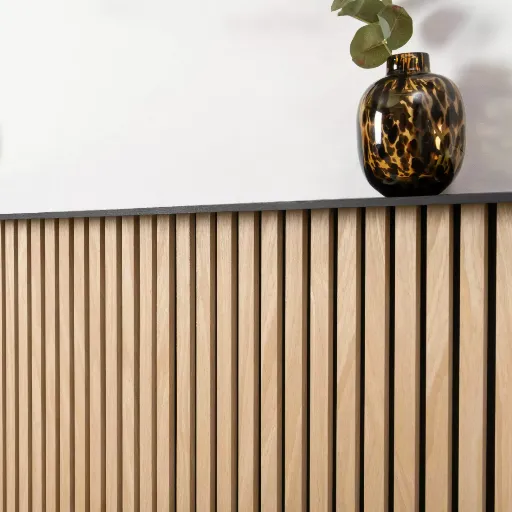
Acoustic panel coverage percentage is the share of a room’s treatable surfaces that you cover with absorbent panels. The formula is simple:
Coverage percentage = treated area ÷ treatable surface area × 100
Treatable surfaces are the parts of walls and ceilings where panels can actually go. They do not include doors, windows, projection screens, whiteboards, fixed cabinets, or large glass walls unless you plan to cover them with special transparent or mounted treatments.
This percentage is independent of panel size. Whether you use 2 x 2 ft panels, 2 x 4 ft panels, or custom-sized WPC slat modules, the coverage percentage tells you how much of the surface must be absorbent. The panel count then follows from the percentage.
For a deeper look at how coverage turns into panel count, see our acoustic panel coverage calculator.
The Basic Coverage Percentage Rule
Use these ranges as a starting point:
| Coverage Level | Wall Coverage | Ceiling Coverage | Best For |
|---|---|---|---|
| Light / 15-20% | 10-15% | 15-20% | Living rooms, lobbies, casual break areas |
| Standard / 25-35% | 20-30% | 20-30% | Offices, conference rooms, classrooms |
| Heavy / 35-45% | 30-40% | 30-40% | Video suites, call centers, recording studios |
| Very heavy / 50%+ | 40-50%+ | 40-50%+ | Critical listening rooms, broadcast studios |
Commercial Acoustics recommends planning for 25-35% of wall and ceiling surface area in NRC 0.85+ material for general commercial rooms.
Primacoustic suggests that covering 15-25% of the wall surface area with acoustic panels is a good starting point to hear a difference in most rooms.
These ranges are not guesses. They come from decades of room-acoustic testing and the Sabine reverberation model. They give you a reliable target before you start counting panels.
How to Calculate Acoustic Panel Coverage Percentage
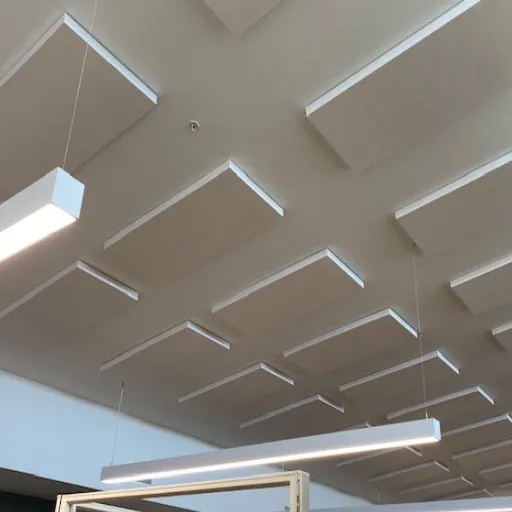
Follow these six steps for any room:
- Measure wall area: 2 × (length + width) × ceiling height.
- Measure ceiling area: length × width.
- Subtract untreatable surfaces: doors, windows, whiteboards, cabinets, glass walls.
- Choose your coverage percentage by room type.
- Calculate treated area: treatable surface × coverage percentage.
- Convert to panels: treated area ÷ area of one panel.
Worked Example: 12 x 15 ft Office at 30% Coverage
- Wall area: 2 × (12 + 15) × 10 = 540 sq ft
- Ceiling area: 12 × 15 = 180 sq ft
- Untreatable (window + door): ~60 sq ft
- Treatable wall area: 480 sq ft; treatable ceiling area: 180 sq ft
- At 30% coverage: 144 sq ft walls + 54 sq ft ceiling = 198 sq ft total
- With 2 x 4 ft panels (8 sq ft each): 198 ÷ 8 = 25 panels
That is how coverage percentage becomes a real order quantity. For the full room-by-room quantity method, see our guide on how many acoustic panels you need for an office.
Office Coverage Percentages by Room Type
Different rooms do different acoustic work. A phone booth needs near-full coverage. A break room may only need light treatment.
| Room Type | Wall Coverage | Ceiling Coverage | Why |
|---|---|---|---|
| Open-plan office | 10-15% | 30-40% | Ceiling is the main noise path across many desks |
| Conference room | 25-35% | 25-35% | Balanced wall and ceiling control for speech clarity |
| Private office | 15-20% | 20-30% | Smaller volume, fewer hard surfaces |
| Call center | 20-30% | 30-40% | Extreme voice density needs more absorption |
| Reception / lobby | 15-25% | 20-30% | Aesthetics and first impressions matter |
| Huddle room | 20-30% | 20-30% | Small room with lots of voice energy |
For conference room specifics, see how many acoustic panels for a conference room. For open-plan layouts, see how many acoustic panels for an open plan office.
Mini-Story: In a 40-desk open-plan office in Austin, the facilities team installed 30 wall panels but left the ceiling bare. The echo barely changed because sound travels across the ceiling plane, not the walls. They moved most of the budget to ceiling baffles at 35% ceiling coverage. Employee complaints about call noise dropped by half within a week.
Wall vs Ceiling: How to Split Coverage
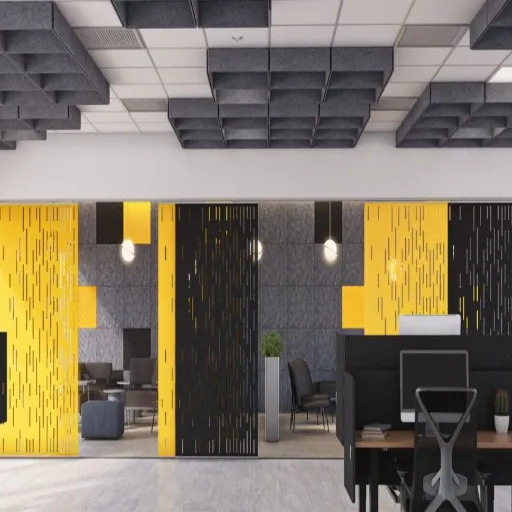
One of the biggest mistakes in office acoustics is treating walls and ceilings as the same problem. They are not.
- Open-plan offices: prioritize the ceiling. Sound travels laterally across a large floor plate, and the ceiling is the first surface it hits. Use 30-40% ceiling coverage and 10-15% wall coverage.
- Small meeting rooms and private offices: walls carry more of the load because the volume is smaller and voices reflect off side walls. Use 20-30% wall coverage and 20-30% ceiling coverage.
- Glass-heavy rooms: when walls are mostly glass, you cannot treat them. Shift coverage to the ceiling and any remaining solid walls.
A common commercial rule is a 60/40 wall-to-ceiling split for general commercial spaces. In offices, that often flips to 40/60 or even 30/70 because of open-plan ceilings and hard floors.
How Panel Material NRC Affects Coverage Percentage
Not all panels absorb equally. A panel’s Noise Reduction Coefficient (NRC) tells you how much sound it absorbs on a scale from 0 to 1. Higher NRC means you need less coverage.
| Material | NRC Range | Coverage Adjustment vs Fiberglass |
|---|---|---|
| Fiberglass / mineral wool | 0.85-0.95 | Baseline |
| PET felt | 0.75-0.85 | +10-15% |
| Wood slat with PET backing | 0.50-0.80 | +20-30% |
| WPC perforated | 0.50-0.75 | +25-30% |
For example, if a fiberglass installation calls for 30% coverage, a WPC installation might need 38-40% coverage to deliver the same total absorption. That does not mean WPC is worse. It means WPC is doing double duty as a finished design surface, and the higher coverage is part of the aesthetic trade-off.
If you are planning a wood slat feature wall, our guide on how many wood slat acoustic panels per wall walks through the calculation. For WPC projects, see our WPC acoustic panel quantity guide.
Mini-Story: A design firm in Toronto wanted WPC slat panels in a client boardroom. The architect originally budgeted for 25% coverage based on a fiberglass estimate. Their Yuheng rep pointed out that the wood slat NRC of 0.65 would need closer to 35% coverage to match performance. They adjusted the layout, and the boardroom passed the client’s RT60 target on the first test.
Budget Tier Coverage Percentages
Coverage percentage is also a budget lever. You can scale up or down based on performance needs.
| Tier | Coverage % | Best For |
|---|---|---|
| Minimum acceptable | 15-20% | Tight budgets, low-traffic areas, break rooms |
| Standard | 25-35% | Most offices, conference rooms, daily meeting spaces |
| Premium AV | 35-50% | Video-conferencing suites, boardrooms, recording spaces |
Use the minimum tier only when the room is not used for focused work. For daily conference calls or open-plan collaboration, standard coverage pays for itself in fewer misheard conversations and less fatigue.
Common Mistakes About Acoustic Panel Coverage Percentage
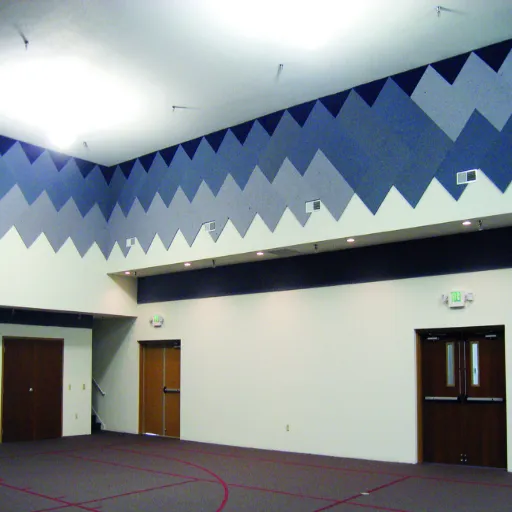
- Ignoring the ceiling. In many offices, the ceiling is the largest untreated surface and the most important one.
- Using the same percentage for every room type. A huddle room and a boardroom have very different needs.
- Assuming all panels absorb equally. NRC varies widely by material.
- Forgetting to subtract untreatable areas. Doors and windows are not part of the calculation.
- Thinking more is always better. Coverage above 50-60% can make a room feel dead and uncomfortable.
- Not adjusting for hard surfaces. Glass, concrete, and tile reflect more sound and often need higher coverage.
How to Tell If Your Coverage Percentage Is Right
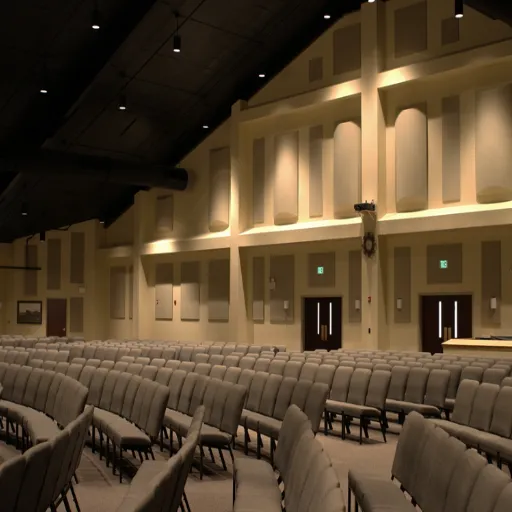
You do not need expensive equipment to check your work.
- Clap test: clap in the center of the room. A sharp ringing tail means you need more coverage.
- RT60 app: measure reverberation time and compare it to your target.
- Speech test: have a conversation across the room. If voices sound clear but not hollow, you are close.
- Video call test: record a meeting and listen for echo or distant voices.
Start with the recommended percentage, then add panels to problem areas rather than guessing from the beginning.
Frequently Asked Questions
What percentage of a wall should be covered with acoustic panels?
For most offices and conference rooms, cover 20-30% of treatable wall area with acoustic panels. Light-use spaces can use 10-15%, while video-conferencing suites may need 30-40%.
Is 20% wall coverage enough for acoustic panels?
20% wall coverage is enough for light echo reduction in casual spaces. It is usually not enough for conference rooms, call centers, or any room used for video calls, where 25-35% is a better target.
How do I calculate acoustic panel coverage percentage?
Measure your treatable wall and ceiling area, subtract doors and windows, choose a coverage percentage by room type, then multiply. For example, 500 sq ft of treatable wall at 30% coverage means 150 sq ft of panels.
Does ceiling coverage count toward acoustic panel coverage percentage?
Yes. Ceiling coverage is often the most important part of the total, especially in open-plan offices. Add wall and ceiling treated areas together, then divide by total treatable surface area.
How does NRC affect coverage percentage?
Higher-NRC panels absorb more sound per square foot, so you need less coverage. Lower-NRC panels like WPC or wood slat need 20-30% more coverage to deliver the same acoustic result.
Do I need more coverage for glass-walled rooms?
Yes. Glass reflects almost all sound, so untreated glass walls increase the load on remaining surfaces. Add ceiling coverage and treat every non-glass wall more aggressively.
Can you have too much acoustic treatment?
Yes. Coverage above 50-60% of total surface area can over-absorb a room, making it feel unnaturally quiet and tiring to speak in. Most office spaces perform best between 25% and 35%.
Conclusion
Acoustic panel coverage percentage is the foundation of every successful treatment plan. For most offices, the target is 25-35% of the treatable wall and ceiling area. Open-plan spaces need more ceiling coverage, while small speech rooms need more wall coverage. Lower-NRC materials like WPC and wood slat need higher percentages, but they also deliver design value that plain panels cannot match.
Keep these principles in mind:
- Calculate from the treatable area, not the total room size.
- Match the percentage to the room type and use case.
- Split wall and ceiling coverage based on how sound actually travels.
- Adjust for panel NRC, especially with decorative materials.
- Test and tune rather than over-treating from the start.
At Linyi Yuheng International Trading Co., Ltd., we help architects and facilities teams choose the right acoustic panel coverage percentage for WPC and wood slat projects. Send us your floor plan, and we will return a coverage target, panel layout, and factory-direct quote.
[Request Your Free Acoustic Coverage Plan and Quote →]
Categories:
Blog
Related Articles