WPC TV Wall Panel: Design Ideas & Planning Guide (2026)
A WPC TV wall panel works best when you plan four things before you buy anything: the panel proportions, the cable and socket route, how the TV itself will be mounted, and where the lighting goes. Get those right and a media wall looks expensive and stays serviceable. Get them wrong and you end up with visible cables, a TV hanging from a surface that was never designed to carry it, and a wall you can’t fix without dismantling it.
Most guides show you the finished photograph and skip the part that made it possible. This one does the opposite. Whether you’re framing one wall in an apartment or specifying media walls across 150 hotel rooms, you’ll finish knowing how to design, wire, mount and light a WPC media wall that lasts. We supply WPC interior panels factory-direct from Linyi, Shandong, and we see the same four mistakes again and again.
Key Takeaways
- A WPC panel is a decorative finish, not a structural board. Fix the TV bracket through the panel into battens or the structural wall with 75 mm+ fixings, and allow a safety margin of about 5x the combined TV and mount weight.
- Extend panels 400-600 mm past each edge of the TV, never less than 300 mm, and set the screen centre at roughly 100-127 cm from the floor.
- Plan the cable, socket and service route before the wall closes. This single step prevents the most common media wall failure.
- Budget for the hidden costs as well as the panels: battens, adhesive, trims, waste, LED strips and drivers, conduit and labour together add 20-35% to the material price.
- WPC louvers reduce echo by scattering high frequencies. They don’t soundproof a room.
Why WPC Panels Work on a TV Wall
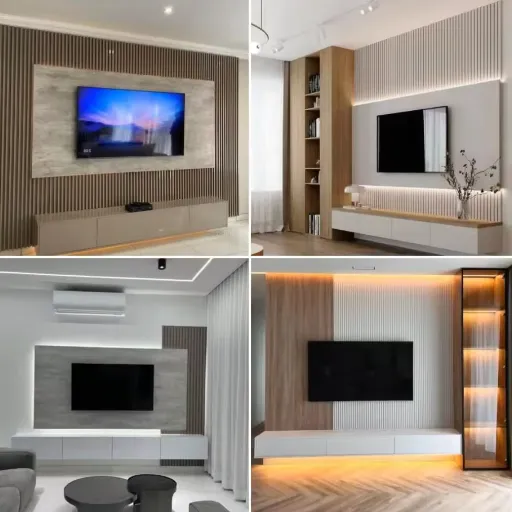
A TV wall sits behind a heat source, holds a bundle of cables, and is the surface every visitor looks at first, which makes it a demanding place for any finish.
Wood plastic composite blends wood fibre and polymer, typically around 55-65% wood content with the balance HDPE or PP. That formulation stays stable through the temperature and humidity swings a living room sees across a year. Water absorption after a 24-hour immersion test sits at 0.5-1%, so a spill or a damp wall doesn’t swell the panel the way it swells MDF.
The payoff is no repainting, no sanding and no annual sealing, with a finish that stays consistent from panel to panel. Living rooms, bedrooms, home offices and hotel guest rooms are the natural applications; continuously wet zones are not. For grade selection, our complete buyer’s guide to WPC wall panels goes deeper.
Design Ideas for a WPC TV Wall
The design you choose dictates the installation underneath it. Deep slats need deeper battens, a curved profile won’t follow a tight radius without a bendable variant, and a floating console needs a frame behind it. For a broader sweep of options across the whole room, see our accent wall panel ideas.
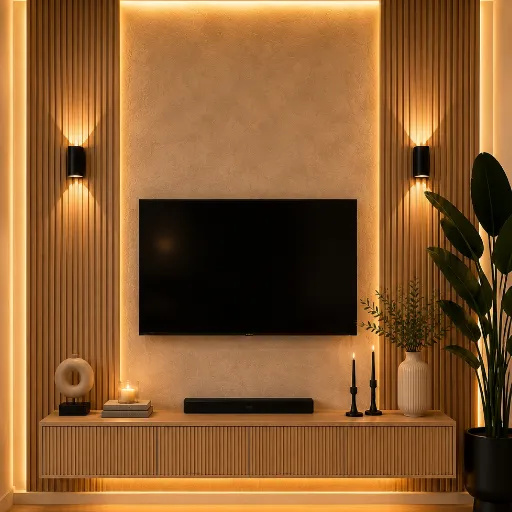
Floor-to-Ceiling Full-Wall Feature
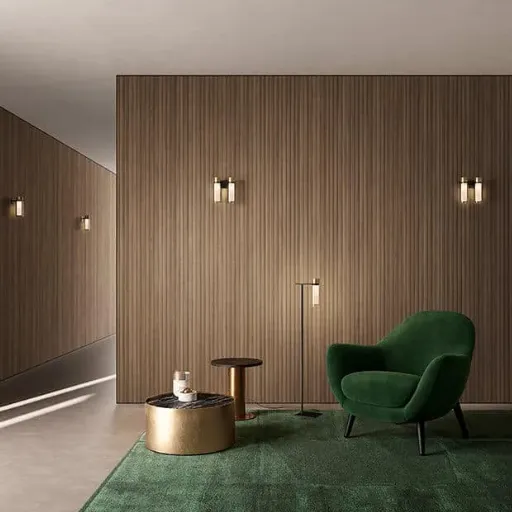
Panelling the entire wall behind the TV gives the strongest architectural result, and vertical grooves draw the eye upward so a standard 2.4 m ceiling feels taller. Buildability note: a full-wall run spans the whole width, so plan the expansion gap at both ends and along the ceiling. Full coverage also hides the cable route completely, which is a benefit as long as you planned it first.
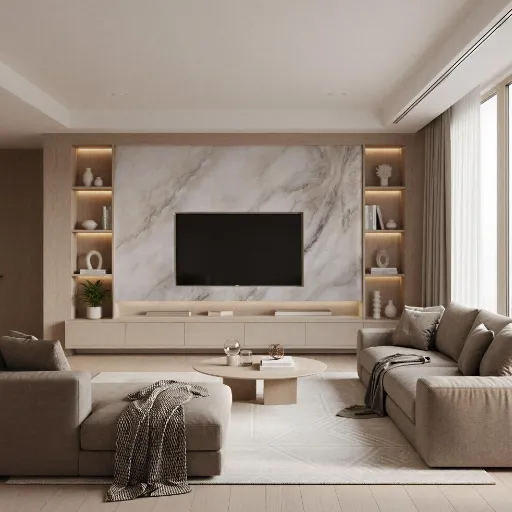
Framing Just the TV Zone
Instead of covering the wall, box the TV area with panels and leave the surrounding surface in paint. This suits apartments, small living rooms and bedrooms. Buildability note: stop the panels less than 300 mm from the screen and it reads as an afterthought, so aim for 400-600 mm each side. Our living room WPC wall panel design guide covers room-level layout decisions in more detail.
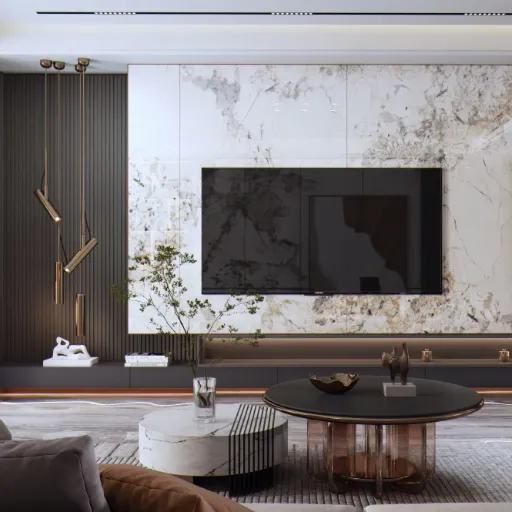
Two-Texture Media Walls: WPC Louvers with Marble, HPL or Glass
Pair vertical WPC louvers with a marble-look HPL or UV sheet in the centre and the TV sits on a clean backdrop while the louvers add depth around it. Fluted profiles, such as the narrower wpc fluted wall panel, work well here because the tighter spacing reads as a single textured field rather than separate slats. A slim metal channel between the materials makes the wall read as considered rather than busy. Buildability note: materials differ in thickness, so set the batten depth to finish both surfaces flush or the transition lands as an awkward step.
Two-Tone Blocks, Floating Consoles and Slat Partitions
Split the wall between two tones, light above and darker grooved below, and the TV feels grounded. A floating console keeps the floor line clear and hides set-top boxes, while a slat partition to one side zones the seating area without blocking light. Buildability note: colour-blocking exposes batch mismatch faster than any other layout because two tones from different runs sit side by side, so order the full quantity in one batch; our guide to WPC wall panel colours explains how to specify this. The console needs a frame and a cable route into its cavity, and a freestanding partition needs floor and ceiling fixings or a frame with enough mass to stay stable.
Planning the Wall Before You Buy Anything
This sequence decides whether the finished wall works. Write the answers down before you order a single panel.
- Measure the wall and the TV. Wall width and height, TV width, VESA pattern, screen weight, and mount type (fixed, tilt or articulating).
- Decide coverage. Full wall, or framing the TV zone? This changes your panel count and batten layout.
- Set proportions. 400-600 mm past each edge of the TV, never less than 300 mm, with symmetrical margins and spare width for a future larger screen.
- Set the TV height. Screen centre at roughly 100-127 cm from the floor, about 110-120 cm for a 50-inch screen, aligned with seated eye level.
- Plan the cable and power route, plus the LED channel and driver location. These are the steps most people skip.
- Plan ventilation. Leave about 10 cm around the screen; a sealed cavity holding a TV, an LED strip and a driver runs hot.
- Order 5-8% extra panels for cutting waste, and 10-15% for complex layouts.
Want to check the finish against your room before you commit? Request a physical sample kit and compare the panels under your own lighting. Request free samples →
Cables, Sockets and Service Access: The Step Everyone Skips
Daniel finished a walnut louvered media wall for a client in Rotterdam in February. It looked superb for about three weeks, until the client added a soundbar and a second streaming stick and discovered there was nowhere to plug them in and no way to reach the cables without pulling panels off the wall. The retrofit cost almost a third of the original install.
Every one of those problems was avoidable at the planning stage. Resolve the following before the panels close.
Build the plenum. Fix horizontal battens, typically 20×40 mm, top, middle and bottom, then mount the panels to them. That creates roughly a 20 mm cavity for cables; deeper framing, such as 2×2 or 2×4, gives more room for larger service runs.
Create a service recess. Fit a recessed power outlet and a low-voltage pass-through directly behind the TV, keeping mains power and signal cables on separate runs and the power side to code. This is standard practice on a properly built TV back panel, as the EngineerFix cable guide sets out.
Leave a pull-wire. Run a spare conduit with a pull string during installation, so when the next device arrives you fish the cable through in minutes instead of opening the wall. Decide now how you’ll reach a set-top box; a removable or hinged panel beats dismantling the feature wall.
Cut cleanly around outlets. Cut the panel around sockets and switches, finish the cut edge, and use grommets where cables pass through. A ragged cut around a visible socket undoes the finish.
Still deciding whether battens or adhesive suit your wall? Our general WPC wall panel installation guide walks through the methods, and the step-by-step feature-wall build lives in how to install WPC wall panels on a wall.
Can You Mount a TV on WPC Wall Panels?
Not on the panel alone. A decorative WPC panel is a finish, not a structural board, and it should never be the surface that carries a television. Mount the bracket through the panel, into the battens or the structural wall behind it. The panel is what you look at; the wall and frame are what hold the TV.
Capacity depends on the full chain: fixture, load, bracket, fixing, panel, substrate and structural support. A tested pull-out value for one fixing point doesn’t prove the assembly is safe. The iGoodsDeco panel-fixing explainer puts it plainly: decorative panels are not universal structural mounting boards unless the exact system has been designed and verified for that purpose.
What that means in practice:
- Cut a service aperture where the bracket lands, because the bracket fixes to the wall, not the panel face.
- Locate studs or add structural backing. Screws alone into drywall or plaster work loose under load.
- Use 75 mm+ fixings through the panel and batten into masonry or concrete.
- Allow roughly 5x the combined weight of the TV and mount as your safety margin; QuickMountTV’s weight guide covers the reasoning.
- Reinforce for large screens. A 55-85 inch screen on a VESA 400×400 pattern needs verified reinforcement, and a full-motion arm multiplies the strain on the wall plate, so a moderate TV on a long arm stresses the fixing like a much heavier static load.
- Keep spare panels in case the bracket penetrates the finish and you need a matching replacement.
The panel isn’t the weak point. A panel used as the only support is.
Lighting a WPC TV Wall
Lighting separates a good media wall from a memorable one, and it’s cheap to add if you plan the channel before the wall closes. Warm white between 2700K and 3000K suits wood tones and gives a cinematic feel, so keep the strip dimmable to drop intensity at night without glare bouncing off the screen. Four placements cover most projects: a bias light strip behind the TV to soften contrast in a dark room; top-down grazing light along the top edge to reveal slat texture, the most common choice in high-end residential and hospitality work; recessed LEDs between panel rows for a floating effect; and a perimetral light line separating the main panel from the background for a home-cinema look.
Only the wall’s reflection should be visible. If you can see individual LED dots, the strip is too close to the surface or lacks a diffuser, so use a profile or channel for a continuous, dot-free line and site the driver where you can reach it later. Retrofitting LEDs into a closed wall is difficult, so treat this as a pre-install decision.
WPC vs MDF vs Wood Slat vs PVC for a TV Wall
The short version: WPC wins on moisture, maintenance and colour consistency, MDF wins on upfront price, wood slat wins on natural grain, and PVC wins on cost in wet zones only.
| Factor | WPC | MDF | Wood Slat | PVC |
|---|---|---|---|---|
| Cost (relative) | Medium | Low | High | Low-Medium |
| Moisture resistance | Very good (0.5-1% absorption) | Poor (swells with moisture) | Moderate, needs sealing | Good |
| Weight | Medium-Heavy | Medium | Medium-Heavy | Light |
| Indoor lifespan | 15-25 years | 8-12 years | 20+ years with recoating | 10-15 years |
| Maintenance | Wipe-clean, no repainting | Paintable, but swells and borers | Recoat every 3-5 years | Wipe-clean |
| Finish consistency | Consistent across batches | Varies with paint | Natural variation | Uniform, less convincing |
| Best for a TV wall | Yes, best all-round | Dry rooms on a tight budget | Feature walls where grain matters | Wet zones only |
MDF is the trap. It is the cheapest option and it paints beautifully, but a sample can swell by around 30% after only two hours of moisture exposure, which behind a TV in a humid room or over a radiator is a short-lived finish. Most designers settle on a hybrid: WPC on the TV zone and paint on the remaining walls. See WPC vs solid wood in detail and how WPC compares with PVC panels for the material breakdowns.
What Does a WPC TV Wall Cost?
Panel price is the number everyone quotes and the number that misleads. Factory-direct WPC interior panels sit in a wide range by grade, and the accessories around them add a consistent 20-35%.
| Grade | Typical Factory Range (per m2) | Notes |
|---|---|---|
| Budget hollow-core | Entry level | Lightest, for dry rooms |
| Mid-range solid | Mid level | Better impact resistance |
| Co-extruded premium | Highest | Best finish durability and fade resistance |
Then add what nobody puts in the headline: battens and framing, construction adhesive, trims and edge profiles (12-18% of material cost), waste at 5-8% for simple layouts and 10-15% for complex patterns, LED strips and drivers plus the channel, conduit and cable, and labour or your own time.
Seven square metres of wall doesn’t mean seven square metres of panel. Once you add waste, trims, battens, adhesive, a 3 m LED run with a dimmable driver, conduit and fixings, a mid-range build lands noticeably above the panel-only figure. That gap is the whole point of quoting it. For current per-m2 pricing across grades, see our full WPC wall panel price breakdown by grade, and for a finish-category comparison across WPC, MDF, wood, PVC, wallpaper and paint, see living room wall panelling cost.
Ready to price your specific wall? Send us your dimensions and TV size and we will return an itemised media-wall quote. Get a media-wall quote →
Sourcing Panels and Specifying for Projects
A media wall is one wall per room, which makes it an ideal candidate for a factory-direct custom kit: the right lengths, the right colour, cut to reduce waste. Two habits prevent the most common sourcing complaint. First, order physical samples, because screens misrepresent wood tones and the gap widens under LED. Second, order the full quantity in one batch with a colour tolerance of dE 1.5 or better.
Maria, a procurement lead for a 150-room boutique hotel in Dubai, learned that second point the hard way. She signed off on a charcoal louver TV wall for every guest room in early 2025, and on the first floor the panels matched perfectly.
By floor eleven they had drifted a shade lighter, because three production batches had gone into the order. The fix was not a repaint. It was reordering eleven floors of panels with a single-batch commitment and a dE tolerance written into the contract.
That’s why a hospitality media wall is specified, not chosen. The approved package carries fire performance (B1, and EN 13501-1 Class B-s1,d0 for European projects, detailed in our fire-rated WPC panel compliance guide), low-VOC and E0 emission data so the wall can be used in sleeping areas, a dE 1.5 or better colour tolerance with batch records, and a stock of matching replacement panels because guest-room TV walls take impact.
Ask your supplier for that documentation up front: fire rating certificate, VOC or E0 emission report, batch traceability, and warranty terms, because factory versus trader usually shows up in exactly this paperwork. For how to vet a supplier, see how to evaluate WPC manufacturers in China, and to see the range we produce, browse our interior WPC panel range.
Frequently Asked Questions
Can TV walls be made with WPC panels?
Yes. WPC is stable, moisture-resistant and wipe-clean, and panels typically come 2.4-3 m long and 150-1220 mm wide, which covers most walls with few joints.
Can you mount a TV directly on a WPC wall panel?
No. Mount the bracket through the panel into battens or the structural wall using 75 mm+ fixings, and allow roughly 5x the combined TV and mount weight as a safety margin.
How do you hide the cables behind a WPC TV wall panel?
Fix horizontal battens to create a 20 mm cavity, route cables through it, and fit a recessed power outlet and low-voltage pass-through behind the TV. Leave a spare conduit with a pull-wire for future devices.
How far should the panels extend past the edge of the TV?
400-600 mm past each side of the screen, never less than 300 mm, with symmetrical margins and spare width for a future larger TV.
Do WPC TV wall panels reduce echo?
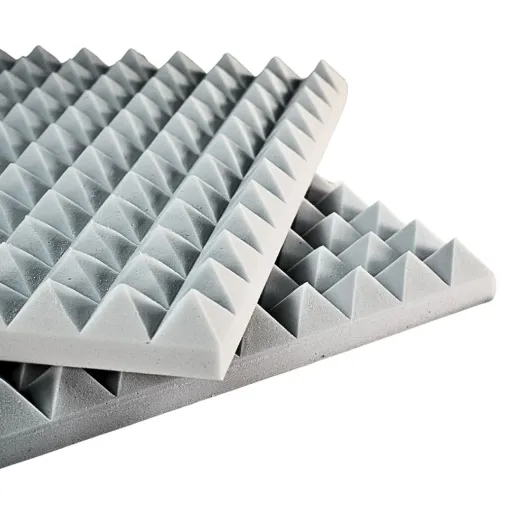
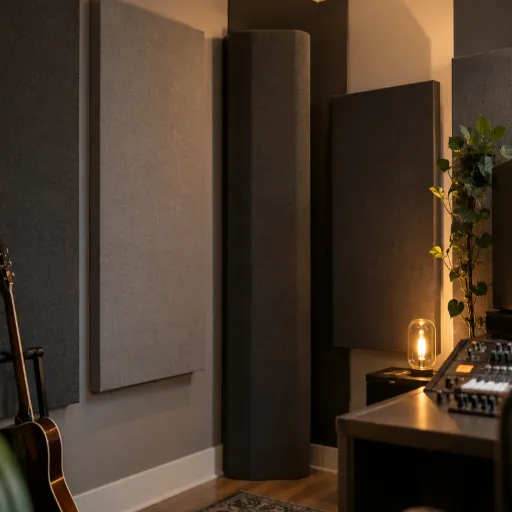
They scatter high frequencies, which is a modest but real improvement, but they don’t soundproof a room or block sound transmission. For genuine acoustic control you need an engineered felt-backed assembly, as our WPC acoustic panels for commercial spaces guide explains.
Are WPC panels better than MDF for a TV wall?
Yes, in most cases. WPC resists moisture and holds a consistent finish, while MDF is cheaper and paintable but swells badly with moisture and suits only dry, well-ventilated rooms.
Conclusion and Next Steps
A great media wall is a design decision and an engineering one. Design it, wire it, mount it, light it, in that order, and the result holds up.
Five things to carry into your project: mount the bracket through the panel to real structure with a 5x safety margin; set proportions deliberately at 400-600 mm past the TV with the screen centre around 110-120 cm; resolve cables, sockets and service access before the wall closes; budget 20-35% above panel price for everything around the panels; and be honest about acoustics, because louvers reduce echo but don’t soundproof.
If you’re planning a WPC TV wall panel for a home or a project, start with a physical sample. Tones behave differently under LED, and a five-minute comparison prevents an expensive mistake. Request a sample kit and tell us your wall dimensions, TV size and target finish. We will come back with panel options and an itemised quote.
Categories:
Blog
Related Articles