How to Reduce Noise in a Restaurant: 11 Fixes That Work
You reduce noise in a restaurant by fixing the surfaces that bounce sound, not by turning the music down and hoping. Start with the cheapest fixes, run a short audit to find out which problem you actually have, then spend real money only on the surface that is causing it. For most venues that means the ceiling.
Here is the part every other guide gets wrong. They hand you one ranked list as if every noisy restaurant has the same disease. It doesn’t.
A room that echoes when it’s empty and a room that’s fine until 8pm have almost nothing in common acoustically. Neither does a venue whose guests complain about chair scrape and one whose neighbours complain about bass. Four different problems, four different first moves.
Nadia found that out the expensive way. She owns a 40-seat café with a low ceiling and an espresso grinder six feet from the counter. She read three guides, bought $700 of foam panels, and glued them to the back wall.
Nothing changed. The wall was never the problem. Moving the grinder and putting felt pads on 40 chairs fixed most of it for under $150.
This guide walks you through the 11 fixes that work, ranked by what they cost per decibel. It also gives you a 15-minute audit to run first, so you spend on the right one.
Want the number for your room? Run your dimensions through our free RT60 calculator before you buy anything. Two minutes, and the rest of this guide becomes specific instead of general.
Key Takeaways
- Diagnose before you spend. Echo, chair scrape, neighbour complaints and loud music are four different problems. The first fix differs for each.
- The cheapest fixes are free or nearly free: felt pads cut chair and cutlery noise by 5 to 8 dB, and background music at 60 to 65 dBA removes the trigger that starts the spiral.
- Ceiling treatment is the highest-leverage purchase. Ceiling-only absorption cuts reverberation time by 40 to 60 percent. Wall-only cuts it by 15 to 25 percent.
- Soft furnishings buy a few decibels, not a fix. They are worth doing. They will not rescue a room measured at 2 seconds or more.
- Target 0.7 to 0.9 seconds RT60 for casual dining and 65 to 72 dBA at peak. Untreated hard-surface rooms land at 2.0 to 4.3 seconds and 77 to 85 dBA.
The 11 Fixes at a Glance
- Treat the ceiling. 30 to 50 percent coverage at NRC 0.85 or higher. Biggest single gain.
- Add wall panels at seated head height. 25 percent of wall area at NRC 0.70 or higher.
- Pull in soft goods you already own. Banquettes, rugs, heavy drapery, tablecloths.
- Stop over-treating. Below 0.5 seconds the room feels dead.
- Fit felt pads and rubber foot caps. 5 to 8 dB on chair scrape. Pennies per chair.
- Break the parallel lines. Shift tables so two hard walls stop facing each other.
- Relocate or isolate loud equipment. Grinders, ice machines, glassware, POS beeps.
- Zone the room. Screens, planting, high-backed booths. You don’t need full walls.
- Recalibrate the music. 60 to 65 dBA, distributed speakers, less bass.
- Service the noise you’ve stopped hearing. HVAC, hoods, loose panels.
- Call a professional. When the audit says the room, not the furniture, is the problem.
That order is by cost, not by impact. If your room echoes, jump to Path A. The ranking changes.
Why Your Restaurant Is So Loud (and Why It Gets Worse at 8pm)
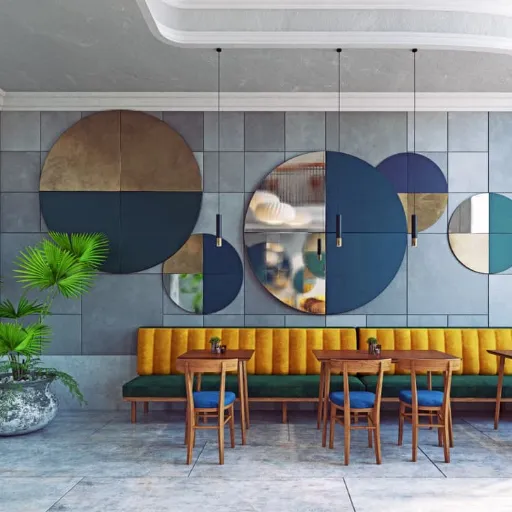
Restaurants are loud because they are built from materials that absorb almost nothing. Exposed concrete sits at 0.02, polished concrete at 0.02, brick at 0.04, glass at 0.05, hard timber tables at 0.05, metal chairs at 0.02 (AcousPlan).
Those numbers mean the surface returns 95 to 98 percent of the sound that hits it. A room built from them has a combined absorption coefficient near 0.03 to 0.05. Its untreated reverberation time lands somewhere between 2.0 and 4.3 seconds.
That alone would be manageable. What turns it into a nightly problem is the feedback loop.
The Lombard Effect: Why a Half-Empty Room Is Fine and a Full One Isn’t
People raise their voices automatically as background noise rises, at roughly 0.3 to 0.6 decibels of extra speech for every 1 decibel of ambient sound. Nobody decides to do this. It happens below conscious control.
So the room spirals. Six tables get loud, the seventh speaks up to be heard, and by 8pm the floor runs 10 dB hotter than it did at opening. Your guests aren’t being rude. They’re compensating.
Once reverberation time passes about 1.2 seconds, that spiral stops being self-correcting. This is why the problem feels like it appeared overnight when it didn’t. The room was always going to do this once it filled.
How Loud Is a Normal Restaurant?
The largest published dataset is Gregory Scott’s 2018 survey of New York City venues. He measured 3,137 and analysed the 2,376 that had at least three peak-hour readings (Open Journal of Social Sciences).
The results:
| Measure | All restaurants | Mainstream | Bars |
|---|---|---|---|
| Average level | 77 dBA | 78 dBA | 81 dBA |
| Share in the “High” band | 63% | 71% | 90% |
| Above 80 dBA | 25% | 31% | 60% |
For context, 80 dBA is the line where SoundPrint stops calling a venue hearing-safe and starts warning about exposure. The same survey found that 93 percent of Loud or Very Loud venues describe themselves as “Quiet” or “Average” on Yelp.
One honest note on the economics. The widely quoted Montreal study found that louder rooms actually increased dwell time and spend, by 3.3 minutes and CA$2.20 per decibel.
That is the real finding, and it holds. But the curve reverses once conversation fails, and that is where the reviews turn.
Reducing noise isn’t about making the room silent. It’s about controlling where your room lands.
Before You Spend Anything: The 15-Minute Noise Audit
This takes one service and costs nothing. It decides everything that follows.
Step 1: Measure at Peak, in Four Places
Use a free phone sound-level app at the dining centre, the bar, the kitchen pass and the entrance. Do it during a full service, not at 4pm.
Read the result against these bands: 70 dBA or below is quiet and hearing-safe. 70 to 75 supports conversation. 75 to 80 makes conversation hard. Above 80 is a hearing risk with prolonged exposure.
A phone app is approximate. It’s good enough to compare zones and to check whether a fix worked. It is not a compliance instrument.
Step 2: Run the Clap Test
Clap once in the empty room. Under 0.8 seconds means minimal echo. Between 1.0 and 1.5 seconds is moderate. Two seconds or more is significant, and it means soft furnishings alone will not save you.
Step 3: Mine Your Own Reviews
Search your reviews for “great food but”, “couldn’t hear”, “too loud”, “shouting” and “won’t be back”. Three or more hits in six months is a signal. It’s also the cheapest diagnostic available, and it’s sitting there for free.
Step 4: Pick Your Path
| What you’re hearing | Path | First fix |
|---|---|---|
| Echo, boxy sound, conversation fails across the table | A: Reverberation | Ceiling treatment |
| Chair scrape, cutlery, glassware, equipment | B: Transient noise | Felt pads, soft goods |
| Neighbour or council complaints, sound escaping | C: Transmission | Not this article. See below |
| Music, HVAC hum, kitchen hood | D: System noise | Recalibrate, service |
Path C is a different problem with a different product. If sound is escaping your building, no amount of ceiling absorption will stop it. Our guide to restaurant soundproofing covers that case properly, and the absorption versus blocking distinction explains why the two get confused.
Path A: The Room Echoes
Fix 1: Treat the Ceiling First
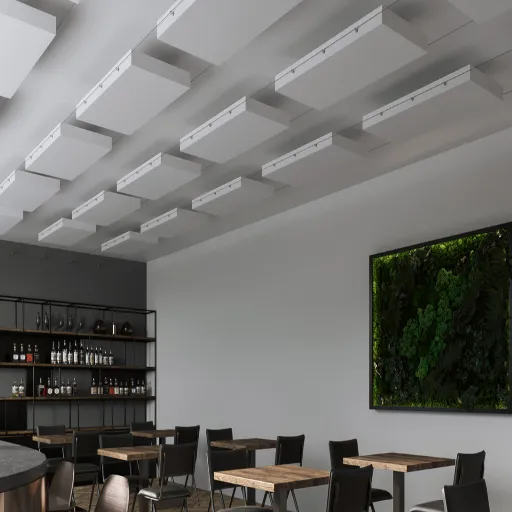
Ceiling absorption on its own cuts reverberation time by 40 to 60 percent. Wall treatment on its own cuts it by 15 to 25 percent. That gap is the whole argument for starting overhead.
The ceiling is usually the largest uninterrupted reflective surface in the room, and it’s the one you can treat without touching the design. Aim for 30 to 50 percent coverage at NRC 0.85 or higher.
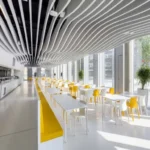
Options depend on what’s up there. A suspended grid takes a tile swap in one evening. An exposed ceiling wants baffles or clouds, and vertical baffles have an advantage in a restaurant because both faces stay exposed and grease doesn’t collect on them. Our ceiling baffles guide compares the formats, and why the ceiling comes before the walls covers the geometry.
Tom and Elena run a 60-seat neighbourhood bistro with an exposed ceiling and a hard floor. Their clap test came back at 1.8 seconds.
They spent about $600 on felt pads, a rug and heavier curtains, got down to roughly 1.3 seconds, and stalled. At full capacity the room still got away from them.
Baffles over the two loudest zones at 35 percent coverage was the fix that finished the job.
Fix 2: Add Wall Panels at Seated Head Height
Wall panels belong at 0.9 to 1.3 metres, roughly seated ear height. That’s where voices originate and where the first side-wall reflection reaches the next table.
Three placements earn their cost: between booths, on opposing hard pairs where glass faces brick, and along the back wall. One placement wastes money, and that’s the bar back. Our panel placement guide covers the geometry.
Target 25 percent of wall area at NRC 0.70 or higher.
Fix 3: Pull the Soft Goods You Already Own
Upholstered banquettes at NRC 0.55 across 30 percent of seating. Carpet or rugs at 0.25 across 40 percent of the floor. Heavy drapery at 500 g/m² with 50 percent fullness, which lands between 0.40 and 0.65. Tablecloths, which are modest but nearly free.
Do these. They’re cheap, they help, and they also make the room look better.
Just don’t expect them to fix a 2-second room. Soft goods typically buy 2 to 5 dB of perceived improvement. That’s often enough. It is not a substitute for absorption, and any supplier who implies otherwise is selling you something.
The Observer makes a fair point about carpet: it absorbs food and drink as well as sound, and a fully carpeted dining room reads as dated. Rugs under tables get most of the benefit without committing the whole floor.
Fix 4: Don’t Over-Treat
Below 0.5 seconds RT60, a restaurant feels sterile. Diners describe it as flat or dead, and the atmosphere you built the room for disappears.
Bars and cafés should stay deliberately livelier, at 0.8 to 1.2 seconds. Some buzz is the product.
Past the audit stage? If your clap test is over 1.5 seconds and soft goods haven’t moved it, you’re buying absorption. Request free samples and a bulk quote with your room dimensions and we’ll come back with a panel count, not a catalogue.
Path B: It’s the Chairs, the Cutlery and the Equipment
Fix 5: Fit Felt Pads and Rubber Foot Caps
Felt pads, rubber caps and rugs under tables cut chair-scrape and dropped-cutlery noise by 5 to 8 dB. They cost pennies per chair.
This is the best cost-per-decibel fix in the entire article, and it is almost always skipped because it’s unglamorous. Do it first. It takes an afternoon.
Fix 6: Break the Parallel Lines
Two hard walls facing each other create flutter echo between them. A diagonal shift of even three feet breaks the direct path.
Move high-backed booths toward open areas, because they’re free sound barriers. Put dense planting in echo-prone corners. The acoustic effect is modest and the cost is near zero, and it reads as design rather than treatment.
Fix 7: Relocate or Isolate the Loud Equipment
Ice machines, grinders, glassware stations, POS beeps and dish returns are point sources at ear height. They’re also the noise guests remember, because they’re intermittent and sharp.
Move what you can. For what you can’t, treat the surfaces immediately around it rather than the whole room. In an open kitchen this becomes its own engineering problem, which our guide to commercial kitchen noise reduction covers in detail.
Fix 8: Zone the Room
Partial dividers, decorative screens, high-backed banquettes and planting break one large acoustic volume into several smaller ones. As one hospitality acoustics specialist put it, you don’t need full walls.
This is also the fix that solves the “fine at half capacity, unbearable when full” pattern, because it stops the whole floor from participating in one feedback loop.
Path D: It’s the Music and the Systems
Fix 9: Recalibrate the Background Music
Aim for 60 to 65 dBA at peak, measured rather than guessed. Distributed speakers at lower volume beat two loud ones, because even coverage matters more than total output.
Cut the bass-heavy playlists. Low frequency passes straight through absorption and drives the Lombard spiral without adding any intelligibility.
Then lower it in 5 dB steps during the first 30 minutes of service and watch what the room does. This is the single biggest free win in most venues, and the reason it goes unused is that it feels like it isn’t doing anything.
Fix 10: Service the Noise You’ve Stopped Hearing
HVAC hum typically sits at 55 to 65 dBA and a kitchen hood at 65 to 75 dBA. A bearing, a loose panel, an unbalanced fan.
Absorption will not fix a mechanical source. Neither will anything else on this list. Service it.
Path C: It’s Coming From Next Door (or Going To It)
If the complaint is from residents, upstairs tenants or the council, the problem is transmission, not reverberation.
That is soundproofing: mass, decoupling and sealing. It’s a different product at a different cost, and it belongs in the soundproofing guide rather than here.
No amount of ceiling baffle will stop a bass line reaching the flat above. That misunderstanding is the most expensive one in this category.
When Cheap Fixes Stop Working
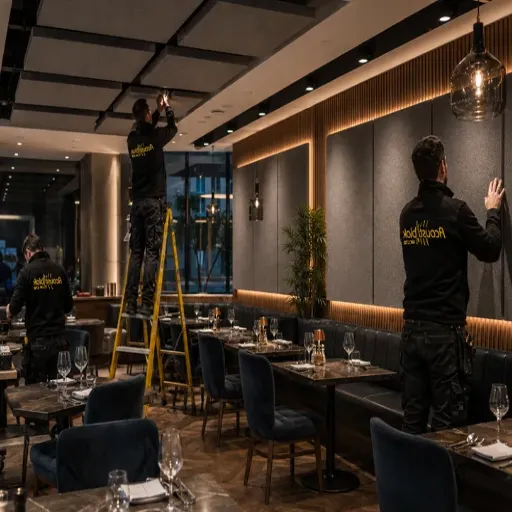
Most operators will work through fixes 5 to 9, spend a few hundred dollars, and still find the room isn’t right. That’s not failure. It’s information.
Daniel runs a 120-seat bar-restaurant with polished concrete and full-height glazing. His clap test came back at 2.6 seconds and peak levels at 84 dBA. He could have bought every rug in the city and still been at 2.4. The room needed absorption, and no amount of soft furnishing was going to change that.
Here are the five triggers that mean you’ve crossed from fixing to specifying:
- The clap test is still over 1.5 seconds after soft goods
- Peak levels are still above 78 dBA after the music is dialled in
- Conversation still fails at six feet across a four-top
- Reviews still mention noise two months after your changes
- The room is fine at half capacity and unbearable when full
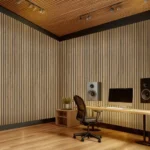
At that point the decision is coverage and material, not more rugs. Start with how many panels you actually need, then look at what treatment costs. If the room is on camera or the design matters, wood slat acoustic panels do the same acoustic job as fabric and read as a feature wall.
And if you’re still weighing foam against panels, read why foam is not the answer in a dining room before you order anything. It fails commercial fire testing and traps grease.
Frequently Asked Questions
How do I stop echo in my restaurant?
Absorb the largest hard surface first. Treat 30 to 50 percent of the ceiling at NRC 0.85 or higher, add wall panels at seated head height, and target a reverberation time of 0.7 to 0.9 seconds for casual dining. Ceiling treatment alone cuts reverberation by 40 to 60 percent.
What is the cheapest way to reduce noise in a restaurant?
Felt pads and rubber foot caps on chairs and tables. They cut scrape and cutlery noise by 5 to 8 dB for pennies per chair. After that, lowering background music to 60 to 65 dBA costs nothing and removes the trigger for the Lombard spiral.
How many decibels should a restaurant be?
Below 70 dBA is quiet and hearing-safe. 70 to 75 supports conversation. 75 to 80 makes it hard. Above 80 is a hearing risk with prolonged exposure.
For reference, the New York survey of 2,376 venues found an average of 77 dBA across all restaurants.
Do acoustic panels work in a restaurant?
Yes, on reverberation. They reduce how long sound hangs in the room, which is what makes conversation hard. They do not block sound travelling between spaces, and they do not fix a noisy HVAC unit. Those need barriers and service respectively.
Will carpet and curtains fix restaurant noise?
They help by a few decibels and they’re worth doing. They will not fix a room measuring 2 seconds or more of reverberation time. Use them as part of the cheap tier, not as a substitute for ceiling absorption.
Can I reduce restaurant noise without closing?
Yes. A drop-grid tile swap takes one evening per zone. Baffle suspension runs two to four nights for a mid-size room, and the room stays usable between phases. Adhesive wall panels take one slow afternoon per zone.
What’s the difference between soundproofing and sound absorption?
Absorption controls sound inside the room, so it stops echoing. Soundproofing blocks sound from passing through a wall, floor or ceiling. A noisy dining room is almost always an absorption problem. A neighbour complaint is almost always a blocking problem.
How loud should background music be in a restaurant?
60 to 65 dBA at peak, measured during a full service. Distributed speakers at lower volume give better coverage than two loud ones. Cut bass-heavy playlists, because low frequency drives the Lombard effect without helping anyone hear.
The Bottom Line
Reducing noise in a restaurant is a sequencing problem, not a shopping problem. Measure at peak, run the clap test, mine your reviews, and decide which of the four problems you actually have.
Then work the cheap tier first. Felt pads, table positions, music level and equipment placement cost almost nothing and solve a surprising share of real complaints. If the room still echoes after that, you’re buying absorption, and the ceiling is where it goes.
The expensive fixes work better than most operators expect. The cheap ones work more often than most suppliers admit. The mistake is doing them in the wrong order.
Ready to specify? Send us your room dimensions for a free acoustic sizing consultation, material samples and a bulk quotation. We work factory-direct with restaurants, café groups and multi-site hospitality operators, and we’ll tell you if the cheaper fix is still the right call.
For the full technical picture, including RT60 targets by venue type, fire compliance and material selection by zone, read the complete restaurant noise control guide.
Categories:
Blog
Related Articles