WPC Vs PVC Wall Panels For Bathroom: Which Is Better?
When you compare WPC vs PVC wall panels for bathrooms, PVC is the safer choice in wet zones because it is 100% waterproof, but WPC wins on aesthetics, durability, sound insulation, and sustainability. The honest answer is zone by zone: use PVC inside the shower and bath surround, and WPC on vanities and feature walls where its wood-look finish shines. Co-extruded (capped) WPC grades are also safe in most bathroom splash zones.
Last spring, a homeowner in Manchester tiled nothing. Instead, he installed standard WPC panels behind his shower, assuming they were “as waterproof as PVC.” Within 18 months, the panel edges swelled, and a faint mold line appeared behind the trim. The fix cost him more than the PVC he had avoided to save a few pounds per square meter.
He was not alone. Most guides online tell you one thing: “PVC for bathrooms, WPC for dry rooms.” That verdict is too simple, and it leaves buyers guessing when the two materials overlap.
If you are renovating a bathroom, comparing panel types before you buy can save you from a costly redo. By the end of this guide, you’ll know exactly which material belongs in which bathroom zone, what each costs over a full project, and how long each will last in a humid environment. We make both WPC and PVC panels, so we can give you the honest trade-offs rather than a sales pitch.
Key Takeaways
- PVC panels are 100% waterproof and the safest choice for shower enclosures and wet rooms (UK/EU Zones 0 and 1).
- WPC panels win on wood-like aesthetics, warmth, sound dampening, and eco-friendliness, with roughly 37% lower carbon footprint than PVC.
- Co-extruded (capped) WPC grades absorb under 0.5% water and are safe in Zones 1 and 2 when edges are sealed.
- PVC costs less upfront ($1.50-3.20/sq ft vs $2.50-4.50/sq ft), but WPC can outlast it by 5-10 years in dry bathroom zones.
- A mixed-material strategy (PVC in the shower, WPC on feature walls) gives you waterproofing where it matters and premium looks where you see it.
What Is the Difference Between WPC and PVC Wall Panels?

Before you compare performance, it helps to know what you are actually comparing. The two materials look similar on a showroom wall, but their composition drives every difference that matters in a steamy bathroom.
WPC (Wood-Plastic Composite)
WPC wall panels are extruded from a blend of 55-65% wood or bamboo fiber, 30-35% HDPE or PP polymer, and roughly 10% additives like coupling agents, UV stabilizers, and waterproofing agents. The wood fiber gives WPC its natural matte texture and warm feel. The polymer binds it together and provides moisture resistance.
The result is a panel that looks like real timber, resists warping up to 80°C, and delivers noticeably better sound dampening and thermal insulation than PVC. Because it contains recycled content, WPC also carries a smaller environmental footprint. For a deeper look at the material, see our complete guide to WPC wall panels.
PVC (Polyvinyl Chloride)
PVC wall panels are made from 100% synthetic polyvinyl chloride polymer, extruded or calendered into rigid sheets. With no organic fiber at all, PVC is non-porous and completely waterproof. It can’t absorb moisture, swell, or feed mold.
PVC panels are lighter (about 3-5 kg/m² versus 6-9 kg/m² for WPC), cheaper to produce, and faster to install with simple adhesives. The trade-off is that they feel smoother and glossier, scratch more easily, and can turn brittle over years of UV exposure. In a bathroom, that gloss can look dated, while a wood-look WPC feature wall reads as warm and premium.
WPC vs PVC Wall Panels for Bathroom: Head-to-Head Matrix
The table below summarizes how WPC and PVC stack up for bathroom use across the criteria that matter most. Keep it handy as your quick reference for this comparison.
| Criteria | WPC Wall Panels | PVC Wall Panels |
|---|---|---|
| Composition | 55-65% wood fiber + 30-35% polymer | 100% synthetic PVC polymer |
| Waterproofing | Water-resistant; standard 1.5-3% absorption, co-extruded <0.5% | 100% waterproof; 0.1-0.5% absorption |
| Wet-Zone Rating | Zone 2 + (co-extruded in Zones 1-2) | Zones 0, 1, 2 all safe |
| Mold Resistance | Good with anti-mold additives | Excellent; inert surface |
| Impact Resistance | High (about 30% better than PVC) | Moderate; cracks under sharp impact |
| Scratch Resistance | Good; surface can be repaired | Moderate; scratches are permanent |
| Thermal/Acoustic | Better insulation and sound dampening | Lower insulation; noisier |
| Aesthetics | Natural wood-look matte finish | Smooth, glossier plastic finish |
| Weight | Heavier (~6-9 kg/m²) | Lighter (~3-5 kg/m²) |
| Install Speed | Slower (framework/adhesive + sealing) | Faster (adhesive-only, 20-30% quicker) |
| Lifespan in Bathroom | 20-30 yrs dry / 15-25 yrs premium wet | 10-15 yrs residential |
| Cost | $2.50-4.50/sq ft | $1.50-3.20/sq ft |
This table answers most of the questions we hear from bathroom buyers. If waterproofing above all else, PVC wins. If you want a wood-look finish that holds up and lasts, WPC is the stronger pick. The real skill is knowing where each belongs in your bathroom.
For the same trade-offs applied to living rooms, kitchens, and commercial spaces, see our broader WPC vs PVC wall panels comparison.
Bathroom Wet Zones: Where Each Panel Is Safe
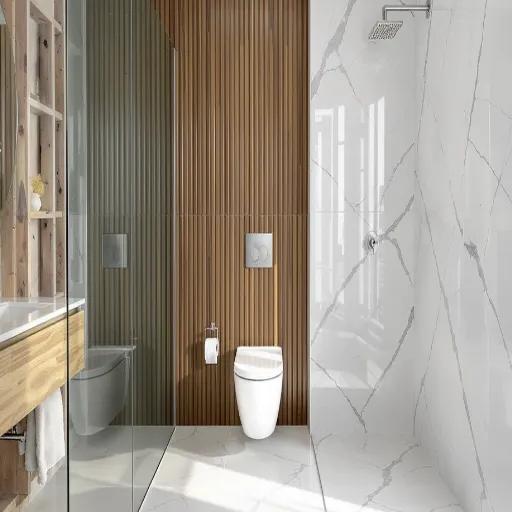
The single best way to decide between WPC and PVC is the UK/EU wet-zone framework. It divides a bathroom into zones based on water exposure, and it applies directly to the wpc vs pvc wall panels for bathroom decision.
- Zone 0: Inside the shower tray or bath trough. Water sits here. Use PVC only. No WPC grade belongs in standing water.
- Zone 1: Above the bath and within 1.2 m horizontally and 2.25 m vertically of the showerhead. This is direct spray territory. PVC is the safest call. A co-extruded WPC with fully sealed edges works as a second option.
- Zone 2: Within 600 mm of Zone 1, covering splash reach. Both materials work. Standard WPC is acceptable if joints and cut edges are sealed.
- Outside zones: Vanity walls, feature walls, dry walls behind towel rails. Both work; WPC preferred for looks.
The practical rule most contractors use: put PVC anywhere water sprays directly, and use WPC where you want the warm wood aesthetic and where splash is occasional. If you want the full breakdown of when WPC is genuinely waterproof in a bathroom, read our bathroom WPC wall panel guide and the WPC vs SPC wet-zone explainer.
WPC vs PVC Waterproof Panels: Water-Resistant or 100% Waterproof?
Here is where the two materials separate most clearly. PVC, being fully synthetic, absorbs nothing essentially. Under ASTM D570 immersion testing, PVC measures 0.1-0.5% water absorption.
Independent roundups like Dundee Deco’s best waterproof wall panels reach the same conclusion: for shower walls, nothing beats a fully synthetic panel. You can install it in a walk-in shower and forget about it.
WPC is different. Standard grades absorb 1.5-3% water by weight, which is excellent for a wood-based product but not zero. If water penetrates a scratched surface or an unsealed cut edge, the wood fibers inside can swell over time. That’s exactly what happened to the Manchester homeowner in our opening story.
The good news is that premium co-extruded (capped) WPC fixes most of this. A dense polymer shell wraps the core, dropping absorption below 0.5%, close to PVC. Nano-treated panels go even lower, under 0.3%.
For a detailed look at grades and how to verify them, see our guide to waterproof WPC wall panels. The key takeaway: if you want WPC near water, buy a co-extruded grade, seal every cut edge, and run a continuous bead of silicone at joints.
Cost: WPC vs PVC for an Actual Bathroom
Upfront, PVC is cheaper. Material runs about $1.50-3.20 per square foot versus $2.50-4.50 for WPC, and the lighter weight means lower shipping and faster installation (roughly 20-30% quicker with adhesive alone). For a modest bathroom, that difference can be several hundred dollars. The global shower wall panel market keeps growing as homeowners swap tile for waterproof panels, so price matters more than ever.
But the cost story does not end at the checkout. Consider a full bathroom wall project over 10 years:
| Cost Factor | PVC Panels | WPC Panels |
|---|---|---|
| Material (per sq ft) | $1.50-3.20 | $2.50-4.50 |
| Install labor | Lower (adhesive-only) | Higher (framework + sealing) |
| Maintenance | Low, but scratches show | Low; surface repairable |
| Replacement cycle | 10-15 yrs residential | 20-30 yrs dry / 15-25 yrs wet |
| 10-year cost per year | Higher once replaced | Lower with longer lifespan |
Both materials beat ceramic tile on install time and grout maintenance, which is a separate comparison covered in our WPC vs ceramic tile for bathroom walls guide. For a full project estimate across all bathroom sizes, see our bathroom wall panel cost guide.
Durability, Lifespan & Maintenance in Bathrooms
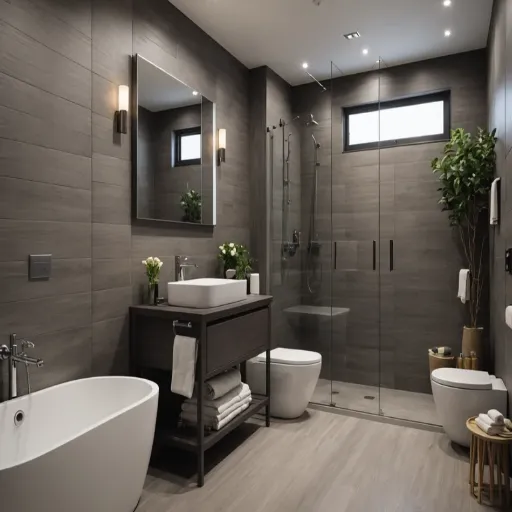
Impact and scratches. WPC handles about 30% more impact than PVC. In a small bathroom where shampoo bottles, shavers, and kids’ toys regularly hit the walls, that matters. A scratch on solid-core WPC can often be sanded out; a scratch on PVC is usually permanent.
Mold and mildew. PVC is inert, so it simply does not feed mold. WPC with anti-mold additives performs well in humid zones, but edges and joints need proper sealing and ventilation behind the panels. If you install WPC on a framework with an air gap instead of gluing it flat, you reduce the chance of condensation and mold behind the panel.
Temperature and UV. WPC resists warping up to 80°C and stays dimensionally stable, which is helpful near hot pipes or heated towel rails. PVC softens and warps above 60°C, so keep it away from steam vents and heat sources.
Cleaning. Both materials wipe down easily. Soap scum and hard water build up on either surface; a soft cloth and mild cleaner handle both.
Bathroom Design: Aesthetics & 2026 Trends
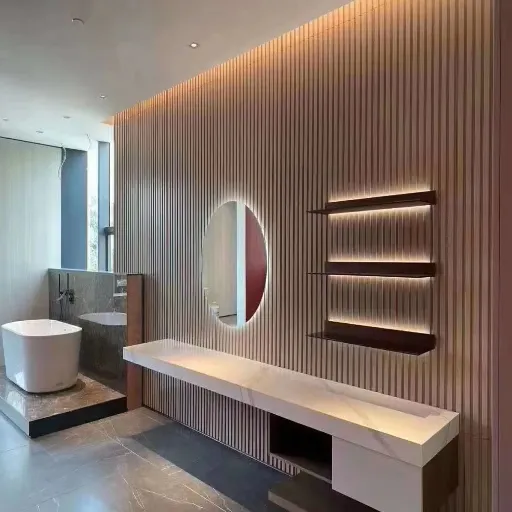
This is where WPC pulls ahead for most buyers. A fluted or slat WPC feature wall behind a freestanding bath reads as a designer statement. The 2.0 mm deep embossing and ultra-matte finish mimic real wood so closely that guests rarely realize it is composite. Meanwhile, smooth high-gloss PVC suits the clean, seamless look of a shower enclosure but can feel plasticky on large walls.
A practical mixed-material strategy:
- Shower walls (Zones 0-1): PVC, for guaranteed waterproofing.
- Bath surround (Zone 1-2): Co-extruded WPC with sealed edges, for warmth.
- Vanity and feature walls: WPC, for the wood-look aesthetic.
- Ceiling: Either; WPC adds acoustic warmth, PVC is lighter.
The 2026 trend cycle favors exactly this split: fluted and vertical slat textures, stone-drenching decors, and matte wood-grain looks on feature walls, paired with seamless glossy panels in wet zones. If you want more inspiration, browse our bathroom wall panel inspiration and the 3D slat and fluted WPC panel range.
Installing WPC vs PVC in a Bathroom
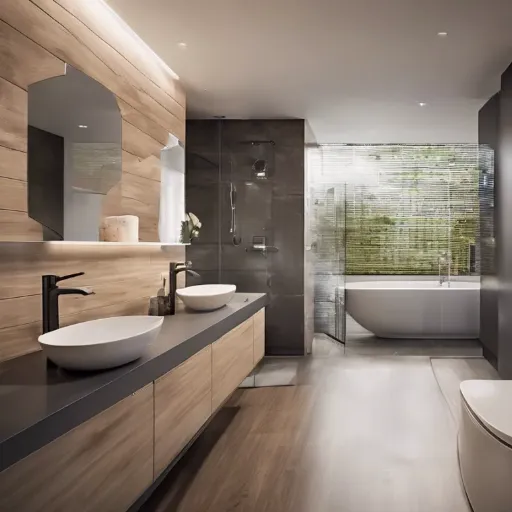
Installation is where a lot of WPC failures actually start. Both materials are DIY-friendly, but they demand different preparation.
- Substrate and moisture barrier: Test the wall for moisture first. In an older bathroom, fit a moisture barrier or vapor membrane before either panel type.
- Fixing method: PVC typically goes up with adhesive alone. WPC is heavier and is better fixed to a framework (furring at 40-60 cm centers), using galvanized or aluminum rails in damp areas. A framework also creates an air gap that reduces mold risk.
- Sealing: This is critical for WPC. Run silicone at every joint, corner, and cut edge, and use a 1-2 mm expansion gap between panels plus a 2-3 mm gap at the floor. PVC is more forgiving, but sealing its trim still keeps water out.
- Cutting around fixtures: Mark, cut, and seal around pipes, taps, and switches. An unsealed hole is a water entry point regardless of material.
For the complete step-by-step process, including how to install over existing tiles, see our bathroom-specific installation guide.
Common Myths and Misconceptions
Myth 1: “WPC is never safe in a bathroom.” Not true. Co-extruded and nano-treated WPC grades absorb under 0.5% water and perform fine in Zones 1 and 2 when edges are sealed. The panels that fail are standard grades used in direct-spray areas without sealing.
Myth 2: “PVC is always cheaper long-term.” PVC costs less upfront, but its shorter lifespan means replacement costs surface sooner. Over 10-15 years in a dry bathroom zone, WPC can cost less per year of service.
Myth 3: “WPC is always more eco-friendly.” WPC has a roughly 37% lower carbon footprint and uses recycled content, but PVC is recyclable too. Check the specific recycled-content claims of the panel you buy.
Myth 4: “Waterproof means zero maintenance.” Even PVC needs sealant upkeep at joints and trim. Waterproof describes the panel core, not the installation.
WPC vs PVC Wall Panels for Bathroom: FAQs
Which is better for a bathroom, WPC or PVC wall panels?
For direct water exposure, PVC is better because it is 100% waterproof and non-porous. For vanities, feature walls, and dry zones, WPC is better because it offers a wood-look finish, better sound insulation, and a longer lifespan. Most bathrooms benefit from using both.
Can WPC panels be used in a shower?
Co-extruded WPC with sealed edges can be used in Zones 1 and 2, but PVC remains the safest choice for direct spray in a shower enclosure. Standard WPC should not be used where water continuously hits the surface.
Are WPC wall panels 100% waterproof?
No. WPC is water-resistant, not fully waterproof. Standard grades absorb 1.5-3% water; co-extruded grades absorb under 0.5%. Only PVC and SPC are considered 100% waterproof.
Do WPC panels mold in bathrooms?
WPC with anti-mold additives resists mold well, but humidity behind panels can cause problems. Install on a framework with an air gap, seal all edges, and ventilate the bathroom.
Is WPC or PVC more scratch-resistant?
WPC is more impact- and scratch-resistant, and surface scratches on solid-core WPC can often be repaired. PVC scratches permanently and can crack under sharp impact.
How long do WPC vs PVC bathroom panels last?
PVC lasts 10-15 years in residential bathrooms. WPC lasts 20-30 years in dry zones and 15-25 years with premium waterproof grades in wet areas.
Which is cheaper, PVC or WPC?
PVC costs less upfront (about $1.50-3.20/sq ft versus $2.50-4.50/sq ft) and installs faster. Over a full lifespan, WPC can deliver better value per year in appropriate zones.
What is the best material for a shower wall?
PVC is the safest and most cost-effective material for shower walls. For a wood-look finish in a shower, use co-extruded WPC with fully sealed edges, or compare SPC in our WPC vs SPC wet-zone comparison.
Conclusion: Choose by Zone, Not by Habit
The short version of the WPC vs PVC wall panels for bathroom question is simple: PVC owns the wet zones, WPC owns the looks. Use PVC in the shower and around the bath where water sprays directly, and use WPC on vanities and feature walls where you want a warm, wood-look finish that lasts. Co-extruded WPC bridges the gap for splash zones when edges are sealed.
Before you buy, check which grade you’re getting, look for a true wet-zone rating, and plan your sealing carefully. The wrong panel in the wrong zone is the most common bathroom failure we see, and it’s entirely avoidable.
Ready to compare them in person? Request side-by-side samples of both WPC and PVC panels for a real wet-zone test, or get a bulk quote if you are sourcing for a renovation project. We will help you match the right panel to every zone in your bathroom.
Categories:
Blog
Related Articles