WPC Bathroom Wall Panels Wholesale: 2026 B2B Buying Guide
The best way to source WPC bathroom wall panels wholesale in 2026 is to buy factory-direct from a qualified manufacturer: you typically save 20-45% versus local distributors, and a 20ft container holds roughly 800-1,000 m² of panels. But price per meter tells you almost nothing until you add ocean freight, import duty, and supplier reliability into the picture. This guide walks wholesale buyers through the full sourcing decision, from grade selection to landed cost.
Two hotel developers once ordered what looked like the same WPC bathroom panel. One project came in on budget with zero moisture claims after two years. The other spent months fighting color mismatch, delayed containers, and edge swelling. The panels looked identical in photos. The difference wasn’t luck, it was how they sourced.
Key Takeaways
- Factory-direct sourcing of WPC bathroom wall panels saves 20-45% vs local distributors; a 20ft container fits about 800-1,000 m².
- Bathroom bulk orders need wet-zone grades: co-extruded/capped panels (water absorption under 0.5%) for shower splash zones, standard WPC for dry walls.
- Landed cost is the number that matters: FOB China $2.50-6.00/m² plus freight ($2,500-4,500 per container) plus duty can total $5-12/m² delivered.
- Typical MOQs run 1,000-3,000 m from a factory; samples are usually free, and a small trial order de-risks the first container.
- Vet the supplier before you pay: check export records, verify certifications with the issuing body, and test physical samples before ordering bulk.
What You’re Really Buying: Bathroom-Grade Panels in Bulk

Before you compare quotes, decide what grade you actually need. Bathrooms are the harshest interior environment for a wall panel: constant steam, splashing water, temperature swings, and cleaning chemicals. A panel that performs fine in a living room can fail in a guest shower within 18 months.
Here is what changes for bulk bathroom orders:
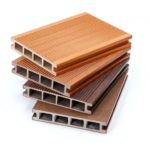
Co-extruded or capped WPC for splash zones. Co-extrusion now accounts for over 60% of new WPC wall panels. The protective cap layer is fused into the panel during extrusion, not coated on afterward, which is why it holds up under moisture and wear. Co-extruded grades absorb under 0.5% water, versus 1.5-3% for standard WPC. For hotel and apartment shower walls, this is the safe default.
Fire-rated panels for commercial code compliance. If you are building or renovating commercial bathrooms, check the fire classification. B1 fire-rated WPC panels surged from 12% of commercial specs in 2022 to 47% in 2026. In the US and EU, that typically means EN 13501-1 or ASTM E84 Class A (flame spread under 25, smoke developed under 450). Ask for the test report, not just the claim.
Mold-resistant certified panels for humid climates. Request a third-party mold test, usually SGS or Intertek, with a rating of Grade 0 or 1. This matters most for bathrooms with poor ventilation and for tropical export markets.
The lesson for bulk buyers is simple: the cheapest panel is the most expensive choice in a 200-room project. We cover the waterproofing reality in detail in our guide to how waterproof WPC truly is in wet zones, and you can see the full range in our complete guide to WPC wall panels for bathroom applications.
Wholesale Pricing by Grade: What You Should Pay in 2026
Prices vary more by grade and order size than by supplier. Here is a realistic range based on 2026 factory and marketplace pricing.
| Grade | Typical Price | MOQ Context | Best Use |
|---|---|---|---|
| Standard WPC | $0.70-0.90 per meter | 1,000-3,000 m | Dry bathroom walls, budget projects |
| Mid-range factory-direct | $0.75-2.50 per meter | 500-3,000 m | Vanity walls, apartments |
| Co-extruded / premium | $1-10 per m² | 500-1,000 m² | Guest shower splash zones, hotels |
Two things to keep in mind. First, price per meter and price per m² are not directly comparable, so convert everything to m² before comparing quotes. Second, a price far below market is usually a warning sign. Excess calcium carbonate filler is the classic cost-cutting trick, and filler-heavy panels are exactly the ones that swell, fade, or crack in a bathroom.
When you are comparing options, our WPC wall panels bathroom cost guide lays out how much a full bathroom project costs versus tiling, including labor and maintenance over ten years.
MOQ, Lead Times, and Container Loading

Minimum order quantities vary widely by supplier type. Factory-direct suppliers typically want 1,000-3,000 meters or one 20ft container. Trading companies and marketplace sellers accept smaller orders, often 10-500 m², but you pay a higher per-unit cost and get less direct control over quality.
Lead times follow a predictable pattern:
- Samples: 1-2 weeks, usually free or at a small fee
- Production: 10-15 days for small orders, 15-45 days for a container
- Ocean shipping: 20-40 days depending on route
Container loading math. A 20ft container holds roughly 800-1,000 m² of WPC wall panels. Board length is capped at about 5.8 meters, so standard lengths of 2.2, 2.4, 2.9, 3.0, or 4.0 meters load cleanly. A 40ft container is usually weight-limited rather than volume-limited, with net product weight capped at about 24,500 kg after packaging.
This is one of the fastest ways to test a supplier’s competence. Ask: “How many m² of my panel spec fit in a 20ft and a 40ft container?” An experienced factory answers immediately with a specific number. A trader who hesitates or dodges the question is a red flag.
Landed Cost: The Number That Actually Matters
Too many first-time importers compare FOB prices, sign a contract, and discover the real cost at the dock. Landed cost is the only number that protects your margin.
Landed cost = FOB price + ocean freight + insurance + import duty/VAT + port and delivery fees
Using 2026 averages, a 20ft container of WPC wall panels runs about $2,500-4,500 in ocean freight. Add duty and VAT for your destination, and the total landed cost typically lands between $5 and $12 per m². If you are in a market with high tariffs, that figure can climb much higher.
Know your destination market before you negotiate. A few 2026 reference points:
- US: combined tariff burden around 61.5% (Section 301 plus other duties). Confirm your supplier’s product passes ASTM E84 Class A and check ISF filing requirements.
- EU: import VAT of 15-25% by country, with anti-dumping duties of 21.3-36.1% on related wood-based products.
- Australia: 0% customs duty under the China-Australia Free Trade Agreement, plus 10% GST.
- UK: 20% import VAT.
- UAE: around 5% customs duty plus 5% VAT.
Use HS code 3925.90.0000 consistently across your documentation to avoid customs delays.
Packaging compliance is non-negotiable. Wood pallets must be ISPM-15 heat treated (56°C core temperature held for 30 minutes) with the IPPC stamp branded into the wood on at least two opposite sides. Painted or stickered marks get rejected at customs. Confirm your supplier ships on compliant pallets before you pay.
When you are pricing a full project, our WPC wall panel pricing guide gives you the numbers to model the difference between panels and tile.
Certifications That Matter for Bathroom Bulk Orders

Certifications are not decoration. For bathroom and commercial work, verify these with the supplier:
- CE for EU market compliance
- ISO 9001 for quality management
- ISO 14001 for environmental management
- Fire rating under EN 13501-1 or ASTM E84 Class A
- Formaldehyde at E0/E1 or F★★★★ level, critical for enclosed hotel bathrooms
- SGS/Intertek third-party reports for mold resistance and water absorption
- FSC certification if you need it for green procurement programs
Here is the key: request the full test report, not a screenshot. Check the report number on the issuing body’s website and confirm the certificate matches the grade you are actually buying. Counterfeit and recycled test reports are common in this industry. Ask the supplier directly: “Can you provide the full report for this exact grade, verified with the issuing body?” A real factory says yes without hesitation.
How to Vet a Wholesale Supplier: Factory vs Trading Company

The single biggest risk in sourcing WPC panels from China is not knowing whether you are dealing with a factory or a trading company. Both can be legitimate. The problem is when a trader hides the arrangement or when a fake factory claims production it does not have.
Factory: lower price, direct quality control, better customization. Verify with current date-stamped production photos or a video call, and check that the business license scope includes manufacturing.
Trading company: more flexible MOQs and a broader catalog. Ask who actually produces your order and whether you can inspect the factory before bulk production.
Use this six-step qualification checklist:
- Verify the business license scope and years registered
- Request current factory photos or videos, ideally date-stamped
- Check sustained export records for your market
- Verify certifications with the issuing bodies
- Request samples and test them (protocol below)
- Place a small trial order before large volume
Red flags to watch for:
- Vague or unverifiable “100% waterproof” claims
- No test reports or certification documentation
- Stock photos only, no factory or QC transparency
- No sample program
- Prices far below market without explanation
- Unrealistically short lead times, like three days for a full container
For a deeper look at factory selection and quality control in China, see our guide to evaluating WPC manufacturers and suppliers.
Sample Testing Protocol: 10 Minutes That Saves a Container

Never order a container based on photos. Test a physical sample against your bathroom requirements. Here is a 10-minute protocol:
- Water absorption: weigh the sample dry, soak it 24 hours, weigh again. Pass is under 1%; high-quality co-extruded panels come in under 0.5%.
- Mold check: confirm the SGS or Intertek mold rating is Grade 0 or 1.
- Scratch and emboss test: run a fingernail across the grain. Embossed texture should not peel the way printed film does.
- Edge seal inspection: are cut edges sealed? Open edges invite moisture into the core.
- Color consistency: compare samples across batches and ask about the supplier’s ΔE tolerance. The industry standard is a ΔE under 1.0, which is invisible to the naked eye.
- Install test: join two panels and check the locking system and the seam.
For a complete decision framework on which panels to choose for your bathroom, including thickness and co-extrusion guidance, read our guide to choosing WPC wall panels for bathroom projects.
OEM/ODM and Private Label for Your Brand
Many wholesale buyers import panels to sell under their own brand. This is standard practice with Chinese manufacturers, and you should confirm three things up front:
- Customization: custom colors, sizes, and surface finishes (fluted, marble-look, wood-grain)
- Packaging: private-label packaging, logos, and marketing materials
- MOQ for custom work: often 1,000-2,000 meters, higher than stock items
For large projects, ask whether the entire order can come from a single production run or the same raw material batch. This is the simplest way to avoid visible color differences between rooms in the same hotel.
Common Wholesale Buying Mistakes to Avoid
- Choosing the lowest price without checking filler content. Excess CaCO₃ means a weak panel.
- Specifying standard WPC for direct-shower zones without co-extrusion or sealed edges.
- Ordering a container on photos without sample testing.
- Skipping certification verification before payment.
- Ignoring ISPM-15 and HS code compliance, then paying for customs delays.
- Forgetting duty and VAT in the landed cost, then watching your margin disappear.
Frequently Asked Questions
What is the wholesale price of WPC bathroom wall panels?
In 2026, standard WPC runs roughly $0.70-0.90 per meter in large volumes, mid-range factory-direct panels $0.75-2.50 per meter, and co-extruded or premium panels $1-10 per m². Total landed cost, including freight and duty, typically lands between $5 and $12 per m².
What is the MOQ for WPC wall panels?
Factory-direct suppliers typically require 1,000-3,000 meters or one 20ft container (about 800-1,000 m²). Trading companies accept smaller orders of 10-500 m², and custom OEM/ODM work usually starts around 1,000-2,000 meters. Samples are generally free.
How many WPC wall panels fit in a container?
A 20ft container holds roughly 800-1,000 m² of WPC wall panels, with board lengths capped around 5.8 meters. A 40ft container is usually weight-limited, with net product weight capped at about 24,500 kg after packaging.
How do I find a reliable WPC wall panel supplier in China?
Verify the business license and export records, request current factory photos or a video call, confirm certifications with the issuing bodies, test physical samples, and place a small trial order before committing to large volume. Watch for stock photos, unverifiable claims, and prices far below market.
What certifications should WPC wall panels have for bathrooms?
Look for CE, ISO 9001, ISO 14001, a fire rating of EN 13501-1 or ASTM E84 Class A, formaldehyde at E0/E1 or F★★★★, and third-party SGS or Intertek mold and water absorption reports. Verify every report number with the issuing body.
What is the difference between a factory and a trading company?
A factory produces the panels and typically offers lower prices, direct quality control, and better customization. A trading company buys from multiple factories, offering more flexible MOQs but less direct control. Verify which one you are dealing with before ordering.
Are WPC bathroom wall panels good for hotel bathrooms?
Yes, when you spec the right grade. Co-extruded or capped WPC with water absorption under 0.5% and a mold rating of Grade 0-1 is a proven choice for guest bathroom walls. For direct-spray public showers, compare against PVC or SPC before finalizing the spec.
Conclusion & Next Steps
Sourcing WPC bathroom wall panels wholesale comes down to five decisions: spec the bathroom grade first, price by grade, do the container and landed-cost math, verify certifications, and vet the factory with samples before a container order. The buyers who skip these steps are the ones who end up with color-mismatched rooms, customs delays, and moisture claims. The buyers who work through them build profitable, long-term supply relationships.
If you are sourcing WPC bathroom wall panels wholesale for a hotel, apartment project, or distribution business, we can help. Linyi Yuheng is based in Linyi, the heart of China’s WPC production region, and we supply factory-direct with CE, SGS, FSC, and ISO 9001/14001 certification across 300+ colors. Request free bathroom-grade samples and a bulk quote with a landed-cost estimate by contacting our team, and we will walk you through the spec that fits your project.
Have a project in mind? Start with a sample order and verify the panels before you commit to a container. The 10-minute test protocol above is all it takes to confirm you are buying a bathroom-grade product, not a cheap lookalike.
Categories:
Blog
Related Articles