Acoustic Foam Fire Rating: What Class A, B & C Really Mean (2026)
An acoustic foam fire rating is a measured result, not a marketing badge. Class A means a flame spread index of 0 to 25 and a smoke developed index of up to 450 under ASTM E84. Class B is 26 to 75, and Class C is 76 to 200. Untreated polyurethane foam ignites at roughly 315°C (600°F); melamine foam is inherently flame-resistant and needs no added chemicals.
That is the short version. The longer version matters more, because there is a fact hiding behind those numbers that almost no vendor will tell you: a Class A foam rating does not, by itself, make acoustic foam a code-compliant wall or ceiling finish. Foam plastic is regulated differently from fabric-wrapped panels, and that difference is exactly where commercial projects fail inspection.
If you are still working through the wider material decision, this article sits inside our full acoustic panels vs acoustic foam comparison guide, which covers absorption, cost and installation. Here we deal only with fire: the standards, the real measured values, the code sections, and how to verify a supplier’s certificate in about five minutes.
Key Takeaways
- An acoustic foam fire rating is a measured ASTM E84 result: untreated polyurethane foam ignites at roughly 315°C (600°F) and is combustible, while flame-retardant grades behave very differently.
- Melamine foam is inherently flame-resistant (FSI 6 / SDI 15) and chars rather than melting or dripping.
- Class A means flame spread index 0 to 25, smoke developed index 0 to 450. Untreated red oak, the calibration baseline, sits at FSI 100.
- Class A alone does not make foam plastic a code-compliant interior finish. IBC 2604.1 requires approval under large-scale tests (NFPA 286, UL 1715, UL 1040 or FM 4880).
- Additive flame retardants degrade with age, so a foam that passed when new may not pass in year five. Only A1 and A2 materials are genuinely non-combustible.
Acoustic Foam Fire Rating: The Short Answer
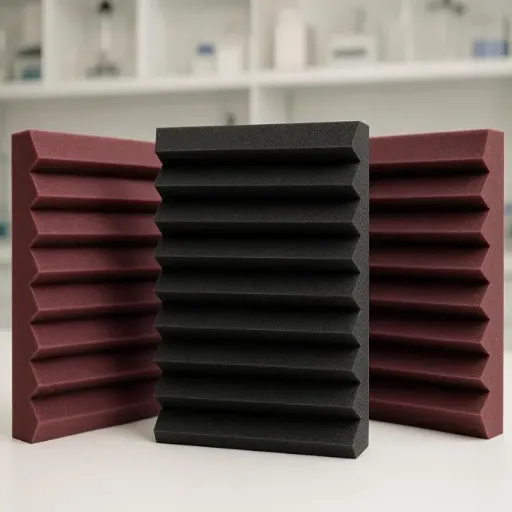
Some acoustic foam is fire retardant and some is not. It depends on the material, and on whether it carries a documented ASTM E84 or EN 13501-1 test report. Untreated polyurethane foam ignites at roughly 315°C (600°F), whereas melamine foam is inherently flame-resistant and needs no added flame retardants.
In practice, the market sorts into three groups, and confusing them is the most common mistake buyers make:
- Untreated polyurethane (PU) foam is combustible. It needs no help to catch fire and releases dense, toxic smoke.
- Flame-retardant (FR) treated PU foam carries a rating, usually Class A or B, but relies on chemical additives that migrate and degrade over time.
- Melamine foam is inherently flame-resistant. It reaches Class A through its own nitrogen-rich chemistry, with no additives and no degradation problem.
One more thing worth stating plainly: “fire retardant” is not a regulated term. It is not a class, a standard or an approved certification. It is a claim, and anyone can print it.
When Daniel fitted out his home studio in 2024, he ordered pyramid foam from a marketplace listing that said “fire retardant.” It was cheap, it looked right, and it arrived with no paperwork. Two years later he asked the seller for the test report and received a screenshot of a badge with no standard number on it. That is what an unverified claim looks like, and it is far more common than the industry admits.
Is Acoustic Foam Flammable?
Yes. Untreated polyurethane acoustic foam is flammable. Its ignition temperature is roughly 315°C (600°F), with a flash point above 250°C and thermal decomposition beginning between 325°C and 370°C.
Those figures sound comfortable until you compare them to real ignition sources. A candle flame burns at about 1,000°C, and a space heater element can reach 400°C. A single incandescent particle from a pyrotechnic device exceeds 1,200°C, and peer-reviewed cone-calorimeter testing found that such particles ignite untreated pyramidal foam in a meaningful share of trials.
Geometry makes it worse. The wedge and pyramid patterns that give acoustic foam its absorption also create an enormous surface-area-to-mass ratio with thin, oxygen-rich edges. As a result, untreated pyramidal foam ignites in as little as 3 to 14 seconds at heat fluxes of 35 to 70 kW/m², with peak heat release rates between 400 and 1,400 kW/m².
Flame-retardant grades behave differently. Combustion-modified PU foam uses phosphorus and nitrogen additives that interrupt the combustion chain, so the material self-extinguishes once the ignition source is removed, typically within two seconds under the UL 94 HF-1 test. Melamine foam takes a third path: it is a thermoset plastic that chars at 350°C to 400°C without melting or dripping, and it is stable past 1,200°F.
If you cannot find a test report that names a standard and a measured value, you have combustible foam regardless of what the listing says. Our piece on whether acoustic foam actually works covers the acoustic side of the same decision.
What a Fire Rating Actually Measures
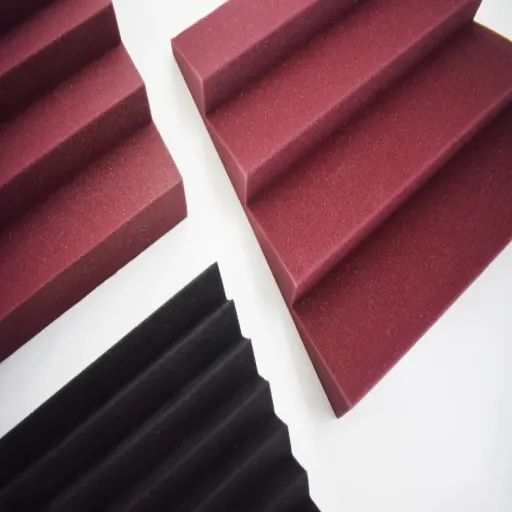
An acoustic foam fire rating describes surface burning behaviour, not fireproofing. No acoustic foam becomes non-combustible through treatment. It becomes slower to spread flame and lower in smoke output.
Two indices matter, and both come from the same test:
- Flame spread index (FSI) measures how far and how fast flame travels across the material’s surface compared with a baseline.
- Smoke developed index (SDI) measures how much visible smoke the material produces.
The baseline that makes the numbers readable is untreated red oak, defined as FSI 100. Every foam result is expressed relative to that.
Both numbers are required together, because smoke, not flame, kills most people in building fires. In documented polyurethane fire fatalities, blood cyanide levels exceeded published lethal thresholds, and researchers concluded that hydrogen cyanide (HCN) poisoning, not carbon monoxide, was the probable cause of death. HCN is the toxic marker specific to polyurethane fires: lethal at roughly 300 ppm over ten minutes, against an OSHA occupational limit of 10 ppm. That is why an FR-treated foam with a high smoke index is not the safe choice its Class A label implies.
ASTM E84 Class A, B and C Explained
The test behind the classes is ASTM E84, also published as UL 723 and NFPA 255. A 24-foot sample is mounted in a 25-foot Steiner tunnel and exposed to a controlled flame for ten minutes, with flame spread and smoke measured against the red oak baseline.
| Class | Flame Spread Index (FSI) | Smoke Developed Index (SDI) | EN 13501-1 equivalent | DIN 4102 | GB 8624 (China) |
|---|---|---|---|---|---|
| Class A (Class 1) | 0–25 | 0–450 | B, A2 or A1 depending on system | B1 | B1 |
| Class B (Class 2) | 26–75 | 0–450 | C to D (approximate) | B1 to B2 | B2 |
| Class C (Class 3) | 76–200 | 0–450 | D to E (approximate) | B2 | B2 |
| Unrated | Above 200 | Above 450 | E or F | B2 to B3 | B2 to B3 |
Three things stand out here. First, all three rated classes permit a smoke developed index up to 450, which is generous. Second, the international equivalents are approximate, because EN 13501-1 uses a different test entirely (EN 13823, the single burning item test) and reports a full classification such as B-s1,d0, where “s1” is the smoke class and “d0” the droplet class. Third, and most important for commercial buyers, there is no column for “is this legal in your building.” That is a code question, not a test question.
One confusion deserves a direct answer: UL 94 is not a substitute for Class A. It is a small-scale laboratory test for plastic specimens, and its highest foam rating, HF-1, describes how a small strip of material behaves. By contrast, a Class A rating describes a wall-sized panel in a room fire, which is why UL 94 should never be presented as a building-code interior finish rating.
Melamine Foam vs Polyurethane Foam: Acoustic and Fire Ratings Compared
If you read only one section of this article, read this one. The gap between melamine and polyurethane is far larger than the gap between any two classes.
| Property | Melamine foam | Standard flexible PU foam | FR-treated PU foam |
|---|---|---|---|
| Flame spread index (FSI) | 6 | 35 | 25 |
| Smoke developed index (SDI) | 15 | 350 | 250 |
| ASTM E84 class | Class A | Class B | Class A |
| EN 13501-1 | B-s1,d0 | E or F untreated | B-s1,d0 with system |
| Ignition / char temperature | Chars 350–400°C | Ignites ~315°C | Ignites ~315°C |
| Behaviour in fire | Chars, no drip | Melts and drips | Self-extinguishes |
| FR additives required | None | None (but combustible) | Yes, additive |
| Performance over time | Stable | N/A | Degrades |
The measured values are the story. Melamine foam sits at FSI 6 and SDI 15, roughly 25 times inside the Class A flame spread limit and 30 times inside the smoke limit. Flame-retardant polyurethane reaches Class A at FSI 25 and SDI 250, technically compliant but with very little smoke headroom. Meanwhile, a well-known brand of standard two-inch studio foam tested at FSI 35 and SDI 350, which is Class B, not Class A, the opposite of what most buyers assume when they see the brand name.
The practical warning is simple: the label matters, the brand does not. If you are comparing materials, how PET felt panels compare with acoustic foam covers a PET option that reaches Class A and B-s1,d0 without these trade-offs.
Sourcing materials for a project that has to pass inspection? We supply PET felt, wood slat and WPC panels with their full fire test documentation. Request the test reports and a bulk quote →
Does Acoustic Foam Pass Building Code?
This is the question most competitors duck, and it decides whether your project passes.
A Class A acoustic foam fire rating alone does not qualify foam plastic as an interior finish. Under IBC 2604.1, foam plastic may be used as interior wall or ceiling finish only where approved through IBC 2603.9, which means a large-scale fire test of the finished assembly. The accepted tests are NFPA 286 (the room corner test), UL 1715, UL 1040 and FM 4880, run on the assembly at its maximum intended thickness, including seams, joints and the actual substrate.
NFPA 286 sets plain numeric acceptance criteria: no flame spread to the ceiling, no flashover, peak heat release rate no greater than 800 kW, and total smoke released no greater than 1,000 m². A foam panel that has never been through a room corner test has never been measured against those limits.
There is a narrow exception. IBC 2604.2 allows foam plastic as interior trim if the density is at least 20 pcf, the thickness is no more than half an inch, the width is no more than 8 inches, it covers no more than 10% of the wall or ceiling area, and its FSI is 75 or less. NFPA 101 tightens the width to 4 inches. This exception is for trim, not for wall-sized acoustic panels.
Separately, NFPA 101 10.2.4.3 states that cellular and foamed plastics shall not be used as interior wall and ceiling finish unless specifically permitted. That applies even when foam sits behind a fabric facing, which surprises people who assume the wrapping changes the classification.
Amara runs facilities for a 200-desk office refurbishment in Manchester. Her contractor specified foam panels at Class A, and the paperwork looked fine at handover. The fire officer failed the installation anyway, for one specific reason: Class A under ASTM E84 is not approval under IBC 2603.9, and nobody held a room-corner test for the assembly. Swapping to FR PET felt cost four weeks and a revised submittal. The foam was not the problem; the standard it was tested to was.
Occupancy then sets the bar:
| Occupancy | Corridor / exit requirement |
|---|---|
| Assembly (bars, clubs, theaters) | Class A unsprinklered; Class B sprinklered |
| Group E (schools) | Class B unsprinklered; Class C sprinklered |
| Group I-2 (healthcare) | Class A unsprinklered; Class B sprinklered |
| Group B (offices) | Class B generally; Class A in exits |
| Group R-3/R-4 (dwellings) | Interior finish rules are far less restrictive |
That last row explains the paradox that confuses almost everyone: the same foam panel can pass comfortably in a home studio and fail a fire marshal’s inspection in a bar, a school or an office. A dwelling is a low-occupancy residential group with minimal interior finish requirements. A commercial space is not, and the difference is not about the foam at all. It is about who is in the room and how quickly they can leave.
Outside the United States, requirements shift but do not disappear. The UK’s Approved Document B sets its own class requirements, and BS 476 classifications were withdrawn from it on 2 March 2025, so older certificates may no longer be accepted.
In the EU, EN 13501-1 governs. China uses GB 8624, where B1 is the common target for acoustic and wall products. For how these apply to wall cladding specifically, see our guide to fire-rated WPC panels for commercial compliance.
The Fire Rating Is Not Fixed: Why Treated Foam Gets Less Safe Over Time
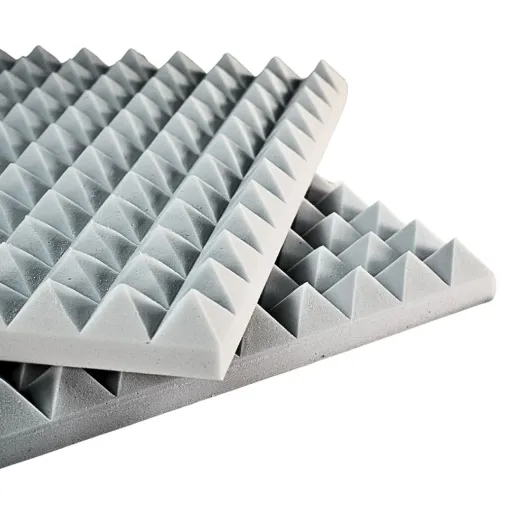
Additive flame retardants are the standard way to make polyurethane foam pass a fire test, and they are also the weak point. Because they are not chemically bonded to the foam, they migrate, volatilize and leach out over the life of the product.
Published research puts numbers on this. Thermal aging at 90°C left only about 22 to 23 percent of the melamine phosphate retained in flexible PU foam, and UV aging degraded roughly 78 percent of it over 90 days. Dermal transfer increased tenfold after UV aging.
The engineering fix is reactive flame retardants copolymerised into the foam’s structure, or microencapsulated systems that slow migration. If you are specifying foam, ask directly: is the flame retardant reactive or additive, and is there aging data? In a long-life installation, an inherently fire-resistant material is the better bet, because its performance does not depend on a chemical staying where it was put.
What to Use Instead: Alternatives With Real Fire Certifications
The forum default answer to “what should I use instead” is rockwool. It is a good answer, but it is not always the right one for the room.
Mineral wool (stone wool). EN 13501-1 A1, non-combustible, melting above 1,000°C. This is the gold standard for fire-critical specifications, and it needs no flame-retardant chemistry at all.
Glass wool and fiberglass panels. Typically Class A in tested assemblies, with published values around FSI 10 and SDI 50. Unfaced variants can meet ASTM E136 non-combustibility.
PET felt acoustic panels. Available in Class A and B-s1,d0 versions, and increasingly the default for commercial office work. How PET felt panels compare with acoustic foam walks through where they win and where they do not. When you specify PET, confirm whether the rating covers the panel alone, the panel with adhesive, or the installed system.
Wood slat acoustic panels. Untreated slats default to Class E or DIN B2. The compliant version is a complete system: FR-treated slats plus an FR felt backing, rated as an assembly at B-s1,d0. The system rating is the one that counts, not the rating of the slat or the felt alone. See wood slat acoustic panels as a foam alternative for the full comparison.
WPC wall and acoustic panels. Typically B1 and B-s1,d0 with halogen-free intumescent treatment, useful where a project needs moisture resistance and a wood look with a documented classification.
One chemistry note connects to a broader question. Brominated flame retardants such as PBDEs and HBCD are listed as persistent organic pollutants under the Stockholm Convention, and they are associated with endocrine disruption and developmental effects. Because they are not bound to the foam, they escape as indoor dust over time.
Halogen-free phosphorus systems, including ammonium polyphosphate and ATH, reach comparable classes with lower smoke toxicity. At the same rating, that is a real tiebreaker.
There is a cost to all of this, and it is worth budgeting for: FR treatment typically reduces acoustic performance by 5 to 10 percent and adds roughly 20 to 30 percent to material cost. We broke down the numbers in the cost of upgrading from foam to acoustic panels.
Ready to specify fire rated acoustic panels that come with their documentation? Start with our office acoustic panel buying guide for commercial projects, or send us your drawings and we will match products to your fire class requirement.
How to Verify an Acoustic Foam Fire Certificate
A fire certificate is only as good as the parameters it covers. Here is what to demand, and what to reject.
Ask for the full original test report, not a badge or a screenshot. A valid report shows the accredited laboratory’s name and accreditation number, the standard and its edition (for example “ASTM E84-23a”), a precise sample description covering material, thickness, density, facing, substrate and fixing method, the measured FSI and SDI values, and a report number and date.
Confirm the tested configuration matches what you are buying. A report for a 70 mm panel does not certify a 50 mm one, and carved, printed and veneered variants are different products requiring their own testing. Similarly, a report issued for a sample tested flat on the floor does not describe a wall-mounted installation.
Watch for documented failure patterns. The Grenfell Tower Inquiry found that certification had been issued for foam insulation on the strength of a report that omitted a component added specifically to pass the test. A 2026 nightclub fire in Crans-Montana, Switzerland killed 40 people in a venue using untreated ceiling foam with an ignition temperature of roughly 405°C, and the provenance documentation turned out to be forged. In another case, a Class A claim rested on a test of a different, thicker product that contained rockwool.
Red flags: “non-flammable” (only A1 and A2 materials are), “self-extinguishing” presented as a rating, no named laboratory, no standard number, and no measured values.
Green lights: a named standard with an edition, real FSI and SDI numbers, third-party listing, and a supplier willing to email you the PDF without asking why. A supplier confident in their product sends documentation immediately. One who deflects to a marketing page is telling you something.
Acoustic Foam Fire Rating: Frequently Asked Questions
Is acoustic foam flammable?
Untreated polyurethane acoustic foam is flammable, igniting at roughly 315°C (600°F). Flame-retardant grades self-extinguish, and melamine foam is inherently flame-resistant.
Is acoustic foam fire retardant?
Some is and some is not. The determining factor is the material and whether a documented ASTM E84 or EN 13501-1 test report exists. “Fire retardant” on its own is an unregulated marketing phrase.
What is the fire rating of acoustic foam?
Melamine foam typically tests at FSI 6 and SDI 15, comfortably Class A. FR-treated polyurethane commonly reaches FSI 25 and SDI 250, also Class A. Standard untreated PU often lands around FSI 35 and SDI 350, which is Class B.
Does acoustic foam need to be fire rated?
For residential use there is usually no legal requirement, though it is a sensible safety choice. In commercial, assembly and healthcare occupancies, foam plastic must typically pass a large-scale assembly test rather than ASTM E84 alone.
Can acoustic foam pass a building code inspection?
Sometimes, but not on the strength of a Class A label. Foam plastic used as interior finish generally requires approval under NFPA 286, UL 1715, UL 1040 or FM 4880 on the finished assembly. Many foam installations fail for exactly this reason.
Is melamine foam or polyurethane foam safer?
Melamine foam is safer on every fire metric: lower flame spread, far lower smoke, no flame-retardant additives to degrade, and charring rather than dripping. The trade-off is cost and a firmer, less conformable surface.
Does fire-retardant spray actually work on acoustic foam?
Spray treatments can improve performance temporarily, but they typically need reapplication within one to five years, and they change the surface appearance. They are not a substitute for an inherently rated material in a regulated space.
Do I need fire-rated foam in a home studio?
You are unlikely to face a code requirement. The safety case is still real: keep foam clear of heat sources, avoid untreated pyramid foam near electronics, and never reuse packaging foam. Our guide to installing acoustic foam with safe clearances covers the practical rules, and acoustic foam vs bass traps for low-frequency problems covers the alternative approach.
Conclusion
The acoustic foam fire rating on a product page is only the starting point. Class A means an ASTM E84 flame spread index of 0 to 25 with smoke developed up to 450. Melamine foam achieves that inherently, at FSI 6 and SDI 15, while FR-treated polyurethane relies on additives that lose potency with age. And the fact that matters most in a commercial project is the one nobody advertises: a Class A rating does not make foam plastic a code-compliant interior finish, because IBC 2604.1 requires large-scale assembly testing under NFPA 286 or an equivalent.
The Station nightclub fire in Rhode Island in 2003 remains the clearest demonstration of what that distinction means. Under identical pyrotechnic exposure, the NIST investigation found that untreated polyurethane foam ignited in about ten seconds while fire-retardant foam did not ignite at all. One hundred people died. The lesson is not that foam is uniquely dangerous; it is that the difference between rated and unrated material is measured in seconds, and the documentation behind the rating is what tells you which one you have.
If you are sourcing acoustic treatment for a commercial space, start by deciding the fire class the occupancy requires, then ask every supplier for the test report that proves it. We supply PET felt, wood slat and WPC panels with their classifications documented at the system level, and we will send the PDFs before you commit to anything.
Request fire test documentation and a bulk quote →
Categories:
Blog
Related Articles