WPC Fluted Wall Panels: Profiles, Groove Depths & How to Choose (2026)
A WPC fluted wall panel is an extruded wood-plastic composite board with parallel grooves or ribs running across one continuous face. Two numbers decide how it looks: groove depth, which is typically 2-8 mm, and pitch, the spacing between flutes, which in 2026 sits in the 30-60 mm range for a current look. Lock those two specs first, then confirm the core, the joint system and the finish before you order anything.
That’s the short answer. The long answer matters because “fluted” describes a profile, not a product, and a cheap panel can carry the name without carrying the look.
Priya, a renovator in Manchester, ordered what the listing called fluted panels for her lounge feature wall. The marketing photo showed deep, dramatic grooves. What arrived had grooves roughly 3 mm deep pressed into a printed film, and from across the room, the wall read as flat. She returned the lot and started again.
You don’t have to make the same mistake. This guide covers how to specify a WPC fluted wall panel, how to verify one before it ships, where fluted suits a living room, and what it genuinely costs factory-direct. We supply WPC interior panels from Linyi, Shandong, and the questions below are the ones buyers ask us every week.
Key Takeaways
- Groove depth (2-8 mm typical; around 20 mm reads strongly across a room) and pitch (30-60 mm is current, 10-20 mm looks dated) decide the visual result. Specify both.
- Check the cut edge: a real panel has a 0.3-0.5 mm co-extruded cap wrapping inside the grooves; a printed imitation has film sitting on a non-WPC base.
- Hollow core runs about 4-7 kg/m² and solid core about 8-12 kg/m² at 20 mm. Solid panels hold screws better for heavy fittings.
- Fluted panels scatter sound, they do not absorb it. A felt-backed slat panel is the acoustic choice.
- Factory-direct interior fluted panels cluster around US$2-5/m², but confirm whether a quote is per square metre or per linear metre before you compare.
What Is a WPC Fluted Wall Panel?
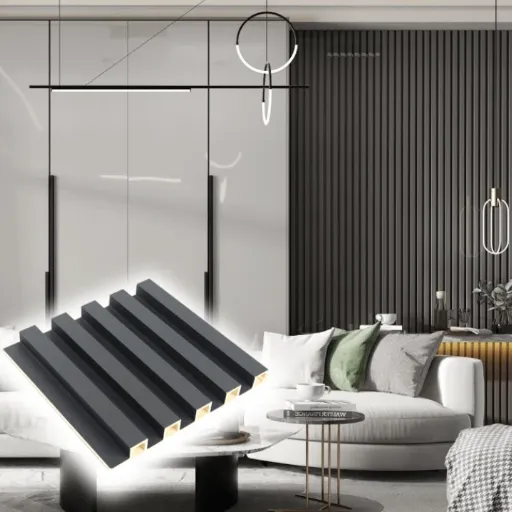
A WPC fluted wall panel is a wood-plastic composite board with a continuous face into which parallel vertical grooves, or flutes, are formed during extrusion. Unlike a slat panel, which uses separate strips with open gaps between them, a fluted panel is one solid profiled surface, so the shadow it creates comes from the shape of the face, not from gaps behind it.
That construction difference explains the whole character of the product. Because the flutes are cut into one face, the light falls across them in soft graduated bands rather than sharp lines. The result reads as a single textured plane, which is why designers reach for it when they want quiet depth instead of a statement.
Fluted, Slat and 3D Panels at a Glance
| Feature | Fluted | Slat | 3D sculptural |
|---|---|---|---|
| Construction | Continuous face, flutes routed or extruded in | Separate strips on a backing | Moulded relief patterns |
| Groove depth | Shallow, typically 2-8 mm | Deep, strips stand 15-30 mm proud | Variable by pattern |
| Shadow character | Soft, graduated | Strong, defined | Dramatic, directional |
| Dust in grooves | Light, wipes clean | Deeper gaps collect more | Traps dust in recesses |
| Acoustics | Scatters sound only | With felt backing, absorbs (NRC 0.5-0.9) | Almost none |
| Install difficulty | Easiest | Moderate | Piece-by-piece |
Why You Will Also See “Louver”, “Great Wall” and “Grille”
The same profile travels under several names. Suppliers call it a louver panel, a great wall panel (after the battlement look of the cross-section), a grille board or simply a fluted wall panel. The customs classification follows the material, not the marketing, landing under HS heading 3925.90.00 for plastic builders’ ware. If two suppliers quote different names at different prices, check the cut edge and the profile drawing before you assume they are different products. Our slat, fluted and 3D profile guide breaks down how the wider family fits together.
Groove Depth and Pitch: The Two Numbers That Decide the Look
Depth and pitch do the visual work. Everything else, colour, finish, brand, is secondary to these two specs.
How Depth Controls Shadow and Perceived Height
A shallow flute of 2-3 mm gives a gentle, almost fabric-like texture that suits calm, minimal rooms. A deeper flute of 6-8 mm produces a defined shadow line that reads clearly from across a room, and a heavily profiled flute near 20 mm becomes a design feature in its own right. Vertical flutes also draw the eye upward, so a wall panelled floor to ceiling in a vertical profile makes a standard 2.4 m ceiling feel taller.
If you are choosing a fluted panel for a small or low-light room, stay shallow. If the wall is large and the ceiling is high, a deeper flute has the room to show off.
How Pitch Dates a Panel
Pitch is the centre-to-centre spacing between flutes, and it moves with the trend. Profiles around 30-60 mm pitch look current in 2026. Narrow, tightly repeated strips at 10-20 mm read as dated, partly because they sit close to the look of an older generation of moulded wall panels. Wider pitch also means fewer grooves to clean.
Matching Depth and Pitch to Room Height and Light
| Room situation | Recommended depth | Recommended pitch |
|---|---|---|
| Compact room, low light | 2-4 mm | 40-60 mm |
| Standard living room | 4-6 mm | 30-50 mm |
| High ceiling, large wall | 6-8 mm or deeper | 30-40 mm |
| Commercial lobby or restaurant | 8 mm and above | 30-60 mm |
Quick snapshot: a WPC fluted wall panel should have a groove depth of 2-8 mm for most interior walls, with a pitch of 30-60 mm for a current look. Choose deeper flutes for high ceilings and large surfaces, and shallower flutes for compact or dimly lit rooms.
Hollow vs Solid Core, and How Fluted Panels Join
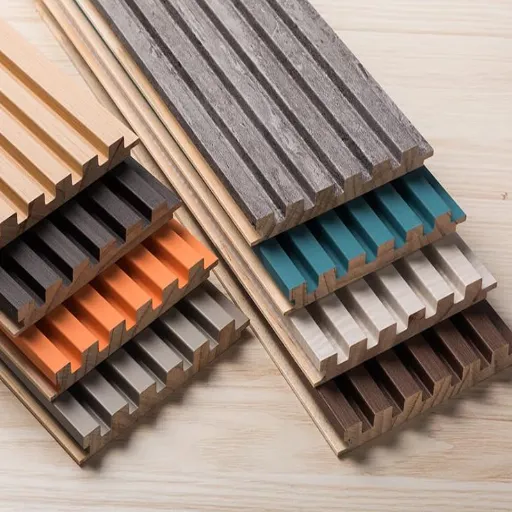
Two panels can share the same profile and still behave completely differently, because the core type drives weight, strength and how the panel fixes to the wall.
Weight, Strength and Screw-Holding
A hollow-core fluted panel contains internal channels, which keeps it light at roughly 4-7 kg/m² for a 20 mm panel. A solid-core panel is denser, at roughly 8-12 kg/m², and holds fixings far better; tested screw pull-out can exceed 1,000 N. That difference matters if you plan to hang a console, a shelf or any load off the wall, and it affects shipping weight on bulk orders.
Joint Systems: Tongue-and-Groove, Clip, Metal Strip and Adhesive
Hollow panels commonly arrive with a tongue-and-groove edge and clip fixing, which makes them quick to align and join. Some solid panels use a metal strip between boards instead, and flat-backed panels bond with adhesive. Your choice follows the core type, the substrate and whether the run is interior or exterior. Expansion gaps at the ends of the run and around the perimeter are non-negotiable in every method, whichever fixing you use. For the full sequence, from substrate prep to cutting around sockets, our step-by-step guide to how to install WPC wall panels on a wall covers every stage.
Which Core for Which Application
- Hollow core: interior feature walls, ceilings, bedrooms and residential living rooms where weight and cost matter.
- Solid core: high-traffic commercial interiors, hotel lobbies, retail fit-outs and any wall that carries fittings or fixtures.
- Either: standard residential feature walls, provided the substrate is flat and the fixing method suits the load.
Straight, Curved and Column Profiles
Fluted panels are rigid boards, and rigidity is exactly what stops a flat panel doing certain jobs. A tight inside corner, an outside corner or a structural column will break the line of a flat run.
Where Rigid Fluted Panels Fail
A flat fluted board cannot follow a curve without either kinking or leaving a gap. Columns, curved display walls, reception desks and any radiused feature surface are where a standard panel gives up. You either accept a hard corner with a trim, or you step up to a bendable profile.
Circular-Arc and Column Profiles
Circular-arc fluted profiles are tooled to a set radius so the flutes carry around a curve without flattening. They wrap columns and curved partitions cleanly and keep the groove pattern continuous through the bend. For most projects this is a made-to-order profile rather than a stock item, so confirm the radius and the lead time early.
Corners, Columns and Trim Integration
For straight runs, corner trim and H-trims handle the joints and give a finished edge. For columns, a wrap profile does the work. Matching the trim and the cap finish to the panel keeps the wall reading as one surface rather than a set of parts. Our Slim, Bold and Circular Arc profile families exist precisely to cover those three cases.
How to Verify a Real Fluted Panel (Printed Film vs Co-Extruded Cap)

This is the single question that separates a wall that still looks good in five years from one that peels in eighteen months. Verifying a panel takes about two minutes on a sample.
The Cut-Edge Test
Ask for a cut-end sample. On a genuine co-extruded panel, a 0.3-0.5 mm cap layer wraps around the entire profile, including inside the grooves, and you can see the cap boundary as a continuous band through the cross-section. On a printed imitation, a wood-grain film sits as a separate decorative layer on top of a non-WPC base, often MDF or a density board, and the edge shows film over a different material rather than one integrated profile. If the base isn’t wood-plastic composite at all, it isn’t a WPC fluted wall panel no matter what the listing says.
Embossed vs Printed Grain
Run your hand across the face. A quality panel uses deep 3D-synchronised embossing or a texture moulded in during extrusion, so the grain follows the flutes and feels tactile. A cheap panel has a flat heat-pressed laminate film that looks artificial, and it carries a real risk of delamination over time.
A Five-Point Inspection Checklist
- Density and weight: compare kg/m² against the datasheet; a suspiciously light panel is a red flag.
- Capping: confirm the co-extruded cap on the cut edge, inside the grooves.
- Embossing: check for tactile, synchronised grain rather than a flat printed surface.
- Colour batch: order the full quantity in one batch; mixed batches show as shade drift.
- Packaging: fluted profiles need spacers between layers so the flutes do not crush in transit.
Want to run the cut-edge test yourself? Request a physical sample kit and compare depth, capping and colour under your own lighting before you commit. Request free samples →
Design Uses in the Living Room
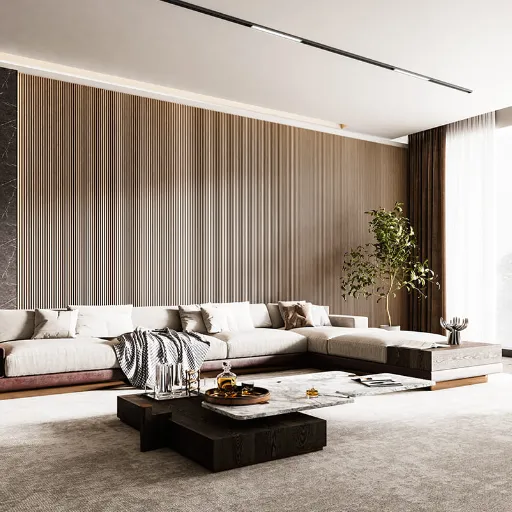
The living room is where fluted panels earn their keep, because a single textured wall anchors the space while the rest of the room stays simple. That shift toward texture over flat paint is a documented trend rather than a hunch. Design press such as BD Online has tracked texture replacing flat surfaces in mainstream interiors, and The Hindu has reported textured panels displacing paint in residential renovations.
Floor-to-Ceiling Feature Walls
Panelling one wall floor to ceiling in a vertical profile gives the strongest, cleanest result. If you are planning the whole room, our living room WPC wall panel design guide covers layout, colour and coordination in depth.
Framing a TV or Media Wall
A fluted panel works well beside a media wall, where the tighter spacing reads as a textured back-drop rather than a set of separate slats. For proportions, cable planning and mounting detail, our TV and media wall design guide walks through the sequence step by step.
Bedroom, Hallway and Dining Accents
The same profile suits a bedroom headboard wall, where vertical flutes add height, and a hallway or dining nook, where a narrow fluted panel needs no more than one wall to make an impact. If the room is compact, our panelling ideas for small living rooms shows how to keep the effect without stealing floor space.
Pairing Colour and Finish
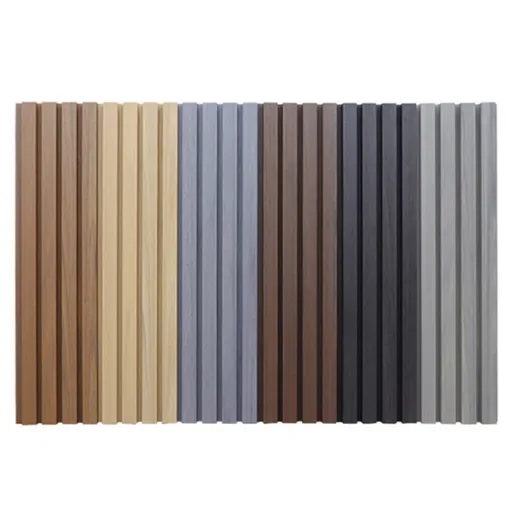
Natural oak and walnut stay warm and forgiving, off-white and greige keep a small room open, and charcoal adds drama in a larger space. Matte finishes below roughly 20 gloss units look current; high-gloss plastic reads as dated. For mood-led schemes and batch consistency, see our guide to WPC wall panel colours.
Beyond the Living Room
Bedrooms, home offices, hotel guest rooms, restaurants and retail interiors all take fluted panels well. Directly wet zones, such as inside a shower, do not, which is a moisture question rather than a trend question. For a wider sweep of room-by-room layouts, browse our feature and accent wall ideas.
Do Fluted Wall Panels Collect Dust? Cleaning and Maintenance
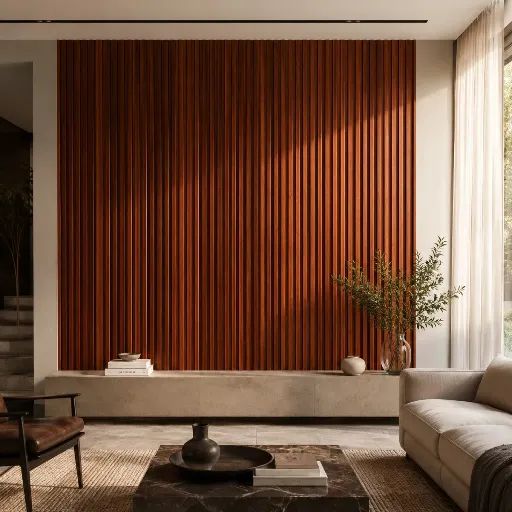
Yes, grooves collect some dust. How much depends on depth, and dark colours show it more than light ones. The honest picture is that shallow flutes are easy to maintain and deep flutes need a little more attention, which is very different from the “no dead corners, never needs cleaning” line some listings use.
The Honest Answer on Dust
A shallow flute of 2-3 mm wipes clean with a single pass. A deep flute of 8 mm or more traps more dust and needs a brush to reach the base of each groove. Rooms near main roads, and kitchens where airborne grease settles, need more frequent attention. This is a maintenance cost, not a defect, and it is the main practical reason to keep pitch wide and depth moderate in a busy home.
The Right Routine
- Dust monthly in living rooms and bedrooms with a soft vacuum brush or a microfibre duster.
- Wipe vertically, top to bottom, with a damp microfibre cloth, rinsing as it loads up.
- Clean more often in kitchens, where grease deposits faster than dust.
- Spot-clean scuffs with a mild soap solution, then dry the surface.
What to Avoid
Skip abrasives, bleach, ammonia and solvent cleaners, all of which can dull or mark the finish. Do not use steam cleaners or leave standing water on the panels, and keep them clear of prolonged direct sun where UV protection is not specified.
Fire, Moisture and Acoustic Reality
Three performance questions come up on almost every project, and they are worth answering plainly rather than with a sales line.
Fire Ratings and How to Verify Them
Interior WPC fluted panels are commonly available in Class B1 under the Chinese GB 8624 standard, which maps broadly to EN 13501 B-s1,d0 in Europe and ASTM E84 Class A or B in the US, depending on formulation. Ask for the actual test report rather than a claim in a brochure, and confirm the standard applies to your market’s code.
Moisture and Humidity
WPC absorbs very little water, typically 0.5-1% after a 24-hour immersion test, which is why it holds up in humid rooms far better than MDF. That still doesn’t make it a wet-zone product. Keep fluted panels out of direct splash zones, and leave ventilation behind any panel that sits in front of a cavity.
Acoustic: Scatter, Not Absorb
A fluted panel scatters sound; it doesn’t absorb it. The grooves break up reflections and can soften an echo, but they carry no meaningful absorption rating, so they won’t soundproof a room. If acoustic performance is the priority, a felt-backed slat panel reaches NRC 0.5-0.9 and is the honest choice. Our fluted vs wood slat panels compared explains where each one wins.
WPC Fluted Wall Panel Cost and Sourcing
Price varies more than any other spec, which is why the numbers below come with their conditions attached.
Price per m² by Specification
Factory-direct interior WPC fluted panels cluster around US$2-5/m², with the exact figure driven by thickness, width, core type and finish. Decorative and premium co-extruded grades sit higher. The single most common pricing trap is the unit: some quotes are per square metre and others per linear metre, and comparing the two directly produces a misleading gap. Always normalise to per square metre for the same width and thickness before you decide.
MOQ, Lead Times and Samples
Standard items carry low minimum order quantities and short lead times, while custom colours and non-standard profiles add days to the schedule. Two rules save the most trouble.
- Request a physical sample so you judge depth, capping and colour on a real panel, not a screen.
- Order the full quantity in one production batch, because colour consistency across batches is the complaint buyers raise most.
Weight and Container Planning
At roughly 4-7 kg/m² for hollow and 8-12 kg/m² for solid, fluted panels are heavier than PVC but lighter than solid wood or stone. That weight, plus the need for packaging spacers, drives container loading on bulk orders. Share your m² total and the profile width and we can size the load before you commit.
Sourcing a project or a container? Get a bulk quote with specimen panels and a batch-consistency commitment. Get a bulk quote →
Frequently Asked Questions
What is a WPC fluted wall panel made of?
It is an extruded wood-plastic composite board, typically wood fibre combined with a polymer such as HDPE, PP or PVC, plus additives. Parallel flutes are formed into one continuous face during extrusion, then finished with a co-extruded cap or an embossed wood-grain surface.
What groove depth should a fluted wall panel have?
For most interior walls, 2-8 mm works well, with 20 mm and above reserved for large, high-ceilinged spaces where the deeper shadow reads across the room. Shallow depths of 2-4 mm suit compact or dimly lit rooms and are easier to clean.
How do I tell a real fluted panel from a printed imitation?
Ask for a cut-end sample. A genuine panel has a 0.3-0.5 mm co-extruded cap wrapping the whole profile, including inside the grooves. A printed imitation has a wood-grain film sitting on a non-WPC base such as MDF, which you can see at the cut edge.
Is a “great wall” panel the same as a fluted panel?
Usually, yes. Great wall, louver, grille and fluted are near-interchangeable trade names for the same grooved WPC profile, named after the battlement look of the cross-section. Always confirm dimensions, core and capping rather than relying on the name.
Hollow or solid core fluted panel, which should I choose?
Choose hollow core for light interior feature walls and ceilings, where lower weight and cost matter. Choose solid core for high-traffic commercial interiors and any wall carrying fixtures, because it is denser and holds screws better, with pull-out above 1,000 N.
Are fluted wall panels still in style in 2026?
Yes. The style has shifted rather than faded: wider pitch of 30-60 mm, natural and muted colours, and matte finishes below roughly 20 gloss units now look current, while narrow 10-20 mm strips and high-gloss finishes read as dated.
Do fluted wall panels collect dust? How do I clean them?
Shallow grooves collect little dust and wipe clean in one pass; deeper grooves need a soft brush. Dust monthly with a vacuum brush or microfibre duster, wipe top to bottom with a damp cloth, and avoid abrasives, bleach, ammonia and steam.
Do fluted panels make a room look taller?
Vertical flutes draw the eye upward, so a floor-to-ceiling vertical run makes a standard 2.4 m ceiling feel taller. The effect is strongest in a narrow room with a light colour and a moderate pitch.
Can fluted panels be used in bathrooms or kitchens?
WPC absorbs under 1% water after 24 hours, so it handles humid rooms well, but keep it out of direct splash zones. In kitchens it is fine on splash-light walls, though grease deposits mean more frequent cleaning than a living room wall.
Are fluted WPC panels fire rated?
Interior fluted panels are commonly available in Class B1 under GB 8624, broadly equivalent to EN 13501 B-s1,d0 and ASTM E84 Class A or B, depending on formulation. Always request the test report rather than accepting a brochure claim.
Do fluted panels help with sound?
They scatter sound and can soften an echo, but they do not absorb it and carry no meaningful NRC rating. For real acoustic benefit, a felt-backed slat panel reaching NRC 0.5-0.9 is the right product.
How much do fluted wall panels cost per m²?
Factory-direct interior WPC fluted panels cluster around US$2-5/m², with premium and co-extruded grades higher. Confirm whether each quote is per square metre or per linear metre, and compare like-for-like width and thickness.
Conclusion
Getting a WPC fluted wall panel right comes down to a short list of decisions, and none of them are complicated once you know to make them.
- Depth and pitch set the look: 2-8 mm deep and 30-60 mm pitch reads current; deeper flutes suit large, high-ceilinged walls.
- Core and joint set the strength: hollow is light, solid holds screws; tongue-and-groove, clip or metal strip each suit different cores.
- Verify before you commit: check the cut edge for a co-extruded cap and confirm the grain is embossed, not printed.
- Fluted scatters sound, it does not absorb it, so choose a felt-backed slat panel if acoustics lead the brief.
- Buy samples and one batch: colour consistency across production runs is the most common avoidable problem.
Tomás, a renovator in Lisbon, did exactly that. He ordered samples in three depths, tested them on his own wall under morning and evening light, then committed to a single batch of 6 mm flutes at 40 mm pitch for a 3.2 m wall. The result was the effect the photographs had promised, because the specs behind the photograph were right.
Whether you are panelling one lounge wall or sourcing for a hotel rollout, we can help you specify depth, pitch, core and finish, and send samples you can hold. Talk to our team about your fluted panel project →
Categories:
Blog
Related Articles