Acoustic Foam vs Acoustic Panels for Home Studios: What Should You Buy?
When you weigh acoustic foam vs panels for home studio use, acoustic panels win for any room where you record music or mix. Foam costs less and works fine in voice-only rooms, but it absorbs almost no bass, and bass is exactly where most home studios fail. For music production, buy panels first, then add foam later only where you need flutter control.
That sounds like a strong claim, so let’s show the numbers behind it. If you’ve ever recorded a vocal and heard a “boxy” low end, or finished a mix and found it sounded muddy in the car, you already know the feeling this guide is about.
I’m going to walk you through what each material actually does in a small room, why foam keeps failing the moment bass enters the picture, and exactly what to buy at three budget levels. You’ll finish knowing how many panels your room needs and where to put them, with no guesswork.
We are a factory-direct supplier of acoustic panels, so we have no reason to push foam you don’t need. Our job is to help you spend once and spend right.
Key Takeaways
- For music mixing and recording, acoustic panels beat acoustic foam because they control bass and low mids, the range where home mixes turn muddy
- Foam absorbs almost nothing below 250 Hz (about 7 to 13% at 125 Hz), so it cannot fix the small-room bass buildup that ruins mix translation
- A proper panel start for a typical 10×12 foot room runs about $300 to $600; a $115 foam kit leaves the low end untreated
- A hybrid setup is the smart budget move: panels at first reflection points and in corners, foam only for high-frequency flutter on a back wall
- Panels last 15 to 20 years; foam needs replacing every 2 to 5, which makes panels cheaper per year over a decade
Why a Home Studio Needs More Than an Office or Podcast Booth

An office treats echoes so people can hold calls. A podcast booth treats echoes so a voice sounds clear. A home studio does something harder: it has to give you an honest picture of the whole frequency range so your mixes sound right everywhere else.
When you mix, you are making decisions about kick drums, bass lines, and low mids that live between roughly 60 and 400 Hz. If your room exaggerates or swallows those frequencies, you compensate with EQ moves that are wrong. The result is a mix that sounds fine in your studio and falls apart in a car, on earbuds, or in another studio. Sound engineers call this “mix translation,” and untreated small rooms are the most common reason it fails.
Foam and panels both fix echo. They do not fix the same frequencies, and that difference decides the argument.
Acoustic Foam vs Panels for Home Studio: The Core Difference
Both acoustic foam and acoustic panels are sound absorbers. Neither soundproofs a room. The difference is how much of the sound spectrum each one absorbs, and for how long.
| Factor | Acoustic Foam | Acoustic Panels |
|---|---|---|
| Material | Open-cell polyurethane or melamine | Fiberglass, mineral wool, or PET core in a frame |
| NRC rating | 0.30 to 0.55 | 0.85 to 1.0 |
| Absorbs 125 Hz | 7 to 13% | Effective down to 125 Hz |
| Frequency range | Mid and high only (roughly 500 Hz up) | Broadband, including bass and low mids |
| Lifespan | 2 to 5 years | 15 to 20 years |
| Cost | $2 to $5 per sq ft | $8 to $15 per sq ft |
The full breakdown of materials, density, and performance lives in our complete acoustic panels vs acoustic foam comparison. This guide focuses on the choice inside your home studio.
Here’s the short version. Foam is a mid-and-high-frequency tool. Panels are a full-spectrum tool. A music room needs the full spectrum, so this is not a close call.
What Acoustic Foam Actually Does in a Home Studio

Let’s be fair to foam. It is cheap, easy to mount, and genuinely useful in the right place.
Acoustic foam tiles are open-cell polyurethane, and they are great at taming flutter echo, slapback, and harsh high-frequency reflections. If you record a voice close to a mic in a small, live room, a few foam tiles around the mic will clean up the take. Many podcasters and streamers use foam happily, and for them it is a fair trade at $50 to $150.
The catch appears the moment music is involved. Standard foam absorbs almost nothing below 500 Hz, and at 125 Hz it soaks up only about 7 to 13% of sound energy. That is why a room treated with foam can still boom on kick drum and bass guitar. If you want the deeper science on what foam can and cannot do, read our guide to what acoustic foam can and can’t do.
A practical rule: if the material you are adding cannot absorb a 100 Hz tone, it is not treating your actual problem. Foam cannot, and panels can.
What Acoustic Panels Do That Foam Can’t
Acoustic panels use a dense core, usually fiberglass, mineral wool, or recycled PET felt, wrapped in a breathable fabric or finished with wood slats. That density is what lets them absorb broadband sound down to 125 Hz and below.
For a mixing room, this matters because the mud you are fighting lives in the low mids. Between 150 and 400 Hz, small rooms build up energy that smears kick, bass, and low guitar parts into an indistinct thump. Foam passes those frequencies right through. A 2-inch panel absorbs them, and a 4-inch panel or a corner trap goes even lower.
Panels also do something foam cannot do at all: they hold up. A fiberglass or mineral wool core does not crumble or oxidize, so a fabric-wrapped panel still performs at year 15. Foam is a polymer, and polymers break down. That lifespan gap quietly doubles foam’s real cost.
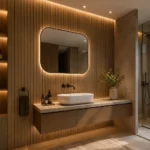
If your studio is also a visible room, panels give you finishes foam never will. PET felt comes in dozens of colors, and wood slat or WPC panels look like interior design rather than studio gear bolted to a wall.
The Real Home Studio Problem: Bass Modes, Not Echo

Here is what most buyers miss. The boom in a small room is not usually echo. It is room modes, which are standing waves caused by your room’s parallel walls reinforcing specific low frequencies.
In a typical home studio, which is a spare bedroom of 10 to 14 feet, those modes land roughly between 40 and 150 Hz. That is the exact range where a kick drum and bass guitar live, and it is the exact range foam cannot touch. A wall of wedge foam leaves the modes ringing, so your low end is inaccurate no matter how much foam you add. GIK Acoustics, which builds and tests acoustic products professionally, has shown that foam makes very little difference below 250 Hz, while rigid panels stay effective far lower.
The fix is not more foam. It is broadband absorption with an air gap, placed in corners and at reflection points, which is what panels and purpose-built bass traps are made for. If you want to understand the low-frequency side of this in depth, our main acoustic panels vs acoustic foam guide covers the science and the absorption data room by room.
How Many Acoustic Panels Does a Home Studio Need?
The most common question after “foam or panels” is “how many?” A useful starter answer for a typical 10×12 foot or 3×4 meter room looks like this:
- 4 to 6 broadband panels for the first reflection points on the side walls and ceiling
- 2 to 4 corner bass traps for the two front corners behind your speakers
- 1 rear-wall panel or a deep shelf behind your listening position
- Optional ceiling cloud above the mix position if the room is very live
That is 6 to 10 panels for a complete start. As a general target, treat about 20 to 30% of the reflective surface. More than that and you risk a dead room with no ambience, which has problems of its own.
Fewer panels, better placed, will always beat more foam. Placement does half the work, and our separate walkthrough on setting up a home studio covers the mirror trick for finding your first reflection points step by step.
Acoustic Foam vs Panels for Home Studio: Cost and Budget Tiers
Money is usually the real question, so let’s put numbers on it. Foam runs $2 to $5 per square foot, and a 24-pack of tiles for a small room lands around $100 to $150. Panels run $8 to $15 per square foot, which is why a complete panel start feels like a bigger spend.
Here is what each budget actually buys.
| Budget | What to Buy | What It Fixes | What It Leaves |
|---|---|---|---|
| $100 to $200 | Foam kit or 2 DIY mineral wool panels | Echo and flutter, voice clarity | Bass and low mids, the mix problem |
| $300 to $600 | 4 to 6 panels plus 2 corner traps | First reflections, low-end buildup | Little, for a small room |
| $800 to $1,500 | 8 to 10 panels, larger corner traps, ceiling cloud | A genuinely accurate mix room | Very little |
The value math matters as much as the sticker price. Foam needs replacing every 2 to 5 years as it oxidizes and crumbles. Panels last 15 to 20 years with no loss of performance. Over a decade, buying foam twice or three times can cost more than installing panels once, and the panels work better every single year. Our acoustic panels vs foam cost comparison shows that full lifetime math.
Take Devon, who runs a beatmaking studio out of a 9×12 foot den in Nashville. In March 2026 he spent about $150 on foam because the panels felt out of reach. Three months later he was still boosting his low end by guesswork because the room could not tell him the truth. Devon saved up, bought six 2-inch panels and two corner traps for around $450, and treated the first reflections. He says the difference was not subtle. His mixes stopped turning to mud on the drive home.
If budget is tight, panels beat monitors. A $300 set of panels on an average pair of speakers will improve your mixes more than expensive speakers in an untreated room. That is the single best upgrade most home studios can make. Get a recommendation on the right panel setup for your room →
The Hybrid Strategy That Saves Money

You do not have to choose all one or all the other. A hybrid setup is often the smartest first purchase for a bedroom producer.
The plan is simple. Put broadband panels at the first reflection points and in the corners, where the science says the problems are. Then use foam only where it is honestly useful, which is usually a back wall behind the mix position to kill flutter echo, or around a vocal mic to clean up takes. This gets you 80% of the benefit for a lower total cost than an all-panel room, and it still fixes the bass that foam alone never would.
When you mount anything, remember two rules. Leave an air gap behind panels, even 20 to 50 mm, because the gap dramatically improves low-frequency absorption. And measure twice before you stick anything permanent on the wall. Our guide to how to install acoustic foam and panels walks through mounting, air gaps, and the mistakes to avoid.
When Acoustic Foam Is Genuinely Enough: Voice-Only Rooms
To stay honest, there is a case where foam is the right answer. If your “home studio” is really a voice room, for podcasts, voiceover, audiobooks, or gaming chat, your content lives almost entirely in speech frequencies, roughly 250 to 4000 Hz. Foam handles the upper part of that range well, and a voice does not demand the bass accuracy that music does.
Lena runs a podcast from a walk-in closet in a 6×8 foot space. She used a $130 foam kit, hung moving blankets on two walls, and her audio sounds clean to listeners. For her use case, panels would have been overkill. If that sounds like your setup, read our guide to acoustic foam for podcast rooms before you buy.
The honest dividing line is this. Voice-only room, tight budget: foam can pass. Any music recording, mixing, or mastering: start with panels.
Acoustic Foam vs Panels for Home Studio: The Bottom Line
If the detail above blurs together, use this table as a shortcut.
| Your Situation | Buy This | Why |
|---|---|---|
| Mixing or mastering music | Panels plus corner traps | Accurate low end, honest mixes |
| Recording vocals and instruments | Panels | Broadband control without coloring the take |
| Voice-only (podcast, voiceover) | Foam is acceptable | Speech-range echo control at low cost |
| Mixing AND podcasting in one room | Panels first, foam later | Panels serve both; foam only kills flutter |
| Tight budget, music room | 2 to 4 DIY panels first | Better than a wall of foam |
Ready to outfit your studio? We are a factory-direct supplier of PET felt, wood slat, and WPC acoustic panels, and we ship worldwide with wholesale pricing for project buyers.
Frequently Asked Questions
Is acoustic foam or acoustic panels better for a home studio?
For music production, acoustic panels are better. They absorb bass and low mids down to 125 Hz, which is the frequency range that makes home mixes sound muddy, and they last 15 to 20 years. Acoustic foam is a cheaper option that works for voice-only rooms, but it absorbs almost nothing below 500 Hz.
Does acoustic foam help with mixing?
Barely, and only for flutter echo. Foam does not absorb the low frequencies that determine whether a mix translates to other systems. If you mix, the material doing the real work needs to be a broadband panel or bass trap, not foam.
How many acoustic panels do I need for a small home studio?
For a typical 10×12 foot room, start with 4 to 6 broadband panels at the first reflection points plus 2 to 4 corner bass traps. In total, aim to treat about 20 to 30% of the reflective surface with panels, and do not over-treat.
Can I mix acoustic foam and acoustic panels?
Yes, and it is often the smart budget move. Use panels at the first reflection points and in corners to handle bass, then use foam on a back wall or around a vocal mic to kill high-frequency flutter. Panels do the heavy lifting; foam handles the extras.
Why does my home studio sound boomy even with foam?
Because the boom is a room mode, a standing wave reinforced by parallel walls, usually between 40 and 150 Hz in a small room. Foam cannot absorb those frequencies. You need thick broadband panels or dedicated corner bass traps with an air gap to fix it.
Conclusion
The acoustic foam vs panels for home studio question comes down to what your room is for. If you record and mix music, buy acoustic panels, because they control the bass and low mids that foam cannot touch and they keep working for 15 to 20 years. If your room is voice-only, foam is an honest budget option that still earns its place.
Start with the first reflection points, add corner bass traps, and cover 20 to 30% of the room. Leave an air gap behind panels and place them with the mirror trick before you commit. Do that and your mixes will finally sound the same on the way home as they did in the studio.
We have helped buyers around the world outfit everything from bedroom studios to full production rooms. If you would like guidance on panel types, coverage, or factory-direct pricing, we are a message away.
Ready to build a room your mixes can trust? Contact us for samples and a wholesale quote →
Categories:
Blog
Related Articles