Wall Panels vs Wallpaper vs Paint: Which Is Worth It Over Time? (2026)
The short answer: paint is the cheapest finish upfront, wallpaper sits in the middle, and wall panels cost the most on day one but usually win on total cost of ownership because they need no repainting and no re-papering. Paint is the right choice for a dry, low-traffic wall you’re happy to refresh every few years. Panels win feature walls, damp rooms and high-traffic areas. Wallpaper earns its place in a dry, decorative room where pattern is the point.
That’s the honest version, and it is not the one most comparison pages give you. Search for “wall panels vs wallpaper vs paint” and you get vendor blogs that always crown panels, plus neutral marketplaces that never commit to an answer. Nobody shows you the arithmetic behind “panels are cheaper long term.”
This guide does. You’ll see how all three finishes perform on durability, moisture, maintenance, repairability, disruption and cost over ten years, and the year the pricier finish actually pays you back. You’ll also see, plainly, when plain paint is the smartest money you can spend.
Key Takeaways
- Upfront, paint is cheapest (roughly ₹30-70/sq ft in India, or $30-100 per wall DIY in the US), wallpaper mid, and wall panels highest (about $7-20/sq ft).
- Over 10-15 years, panels usually win: paint is repainted every 2-5 years, wallpaper fails in damp rooms, and WPC panels last 15-25 years with no recurring work. The break-even usually lands around 5-7 years.
- Moisture decides more than price. Paint peels and wallpaper lifts in steam. WPC absorbs 0.5-1% water and is wipe-clean, which is why wet and high-traffic walls belong to panels.
- Repairability flips the choice for some people. Paint patches, wallpaper can’t be spot-fixed, and a single panel can be swapped if you kept spare stock from the same batch.
- The hybrid wins most often: panel the feature or high-traffic wall, paint the rest. This is the spec designers actually use.
Wall Panels vs Wallpaper vs Paint: The Short Answer
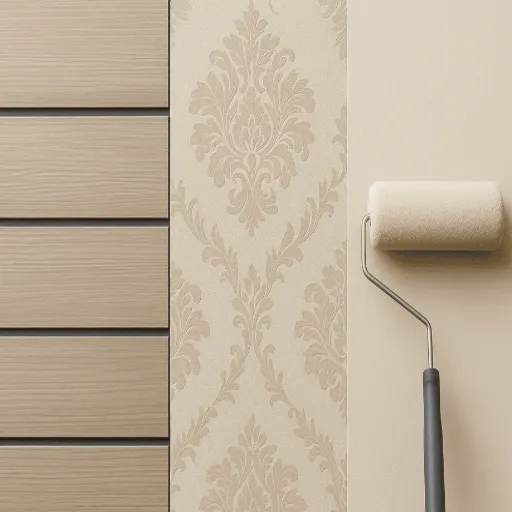
If you want the decision without the detail, match the finish to the wall rather than to the price tag.
- Dry, low-traffic wall you’ll happily repaint? Paint. It is the cheapest option on day one and the cheapest to patch.
- Damp, steamy or frequently cleaned wall? Wall panels. Paint and paper both fail here; a waterproof WPC panel does not.
- Feature wall or high-traffic hallway? Wall panels. They take knocks, wipe clean, and hold their look for 15 to 25 years.
- Dry decorative room where pattern matters? Wallpaper. Nothing else gives you the same pattern range, and in the right room it lasts a decade or more.
One caution on units: UK and EU guides quote per square metre, while US and India quote per square foot. If you are comparing, remember that one square metre is about 10.76 square feet. It’s the single most common reason quotes look wildly different when they are actually close.
For the design side of that decision, our living room WPC wall panel design guide walks through where panels earn their keep room by room.
Paint vs Wallpaper vs Wall Panels: Head-to-Head Comparison
Here is every factor that actually decides the outcome, on one basis. No competitor on this topic lays it out this way, so read this table as the map for the rest of the article.
| Factor | Paint | Wallpaper | Wall Panels (WPC) |
|---|---|---|---|
| Upfront cost | ₹30-70/sq ft; $30-100/wall DIY, $150-400 pro | Mid; $320-820/room installed (US) | Highest; $7-20/sq ft ($200-1,000+/wall DIY, $600-2,000+ pro) |
| Lifespan | 3-7 years | ~15 years average (vinyl 20+, peel-and-stick ~5) | 10-25 years (WPC 15-25 years indoor) |
| Maintenance | Repaint every 2-5 years | Re-paper when seams lift or fade | Wipe-clean only; no recurring work |
| Moisture / mould | Peels and moulds in steam | Paper degrades; doesn’t suit wet rooms | Absorbs 0.5-1%; wipe-clean; mould-resistant |
| Repairability | Easy: touch-up tin blends marks | Hard: re-paper the drop or wall | Single-panel swap from spare stock |
| Installation | Multi-day: prep, primer, 2-4 coats, cure | Time-heavy: precise, clean dry substrate | Same-day dry install; goes over paint or tile |
| Odour / room downtime | Paint smell; days out of use | Paste odour; needs ventilation | Minimal odour; hours, not days |
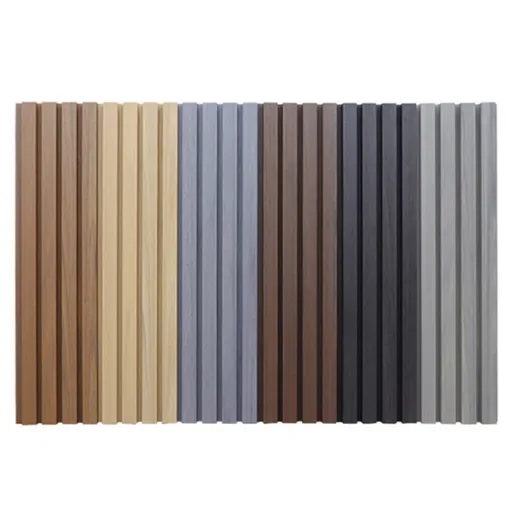
| Design range | Any colour, flat finish only | Widest pattern range | Deep texture and wood grain |
| Fire performance | N/A (inert) | Varies | B1 / Class B-s1,d0 option available |
| 10-year cost of ownership | Highest (repeated repaints) | High (fails and re-papers) | Lowest (no recurring spend) |
Two things stand out. Paint is the cheapest on day one and the most expensive to live with over a decade. Panels are the reverse. Wallpaper is the wildcard: excellent in a dry decorative room, a poor fit anywhere moisture or cleaning live.
The maintenance contrast is worth a pause. Paint’s recurring cost is not just money; it is the chore of clearing a room, protecting furniture and living with fumes every few years. WPC panels need a wipe. If you want the full care routine, our guide to WPC wall panel maintenance and long-term care covers it, and to see how a synthetic panel compares with a synthetic coating, it is worth reading how WPC compares with PVC panels.
Want to compare finishes against your own wall? Request a free sample kit and hold a WPC panel next to your existing paint and paper before you commit.
Durability and Lifespan: How Long Does Each Finish Last?
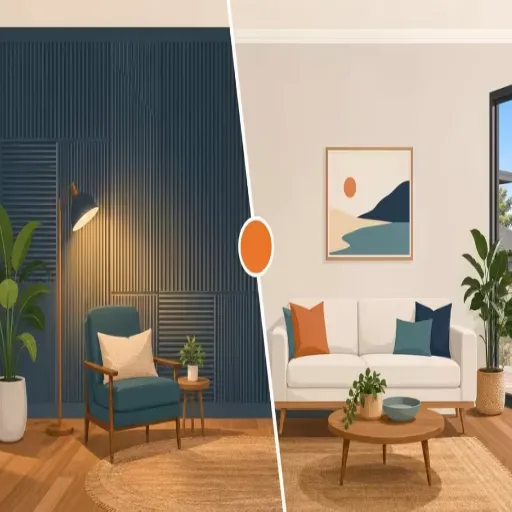
Paint is a coating. It sits on the wall, takes the scuffs, and wears. In a busy home you’ll see it looking tired in three to five years, and in a hallway or near a door within two. The repaint cycle for most living spaces runs every two to five years.
Wallpaper is a layer of pattern bonded to the wall. Good vinyl wallpaper can hold up to twenty years, but that average hides a wide range. Peel-and-stick wallpaper often fails inside five years, and any paper-backed wallpaper starts to lift at the seams wherever humidity reaches it. Corners and hallways are where it goes first.
Wall panels are different in kind, not just degree. A panel is not a coating that ages; it is a surface that stays. WPC panels last 15 to 25 years indoors. There is no repainting and no re-papering to schedule, because there is no surface layer to renew. If a panel does get damaged, you replace that panel, not the wall.
This is the single biggest reason the lifetime maths favours panels. Paint and wallpaper need to be redone. Panels mostly do not.
It also changes how the room feels to own. A finish you never have to refresh frees up weekends and budget you would otherwise spend decorating again. If you are weighing whether that durability is worth the higher entry price, our honest breakdown of whether WPC wall panels are good for living rooms covers where they win and where they do not.
Profile choice sits inside that decision too. A textured panel ages better than a flat coating anyway, but the profile you pick still matters for how it wears and how it cleans. If you are choosing between the two most popular panel styles, our guide to fluted vs wood slat panels compared covers groove depth, dust behaviour and which one suits a wall like yours.
Moisture, Mould and Humidity: Where Paint and Wallpaper Fail
Moisture is the factor that quietly decides more walls than price ever does. Bathrooms, kitchens, laundry rooms, basements and humid climates all favour the finish that doesn’t care about water.
Paint is, at best, surface-moisture resistant. Only satin or shinier finishes resist moisture at all, stains sink into the surface, and scrubbing them out damages the paint you were trying to protect. In a steamy room, paint is where mould gets a foothold.
Wallpaper is more fragile still. Paper wallpaper degrades in damp air, and even vinyl wallpaper can lift at the seams or trap moisture behind it. Neither finish was designed for a wall that gets wet.
WPC panels absorb just 0.5-1% of their weight in water after 24 hours of immersion, measured to the ASTM D570 standard. They are non-porous, they don’t swell, and they don’t feed mould. For wet and high-humidity walls this is the deciding property, and it is why waterproof grades exist for the harshest zones. If you are finishing a bathroom or a splash-prone wall, our guide to waterproof WPC panels covers the grade to choose.
The practical rule: if there is any moisture, steam or frequent cleaning, paint and paper are the wrong tools. Pick the panel.
Repairability: What Happens When the Finish Gets Damaged?
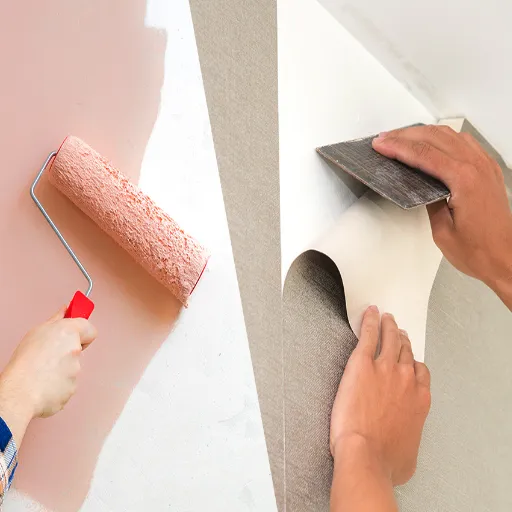
No comparison page on this topic covers repairability, and it is the factor that decides how you feel about your choice two years in, long after the first-day look is forgotten.
Paint is the easiest to fix. A scuff, a mark, a scratch from moving furniture: a touch-up tin blends it in an afternoon. The catch is that repeated patches over the years can leave a wall looking patchy rather than fresh, which is why people repaint the whole wall eventually.
Wallpaper is the hardest to fix. There is no way to spot-repair it. A scuff, a stain, or a child’s drawing means re-papering the whole drop, and matching the pattern from a different batch of the same design is rarely perfect. One incident can mean redoing a wall.
Panels sit in between, and that is a strength. A damaged WPC panel unclips and a new one goes in. The condition is that you kept spare panels from the same original batch, which is the single most useful habit with any panel project. Order 5-10% extra, store it flat, and future repairs stay invisible. Our guide on how to clean and care for WPC wall panels covers the day-to-day side of keeping them sharp.
For anyone with young children or a busy household, this section alone often settles the decision. A repairable wall is a forgiving wall.
Installation, Disruption and Odour
The first-day experience differs as much as the ten-year one, and it matters if the room is in use.
Painting is a multi-day job. You prep and fill, sand, prime, then apply two to four coats with drying time between each. The paint smell lingers and the room is out of action for days. It is the most familiar option, but it is not the fastest.
Wallpaper is slower and less forgiving. It needs a clean, smooth, dry substrate, and getting the pattern aligned and the seams tight is a skill. The paste odour needs ventilation, which pushes the room’s return to use further out.
Panels are the fastest and least disruptive. A WPC panel wall is a same-day dry install: clip or tongue-and-groove, minimal preparation, no curing wait, and no strong smell. Panels can go directly over existing paint, and in many cases over tile. The trade-offs are honest and worth stating: deep profiles take up a little usable floor space, and panels are not the right call for a very small room. For the step-by-step method, our guide on how to install WPC wall panels on a feature wall covers substrate prep, expansion gaps and socket cutting.
If your project is mid-renovation and you need a livable room fast, panels are the finish that lets you have one.
Total Cost of Ownership: When Do Panels Pay Back?
The sticker price is the least useful number in this decision. What matters is the cumulative cost of owning each finish over the years you’ll live with it.
Model one typical accent wall (about 12 square metres, or 130 square feet) over fifteen years:
- Paint: lowest first cost. But repainted every three to four years, plus the labour or the weekends, the spend stacks up. As one Australian renovation analysis put it, over 15 years the total paint spending often creeps close to what panelling would have cost from the start.
- Wallpaper: mid first cost, but a re-papering cycle and one moisture repair in fifteen years erodes the “cheaper” story quickly, because each repair is priced like a fresh install.
- WPC panels: highest first cost, then almost nothing. No repainting, no re-papering, wipe-clean maintenance, fifteen to twenty-five years of service.
Put those lines on one chart and they cross somewhere in the five to seven year window. Before that, paint is cheaper. After it, panels are. On high-traffic or damp walls, where paint and paper wear faster, the crossover arrives sooner.
For readers weighing a full room rather than a single wall, the exact numbers by material and scope live in our living room wall panelling cost guide. And if you want the wider material context before you commit, start with our complete buyer’s guide to WPC wall panels.
The honest caveat matters as much as the maths: if you enjoy repainting every few years, or you like changing wall colour often, paint is cheaper and it is the right choice. Panels win on lifetime cost precisely because they never change. If changing is part of the fun for you, that is not a saving you want.
See the numbers for your own project. Get a factory-direct quote sized to your wall and compare it against a decade of repainting.
Does the Finish Add Value? A Straight Answer on Resale
Every panel brand wants to tell you panelling adds 10 or 15 percent to your home’s value. Treat that with suspicion. No finish guarantees a specific resale uplift, and anyone quoting a precise percentage is selling, not advising.
What is true is subtler, and it is about perception. A well-executed feature wall photographs well and reads to a buyer as a considered design choice. A worn, swollen or badly matched wall reads as a defect that needs fixing.
- Paint is neutral and safe for resale, but it looks generic and shows its age.
- Wallpaper is personal. A strong pattern can delight one buyer and put off the next, so paper the room you’ll enjoy, not a speculative bet on a stranger’s taste.
- Panels add texture and intention when they are well matched to the room, but a cheap, mismatched panel wall hurts more than it helps.
The durable rule: choose the finish for how you’ll live with it, not for a number someone promised you. If you are weighing a panel against a natural alternative, our comparison of WPC vs solid wood in detail covers where each one earns its place.
The Hybrid That Usually Wins: Panels on the Feature Wall, Paint on the Rest
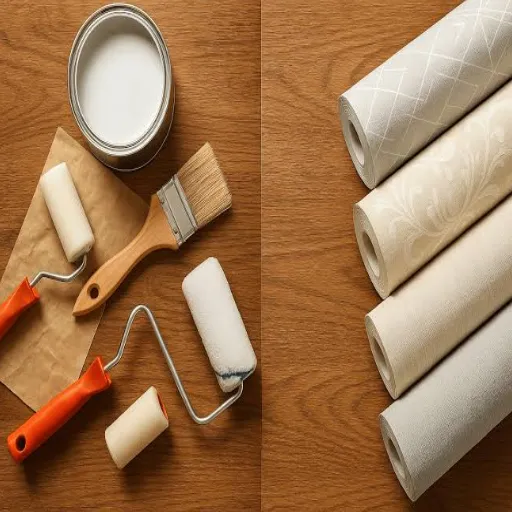
If you want the best-value outcome rather than a single-material rule, this is the spec designers reach for most often.
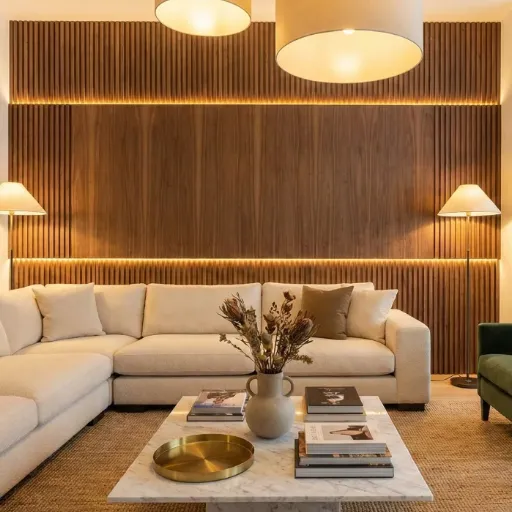
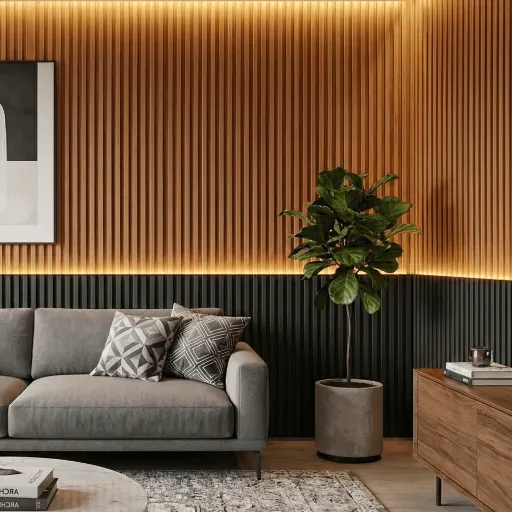
Panel the feature wall, the high-traffic wall, or the damp wall. Paint everything else.
You get the durability, the wipe-clean surface and the design impact exactly where they are needed, while keeping the light, low-cost, space-friendly finish on the walls that don’t need protection. It also keeps you from over-cladding a small room, where panels can steal floor space for no benefit. It is the recommendation our living room wall panel design ideas article returns to again and again, because it solves the real budget and the real wear at the same time.
Wallpaper still earns its place in one scenario: a dry, decorative room where pattern is the whole point and you expect to change it down the line.
The Same Decision at Commercial Scale
Everything above scales up, and it is worth knowing because the same logic drives hotel, office and fit-out specifications.
In corridors, lobbies and other high-traffic commercial interiors, paint and vinyl wallpaper are being replaced by panels for three operational reasons. They survive contact with trolleys, luggage and cleaning machines. They install same-day and dry, which means minimal downtime for a room or a floor. And a single damaged panel is swapped rather than triggering a full redecoration.
For specifiers, the package that gets approved looks like this: a B1 or EN 13501-1 Class B-s1,d0 fire rating, low-VOC/E0 emissions, water absorption of 0.5-1%, colour tolerance within ΔE ≤1.5, and batch traceability so a multi-floor rollout matches. Our fire-rated WPC panel compliance guide covers the documentation to ask a supplier for.
Frequently Asked Questions
Are wall panels better than wallpaper and paint?
They are better where durability, moisture or cleaning matter most: feature walls, hallways, kitchens and bathrooms. Paint is better and cheaper for dry, low-traffic walls you’ll repaint. Wallpaper is better for dry decorative rooms where pattern is the priority.
Is it cheaper to paint or panel a wall?
Upfront, paint is always cheaper. Over ten to fifteen years, panels usually cost less because paint must be reapplied every two to five years while panels need only wiping. The break-even typically lands around five to seven years.
Which lasts longest: paint, wallpaper, or wall panels?
Wall panels last longest, at 10-25 years (WPC 15-25 years indoors). Wallpaper averages about 15 years, from 20-plus for vinyl down to roughly 5 for peel-and-stick. Paint lasts 3-7 years before it needs redoing.
Can I install wall panels over existing paint or wallpaper?
Over paint, yes, panels install directly. Over wallpaper, remove it first, because the paste layer can fail and take the panel with it. The full method is in our feature wall installation guide.
Are wall panels good for damp or humid rooms?
Yes. WPC panels absorb only 0.5-1% water and are non-porous, so they don’t swell or support mould, which is why they suit bathrooms, kitchens and humid climates where paint and paper struggle.
Do wall panels add value to a home?
No finish guarantees a specific uplift. A well-executed panel wall improves a buyer’s perception of the space, while a cheap or mismatched one reads as a defect. Choose for how you’ll live with it.
What looks most modern: panels, wallpaper, or paint?
Textured panels currently read as the most contemporary option, and wood-grain and fluted profiles are driving the shift away from flat paint in residential interiors. That said, “modern” changes; durability and fit matter more than trend.
How often do you have to repaint a painted wall?
Most rooms need repainting every two to five years, and high-traffic areas such as hallways can need it sooner. That recurring cycle is the hidden cost that panels avoid.
Can wall panels be painted over if I change my mind?
Technically some panels can be over-painted with the right primer, but the texture is the point of a panel, and painting it flattens that. If you want to change colour easily, paint or wallpaper is the more flexible base.
Do wall panels smell or need ventilation after installation?
WPC panels install with minimal adhesive and no curing wait, so odour is low and brief. Wallpaper paste is the finish that needs real ventilation, which can delay a room’s return to use.
The Bottom Line
“Wall panels vs wallpaper vs paint” is not a question with one winner. It is a question about your wall.
- Match the finish to the wall: dry and low-traffic means paint, damp or high-traffic means panels, dry and decorative means wallpaper.
- Panels cost more upfront and less over ten to fifteen years, with a break-even around five to seven years.
- Moisture and repairability decide long-term happiness more than first-day price.
- Panels are also the fastest, cleanest install, which matters in a live renovation.
- The hybrid, panels on the feature wall and paint elsewhere, delivers the highest value for most homes.
If you are leaning toward panels, the smartest next step is to see and feel one against your existing paint and paper before you spend anything. Request a free sample kit and we will send finishes that match your room, along with a factory-direct quote sized to your wall. As a factory-direct supplier, we publish real specification data for every panel we ship, and we are happy to tell you when paint is the better call for a particular wall. Tell us your wall dimensions and we will take it from there.
Categories:
Blog
Related Articles