WPC Fluted Panels vs Wood Slat Panels: Which to Choose?
Short answer: choose WPC fluted panels when moisture resistance, wipe-clean durability, colour consistency and lower cost matter most, and choose a felt-backed wood slat panel when you need real sound absorption (NRC roughly 0.5 to 0.9) in a dry room. The two are built differently, and that single difference decides almost everything else.
That answer surprises most buyers. People walk into a showroom, run a hand over both, and assume the choice is about looks. It is not. The panel you pick changes how the wall handles sound, humidity, dust and a cleaning cloth for the next fifteen to twenty-five years.
Here is the part that catches people out: the acoustics of a wood slat panel have almost nothing to do with the wood. What absorbs sound is the assembly behind the slats. Read on and you will be able to tell the two panel types apart at a glance, specify the right one for each room, and avoid paying premium money for a panel that performs like a budget one.
Key Takeaways
- Fluted panels are one continuous grooved face with no gaps; slat panels are separate strips with real open gaps sitting over a backing. That construction difference drives sound, shadow and cleaning.
- Absorption comes from the assembly (open gaps plus a porous backing), not the slat material. A WPC slat over PET felt absorbs just as well as a wood slat over PET felt.
- Plain fluted panels carry no meaningful NRC rating; felt-backed slat builds reach roughly NRC 0.5 to 0.9 depending on backing and mounting.
- Absorption is not soundproofing. Neither panel blocks noise passing between rooms.
- Standard WPC fluted panels start around US$0.68 to 2.00 per m² factory-direct; wood slat acoustic builds typically run US$5.50 to 16.00 per m². Compare landed cost per m², not factory price per panel.
WPC Fluted vs Wood Slat: The Short Answer
If the wall is seen and the priority is durability, moisture resistance and value, a WPC fluted panel is usually the safer, more practical buy. It wipes clean, it handles humidity, and it holds its colour across a large order.
If the room echoes and the priority is cutting that echo, a felt-backed slat panel is the honest choice. The open gaps let sound reach the absorbent backing, which is where the real acoustic work happens.
Everything below explains why, and where the two overlap more than their marketing suggests.
The Structural Difference That Drives Everything
One continuous grooved face vs separate strips on a backing
A fluted panel is a single continuous surface with parallel grooves or ribs machined or extruded into it. The grooves are typically 2 to 8 mm deep. There are no open gaps anywhere on the face.
A slat panel is assembled from individual strips fixed at set spacing, standing roughly 15 to 30 mm above an MDF, WPC or acoustic-felt backing. The gaps between the strips are the defining feature. They are also the function.
This is the fact that decides the rest of the comparison. Shadow depth, airborne sound, dust and cleaning all trace back to whether the panel is one face or many strips.
What this does to shadow, light and perceived height
Because slat strips stand above the backing, light hits the strip face while the gap stays in shadow. That produces deep, defined shadow lines and a strong graphic rhythm. Fluted grooves read as a single textured plane, so the shadow is softer and more continuous.
Both profiles, run vertically, lift the eye and make a low ceiling feel taller. But the fluted panel is the quieter of the two. In a small room it adds texture without the busy, striped effect a tight slat wall can create.
A spec-bearing comparison table
| Feature | WPC Fluted Panel | Wood Slat Panel (acoustic) |
|---|---|---|
| Construction | One continuous grooved face | Separate strips over a backing |
| Open gaps | None | Yes, the core of the design |
| Groove / gap | Grooves 2 to 8 mm deep | Gaps and 15 to 30 mm strip stand-off |
| Shadow effect | Soft, continuous | Deep, defined |
| Sound absorption | Low unless engineered | NRC roughly 0.5 to 0.9 when felt-backed |
| Moisture | Waterproof through a WPC core | Dry interior only on MDF cores |
| Cleaning | Wipe the grooves | Vacuum the gaps; felt is not washable |
| Install difficulty | Low, tongue-and-groove or adhesive | Moderate, level strips and alignment |
| Typical factory cost | From about US$0.68/m² | From about US$5.50/m² |
One buying caution while you are here. Sellers use the words loosely. Some shallow fluted panels are advertised as “slat,” and some printed panels are sold as solid. Ask for a physical sample and a section drawing before you commit. If the “slat” has no gaps, it is a fluted panel, and it will not absorb sound the way the listing implies.
You can see the full breakdown of how each profile is built in our guide to fluted wall panel profiles and specs.
The Acoustic Question: It Is Not About WPC vs Wood
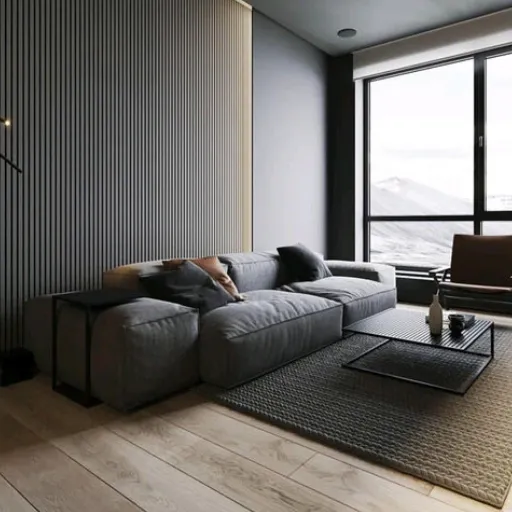
The myth to correct
A lot of supplier content frames the acoustic difference as a material question: WPC reflects sound, wood or wood-felt absorbs it. That framing is misleading.
What absorbs sound is the assembly. Sound passes through the open gaps, reaches a porous backing such as PET felt or mineral wool, and is absorbed there. The face material, whether wood slats or WPC slats, mostly reflects sound either way.
Put a WPC slat over the same felt backing as a wood slat and you get the same absorption band. The wood does not absorb. The backing does. This matters because it means you can specify the moisture-resistant, wipe-clean WPC look without automatically giving up acoustic performance, provided you choose a slat-on-felt build rather than a solid fluted face.
NRC by assembly: the table that decides your spec
NRC is the Noise Reduction Coefficient, a 0 to 1 score for how much sound a surface absorbs. Higher is more absorptive.
| Panel build | Typical NRC | Notes |
|---|---|---|
| Plain fluted (continuous face) | No meaningful rating | Grooves scatter sound, they do not absorb it |
| Slat + thin felt, 3 to 8 mm | 0.30 to 0.55 | Looks premium, performs like a foam tile |
| Slat + dense PET, 10 to 20 mm | 0.50 to 0.75 | Reaches into the low-mid range |
| Slat + mineral wool, 50 mm | 0.80 to 0.95 | Best all-round performer |
| Slat + mineral wool + 25 to 45 mm air gap | 0.85+ | Batten-mounted, adds low-frequency depth |
For mineral wool, an optimal density of 40 to 80 kg/m³ is the useful range. Looser material lets sound pass through; denser material reflects it back. The same rule explains why a batten-mounted panel with an air gap behind it outperforms one glued flat to the wall.
A reference timber slat build measured to ISO 354 shows absorption coefficients of roughly 0.25 at 125 Hz, 0.40 at 250 Hz, 0.55 at 500 Hz, 0.65 at 1 kHz, 0.60 at 2 kHz and 0.55 at 4 kHz, for an NRC near 0.55 (reported by the AcousPlan timber slat panel database). That is a useful, honest benchmark. It also shows the limit: thin decorative slats do not reach deep low frequencies.
Do fluted grooves absorb sound?
No, not meaningfully. Grooves and ribs break up some reflections and can soften a flutter echo in a hard room, but a plain fluted panel carries no real absorption rating. If a supplier claims an acoustic rating, ask for the test report for the exact assembly you are buying. A number without a report is a slogan.
Absorption is not soundproofing
This catches out almost every first-time buyer. Acoustic panels reduce echo and reverberation inside a room. They do not block noise travelling between rooms. Stopping sound transmission is a wall-build job involving mass, decoupling and sealing, not a decorative panel.
Neither a fluted WPC panel nor a wood slat panel will soundproof your home office. Both can make it sound better inside. That is the honest scope.
Moisture, Durability and Where Each One Survives
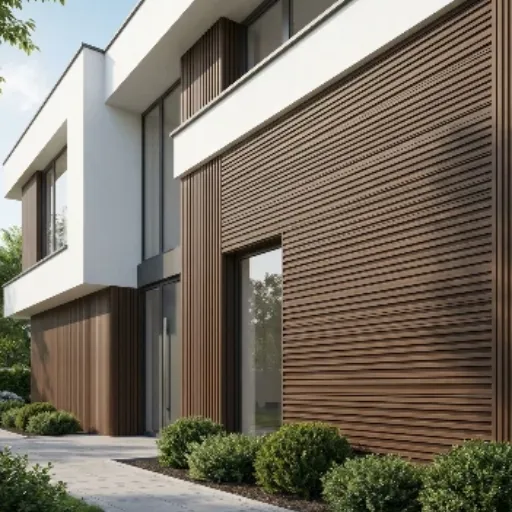
WPC fluted: waterproof through the core
WPC, or wood-plastic composite, blends wood fibre with polymers. It absorbs very little water, typically under 0.5 to 1 percent, compared with 10 to 20 percent for natural wood, which is why WPC is generally treated as waterproof rather than merely water-resistant. That makes it resistant to swelling, rot, termites and fungal growth, and stable under humidity swings.
Practical result: a WPC fluted panel suits kitchens, entryways, bathroom dry zones and any humid climate. It also wipes clean, so spills on a kitchen island front or a busy corridor wall are a non-event.
Wood slat on MDF: a dry-interior product
Most acoustic slat panels use an MDF or MR-MDF core behind the strips. MDF is excellent in dry rooms and costs less, but it swells and lifts at cut edges once moisture reaches the core. The acoustic felt backing behind the strips is not washable either. This confines most wood slat builds to dry, well-ventilated rooms: living rooms, bedrooms, media rooms and offices.
The core decides, not the profile
Here is the rule that resolves most of the confusion. The profile (fluted or slat) sets the look and the acoustics. The core sets the durability. A WPC-cored slat panel can absorb sound and survive a humid room. An MDF-cored slat panel absorbs sound but will not.
So the real question is rarely “fluted or slat.” It is “which core for this room, and which profile for this look.” For a deeper look at that material choice, see our comparison of WPC vs solid wood wall panels and the honest pros and cons of WPC wall panels for living rooms.
Look, Shadow and the Design Effect
Design intent usually settles the profile question faster than any spec.
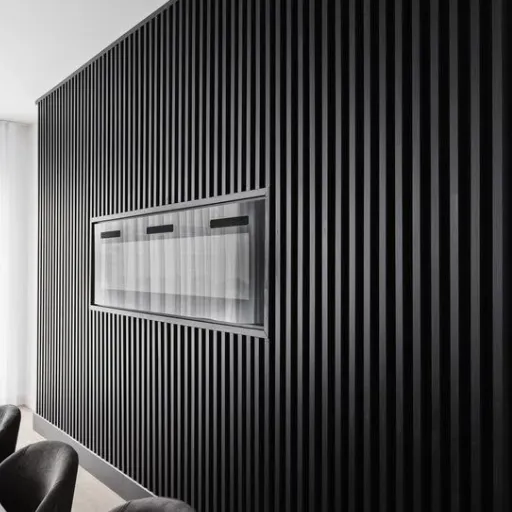
A slat wall is the bolder move. The deep gaps give strong vertical rhythm, dramatic shadow, and a graphic, architectural feel that suits media walls, reception areas and larger rooms.
A fluted wall is the softer, more continuous move. It adds texture and warmth without the striped intensity, which makes it a natural fit for calmer spaces and smaller rooms where a heavy slat grid would feel busy.
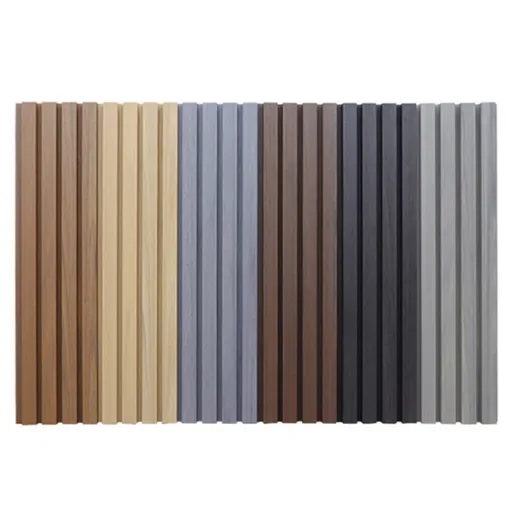
Colour consistency is where WPC pulls ahead for large projects. A co-extruded WPC panel carries a colour cap that wraps the whole profile, and single-batch production holds shades together to a tolerance of roughly ΔE 1.5. That solves the most common buyer complaint in this category, one panel arriving a shade off the rest. Real wood slat carries natural species and batch variation, which is a feature in a single room and a problem across a hundred-room rollout.
Cleaning and Maintenance in Real Rooms
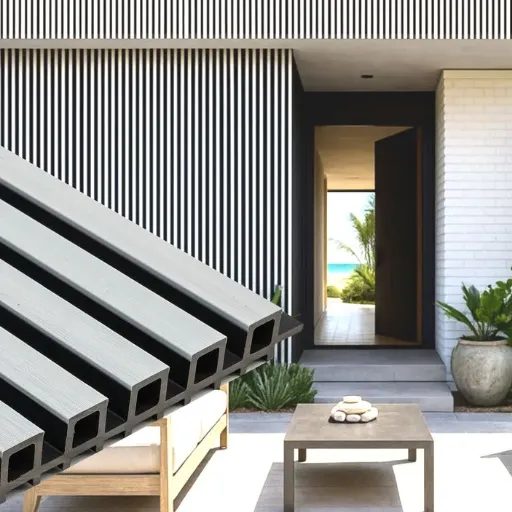
Maintenance is a quiet decider, and it is tied directly to the construction difference.
A fluted panel is easy to live with. A soft vacuum brush or a damp microfibre cloth run across the channels keeps it clean. Dust gathers in the grooves slowly and wipes away.
A slat panel needs more care. Dust collects in the gaps between strips, so cleaning means vacuuming those gaps as well as wiping the strip faces. The felt or PET backing behind the strips is not washable, which is why slat walls suit cleaner, drier environments or occasional professional cleaning rather than a kitchen backsplash.
On both, avoid abrasive pads, bleach, ammonia, steam cleaners and standing water. Mild soap and a damp cloth handle almost everything.
Cost: Retail vs Factory-Direct
Cost is where the two diverge sharply, and it is worth comparing like for like.
Factory-direct, MOQ-dependent wholesale ranges look roughly like this in 2026:
- Standard WPC fluted panel (decorative): from about US$0.68 to 2.00 per m²
- Co-extruded or acoustic-positioned WPC fluted panel: about US$5.50 to 14.65 per m²
- Wood slat acoustic panel (wood or MDF strips over PET felt): about US$5.50 to 16.00 per m²
Retail prices sit several times higher than factory numbers, so a retail wood slat panel can run US$15 to 30 per square foot. That gap is channel margin, not materials.
Two practical notes for bulk buyers. First, compare landed cost per square metre, not factory price per panel: freight, MOQ, waste factor, trims, backing and fire treatment all move the real number. Fire-retardant grades commonly add 15 to 35 percent. Second, MOQs differ: WPC panels often start around 100 to 1,000 m², while wood slat acoustic panels often start around 50 to 100 m².
For the fuller arithmetic, see our living room wall panelling cost guide and the WPC wall panel price breakdown by grade.
Sourcing a project or a container? Get a bulk quote with specimen panels of both types and a batch-consistency commitment. Get a bulk quote →
Fire and Specification: What to Ask For
Fire performance matters the moment a project has an inspector. Interior WPC fluted panels commonly reach Class B1 under GB 8624, with equivalents of EN 13501-1 B-s1,d0 and ASTM E84 Class A or B depending on formulation. Wood slat acoustic panels that are fire-rated typically reach EN 13501-1 Class B (B-s1,d0), with some holding ASTM E84 Class A.
The trap is the phrase “Class A.” On wood slat products it often refers to a build-up using a plasterboard substrate with battens and insulation, not to the panel alone. It can also refer to an acoustic rating rather than a fire classification. Always ask which standard was tested, and which assembly. Request the certificate for the tested assembly, not a “fire-retardant” sticker. For the strictest EN 13501-1 A2-s1,d0 projects, wood slat is not the right product at all.
For the compliance detail behind these classes, see our fire-rated WPC panel guide.
Which Should You Choose? A Room-by-Room Answer
| Room / use | Better first choice | Why |
|---|---|---|
| Living room feature wall | Either | Fluted for calm texture, slat for bold shadow |
| TV or media wall | WPC fluted as backdrop, slat if echo is a problem | Fluted is cleaner behind a screen; felt slat cuts echo |
| Bedroom headboard | WPC fluted | Soft texture, easy clean, adds height |
| Bathroom, dry zone | WPC fluted | MDF-cored slat fails once wet |
| Kitchen, island front | WPC fluted | Wipe-clean, no gaps to clog with grease |
| Home office | Felt-backed slat (WPC core if humid) | Echo control is the point |
| Hotel corridor | WPC fluted | Wipe-clean, colour-matched across rooms |
| Restaurant or boardroom | Felt-backed slat | Noise reduction with a premium look |
The simple rule: choose fluted where durability and aesthetics lead, and felt-backed slat where echo control leads. Do not spend acoustic money in a room that does not need it, and do not spend decorative money where you actually needed absorption.
If the room you have in mind is a living room, our guide to WPC wall panels for living rooms works through layout, proportions and colour for that space specifically.
Can You Use Both on One Project?

Yes, and this is the specification that actually gets built. Use fluted WPC on the walls that take wear and moisture, and a felt-backed slat panel on the reflect-heavy walls, typically the media wall or the dining wall. Keep both in one colour family so the two profiles read as a single scheme rather than two competing ideas.
A well-planned hybrid gives you the durability of WPC where it matters and the acoustic comfort of felt where it counts, which is usually the best of both budgets and the best of both performance profiles.
Frequently Asked Questions
What is the difference between a fluted panel and a slat panel?
A fluted panel has one continuous face with grooves cut into it, so there are no open gaps. A slat panel is built from separate strips with real gaps, standing over a backing. The gaps are the defining feature of a slat panel.
Which is better for sound, fluted or slat?
Slat, when it is felt-backed. Sound passes through the gaps and is absorbed by the backing, reaching NRC roughly 0.5 to 0.9. A plain fluted panel scatters sound slightly but carries no meaningful absorption rating of its own.
Do fluted WPC panels absorb sound?
No, not meaningfully. Grooves break up some reflections and can soften an echo, but a standard fluted panel has no real absorption rating. Treat any acoustic claim as needing a test report for the exact assembly.
Does the wood or the backing absorb the sound in a slat panel?
The backing. The slats, whether wood or WPC, mostly reflect sound. The open gaps let sound reach the porous felt or mineral wool behind them, and that is where absorption happens. This is why a WPC slat over felt performs like a wood slat over felt.
Are WPC fluted panels waterproof?
They resist water well. WPC absorbs very little moisture, typically under 0.5 to 1 percent, and resists rot, termites and swelling. They suit humid rooms and bathroom dry zones, though not direct shower splash.
Can wood slat acoustic panels go in a bathroom?
Not with an MDF core. MDF swells and lifts at the edges once wet, and the felt backing is not washable. A WPC-cored slat panel can handle a bathroom dry zone; an MDF one cannot.
Are fluted panels cheaper than wood slat panels?
Usually, yes. Standard decorative WPC fluted panels start around US$0.68 per m² factory-direct, while wood slat acoustic panels typically start around US$5.50 per m². Acoustic-positioned fluted panels close much of that gap.
How do you clean fluted vs slat panels?
Wipe fluted grooves with a soft brush or damp microfibre. For slat panels, vacuum the gaps and wipe the strip faces, and keep the felt backing dry. Avoid abrasives, bleach, ammonia and steam on both.
Can I mix fluted and slat panels in one room?
Yes, and it often looks deliberate when done in one colour family. Use fluted where durability leads and felt-backed slat where echo control leads. See our wood slat vs acoustic foam comparison for the acoustic side of that decision.
Do acoustic panels soundproof a room?
No. Acoustic panels reduce echo and reverberation inside a room. They do not block noise moving between rooms. Soundproofing is a wall-construction job involving mass, decoupling and sealing.
Conclusion
The choice between WPC fluted panels and wood slat panels comes down to one structural fact and one correction.
Structurally, fluted is a single grooved face, and slat is separate strips over a backing with real gaps. That gap decides shadow, sound, dust and cleaning. Practically, WPC fluted wins on moisture, wipe-clean durability, colour consistency and cost, while a felt-backed slat panel wins on genuine sound absorption.
The correction is the one worth remembering: absorption comes from the assembly, not the slat material. A WPC slat over felt absorbs as well as a wood slat over felt. So you no longer have to trade durability for acoustics. You just have to specify the right build for the room.
Still deciding? Request a sample kit with both types, get a bulk quote, or send us your wall plan and we will recommend a profile, core and backing per room. Talk to our team about your project →
Categories:
Blog
Related Articles