
Office Acoustic Panel Placement: Where to Put Panels for Maximum Impact
One panel in the right place outperforms four panels on the wrong wall. That is the single most important principle of office acoustic panel placement, and most facilities managers get it wrong.
When David, a project manager in Dubai, oversaw the acoustic treatment of a 12,000-square-foot office floor, his contractor installed 200 fiberglass panels evenly across every wall surface. The coverage looked impressive. But noise complaints from the open-plan area continued for months. The problem was not quantity. It was placement. The panels covered walls that reflected almost no sound, while the ceiling, which carried 60% of the acoustic load in that open space, remained bare.
If you are asking where to place acoustic panels in an office, the answer depends on three things: the room type, the surface that carries the most sound energy, and the material you are installing. A conference room needs different treatment than an open plan. A private office needs different treatment than a call center. And WPC panels with NRC 0.75 need different spacing than fiberglass panels with NRC 0.90.
This guide gives you a room-type-specific framework for office acoustic panel placement. We cover the five priority zones, a decision matrix for ceiling versus wall treatment, material-aware placement strategies, and mounting height guidelines that target seated ear level for maximum speech clarity.
Key Takeaways
- The ceiling carries 60% of the acoustic workload in open-plan offices, making it the first surface to treat.
- Conference rooms need balanced wall and ceiling treatment, with the rear wall behind seating as the highest priority.
- Private offices achieve adequate treatment with 4 to 6 panels placed at first reflection points and behind the desk.
- WPC and wood slat panels need 20-30% more units than fiberglass but offer durability that justifies the higher count.
- Mount wall panels at 42 to 52 inches from the floor to target seated ear level where speech reflections matter most.
Why Placement Matters More Than Quantity in Offices
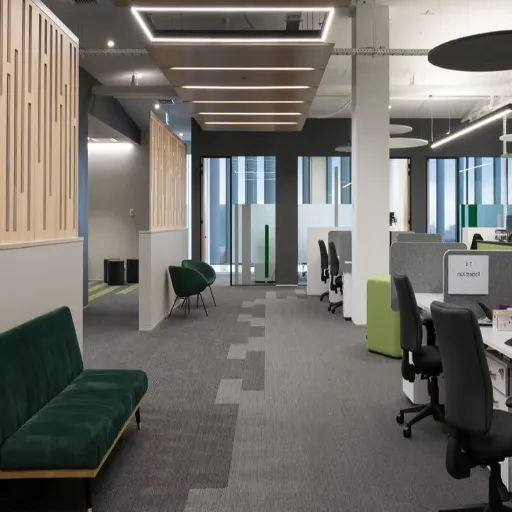
Most offices waste 30 to 40% of their acoustic budget on panels placed in low-impact zones. Poor office acoustic panel placement is the root cause. A full wall of panels behind the reception desk looks professional, but if the noise problem comes from ceiling reflections in the open-plan area behind it, those panels do almost nothing for acoustics.
The science is straightforward. Sound reflects off surfaces in predictable patterns. In a typical office with hard floors, glass partitions, and drywall ceilings, the largest uninterrupted hard surface is usually the ceiling. That surface reflects the most sound energy into the workspace. Treating it first gives you the biggest improvement per panel installed.
This is especially true in open-plan offices where wall space is limited by windows, doors, and workstation partitions. The ceiling becomes the acoustic battlefield. In contrast, a private office with four solid walls has more treatable wall surface, so walls become the priority. Knowing where to place acoustic panels in an office, whether on the ceiling or walls, directly determines whether your budget delivers results.
For a deeper understanding of how room volume and surface area affect your panel count, see our how many acoustic panels you need calculator. For the science behind first reflection points and the mirror trick, our acoustic panel placement guide covers the methodology in detail.
The 5 Priority Zones for Office Acoustic Panel Placement
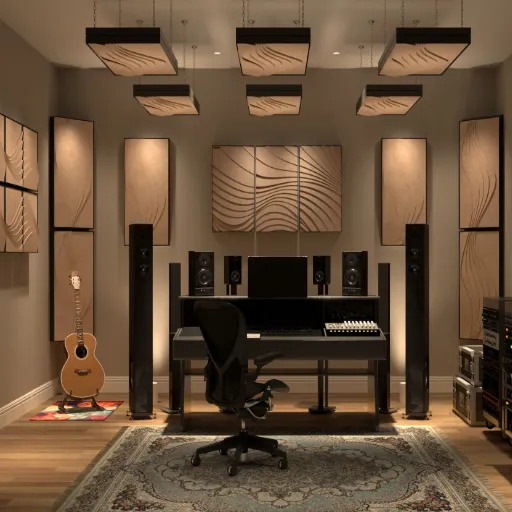
Every office has five zones where acoustic panels deliver the most impact. Treating these zones in order of priority ensures you get measurable improvement with every panel installed.
Zone 1: Ceiling Clouds and Baffles
In open-plan offices and call centers, the ceiling is the number-one priority. Ceiling baffles hung in parallel rows absorb sound as it travels horizontally across the workspace. Ceiling clouds mounted directly above workstations or conference tables catch vertical reflections before they bounce between floor and ceiling.
For open plans, run ceiling baffle rows perpendicular to the main traffic flow. This creates absorption corridors that catch sound as employees move through the space. Standard spacing is 2 to 3 feet between baffle rows. Ceiling acoustic panels in office placement are the single highest-impact investment for open-plan spaces, where they manage sound energy that walls alone cannot control.
Zone 2: First Reflection Points on Walls
First reflection points are where sound from a speaker or display first hits a wall and bounces back toward listeners. Office wall acoustic panel placement at these points delivers the highest per-panel return in conference rooms, where the side walls at seated head height, roughly 4 to 5 feet from the floor, create the strongest reflections. Treating these points with 2 to 3 panels per side wall eliminates the slap echo that makes video calls sound hollow.
The mirror trick is the standard method for finding first reflection points. Sit in the primary listening position, have someone hold a mirror against the side wall, and mark the spots where you can see the speaker or display. Those are your first reflection points.
Zone 3: Rear Wall Behind Seating
The rear wall in a conference room or the wall behind a desk in a private office is a high-priority surface. Sound from speakers, displays, and conversations reflects off this wall and returns to listeners with a delay that creates an echo. In video call scenarios, the wall behind the camera is especially important because it affects what remote participants hear.
Zone 4: Side Walls at Speech Level
Side walls between 42 and 52 inches from the floor are where most speech reflections occur in seated office environments. Panels mounted in this band absorb the sound energy that would otherwise bounce between parallel walls and create flutter echo.
Zone 5: Corners and Junctions
Corners where two walls meet, or where walls meet the ceiling, are natural collection points for low-frequency energy. While bass traps are more critical in studios, adding thicker panels or doubled-up panels in office corners helps control the low-frequency buildup that makes open-plan spaces feel “boomy.”
Office Room Type Placement Framework
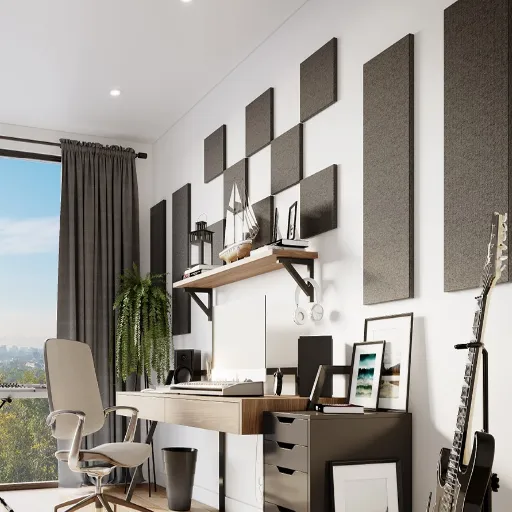
Different office spaces have different acoustic priorities. Here is a room-by-room placement framework for six common office types.
Open-Plan Offices: Ceiling First
Open-plan offices are the most acoustically challenging workspace. With dozens of employees sharing one large space, sound travels long distances across hard surfaces. The ceiling carries the acoustic load because wall space is limited by windows and workstation partitions.
Placement strategy:
- Install ceiling baffles in parallel rows across the open area, 2 to 3 feet apart
- Add wall panels at perimeter walls only where reflection points exist
- Use desk-mounted acoustic dividers to supplement ceiling treatment
- Leave 6 to 12 inches between wall panel edges for even distribution
Conference Rooms: Balanced Wall and Ceiling
Conference rooms need precise acoustic control for speech intelligibility during video calls and presentations. The goal is to reduce echo without making the room sound dead.
Placement strategy:
- Treat the rear wall behind the seating with 2 to 4 panels
- Add panels at first reflection points on both side walls
- Install a ceiling cloud or 2 to 3 ceiling panels directly above the conference table
- Prioritize the wall opposite the display for video call clarity
Private Offices: Wall Behind Desk First
Private offices are smaller and easier to treat. One or two people share the space, and the goal is to reduce echo for phone calls and video conferences.
Placement strategy:
- Place 1 to 2 panels on the wall behind the desk
- Add 1 panel at the first reflection point on each side wall
- Install 1 to 2 ceiling panels above the desk area
- Most private offices achieve adequate treatment with 4 to 6 panels total
Call Centers: Ceiling-Heavy with Desk Dividers
Call centers have dozens of agents on the phone simultaneously. The ambient noise level is consistently high, and the goal is to reduce overall reverberation so agents can hear customers clearly.
Placement strategy:
- Install ceiling baffles in rows between workstation clusters
- Add perimeter wall panels at 42 to 52 inches in height
- Use desk-mounted acoustic dividers between agents
- Focus treatment on the ceiling first, then the perimeter walls
Reception Areas: Feature Wall Strategy
Reception areas need a balance of acoustic control and visual design. These spaces create first impressions, so panels must look intentional, not clinical.
Placement strategy:
- Create a decorative WPC or wood slat feature wall behind the reception desk
- Add ceiling panels or clouds above the waiting area
- Treat the wall opposite the entrance to catch sound reflections
- Target 25 to 35% wall coverage with visually striking materials
Huddle Rooms: Quick Treat Priority Surfaces
Huddle rooms are small, informal meeting spaces. They need enough treatment for clear conversation but not the precision of a conference room.
Placement strategy:
- Treat the wall behind the door and the wall opposite the seating
- Add 1 to 2 ceiling panels if the ceiling height exceeds 9 feet
- 4 to 6 panels often provide complete treatment in spaces under 100 square feet
Ceiling vs Wall: Which to Treat First?
The ceiling-versus-wall question is the most common placement decision offices face. The answer depends on room type, ceiling height, and the noise problem you are solving.
| Room Type | Priority Surface | Coverage Target | Why |
|---|---|---|---|
| Open-Plan Office | Ceiling first | 50-60% ceiling, 10-20% walls | The ceiling carries 60% of the acoustic load in open spaces |
| Conference Room | Balanced | 25-35% walls, 25-35% ceiling | Speech clarity needs both surfaces treated |
| Private Office | Wall first | 15-20% walls, 20-30% ceiling | Limited ceiling space; walls at desk level matter more |
| Call Center | Ceiling first | 50-60% ceiling, 15-20% walls | Wall space occupied by workstations |
| Reception | Wall first | 30-40% walls, 20-30% ceiling | Visual design drives wall treatment priority |
| Huddle Room | Wall first | 20-30% walls, 20-30% ceiling | Small room; walls are easier to treat |
How Material Changes Your Placement Strategy
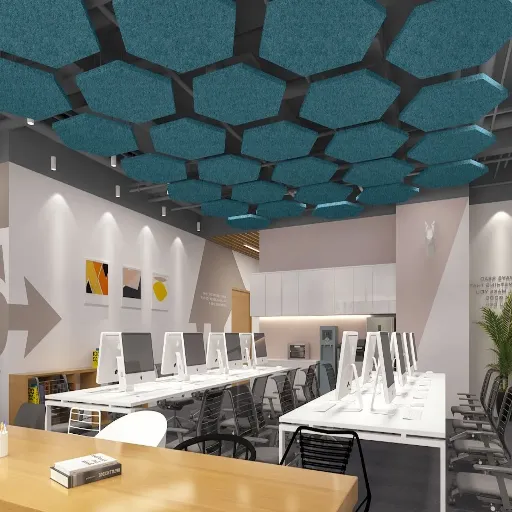
The panel material you choose affects not just how many panels you need, but where you place them.
Fiberglass and mineral wool (NRC 0.85-0.95): Standard placement rules apply. These panels absorb efficiently at all frequencies, so you need fewer panels and can space them further apart.
PET felt (NRC 0.75-0.85): Requires 10 to 15% more coverage area. Place panels slightly closer together to compensate for lower absorption per unit. PET felt panels are often used as ceiling tiles or decorative wall features.
WPC and wood slat (NRC 0.50-0.80): Needs 20 to 30% more panels than fiberglass. The air gap behind WPC panels is critical for performance. A 2 to 4 inch air gap increases absorption by 15 to 25%. WPC panels work best as feature walls in reception areas and conference rooms where visual impact matters. For detailed WPC installation guidance, including keel framework and air gap optimization, see our WPC acoustic panel installation guide.
Acoustic foam (NRC 0.40-0.70): Not recommended for commercial offices. Foam degrades quickly, has poor fire ratings, and looks unprofessional in business environments.
| Material | NRC Range | Placement Adjustment | Best Application |
|---|---|---|---|
| Fiberglass | 0.85-0.95 | Standard spacing | Studios, critical listening spaces |
| PET Felt | 0.75-0.85 | +10-15% coverage | Ceiling tiles, modern office walls |
| WPC / Wood Slat | 0.50-0.80 | +20-30% panels, 2-4 inch air gap | Feature walls, high-traffic areas |
| Acoustic Foam | 0.40-0.70 | Not recommended | Budget setups, temporary use only |
Mounting Height and Spacing Guidelines
Correct mounting height is the difference between panels that absorb speech reflections and panels that absorb nothing useful.
Wall panels: Center at 42 to 52 inches from the floor. This targets seated ear level, where most office speech originates and is received. Panels mounted above 6 feet miss the primary reflection zone for seated occupants.
Panel spacing: Leave 6 to 12 inches between wall panel edges. Do not cluster panels on one wall. Distribute them across all treatable surfaces for even absorption.
Air gap: A 2 to 4 inch gap behind the panel improves low-frequency absorption by 15 to 25%. This is especially important for WPC and wood slat panels, which rely on the air cavity behind the panel to boost their effective NRC.
Ceiling baffles: Hang 2 to 3 feet apart in parallel rows. In open plans, run rows perpendicular to the main traffic flow. Standard suspension height is 8 to 12 inches below the ceiling surface.
For detailed spacing rules, including symmetry principles and air gap calculations, see our acoustic panel spacing guide.
Common Office Placement Mistakes
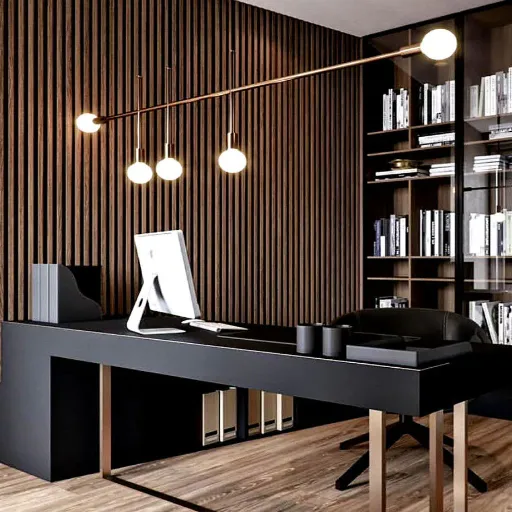
Even experienced facilities managers make these office acoustic panel placement errors. Avoid them to get the most from your budget.
- Treating only conference rooms. Conference rooms are the easiest to treat, so they get all the panels. But open-plan areas generate 80% of noise complaints. Balance your budget across all space types.
- Mounting panels too high. Panels above 6 feet miss the seated ear level, where speech reflections matter. In offices with 9 to 10-foot ceilings, mounting at 7 feet treats the ceiling reflection zone but ignores the side-wall reflection zone at 4 to 5 feet.
- Covering only one wall. A full wall of panels on the back wall does nothing for side-wall flutter echo or ceiling bounce. Distribute panels across priority zones for even absorption.
- Ignoring the ceiling in high-ceiling offices. Offices with 12-foot or higher ceilings have significantly more volume to treat. The ceiling becomes even more important as the primary reflection surface.
- Using studio-grade foam in commercial spaces. Foam panels degrade, have poor fire ratings, and look unprofessional. Fiberglass, PET felt, or WPC panels are better choices for commercial offices.
- Forgetting doors, windows, and fixtures. Subtract the area of doors, windows, whiteboards, and built-in cabinets from your wall surface area before calculating coverage.
Measuring Results: Before and After
The only way to know if your office acoustic panel placement is working is to measure.
Target reverberation times by room type:
- Open-plan office: 0.6 to 0.8 seconds
- Conference room: 0.5 to 0.7 seconds
- Private office: 0.4 to 0.6 seconds
- Call center: 0.6 to 0.8 seconds
- Reception: 0.6 to 1.0 seconds
Free measurement tools: Apps like ClapIR and RT60 Meter provide basic reverberation time measurements using your phone’s microphone. While not laboratory-accurate, they give you a reliable before-and-after comparison.
What to listen for: After installation, stand in the treated space and clap once. If you hear a distinct echo or ringing, you need more treatment. If the clap sounds dry and short, the treatment is working. Compare this experience to the same clap test before installation.
Frequently Asked Questions
Where should acoustic panels be placed in an office?
Place acoustic panels at five priority zones: ceiling clouds above work areas, first reflection points on side walls, the rear wall behind seating, side walls at seated ear level (42 to 52 inches), and corners where walls meet. The ceiling is the priority in open-plan offices. Walls are the priority in private offices and conference rooms.
Should acoustic panels go on the ceiling or walls in an office?
It depends on the room type. In open-plan offices and call centers, treat the ceiling first because it carries 60% of the acoustic load. In conference rooms, treat walls and ceiling equally. In private offices, start with the wall behind the desk, then add ceiling treatment. See our ceiling vs wall acoustic panels guide for a detailed decision matrix.
How high should acoustic panels be mounted in an office?
Mount wall panels with the center at 42 to 52 inches from the floor. This targets the seated ear level, where most office speech originates and is received. Panels mounted above 6 feet miss the primary reflection zone for seated occupants. Ceiling baffles should hang 8 to 12 inches below the ceiling surface.
What is the best acoustic panel layout for a conference room?
The best layout for a conference room is: 2 to 4 panels on the rear wall behind seating, 2 to 3 panels at first reflection points on each side wall, and a ceiling cloud or 2 to 3 ceiling panels directly above the conference table. Prioritize the wall opposite the display for video call clarity.
How many acoustic panels do I need for office wall placement?
Most offices need 3 to 4 wall panels per private office, 6 to 8 wall panels per conference room, and 16 to 20 wall panels for a 2,000-square-foot open-plan area. The exact number depends on room size, ceiling height, and panel material. Use our how many acoustic panels calculator for precise counts by room type.
Can acoustic panels improve video call audio quality?
Yes. Acoustic panels at first reflection points and on the wall behind your camera significantly reduce echo and reverberation that remote participants hear. A private office with 4 to 6 panels at key reflection points can improve speech clarity on video calls by 40 to 60% compared to an untreated room.
Conclusion
Office acoustic panel placement is not about covering every wall with panels. It is about putting panels where they absorb the most sound energy for the room type you are treating. The ceiling carries the acoustic load in open plans and call centers. Walls matter more in private offices and conference rooms. And the material you choose, whether fiberglass, PET felt, or WPC, changes both the quantity and the placement strategy.
Start with the five priority zones: ceiling clouds, first reflection points, rear walls, side walls at speech level, and corners. The acoustic panel layout for your office should follow this framework to ensure every panel installed delivers measurable improvement. Mount panels at seated ear level. Leave air gaps behind WPC panels. And measure your results before and after to confirm the improvement.
If you are ready to move from planning to installation, read our guide on how far apart acoustic panels should be spaced for detailed spacing rules. For a complete overview of placement principles across all room types, our acoustic panel placement guide covers studios, home theaters, and commercial spaces.
At Linyi Yuheng International Trading Co., Ltd., we manufacture WPC acoustic panels and wood slat panels in custom sizes for commercial offices worldwide. Our standard panels ship in 2-foot by 4-foot and 2-foot by 2-foot formats, with NRC ratings up to 0.85 and fire-rated cores for code compliance.
Request a Free Office Layout Consultation. Send us your floor plan and ceiling height, and our team will create a placement strategy with a three-tier option breakdown within one business day.
Categories:
Blog
Related Articles