Acoustic Panels vs Soundproofing for Offices: What’s the Real Difference?
Acoustic panels absorb sound within a room to reduce echo and improve speech clarity. Soundproofing blocks sound from passing through walls, ceilings, and floors to prevent noise transmission between rooms. Most offices have an echo problem, not a transmission problem — which means they need acoustic treatment, not construction-based soundproofing.
“I want to soundproof my office.” If you manage a facility or run a business, you have probably said or heard this phrase. The problem is that it almost always describes the wrong solution. The person complaining about noise is usually sitting in a room with hard walls, glass, and concrete — an echo chamber where every conversation bounces around for seconds. What they actually need is sound absorption. Soundproofing, which requires adding mass to walls and sealing gaps, would not fix the echo they are hearing.
This guide breaks down the real difference between acoustic panels and soundproofing for office environments. You will learn how to diagnose your specific noise problem, which metric matters for your situation, and how to avoid spending thousands on the wrong approach.
For a complete overview of office acoustic solutions, see our office acoustic panels buyer’s guide.
Key Takeaways
- Acoustic panels absorb echo (NRC) — they do NOT block sound from leaving or entering a room
- Soundproofing blocks sound between rooms (STC) — it requires construction, not wall panels
- Most office noise complaints are about reverberation inside a room, not transmission through walls
- Open offices need absorption; private offices next to loud rooms may need blocking
- A combination of absorption, blocking, and sound masking solves the widest range of office noise problems
The Core Difference: Absorption vs Blocking
What Acoustic Panels Actually Do
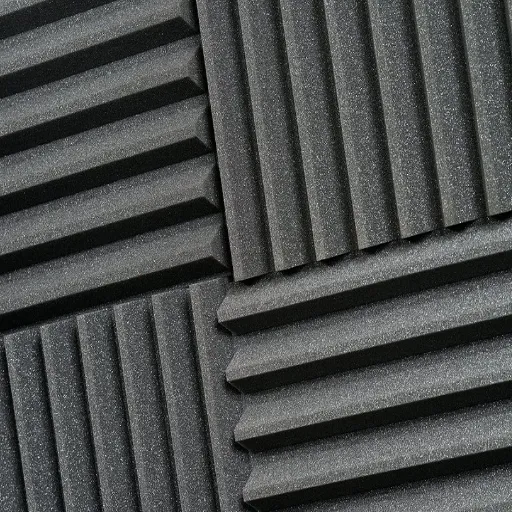
Acoustic panels are porous materials — fiberglass, mineral wool, PET felt, or foam — that trap sound energy as it passes through their fibers. When sound hits a panel, the vibrations convert to heat through friction. The sound disappears from the room instead of bouncing back into the space.
Acoustic panels improve what you hear inside a room. They reduce reverberation time (RT60), lower ambient noise levels, and make speech clearer. They are the right solution when the problem is echo, background noise buildup, or poor audio quality on video calls.
What acoustic panels cannot do is stop sound from leaving the room or entering from outside. A panel on a wall absorbs sound that hits it from inside the room. It does not create a barrier. Sound still travels through the drywall, studs, and air gaps around the door.
What Soundproofing Actually Does
Soundproofing is a construction discipline, not a product category. It uses three principles: mass, decoupling, and damping. Mass makes walls heavier, so sound waves lose energy passing through. Decoupling separates wall layers so vibrations cannot transfer. Damping converts vibrational energy to heat using specialized compounds.
Soundproofing improves what you hear from adjacent spaces. It reduces the amount of sound that passes through walls, ceilings, and floors. It is the right solution when you can clearly understand conversations from the room next door, or when HVAC noise travels between floors.
What soundproofing cannot do is improve sound quality inside the room you are treating. A perfectly soundproofed room with hard surfaces still has an echo. In fact, soundproofing often makes the echo worse by trapping sound inside the room.
The Sponge and the Bucket
Think of your office as a bucket and noise as water. Absorption is like a sponge inside the bucket — it soaks up the water already there. Blocking is like a lid on the bucket — it keeps water from splashing out. Most offices have a wet floor problem, not a leaking bucket problem. They need the sponge.
NRC vs STC: The Two Metrics That Matter
Every acoustic discussion revolves around two metrics. Understanding the difference saves you from buying the wrong product.
| Metric | Full Name | Measures | Scale | What It Tells You |
|---|---|---|---|---|
| NRC | Noise Reduction Coefficient | Sound absorption | 0 to 1.0 | How much echo a material removes |
| STC | Sound Transmission Class | Sound blocking | 20 to 70+ | How much sound does a wall stop |
NRC 0.80+ is the target for office acoustic panels. A panel with NRC 0.85 absorbs 85% of the sound that hits it. ASTM C423 testing standards determine NRC ratings by measuring absorption across the speech frequency range.
STC 50+ is the target for office privacy. Most standard office walls are STC 35-45. This means you can understand normal conversation through the wall. Raising STC to 50+ requires adding mass, decoupling, or sealing gaps — not hanging panels.
The critical distinction: acoustic panels improve NRC but have almost no effect on STC. You can cover 100% of a wall with NRC 0.95 panels, and the STC of that wall will increase by 1-2 points at most. The sound still passes through the drywall and studs behind the panels.
STC ratings are determined by ASTM E90 testing standards and classified under ASTM E413, which measures how much sound a partition blocks across the speech frequency range.
When Your Office Needs Acoustic Panels (Absorption)
The Symptoms
You need absorption if you recognize these problems:
- Conference calls sound hollow or distant
- Multiple conversations in an open office create a distracting rumble
- Video call participants complain about the echo
- Clapping your hands produces a ringing “tail.”
- Employees say it is “too loud,” but cannot identify a specific source
The Solutions
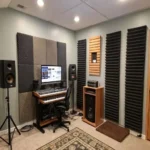
Acoustic treatment for offices typically includes:
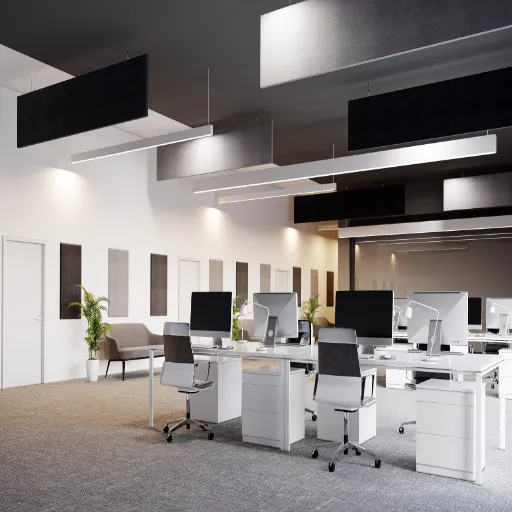
- Ceiling baffles and clouds: NRC 0.85-1.00, cover 50-60% of the ceiling area
- Wall-mounted fabric panels: NRC 0.80-0.95, cover 20-30% of wall area
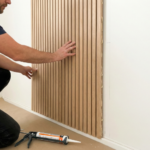
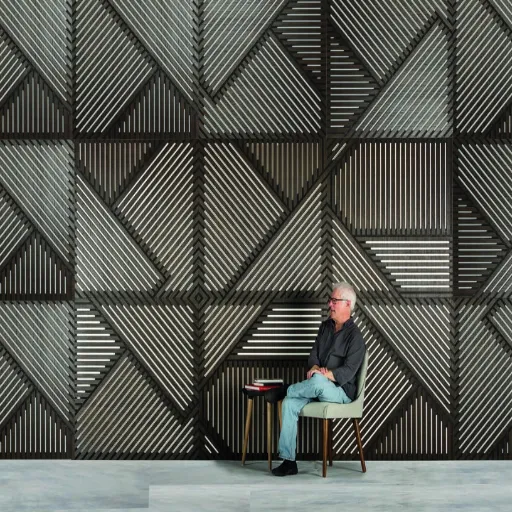
- Wood slat panels with PET backing: NRC 0.55-0.80, for design-forward spaces
- Desk-mounted screens: NRC 0.60-0.80, for workstation-level privacy
When the Denver law firm of Hartwell & Associates moved into a new office in 2024, the open plan layout looked modern but sounded like a cafeteria. Every phone call, keyboard tap, and conversation reflected off the concrete floors and glass walls. Employees started wearing noise-canceling headphones. Partners assumed they would need to build private offices — a $80,000 construction project. Instead, they installed ceiling baffles covering 55% of the ceiling and wall panels on two feature walls. Total cost: $12,000. The RT60 dropped from 1.2 seconds to 0.6 seconds. Six weeks later, the headphone policy was gone, and employee satisfaction scores had risen 34%.
When Your Office Needs Soundproofing (Blocking)
The Symptoms
You need to block if you recognize these problems:
- You can understand words from the conversation in the next room
- Conference room discussions are audible in adjacent offices
- HVAC or mechanical noise transmits between floors
- Phone calls in one office disturb people in the next office
- Employees whisper in meetings because they know others can hear
The Solutions
Soundproofing for offices requires construction-level interventions:
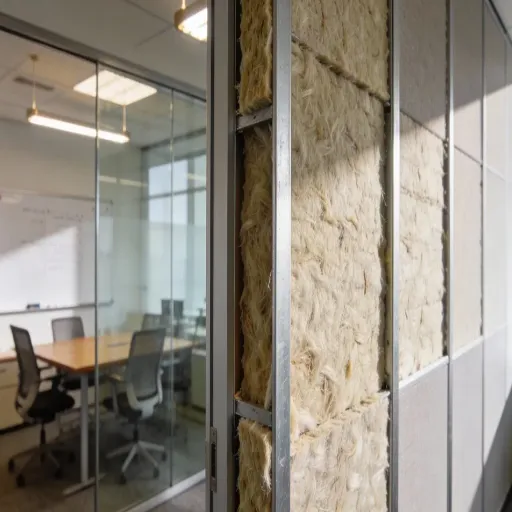
- Adding mass: Additional layers of drywall, mass-loaded vinyl, or cement board
- Decoupling: Resilient channels, staggered studs, or double-wall construction
- Damping: Green Glue or similar compounds between drywall layers
- Sealing: Acoustic door sweeps, perimeter seals, and outlet gaskets
- Upgrading doors: Solid-core doors with full perimeter seals
Raising a wall’s STC from 40 to 50 typically costs $15-30 per square foot of wall area. For a 200-square-foot shared wall between two offices, that is $3,000-6,000 in materials and labor. The work also creates dust, noise, and disruption — often requiring the office to close for several days.
The Hybrid Approach: When Offices Need Both
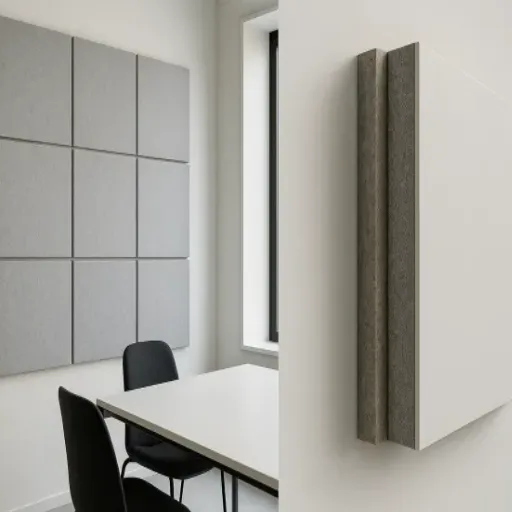
Some offices have both problems — echo inside the room and sound leaking through the walls. The solution is a phased combination approach.
Phase 1: Absorption
Start with acoustic panels. They are cheaper, faster to install, and solve the most common complaint. Treat the ceiling first with baffles or clouds, then add wall panels. This addresses 70% of typical office noise complaints.
Phase 2: Blocking
If employees still report hearing conversations through walls after absorption treatment, add blocking measures. Start with the cheapest and least disruptive: door seals, outlet gaskets, and weatherstripping. These small fixes can raise effective STC by 3-5 points. If that is insufficient, consider mass-loaded vinyl on shared walls.
Phase 3: Masking
Sound masking adds low-level background sound — similar to airflow — to cover residual speech transmission. A masking system costs $2-4 per square foot and installs in days. It does not block or absorb sound; it covers it. For offices where full soundproofing is too expensive, masking provides 80% of the privacy benefit at 20% of the cost.
When a Chicago marketing agency moved into a converted warehouse, it faced both problems. The 18-foot ceilings created a massive echo, and thin brick walls let sound travel between every office. They installed ceiling baffles for $14,000, added mass-loaded vinyl to shared walls for $8,000, and deployed a sound masking system for $6,000. The combination dropped RT60 from 1.6 seconds to 0.7 seconds and raised effective speech privacy from “clearly audible” to “unintelligible beyond the door.” Total investment: $28,000. Estimated cost of full construction soundproofing for the same space: $75,000+.
Cost Comparison: Absorption vs Blocking vs Masking
| Approach | Cost per Sq Ft | Typical Project | Timeline | Disruption |
|---|---|---|---|---|
| Acoustic panels (absorption) | $4-15 | $5,000-15,000 | 1-2 weeks | Minimal — after-hours install |
| Soundproofing (blocking) | $15-40 | $10,000-40,000 | 2-4 weeks | High — construction required |
| Sound masking | $2-4 | $3,000-8,000 | 2-3 days | Minimal — ceiling speaker install |
| Combination | Variable | $15,000-50,000 | 3-6 weeks | Moderate |
The key insight: Absorption costs 3-4 times less than blocking and solves 70% of office noise complaints. Always start with absorption. Only add blocking if specific privacy problems persist.
Excessive workplace noise is a documented health concern — OSHA workplace noise guidelines establish permissible exposure limits that poorly treated offices frequently approach or exceed.
How to Decide What Your Office Needs
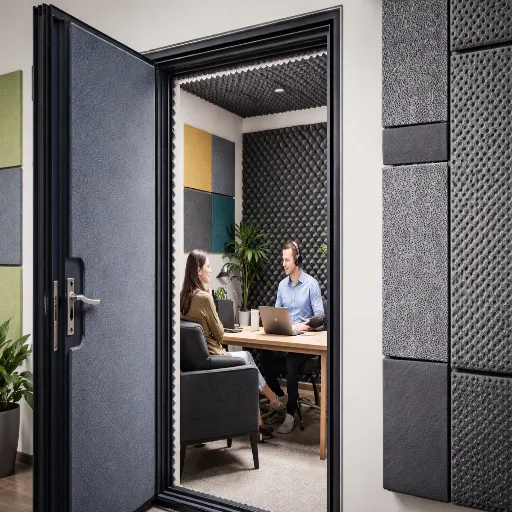
Use this three-question diagnostic:
Question 1: Is the noise coming from inside your room or through the walls?
- Inside → Start with absorption
- Through walls → Consider blocking
Question 2: Can you understand words from the next room?
- Yes → Blocking is needed
- No, just a muffled rumble → Absorption may be enough
Question 3: Did the problem start recently, or has it always existed?
- Started after renovation (removed carpet, added glass) → Absorption
- Always existed → May need blocking + absorption
Decision Framework by Office Type
| Office Type | Primary Need | Secondary Need | Estimated Budget |
|---|---|---|---|
| Echoey conference room | Absorption | — | $2,000-5,000 |
| The open office is too loud | Absorption | Masking | $6,000-15,000 |
| Can hear next door’s calls | Blocking | Absorption | $10,000-25,000 |
| Video calls sound terrible | Absorption | — | $2,000-6,000 |
| HR / legal needs privacy | Blocking | Masking | $12,000-30,000 |
| Boardroom + adjacent offices | Combination | All three | $15,000-40,000 |
When Marcus, an IT director in Austin, received a $20,000 budget to “fix the noise problem,” he spent it all on high-end acoustic panels for every wall in the building. Six weeks later, employees in private offices still complained about hearing their neighbors. Marcus had solved the echo in common areas but ignored the transmission problem between offices. He needed to reserve $8,000 of that budget for door seals, outlet gaskets, and wall mass upgrades. The lesson: diagnose first, then spend.
Conference rooms are particularly susceptible to both echo and transmission issues due to their hard surfaces and shared walls.
Frequently Asked Questions
Do acoustic panels block sound from neighbors?
No. Acoustic panels absorb sound within a room but do not block sound from passing through walls. If you can hear your neighbor’s conversation, you need soundproofing (blocking), not acoustic panels. Panels may help slightly by reducing the overall noise level in your room, but they will not stop transmission.
Can I soundproof an office without construction?
Partially. You can improve sound blocking without major construction by sealing gaps around doors, adding door sweeps, installing outlet gaskets, and adding mass-loaded vinyl to walls. These measures can raise effective STC by 5-10 points. However, significant soundproofing (STC 50+) always requires some level of construction.
What is better for office noise: panels or soundproofing?
For 70% of office noise complaints, acoustic panels are the better starting point. They are cheaper, faster to install, and address the most common problem: echo and reverberation. Only add soundproofing if you have confirmed sound transmission problems between rooms.
How much does it cost to soundproof an office?
Basic soundproofing (sealing, door upgrades) costs $3,000-8,000 for a typical office. Moderate soundproofing (adding mass to walls) costs $10,000-25,000. Full construction soundproofing (decoupled walls, double doors) costs $25,000-75,000+. In contrast, acoustic treatment typically costs $4-15 per square foot.
Do acoustic panels really work in offices?
Yes, for the problems they are designed to solve. Acoustic panels reduce echo, lower ambient noise, and improve speech clarity. They do not work for sound transmission between rooms. When properly installed with adequate coverage (25-60% of ceiling and wall area), panels create a measurable and noticeable improvement in acoustic comfort.
What is sound masking, and do I need it?
Sound masking adds low-level background sound to an environment to cover speech and reduce distraction. It is the third option alongside absorption and blocking. Masking is most useful in open offices and spaces where full soundproofing is too expensive. It costs $2-4 per square foot and installs quickly.
Conclusion
The acoustic panels vs soundproofing office debate is not really a debate. It is a diagnostic question. Most offices need absorption first because most office noise complaints are about echo and reverberation inside a room, not sound leaking through walls. Acoustic panels solve this at $4-15 per square foot with minimal disruption.
Soundproofing becomes necessary only when you have confirmed transmission problems — when you can understand conversations through walls or when privacy regulations require it. Blocking is effective but expensive, typically requiring construction-level interventions.
Start with the three-question diagnostic. Treat absorption first. Add blocking only if specific privacy problems persist. Consider masking as a cost-effective complement. And never spend a dollar before you know whether you have a sponge problem or a lid problem.
Unsure which approach your office needs? Send us your floor plan and a description of your noise problem. We will diagnose whether you need absorption, blocking, or a combination — and provide a factory-direct quote for the right solution.
Categories:
Blog
Related Articles