WPC Wall Panel Colours: The Complete Colour & Finish Guide (2026)
WPC wall panel colours fall into five families: woodgrain and natural wood finishes, solid matte neutrals, stone and concrete effects, marble and linen patterns, and metallic or speciality finishes. Standard profiles typically ship in six to eight core colours, while custom Pantone and RAL matching extends the range past one hundred.
That is the short answer. The longer one is what protects your order, because the gap between the panel on your screen and the panel on your wall is where most WPC projects go wrong.
Elena, a designer in Valencia, specified walnut WPC panels for a client’s living room in early 2026. The catalogue image showed a cool, muted brown. The panels that arrived were warm and noticeably red, closer to cherry than walnut. Because she had ordered the full room in one batch, the entire wall was wrong, not a single panel. A physical sample checked under the client’s own lighting would have caught it in a day. The resupply took five weeks.
You don’t have to repeat that. This guide walks through every colour and finish family, which WPC wall panel colours suit which rooms, what is trending in 2026, and exactly how to specify colour so an entire order matches. It is part of our complete guide to WPC wall panels, and we supply them from Linyi, Shandong, where colour matching is one of the questions buyers ask us most.
Key Takeaways
- WPC wall panels come in five colour families: woodgrain, solid matte, stone/concrete, marble/linen, and metallic or speciality finishes.
- Standard profiles offer 6-8 core colours; custom Pantone/RAL and OEM matching opens the range past 100.
- Co-extruded panels fade roughly 3-5% in year one, versus 10-15% for first-generation WPC.
- Specify a contractual ΔE ≤ 1.5-2.0 tolerance and order the full quantity in a single batch to prevent colour mismatch.
- Always approve a physical sample under your own lighting. Screens and RAL codes misrepresent wood tones.
What Colours Do WPC Wall Panels Come In?
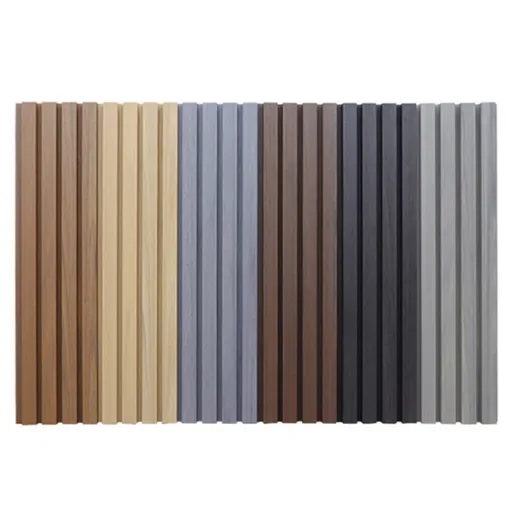
WPC wall panel colours, or WPC wall panel colors if you use the US spelling, are made in five families, and every supplier’s catalogue is some mix of them. Knowing the families helps you ask for the right thing and spot when a listing is quietly selling you a cheaper finish.
Woodgrain & Natural Wood Finishes
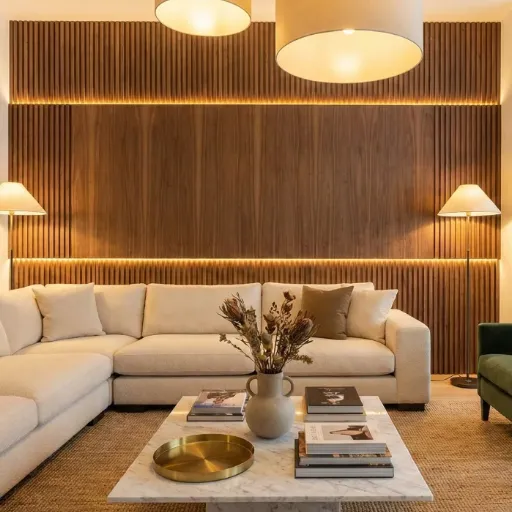
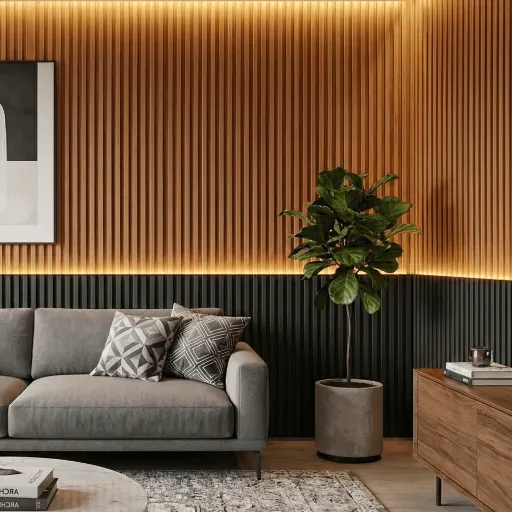
Woodgrain is the most widely offered family and the one most buyers are looking for. Common options include teak, oak, walnut, ash, maple, rosewood and ebony. The grain is either embossed into a co-extruded film or printed and pressed onto the surface. Embossed woodgrain has real texture you can feel and holds its depth for years; printed woodgrain can look flat from an angle. If a living room feature wall is the goal, this is usually the starting family, and our WPC fluted wall panel guide explains how a grooved profile changes the way a wood grain WPC wall panel reads under light. The WPC fluted panel colours you choose matter as much as the base tone, because shadow in every groove deepens the shade.
Solid Matte & Neutral Colours
Solid colours carry no wood grain at all and produce a clean, seamless surface. The most common are warm white, cream, greige, taupe, charcoal, forest green and navy. They work well across large surfaces and minimalist interiors, where a repeating grain would start to feel busy. Matte finishes (under 20 gloss) are the 2026 default; high gloss now reads dated in most interiors.
Stone, Concrete & Marble Effects
Stone-look and concrete-look panels mimic slate, cement, travertine and micro-cement. They suit industrial and architectural schemes, plus commercial spaces where a natural masonry look would be heavy or expensive to install. Marble grain adds a brighter, more polished option for feature walls and reception areas.
Metallic, Linen & Speciality Finishes
Speciality finishes include brushed gold, champagne and copper metallics; linen and cloth grains; and dual-tone or mixed-colour surfaces. These are niche but high-impact, and they are common in hospitality and branded retail. Metallic finishes are also the most likely to shift appearance between batches, so they need the closest colour control.
WPC Wall Panel Colour Chart
The table below maps each WPC wall panel colour family to where it performs best. Use it as a quick reference before you request samples.
| Colour family | Example colours | Look | Best for | Fade resistance |
|---|---|---|---|---|
| Woodgrain & natural wood | Teak, oak, walnut, ash, maple, rosewood, ebony | Warm, textured, natural | Living rooms, bedrooms, hotels | High (co-extruded); medium (printed) |
| Solid matte & neutrals | Warm white, cream, greige, taupe, charcoal, forest green, navy | Clean, seamless, contemporary | Large surfaces, offices, minimalist interiors | High |
| Stone, concrete & marble | Slate, cement, travertine, micro-cement, marble grain | Industrial, architectural | Retail, commercial, feature walls | High |
| Metallic & speciality | Brushed gold, champagne, copper, linen, dual-tone | Bold, luxurious | Hospitality, branded retail, showrooms | Medium-high |
| Exterior (UV-stable palette) | Teak, silver grey, antique grey, maple, coffee, charcoal | Weathered, natural | Facades, cladding, soffits | Highest (co-extruded) |
Patterns and colours also come in far more variety than this chart alone suggests. Woodgrain alone can run to hundreds of embossed textures across the whole industry, and mixed and double-colour co-extrusion now produces panels with two visible tones in one board.
Need to see them in the hand, not on a screen? Request a free colour sample kit and we’ll ship physical chips in up to eight finishes.
How WPC Wall Panel Colours Are Made

Understanding how colour gets into a WPC panel explains why some panels hold their shade for twenty years and others shift within two seasons. It also tells you which questions to ask a supplier.
Masterbatch vs Dry Pigment
Colour is added in one of two ways. Dry pigment is mixed straight into the wood-plastic blend at low cost but disperses unevenly, so it drifts from batch to batch. Masterbatch is a pre-compounded colour concentrate carrier that disperses consistently, batch after batch. Masterbatch always costs a little more and always holds colour better. When a supplier quotes an unusually low price, dry pigment is often the reason.
Co-Extruded Film vs Printed Film
Co-extruded (capped) panels carry a coloured outer shell over the core, so the colour runs through the top layer rather than sitting on it. Printed panels apply an ink layer to the surface. The difference is not just looks: a co-extruded panel resists scratching and fading far better because a cut or a scuff exposes more of the same colour, while a printed panel exposes the core underneath. For exterior work, co-extrusion is the standard, not the upgrade.
Why Colour Varies at All
Even with good controls, three things move colour: the wood-flour lot (different timber sources tint the base), the pigment loading, and the extrusion temperature. Good factories hold the extrusion zones within ±2°C of target along the whole run, because excessive heat can decompose pigments and shift the shade. Colour consistency is a process outcome, not a marketing claim.
Choosing WPC Wall Panel Colours by Room and Application
The right WPC wall panel colour depends less on taste and more on the room’s light, size and use. Here is how the families break down by space.
Living Room
For a living room, the safest scheme is a woodgrain feature wall in oak or walnut, with cream or greige on the remaining walls. Where you want drama, a charcoal feature wall works well on larger walls but can shrink a small room. Our living room WPC wall panel guide goes deeper on layouts and lighting, and our accent wall panel ideas show how colour families sit in different feature-wall layouts. If a media wall is the focus, the WPC TV wall panel ideas cover colour pairings around screens and LED runs.
Bedroom
Bedrooms reward calmer choices: soft neutral, light oak, warm white or muted sage for the headboard wall. Indigo or deep blue works as a single accent when you want more depth. Keep the ceiling and side walls light so the room stays restful rather than heavy.
Kitchen & Bathroom
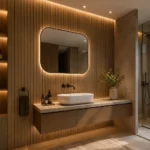
In kitchens and bathrooms, moisture and hygiene drive the choice. Warm white, light grey and light oak are the workhorses, and they hide water spots better than dark tones. Avoid a glossy black panel in a direct wet zone. Our bathroom WPC wall panel design ideas cover wet-room colour and finish options in more detail.
Commercial & Hospitality
Commercial interiors often need brand consistency more than variety. Here, matte finishes beat gloss, deep grey and navy match corporate identities, and stone-look panels suit industrial retail. For branded franchises and showrooms, a custom Pantone colour is usually the right answer.
Exterior Cladding
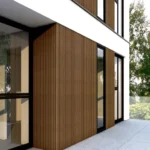
Exterior colours come in a narrower, harder-wearing palette: teak, silver grey, antique grey, maple, coffee and charcoal, typically six to eight options. The palette is smaller for a reason, only pigments paired with strong UV stabilisers survive the sun, and every exterior panel should be co-extruded. For facade-specific choices, see exterior WPC wall cladding.
WPC Wall Panel Colour Trends for 2026
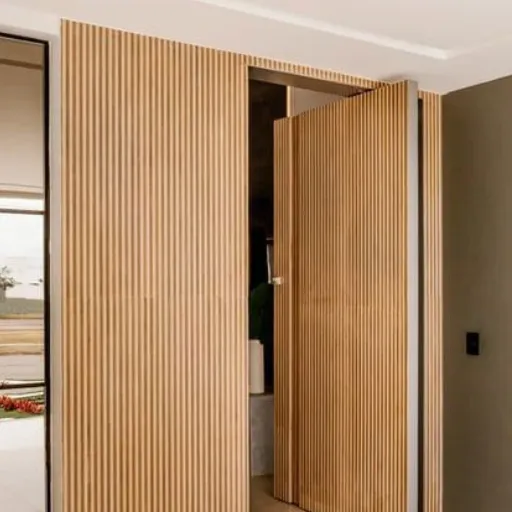
2026 has turned its back on cool minimalism. Across interior sources such as Elle Decor’s 2026 colour trend report, the palette has shifted to warm, nature-led earth tones: espresso and chocolate browns, moss and olive greens, terracotta, ochre and sun-washed neutrals. Design houses and paint brands alike anchored the year in deep browns and muddy greens rather than millennial grey.
Warmer wood species are leading too. White oak, walnut and lighter natural tones dominate, while darker finishes have retreated to studies, media rooms and feature bars. Fluted profiles are trending wider and softer rather than thin and busy, and panels are getting broader, which means a colour reads more saturated on a wide face than on a narrow strip.
Good WPC wall panel colour combinations follow two practical rules. Matte finishes over gloss. And the three-colour rule: keep visible colours to no more than three per connected space, treating white, black, grey and metallics as free. If you want your scheme to look current in five years rather than two, warm white, ivory, greige, cream and light oak are the most timeless WPC colours; olive green, dusty blue, terracotta and champagne metallic are the trend-forward picks.
Colour Matching & Batch Consistency: How to Guarantee It
This is where WPC wall panel colour matching becomes a specification problem rather than a design one, and where the difference between a good supplier and a cheap one shows up.
The most common colour complaint in the category is mismatched panels: a wall where two boards read as two shades. It happens because colour is not perfectly identical from one production run to the next. The fix is to stop treating colour as an assumption and start writing it into the order.
- Set a contractual tolerance. Specify ΔE ≤ 2.0 between any two panels in a delivery, and a stated maximum ΔE between repeat orders. For multi-room projects, tighten it to ΔE ≤ 1.5.
- Approve a physical master sample. Both buyer and supplier keep the approved chip. Do not rely on screens or on a RAL code alone, because the backing and finish alter the perceived colour.
- Order the full quantity from one batch. Where a phased rollout is unavoidable, request a retained sample from every run before dispatch.
- Ask for batch traceability. Each batch should carry a unique number linking to raw-material lots and a spectrophotometer record. A serious factory retains a panel sample from every batch for at least 12 months.
A 240-room hotel renovation makes the case. The specifier set a colour tolerance of ΔE ≤ 1.5 across all 12,000 m², including between batches, and verified the finished panels landed between 1.2 and 1.5 with no visible mismatch on any floor. That result didn’t happen by luck. It happened because colour was written into the contract, with master samples and per-batch records behind it. For the supplier checks that make this work, see how to choose a WPC manufacturer in China.
Custom WPC Wall Panel Colours: Pantone, RAL & OEM
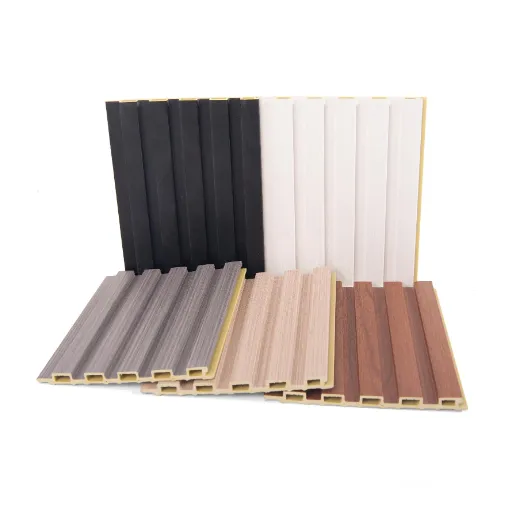
When the standard range doesn’t match, custom colour is available, and most buyers are surprised how accessible it is.
The process is simple. You send a physical colour chip or a brand guideline, the factory runs a colour sample, and once you approve it, production follows. Pantone and RAL matching is standard for branded commercial work, and OEM colour lets a retailer or developer own a shade their competitors can’t buy.
Two practical limits matter. First, minimum order quantity: custom colour typically starts around 50 m² (roughly 400 running metres) per profile and colour, or about 300 metres per model and colour, up to a full container for a broader palette. Second, lead time: custom colours usually add around 7 to 15 days over standard items, because the run has to be scheduled and the colour confirmed before extrusion.
If you’re weighing colour against budget across a residential project, our living room wall panelling cost guide breaks down how grade and finish affect price per square metre.
Do WPC Wall Panel Colours Fade?
Yes, some fade is normal outdoors, but the amount depends almost entirely on the panel generation, and the numbers are worth knowing before you buy.
First-generation WPC can lose roughly 10-15% of its colour intensity in the first year outdoors, then stabilise. Co-extruded WPC, with its pigmented protective shell, limits first-year fading to about 3-5% and then holds. Warranties reflect the gap: typically ten years for co-extruded panels versus eight for first-generation.
Indoors, fading is a minor concern; the real enemies are UV through large windows and direct sun. For any exterior panel, ask for accelerated weathering data measured against ISO 4892-3 or ASTM G154/G155, targeting a colour change of ΔE ≤ 4.0 after 2,000 hours. And note that in a co-extruded panel the colour runs through the material, not just the surface, so a repair or a light sanding keeps the shade instead of exposing a different one underneath.
Once your panels are up, finish choice affects how easy the colour is to keep clean, a topic we cover in how to clean WPC wall panels.
Frequently Asked Questions
What colours do WPC wall panels come in?
WPC wall panels come in five families: woodgrain (teak, oak, walnut, ash), solid matte neutrals (warm white, cream, greige, charcoal, navy), stone and concrete effects, marble and linen patterns, and metallic or speciality finishes. Standard profiles ship in 6-8 colours; custom matching expands the range beyond 100.
How many colours are available in WPC panels?
Most suppliers stock 6-8 core colours for standard profiles, with co-extrusion and fluted lines often sharing a fixed palette. Custom Pantone, RAL and OEM matching can extend the range to well over 100, subject to minimum order quantities.
Can WPC wall panels be custom coloured?
Yes. Send a physical chip or brand guideline and the factory produces a colour sample for approval before full production. Custom colour typically requires around 50 m² per profile and colour and adds roughly 7-15 days to lead time.
Do WPC wall panels fade?
Indoors, fading is minimal. Outdoors, first-generation WPC can fade 10-15% in year one before stabilising, while co-extruded WPC fades only 3-5%. Co-extruded panel warranties commonly run to ten years versus eight for first-generation.
What is the most popular WPC wall panel colour?
Warm white, cream, greige and light oak are the most timeless choices and the easiest to resell with a property. In 2026, warm earth tones like espresso brown and moss green are the trend-forward picks.
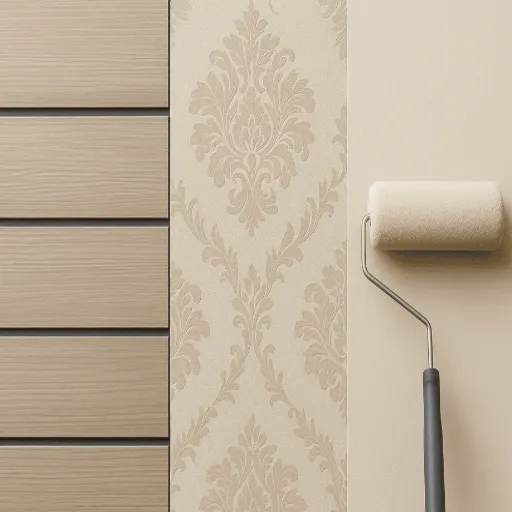
Can you paint WPC wall panels?
WPC panels are supplied pre-coloured and don’t need painting. If you paint them, the surface needs pre-treatment such as light abrasion or flame treatment for the coating to adhere, and a dedicated exterior coating is required for outdoor panels.
How do I match WPC wall panel colours across a room or project?
Specify a contractual colour tolerance (ΔE ≤ 1.5-2.0), approve a physical master sample held by both parties, order the full quantity from a single production batch, and request batch traceability with retained samples for phased supply.
Are darker WPC panels harder to maintain?
Dark panels show dust and water spots more readily than light ones, and high-gloss dark surfaces amplify it. In bathrooms and high-traffic areas, light matte finishes stay looking clean with less effort.
Conclusion and Next Steps
Choosing WPC wall panel colours comes down to five things. Know the five colour families so you ask for the right finish. Match colour to the room, woodgrain and an accent wall for living rooms, calm lights for bedrooms, warm neutrals for wet areas, brand colours for commercial. Follow the 2026 shift toward warm earth tones and matte finishes. Treat colour as a specification by setting a ΔE tolerance and ordering one batch. And remember that custom Pantone, RAL and OEM colour is available direct from the factory.
The colour you see on a screen is only a promise; the colour on your wall is the result. Approve a physical sample first, and you remove the one variable that ruins the most projects.
Ready to lock in your colour? Request a free sample kit in up to eight finishes, or send us your brand colour for a matched quotation. Our team will confirm the sample, the tolerance and the lead time before a single panel is extruded.
Categories:
Blog
Related Articles