Are WPC Wall Panels Good for a Living Room? The Honest Pros and Cons
Short answer: yes, WPC wall panels are a good choice for most dry living rooms. They resist moisture, termites and cracking, last roughly 15 to 25 years indoors, wipe clean, and cost far less than solid wood. They are not soundproof, they cost more upfront than paint or wallpaper, and they need sealed cut edges and expansion gaps. If those trade-offs fit your room, WPC is one of the most practical wall finishes you can buy.
That answer usually disappoints one of two people. It disappoints the buyer who hoped WPC was a miracle material with no downsides. And it disappoints the buyer who was told, by a showroom, that WPC is “basically plastic” and not worth the money.
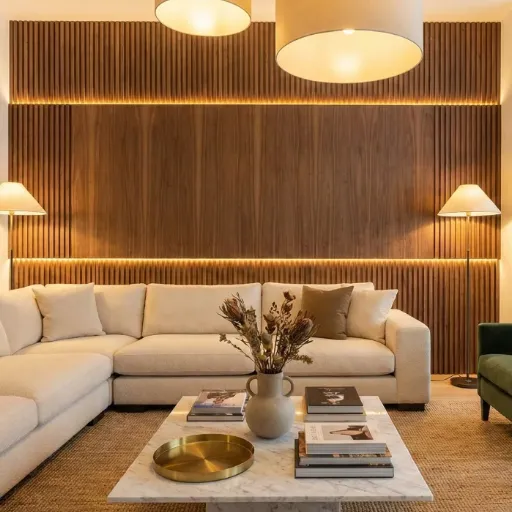
You have probably already seen WPC somewhere: a fluted feature wall behind a TV, a slatted accent wall in a hotel lobby, a wood-look panel holding up beautifully in a humid climate. You like the look. Your real question is whether it holds up, whether it looks cheap in person, and whether it is worth the spend.
Here is the honest version, including the downsides most sellers leave out. By the end you will know exactly when WPC wins in a living room and when a different finish is the smarter call.
Key Takeaways
- WPC is a strong fit for most dry living rooms: it resists moisture, termites and cracking, and lasts roughly 15 to 25 years indoors with almost no maintenance.
- The single biggest misbelief is soundproofing. Plain WPC panels do not block sound. Felt-backed builds only cut echo, and only when the assembly allows it.
- Expect a higher upfront cost than paint or wallpaper. The savings show up in lifespan and repairability, not at checkout.
- Co-extruded WPC outlasts hollow-core in colour and surface stability, and it is the grade worth specifying for a feature wall you want to keep for a decade.
- Every WPC install needs two things done right: sealed cut edges and 5 to 8 mm expansion gaps. Skip either and the panel will fail, not the material.
Are WPC Wall Panels Good for a Living Room? The Short Answer
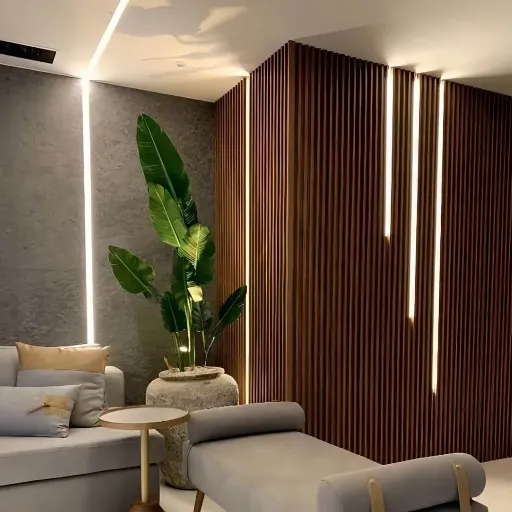
Yes. For a living room, WPC wall panels are a good choice when the room is dry, the walls are seen, and you want a wood look without wood’s maintenance. They handle humidity better than MDF, resist termites and rot, clean with a damp cloth, and keep their colour across a large order.
They become the wrong choice when your main goal is to quiet a noisy room, when the budget is tight and paint would do, or when the wall sits next to direct high heat. Everything below explains why, and it is worth reading before you order.
If you want the full picture first, our complete guide to WPC wall panels for living rooms walks through design, profiles and installation in one place.
Why WPC Suits Living Room Walls
Durability and lifespan: how long WPC actually lasts indoors
This is where WPC earns its place. A hollow-core WPC panel typically lasts 15 to 20 years indoors. A co-extruded panel, where a protective skin is bonded over the core, reaches 20 to 25 years. Compare that with MDF or plywood panelling at 5 to 10 years, or solid timber at 10 to 20 years with regular care.
Surface hardness tells the same story. Manufacturers commonly rate hollow WPC at 1,800 to 2,400 N/mm² and co-extruded WPC at 3,000 to 3,500 N/mm², which rivals or beats a lot of solid timber.
For a living room wall that takes years of furniture bangs, door swings and vacuum cleaners, that durability matters. You are not repainting it every three years or replacing swollen MDF.
Moisture, termites and cracks
A living room is not a wet room, but it still sees seasonal humidity, condensation near windows, and the occasional spill against a wall. This is where wood-based panels struggle and WPC does not.
WPC does not swell, warp, rot or attract termites. Its water absorption sits at around 1% or below, and premium co-extruded grades go lower. Standard MDF, by contrast, crumbles once it takes on water, and solid wood moves with the seasons until it cracks.
I saw this play out for a client who runs short-stay rentals on a coastal strip. Priya had used MDF panelling in three living rooms. After two rainy seasons, two of the three had swollen edges and peeling seams. The third room, panelled in WPC, looked the same as the day it went up. She replaced the two failures with WPC and has not touched them since.
Wipe-clean, low-maintenance surfaces
WPC asks almost nothing of you. A damp cloth and mild soap handle dust, fingerprints and everyday marks. No sanding, no staining, no re-sealing, no annual polish.
That is a real advantage in a living room, which is usually the highest-traffic, most-touched room in the house. You are not protecting a delicate finish; you are wiping a sealed surface.
Wood-look aesthetics without wood’s upkeep
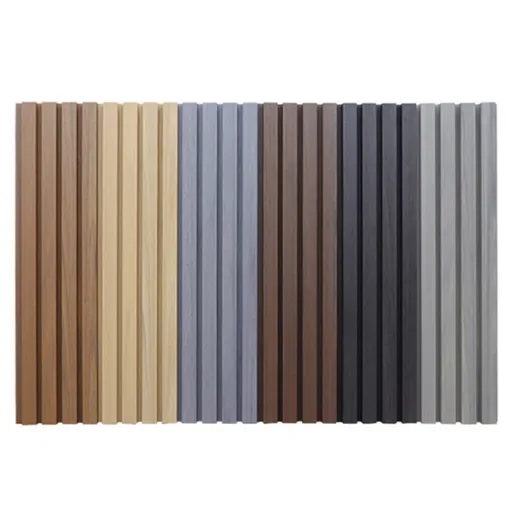
WPC gives you the warmth and grain of wood, in fluted, slatted and flat profiles, in matte and textured finishes. Modern co-extruded panels read convincingly as timber up close, and the finish is consistent from panel to panel.
That consistency is the quiet benefit. Ask for samples and order the full quantity in one batch, and your feature wall will match end to end.
Fast, dry, DIY-friendly installation
Because the panels are lightweight and click or slot together, a living room wall can go up in about a day. No mortar, no cement, no wet trades. Many homeowners install a feature wall themselves with a saw and a level.
Ready to see the finish in your own light? Request a WPC sample kit and check the colour against your room before you commit.
The Honest Downsides of WPC Wall Panels
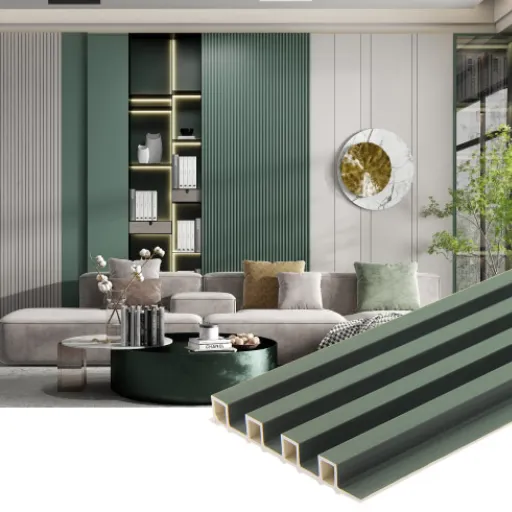
Every seller lists the pros. Here is what the pros sections leave out, and what to do about each one.
They are not soundproof
This is the most common misunderstanding, so let us be blunt. Plain WPC wall panels do not block sound. They add little acoustic value on their own.
The fluted or slatted shape does diffuse some sound, and hollow-core panels give a modest reduction, roughly 18 to 22 dB. Real acoustic performance only comes from the assembly: thick panels, a mineral-wool cavity behind them, and careful fixing. That build reaches around 35 to 42 dB (Rw) and needs a proper frame.
So if your goal is a quieter room, treat WPC as a design finish, not a sound solution. For the material-level comparison, see our WPC fluted panels vs wood slat panels breakdown, which explains where absorption actually comes from.
Heavier than PVC
WPC is denser and heavier than PVC panelling. That extra mass is part of why it feels solid and durable, but it also makes handling harder for one person. If you are installing a tall wall solo, plan for help or a panel lifter.
Higher upfront cost than paint or wallpaper
WPC costs more than the finishes most people default to. Interior WPC panels typically run US$35 to US$90 per m² depending on grade, with solid-core and premium finishes at the top of that range. Accessories add US$15 to US$25 per m², and professional installation adds US$60 to US$130 per m² (source: HSCS Decor 2026 price guide).
That is more than a tin of paint. The question is whether the lifespan justifies it. Paint lasts 3 to 5 years before it needs redoing; wallpaper lasts 5 to 8. WPC lasts 15 to 25. Judged per year of service, the gap narrows a lot.
For the real-world numbers, including the costs nobody quotes like battens, trims, waste and labour, see our living room wall panelling cost guide.
Heat sensitivity and sun fading
WPC is stable in a normal living room, but it does not like intense direct heat. Keep it away from stove surrounds and heater panels, and avoid any spot where surface temperature climbs above roughly 60°C, where the panel can soften or deform.
Full sun is the other watch point. Interior-grade WPC can fade under sustained direct sunlight, so for a bright sun-facing wall, specify a UV-stable grade.
Cut edges and expansion gaps must be handled correctly
Two installation details decide whether your wall lasts. Get them wrong and people blame the material when the material was fine.
- Seal every site-cut edge within 30 minutes using a compatible end sealant. Exposed cut edges can wick moisture and swell, even on a good panel.
- Leave 5 to 8 mm expansion gaps at the panel ends and around the perimeter, then cover them with trims. WPC expands and contracts with temperature. Nearly every “warped WPC” complaint traces back to a missing gap.
The environmental trade-off
WPC uses recycled wood fibre, which keeps waste out of landfill. But it also contains a polymer binder, so an interior panel is not biodegradable, and it is not the same thing as solid timber on end-of-life.
The honest framing: WPC is a durable, lower-waste alternative to virgin hardwood, and it lasts long enough to matter. It is not a fully green material, and no supplier should tell you otherwise. Ask for low-VOC or formaldehyde-free grades if indoor air quality is a priority for your family.
WPC vs the Alternatives: Is It the Best Living Room Wall Panel?
Here is how the main options compare for a living room wall.
| Material | Lifespan indoors | Moisture | Acoustic help | Maintenance | Relative cost |
|---|---|---|---|---|---|
| WPC | 15 to 25 yrs | Excellent | Low (unless engineered) | Wipe clean | Medium |
| PVC | 10 to 20 yrs | Excellent | Low | Wipe clean | Low |
| MDF | 5 to 10 yrs | Poor (swells) | Low | Paint/seal, fragile edges | Low to medium |
| Solid wood | 10 to 20 yrs | Moderate | Low | Re-oil/re-seal regularly | High |
| Wallpaper | 5 to 8 yrs | Poor | None | Replace when soiled | Low |
| Paint | 3 to 5 yrs | Varies | None | Recoat | Low |
The pattern is clear. WPC is the middle-cost option that behaves like the expensive ones. It gives you a wood look with wood-beating moisture resistance and almost no maintenance. PVC is cheaper and fully waterproof but looks less premium. MDF is affordable but does not belong near moisture or high-traffic wear.
If your real comparison is WPC against the two things you already know, paint and wallpaper, our wall panels vs wallpaper vs paint article runs the full total-cost-of-ownership math, including the break-even point. And if you are weighing wood specifically, see WPC vs solid wood wall panels.
Do WPC Wall Panels Look Cheap?
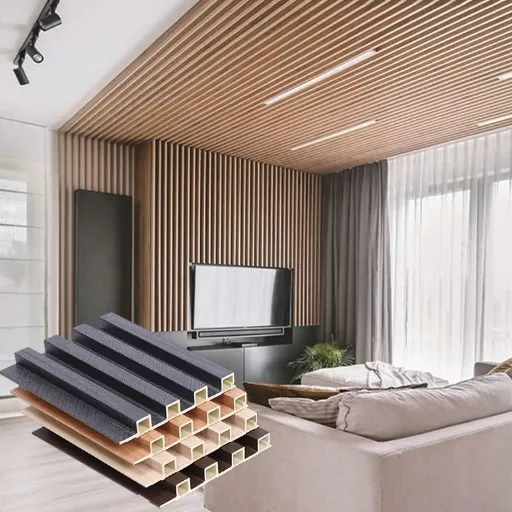
This is the fear that stops a lot of people, so let us deal with it honestly.
WPC looks cheap when it is installed badly. It looks premium when it is specified and fitted well. The material is rarely the problem.
The usual causes of a cheap look:
- Wrong profile for the room. Busy, tight slats in a small living room feel cluttered. Smoother profiles or wider spacing read calmer and more expensive.
- Visible, mismatched trims. Cheap, obvious corner and edge trims scream budget. Matched, tight trims disappear.
- Cool, flat lighting. WPC reads best in warm light around 2700K, where the grain warms up. Cold, harsh light makes any panel look flat and plastic.
- Over-coverage. Panelling every wall in a living room is usually too much. One well-lit feature wall reads as a design decision; four walls read as a renovation shortcut.
- Wrong grade and finish. A glossy, thin, printed panel looks cheaper than a matte, co-extruded, textured one. Finish quality is visible in the hand.
Get those five right and WPC holds its own against far more expensive finishes. Our accent wall panel ideas guide covers the layouts and lighting that consistently produce the premium result.
Should You Choose WPC for Your Living Room? A Decision Checklist
Choose WPC if:
- Your living room is dry and normally heated or ventilated.
- You want a wood look without annual re-oiling or re-sealing.
- The wall will be seen and touched, so durability and wipe-clean surfaces matter.
- You want a feature wall that still looks right in ten years.
- You value consistent colour across a large order.
- You want a fast, dry installation with no wet trades.
Choose a different finish if:
- Your priority is genuinely blocking noise between rooms (fix the wall build, not the panel).
- Your budget is tight and repainting every few years is acceptable (paint wins on upfront cost).
- The wall sits beside a stove or heater, in sustained high heat.
- The wall faces constant direct sunlight without a UV-stable grade.
- You need a fully biodegradable, plastic-free material.
If more of the first list sounds like your room, WPC is the right call. If more of the second does, you have just saved yourself a costly mistake by reading this far.
Getting It Right: Sourcing, Samples and Specifying
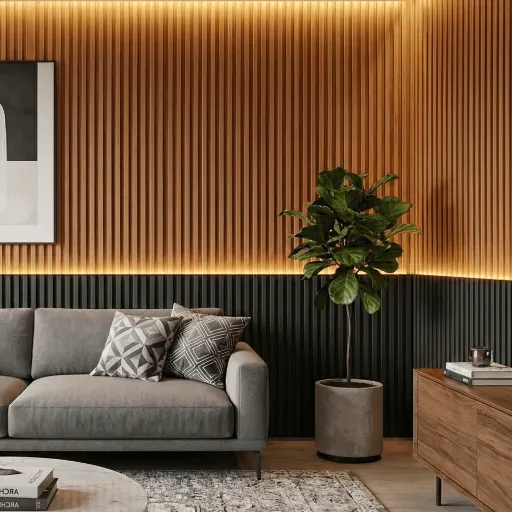
The difference between a WPC wall that impresses for 20 years and one that disappoints in year three is almost never the brand. It is the grade, the sample check, and the batch.
Specify co-extruded over hollow-core for a living room feature wall. You get the longer lifespan, harder surface and better colour stability, and the cost difference is modest against the life of the wall.
Confirm the fire class. Look for documented B1 or Class B-s1,d0 certification (EN 13501) rather than a verbal promise. In many commercial interiors it is mandatory, and it is good practice at home.
Then do the two steps that prevent the most common complaints:
- Request physical samples first, and view them in your own room lighting, not showroom light.
- Order the whole wall in one batch. Colour can shift slightly between production runs. A single batch keeps the finish consistent end to end.
This is where working factory-direct pays off. At Linyi Yuheng International Trading Co., Ltd., we supply co-extruded and hollow WPC interior panels in matched batches, with sample kits and bulk pricing for homeowners, designers and trade buyers. You get consistent colour, documented specifications and a reliable supply chain, whether you are panelling one living room or fitting out a portfolio of them.
Have your wall measurements ready? Get a bulk quote and sample kit and we will match panels, trims and accessories to your project.
The Verdict: Are WPC Wall Panels Good for a Living Room?
Yes, for most living rooms, WPC wall panels are a genuinely good choice. Here is what to take away:
- Durability wins. 15 to 25 years indoors, with no painting, sealing or re-oiling, beats MDF and paint on lifespan.
- Moisture and pests are handled. WPC does not swell, rot or attract termites, unlike wood-based panels.
- The look is premium when it is specified well. Profile, lighting, trims and grade decide this, not the material alone.
- Know the limits. WPC is not soundproof, it costs more upfront than paint, and it needs sealed edges and expansion gaps.
- The material rarely fails. The installation does. Seal cut edges, leave expansion gaps, and use one batch.
If a wood-look wall that survives real life fits your plan, WPC is one of the smartest finishes you can put in a living room. Start with samples, see the finish in your own light, and choose the grade that matches how long you intend to keep it.
Take the next step: request your WPC sample kit today and compare it against your room before you order. It is the cheapest way to avoid an expensive mistake.
Categories:
Blog
Related Articles