Wood Slat Acoustic Panels vs Foam: Design or Absorption?
Wood slat acoustic panels beat foam wherever the wall is seen. With the right backing they absorb a wider frequency range, they carry a real fire classification, and they last 15 to 25 years. Foam wins on one thing only: upfront cost. If nobody will ever look at the surface, foam is often the correct engineering answer.
Here is the part most buyers miss. The wood is not the acoustic material. The backing is. A slat panel with thin 6 mm felt behind it performs almost exactly like the foam tile you were about to reject, and it costs ten times more per square foot.
That single fact decides most of this comparison, so we are going to spend this article on it. We manufacture and export acoustic panels, including wood slat and WPC lines, so we have a commercial interest in selling you panels. We also have an interest in you specifying the right ones, because a wall that underperforms on a technicality is a warranty claim, not a repeat order.
By the end you will know what absorbs sound in a slat panel, whether the diffusion claims hold up, what NRC you actually get at each backing type, which core to choose, what “Class A” fire claims really mean, and what all of it costs from retail down to factory. If you want the wider material picture first, our acoustic panels vs acoustic foam comparison covers all five panel categories side by side.
Key Takeaways
- The wood slats are decorative and reflective. The backing absorbs. Performance is set by backing density and the open-gap-to-slat ratio, not by wood species or finish
- A slat panel with thin 3-8 mm felt rates NRC 0.30-0.55, roughly the same as a cheap foam tile. Slat panels only reach NRC 0.80-0.95 with 50 mm mineral wool, and 0.85+ with a 25-45 mm batten air gap
- Decorative slats 12-21 mm deep are not true diffusers. They act as partial reflectors, which is why a slat wall avoids the dead, over-damped sound a full foam wall creates
- Most fire-rated wood slat panels are EN 13501-1 Class B (B-s1,d0), not Class A. “Class A” claims on slat panels usually mean an ASTM E84 result or an acoustic rating with a plasterboard build-up. Ask which
- Retail slat panels run $15-35 per sq ft against foam at $1-5. Factory-direct panel pricing starts near $1.40-1.50 per sq ft, so most of the retail gap is channel margin, not materials
Wood Slat Acoustic Panels vs Foam: The Short Answer
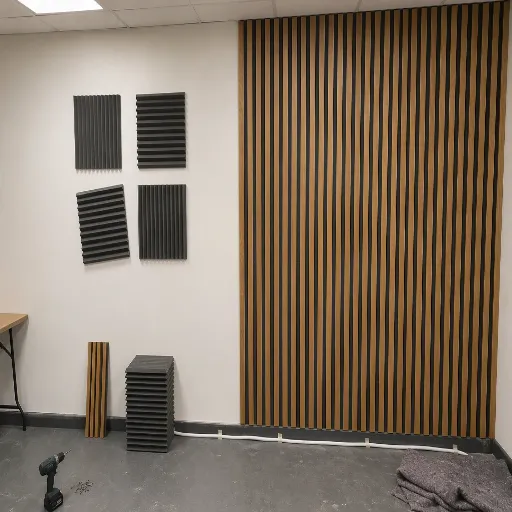
Choose wood slat acoustic panels over foam when the surface is visible, when the room needs absorption below 500 Hz, or when a fire classification has to go on a spec sheet. Choose foam when the surface is hidden, the budget is fixed, or the install must be temporary.
Both products absorb sound. Neither soundproofs, so if your goal is to stop noise crossing into the next room, you need mass and sealing, not either of these.
The practical rule we give buyers: if a guest will see it, foam has to be defended. If nobody will ever see it, foam is often the right call. Everything between those two poles is a specification decision, and that is what the rest of this article is about.
What’s Actually Doing the Work: The Slats vs the Backing
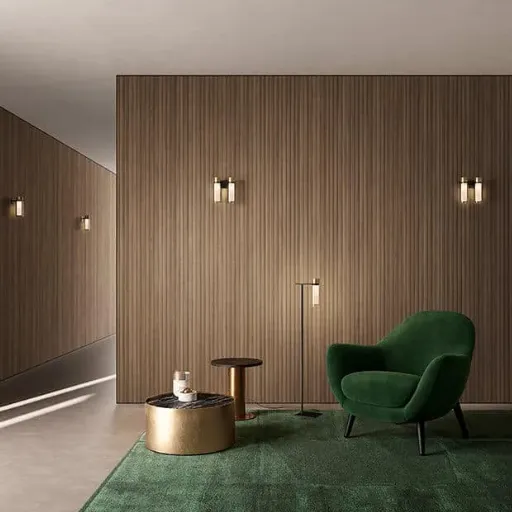
A wood slat acoustic panel is two products stacked together. The front is a row of decorative slats. The back is an acoustically absorbent layer.
Sound hits the slats and passes through the gaps between them. What reaches the backing gets absorbed as the air moves through the porous material and loses energy as heat. The slats themselves return part of what hits them back into the room.
That means three variables set your performance, and none of them is the wood:
- Backing density. This does the absorbing.
- Backing thickness. This sets how far down the frequency range you reach.
- Open-gap-to-slat ratio. Wider gaps expose more backing and absorb more. Tighter gaps look denser and absorb less.
Slat spacing across the industry runs 10-50 mm, slat thickness 6-18 mm, and overall panel depth 25-60 mm. Common slat spacing clusters at 13, 14, and 20 mm.
This is where buyers lose money. Marcus, a studio owner in Manchester, specified a walnut slat feature wall for a client’s living room in early 2023. The quote looked good, the finish samples were beautiful, and the backing was 6 mm polyester felt. The wall looked like a design magazine. The room still rang with flutter echo, because a 6 mm felt backing is a mid and high frequency product, and the client’s complaint was about voices sounding hollow. Re-specifying the same wall with 50 mm mineral wool on 25 mm battens solved it. The slats never changed.
NRC by Backing Type: What Your Spec Sheet Really Buys
Noise Reduction Coefficient (NRC) is a single number averaged across 250, 500, 1,000 and 2,000 Hz. It tells you how much sound energy a material absorbs. Higher is better. Here is what you actually get at each build, with foam in the same frame for comparison.
| Build | NRC range | What it means in the room |
|---|---|---|
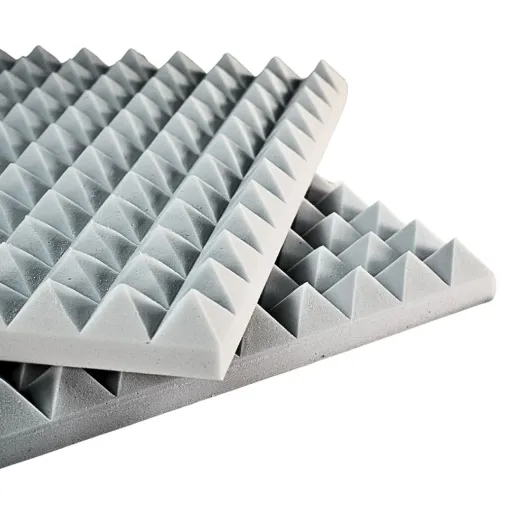
| Foam tile, budget 25 mm | 0.30-0.40 | Tames flutter echo. Nothing below 500 Hz |
| Foam, quality 50 mm | 0.40-0.55 | Better high-frequency control. Still no bass |
| Slat panel + thin felt, 3-8 mm | 0.30-0.55 | Looks premium, performs like foam |
| Slat panel + dense PET, 10-20 mm | 0.50-0.75 | Reaches into the low-mid range |
| Slat panel + mineral wool, 50 mm | 0.80-0.95 | Best all-round performer |
| Slat panel + mineral wool + 25-45 mm air gap | 0.85+ | Batten-mounted. Adds low-frequency depth |
Two specifications matter more than the rest.
Mineral wool density should sit between 40 and 80 kg/m³. Looser material lets sound pass straight through. Denser material reflects it back. The sweet spot is narrower than most suppliers admit.
Thickness sets your floor. A 50 mm backing is effective above 500 Hz. Step to 100 mm and you reach 250 Hz. Getting to 125 Hz needs 200 mm or an air gap, which is why batten-mounted panels outperform direct-mounted ones at low frequencies.
For reference, a standard timber slat panel build measures NRC 0.55 when tested to ASTM C423, with absorption coefficients of 0.25, 0.40, 0.55, 0.65, 0.60 and 0.55 at 125, 250, 500, 1,000, 2,000 and 4,000 Hz. That curve is published in AcousPlan’s timber slat panel data. Anything below about 0.20 at 125 Hz means the panel is doing nothing for bass, whatever the marketing says.
The honest verdict: a budget slat panel is a foam panel in a nicer jacket. The price difference you are paying is aesthetics until you upgrade the backing.
Polyester felt and PET felt are the same material family, so the difference between the 6 mm felt in the Marcus example and a 10-20 mm dense PET layer is thickness and density, not chemistry. If your build uses a PET felt backing, our pet felt acoustic panels vs foam comparison covers the eco and safety side of that choice.
Do Wood Slat Panels Actually Diffuse Sound?
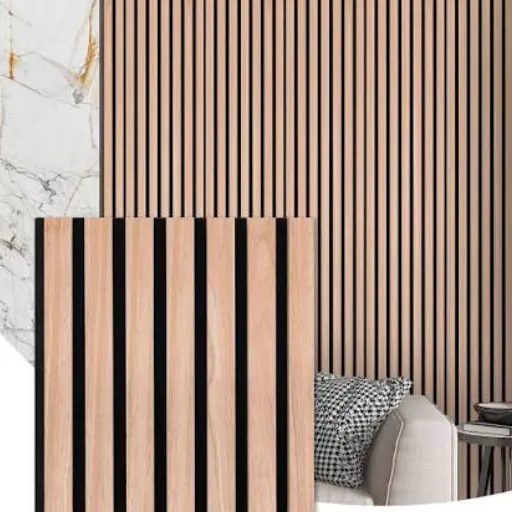
No, not in the way the term is normally used, and this is worth being direct about because almost every supplier page repeats the claim.
Diffusion means scattering sound evenly in many directions. Real diffusers are purpose-built geometries, and they need depth to work. Decorative slats are typically 12-21 mm deep. At that depth they cannot scatter meaningfully at the frequencies where scattering would help.
What the slats actually do is act as partial reflectors. They return part of the mid and high frequency energy into the room. A well-known practitioner analysis of slat panels on Audio Science Review puts it plainly: the wooden slats are too small to act as diffusers, so they behave as partial reflective panels that keep the highs from being damped too much.
That is not a defect. It is the feature. A full foam wall over-absorbs the top end and leaves a room sounding dead and lifeless. It is also the strongest practical argument in the wood slat acoustic panels vs foam comparison. A slat wall absorbs at the backing and reflects a little at the surface, so the room stays balanced. That is why listeners describe slat panels as natural rather than clinical.
Genuine slat-based acoustic devices do exist. Slat resonators use slats over a sealed cavity with deliberate depth and varied slot widths to absorb a tuned low-frequency band. Those are engineered instruments with measured performance. A decorative wall panel is not one.
Buy a slat panel for controlled absorption plus a live top end. Do not buy it because you read that it diffuses like a studio diffuser.
If you want the placement side of this, our acoustic panels vs foam home theater guide covers media walls, first reflection points and corner treatment in detail.
Core, Fire Rating, and Finish: What to Verify Before You Buy
Three specifications decide whether the panel still performs in year five: the core, the fire classification, and the surface. All three matter more in a wood slat acoustic panels vs foam decision than the finish you choose.
WPC vs MDF
MDF is the standard acoustic slat core. It is lower cost and excellent in dry interiors: living rooms, offices, boardrooms, home theaters. It swells and delaminates at the edges when it gets wet. Even moisture-resistant grades tolerate ambient humidity only, not splash.
WPC, a wood-plastic composite, is waterproof through the core. It resists moisture, termites and fungus, which makes it the correct choice for bathrooms, kitchens, spa areas, humid climates and high-traffic walls. For the wet-area specification in detail, see our WPC wall panels for bathrooms guide.
Tom, a fit-out contractor in Dubai, learned this the expensive way. He installed MDF-cored slat panels through a hotel spa in 2024 because the client wanted a walnut look and the MDF line was in stock. Within a season the panel edges had swollen and the joints had opened. The WPC replacement cost more than the original spec would have, and the fix delayed the handover. A stable core also keeps your slat gaps, and therefore your NRC, exactly where you specified them. Oak slats that expand can close the gaps and quietly reduce performance over time.
What “Class A” Actually Means
This is where spec sheets get slippery, so ask precisely.
Most fire-rated wood slat panels are EN 13501-1 Class B, typically B-s1,d0 or B-s2,d0. Some carry ASTM E84 Class A. Both are good, specifiable results.
The trap is that “Class A” claims on wood slat panels frequently refer to:
- an ASTM E84 result being quoted under a European heading,
- an acoustic rating, which has nothing to do with fire, or
- a full build-up using a plasterboard substrate rated A1 or A2, with battens and insulation and no air gap.
Always ask which rating, which standard, and which assembly was tested. Then request the certificate for that assembly, not a “fire-retardant” label. For the strictest EN 13501-1 A2-s1,d0 requirements, wood slat is not the right product at all; wood wool panels are.
Even so, Class B wood slat is a decisive win over untreated polyurethane foam, which burns fast and emits dense toxic smoke. If you need the foam side of that comparison, see what acoustic foam actually absorbs and our fire-rated WPC panels range for compliant commercial builds.
Finish and Coverage
Finish families run across natural veneer, engineered and reconstituted veneer, melamine and PVC film, and WPC. Warm oak and walnut suit living spaces. Charcoal and black oak suit media rooms and boardrooms. Pale ash lifts bright commercial interiors.
For coverage, treat roughly 15-30% of the wall surface for a noticeable improvement. Full-wall coverage gives the maximum effect. A single feature wall is usually chosen for looks and then justified acoustically, not the other way around, and that is a legitimate way to buy. For design layouts, see our WPC 3D slat wall panel design options and the full buyer’s guide to wood slat acoustic panels.
Cost: Retail vs Factory-Direct, and Where Foam Still Wins
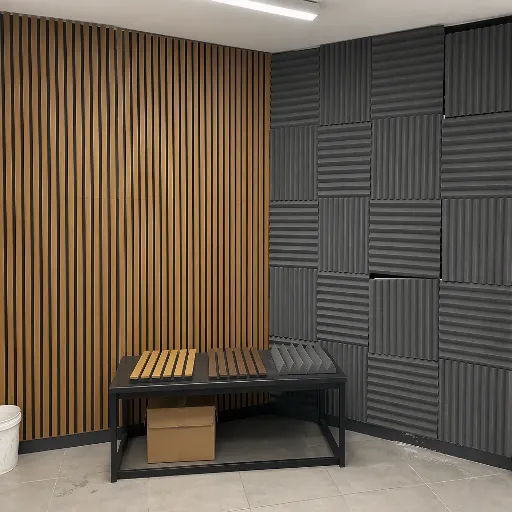
Here are the sticker prices. Foam runs $1-5 per sq ft. Wood slat panels run $15-35 per sq ft at retail. That gap is the entire wood slat acoustic panels vs foam debate in one line.
It is real, and it is mostly channel. The same class of slat panel leaves a Chinese factory at roughly $1.40-1.50 per sq ft, around $15.57-15.79/m² at volumes of 500-1,000 m² or more, carrying EN 13501-1 Class B, ASTM E84 Class A and NRC 0.8. Fire-retardant treatment adds roughly 15-35% to that. Treat those as ranges, not quotes, because MOQ, finish, backing and fire treatment all move the number.
So before you compare a $30 retail panel against a $3 foam tile, check what the panel costs direct. Our full foam vs panel cost breakdown works through the ten-year math and the replacement cycle.
Volume buyers should also weigh freight. Foam is light and cheap to ship. Slat panels are dense and heavy, and freight becomes a genuine line item on full-container orders. A factory-direct supplier can consolidate it; a retail reseller cannot.
Where foam genuinely wins. This is not a sales pitch, so here is the honest list. Foam is the right answer when the surface is never seen, such as behind a radiator, above a ceiling tile, inside a riser or in a workshop. It wins when the budget is a hard ceiling, when the install must be temporary or renter-friendly, when weight is a constraint on a plasterboard ceiling, and when a voice-only room needs high-frequency flutter control and nothing more.
Its real drawbacks are worth stating too. Foam lasts 3-10 years before it yellows, sags and crumbles. Its static charge attracts dust, lint and pet hair. It is difficult to clean without damaging it. Adhesive can tear drywall paper on removal. And untreated polyurethane burns.
Ready to spec this properly? Request free samples and a factory-direct quote and we will match the backing to your room.
Wood Slat Acoustic Panels vs Foam: The Bottom Line
| Your situation | Choose | Why |
|---|---|---|
| Visible living room or media wall | Slat panel, 50 mm mineral wool | Looks intentional and absorbs below 500 Hz |
| Boardroom, reception, restaurant, hotel | Slat panel, Class B minimum | Design and compliance in one line item |
| Bathroom, kitchen, spa, humid climate | WPC-cored slat panel | MDF edges swell; WPC is waterproof through the core |
| Home theater or music room | Slat panel plus corner bass traps | Foam cannot touch room modes |
| Hidden surface: riser, plant room, workshop | Foam | Cheapest correct answer |
| Rental or temporary install | Foam | Removable, no damage to the wall |
| Tight budget, voice-only room | Foam, with honest expectations | Controls flutter echo and nothing else |
One line to remember: foam is a consumable, panels are an asset. Foam gets replaced every few years and has no resale value. A slat wall is a permanent part of the room, and it reads as architecture at handover.
Frequently Asked Questions
Are wood slat acoustic panels better than acoustic foam?
Yes, wherever the surface is visible or the room needs absorption below 500 Hz. With 50 mm mineral wool backing, slat panels reach NRC 0.80-0.95 against foam’s 0.30-0.55, and they last 15-25 years instead of 3-10. Foam only wins on upfront cost and in hidden locations.
Do wood slat acoustic panels actually absorb sound, or is it just the backing?
The backing does the absorbing. Sound passes through the gaps between slats and loses energy in the porous backing material. The slats themselves are reflective. This is why backing density and thickness, not wood species, determine your NRC.
Do wood slat panels diffuse sound?
Not in the technical sense. Decorative slats are 12-21 mm deep, far too shallow to scatter sound the way a purpose-built diffuser does. They act as partial reflectors, which keeps the top end from being over-absorbed. Genuine low-frequency absorption from slats requires a resonator design with depth and varied slot widths.
What NRC do wood slat acoustic panels have?
It depends entirely on the backing. Thin felt (3-8 mm) gives 0.30-0.55. Dense PET (10-20 mm) gives 0.50-0.75. Mineral wool at 50 mm gives 0.80-0.95, and adding a 25-45 mm batten air gap pushes it above 0.85.
Are wood slat acoustic panels fire-rated?
Most are EN 13501-1 Class B, typically B-s1,d0, and some hold ASTM E84 Class A. Be careful with “Class A” claims, because they often mean an ASTM result or a build-up using a plasterboard substrate. Ask which standard and which assembly was tested, and request that certificate.
Can wood slat panels be used in a bathroom?
Only with a WPC core. MDF-cored panels swell and delaminate when wet and are specified for dry interiors only. WPC is waterproof through the core and suits bathrooms, kitchens and humid climates.
Are wood slat acoustic panels worth the cost versus foam?
Over ten years, usually yes, particularly where the wall is visible. Foam needs replacing every 3-10 years and never absorbs bass. Buying factory-direct rather than retail cuts the panel cost dramatically, which changes the comparison entirely.
Conclusion
The comparison comes down to four things.
- The backing decides performance. Wood species, finish and colour do not move your NRC. Felt thickness and mineral wool density do.
- The diffusion claim is overstated. Slats are partial reflectors, and that is what keeps a slat wall sounding alive rather than dead.
- Verify the fire classification, not the marketing. Class B is the honest answer for most slat panels. Class A claims usually mean something else.
- Check the factory price before you judge the retail one. Retail slat panels run $15-35 per sq ft against factory pricing near $1.40-1.50.
In a wood slat acoustic panels vs foam decision, foam remains the right answer for hidden surfaces and temporary rooms. Everywhere the wall is seen, specify wood slat, and specify the backing properly the first time.
Request free samples and a factory-direct bulk quote, and tell us the room, the surface area and whether it will get wet. We will recommend the core, the backing and the fire classification that fits.
Categories:
Blog
Related Articles