Wood Slat Acoustic Panels for Modern Offices: Design & Performance Guide
Wood slat acoustic panels for offices combine visible wood slats with hidden acoustic backing to absorb 55-80% of incident sound while serving as architectural wall features. WPC core panels outperform MDF cores in moisture resistance and fire ratings, making them the better choice for commercial office environments.
Most offices face the same dilemma. Employees need acoustic treatment to concentrate, but standard fabric-wrapped panels look utilitarian at best — and institutional at worst. In client-facing spaces like reception areas and boardrooms, utilitarian acoustic panels undermine the professional image the company is trying to project.
Wood slat panels solve this by making the acoustic treatment part of the design. The visible slats read as intentional millwork. The hidden PET felt backing does the acoustic work. The result is a wall that looks like an architectural feature and performs like a professional acoustic treatment.
For a complete overview of office acoustic panel types, materials, and placement strategies, see our office acoustic panels buyer’s guide.
Key Takeaways
- Wood slat panels achieve NRC 0.55-0.80 depending on slat spacing and backing thickness
- WPC cores resist moisture and impact better than MDF, with Class A fire ratings achievable
- Tight slat spacing (1/4-inch gaps) with 9mm+ backing delivers the highest NRC values
- Wood slat panels cost $10-20 per square foot — 40-60% more than fabric panels but with design value
- Best applications: reception areas, boardrooms, executive offices, and branded feature walls
What Are Wood Slat Acoustic Panels?
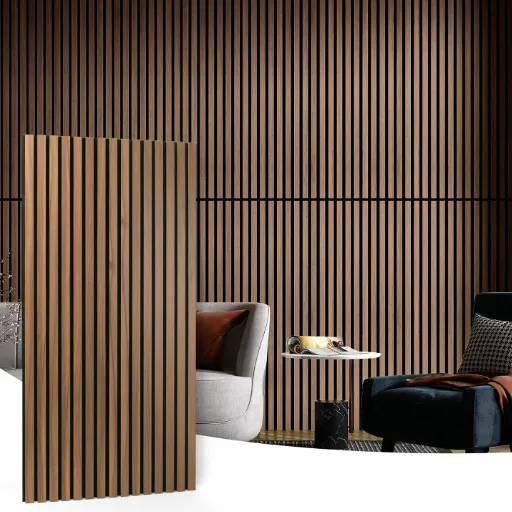
Wood slat acoustic panels are two-layer wall systems. The visible layer consists of linear wood slats spaced at regular intervals. The hidden layer is an acoustic backing material — typically PET felt, fiberglass, or mineral wool — that absorbs sound passing through the gaps between slats.
When sound hits the panel, it travels through the gaps between slats and enters the porous backing material. The sound energy converts to heat through friction as it moves through the fibers. The slats themselves reflect some sound, which is why wood slat panels never achieve the NRC values of fully exposed fabric panels. But the trade-off is intentional: you sacrifice some absorption for a finished appearance that works in high-visibility spaces.
Standard panel dimensions are 24 by 48 inches or 24 by 96 inches, though custom sizes are common for large projects. Slat widths typically range from 1/2 inch to 2 inches. Gap widths range from 1/8 inch to 3/4 inch. These dimensions are not arbitrary — they determine both the visual rhythm and the acoustic performance.
MDF vs WPC Core: The Decision That Determines Everything
The core material behind the slats is the single most important specification decision. It affects acoustic performance, durability, fire rating, moisture resistance, and cost.
MDF Core Panels
MDF (medium-density fiberboard) is the traditional choice for wood slat panels. It is made from wood fibers bonded with resin under heat and pressure. MDF machines cleanly, holds paint well, and provides a smooth surface for veneer applications.
Acoustic performance: MDF cores with 9mm PET felt backing achieve NRC 0.60-0.75 depending on slat spacing. The uniform density of MDF provides a consistent performance panel-to-panel.
Limitations: MDF swells when exposed to moisture. In environments above 80% relative humidity, MDF panels can warp, delaminate, or grow mold. This makes MDF unsuitable for humid climates, buildings with unreliable HVAC, or areas near kitchens and bathrooms.
Fire rating: Standard MDF achieves Class B or C under ASTM E84. This meets some commercial requirements but fails stricter codes that mandate Class A for interior finishes.
Cost: $10-16 per square foot. MDF is the budget-friendly option for wood slat panels.
Best for: Dry climates, interior offices with stable humidity, budget-conscious projects, and temporary installations.
WPC Core Panels
WPC (wood plastic composite) combines wood fibers with thermoplastics — typically PVC or polyethylene. The result is a material that looks and feels like wood but resists moisture, impact, and insects.
Acoustic performance: WPC cores with 9mm PET felt backing achieve NRC 0.65-0.80. The slightly lower density of WPC compared to MDF allows more sound energy to pass through to the backing, improving absorption.
Durability advantages: WPC does not absorb moisture. It maintains dimensional stability in environments up to 95% relative humidity. It resists dents and impacts better than MDF, making it suitable for high-traffic walls in commercial buildings.
Fire rating: WPC formulations with fire-retardant additives achieve ASTM E84 Class A ratings. This opens applications in commercial buildings with strict fire codes, healthcare facilities, and government offices.
Sustainability: Many WPC products incorporate recycled plastic content. The thermoplastic component can come from post-consumer sources, and the wood fiber can come from sawmill waste.
Cost: $12-20 per square foot. The premium over MDF is 20-40%, but the durability and code compliance advantages often justify the difference.
Best for: Commercial offices, humid climates, high-traffic walls, projects requiring Class A fire ratings, and long-term installations.
When Priya, an architect in Miami, specified wood slat panels for a law firm’s reception area, she initially chose MDF for budget reasons. The firm’s building had inconsistent HVAC humidity control. Within eight months, the MDF panels along the exterior wall showed swelling at the edges. She replaced them with WPC panels at 25% higher cost. Two years later, the WPC panels show no degradation despite the same humidity conditions.
Core Material Comparison
| Feature | MDF Core | WPC Core |
|---|---|---|
| NRC (9mm backing, tight spacing) | 0.65-0.75 | 0.70-0.80 |
| Moisture resistance | Low (swells above 80% RH) | High (stable to 95% RH) |
| Impact resistance | Moderate | High |
| Typical fire rating | Class B/C | Class A (with FR additives) |
| Cost per sq ft | $10-16 | $12-20 |
| Panel weight | Heavier (denser) | Lighter |
| Best application | Dry interiors, budget | Commercial, humid, high-traffic |
For technical details on WPC material properties and acoustic performance, see our guide to WPC acoustic panels for offices.
Slat Spacing and NRC: The Hidden Variable

The gap between slats is the acoustic pathway. Wider gaps expose more backing material, which suggests better absorption. But the relationship is not linear. The slats themselves reflect sound, and the ratio of slat width to gap width determines how much sound reaches the backing.
NRC by slat spacing (all with 9mm PET felt backing):
| Slat Gap | NRC Range | Visual Effect | Best For |
|---|---|---|---|
| 1/8 inch | 0.75-0.80 | Dense, subtle | Maximum acoustic performance |
| 1/4 inch | 0.70-0.75 | Balanced | Standard office applications |
| 3/8 inch | 0.60-0.70 | Visible rhythm | Design-forward spaces |
| 1/2 inch | 0.55-0.65 | Dramatic lines | Feature walls, low NRC needs |
| 3/4 inch | 0.50-0.60 | Very open | Reception, visual impact priority |
Backing thickness matters too:
- 6mm PET felt: reduces NRC by 0.05-0.10 compared to 9mm
- 9mm PET felt: standard performance
- 12mm PET felt: increases NRC by 0.05-0.08 compared to 9mm
- 25mm mineral wool: increases NRC by 0.10-0.15 but adds bulk
For conference rooms and video conferencing suites where speech intelligibility is critical, specify 1/4-inch gaps with 9mm or thicker backing. This achieves NRC 0.70+ — sufficient for meaningful acoustic improvement while maintaining a refined appearance.
For reception areas where the visual statement matters more than maximum absorption, 3/8-inch or 1/2-inch gaps create a more dramatic linear pattern. Supplement with ceiling baffles to compensate for the lower wall-panel NRC.
For conference rooms and video conferencing suites where speech intelligibility is critical, specify 1/4-inch gaps with 9mm or thicker backing. This achieves NRC 0.70+ — sufficient for meaningful acoustic improvement while maintaining a refined appearance. NRC ratings are determined by ASTM C423 testing standards, which measure absorption across the speech frequency range.
Design Applications for Offices
Reception Areas
Reception is where first impressions form. Wood slat panels behind the reception desk create a branded backdrop that photographs well and signals attention to detail. Specify WPC cores for durability — reception walls endure more contact than typical office walls.
A San Francisco tech company specified walnut-finish WPC slat panels for their reception feature wall. The panels span 16 feet wide by 9 feet tall, with 1/4-inch gaps and integrated LED strip lighting between the slats. Visitors comment on the “warm, designed space” without realizing the primary purpose is acoustic. The NRC of 0.72 reduced the reception area echo by approximately 50%.
Boardrooms and Conference Rooms
Boardrooms need acoustic treatment that does not look like an afterthought. Wood slat panels on the rear wall — the surface directly behind the presenter — serve as a branded video call backdrop while absorbing reflections that would otherwise create echo for remote participants.
For video conferencing suites, combine wood slat panels with hidden high-NRC backing. The visible slats create the design impact. A layer of fiberglass behind the PET felt boosts overall NRC to 0.80+ without changing the exterior appearance.
For video conferencing suites, the rear wall treatment should combine wood slat panels with hidden high-NRC backing to achieve both design impact and speech clarity.
Open Office Feature Walls
In open plans, wood slat panels on a feature wall define zones without physical barriers. A full wall of slat panels between the workstation area and breakout space creates visual separation while adding absorption to both sides.
In open offices, wood slat panels work best as part of a combination approach. Pair them with ceiling baffles for overall noise reduction. The ceiling handles the bulk of the acoustic treatment. The wood slat wall provides the design moment.
Executive Offices
Executive offices demand premium materials. Specify real wood veneer over WPC core for the best combination of appearance, durability, and acoustic performance. Oak, walnut, and ash are the most common choices. Custom stains can match existing millwork or corporate branding.
Installation Aesthetics: What Designers Need to Know

How panels meet the wall, floor, and ceiling determines whether they look like an architectural feature or a mounted product.
Flush Mount vs. Shadow Gap
Flush-mount panels sit flat against the wall with minimal visible gap. This creates a monolithic appearance where the slats read as part of the wall itself. It requires a flat, plumb wall surface and precise panel alignment.
Shadow gap installation leaves a 1/4-inch to 1/2-inch gap between the panel perimeter and the surrounding wall. This creates a deliberate reveal that frames the panel as a distinct design element. Shadow gaps are more forgiving of imperfect walls and add visual sophistication.
Concealed vs. Exposed Fasteners
Concealed mounting uses z-clips or French cleats hidden behind the panel. No fasteners are visible on the panel face. This is the standard for premium installations.
Exposed fasteners — typically black or brass screws through the slats — create an industrial aesthetic. Some designers specify exposed fasteners intentionally for a loft or studio vibe.
Integrated Lighting
LED strip lighting installed behind the slats creates a halo effect where light washes the wall between the panel and the backing. The light catches the edges of the slats, emphasizing the linear pattern. This works best with shadow gap mounting, where the light has space to diffuse.
Corners and Transitions
Inside corners require mitered panel edges or custom corner trim pieces. Outside corners need protective edge profiles or mitered returns. Plan panel layout so that seams fall at logical boundaries rather than mid-wall.
Fire Ratings and Commercial Compliance
Commercial buildings require fire-rated interior finishes. Wood slat panels must meet the same standards as any other wall covering.
ASTM E84 measures flame spread and smoke development. Class A (flame spread 0-25) is required for most commercial interiors, especially corridors, lobbies, and assembly spaces.
EN 13501-1 is the European equivalent. A B1 rating is the standard for office interiors.
MDF fire ratings: Standard MDF cores achieve Class B or C. Some manufacturers offer fire-retardant MDF that reaches Class B but rarely Class A. Check current test reports before specifying MDF for commercial projects with strict codes.
WPC fire ratings: WPC with fire-retardant additives consistently achieves Class A under ASTM E84. The thermoplastic content can be formulated with intumescent additives that char when exposed to flame, creating a protective barrier. Always request a current test certificate for the specific product and formulation.
When specifying for commercial projects, include the fire rating requirement in your purchase documentation. Factory-direct manufacturers can typically provide test certificates and third-party lab reports faster than distributors.
Finishes, Colors, and Customization

Standard Wood Veneers
- Oak: Light to medium tone, prominent grain, versatile
- Walnut: Dark, rich, premium appearance
- Ash: Light with dramatic grain patterns
- Maple: Very light, subtle grain, modern aesthetic
- Teak: Golden-brown, tropical aesthetic
Painted and Lacquered Finishes
Any Pantone color can be specified. Matte, satin, and high-gloss lacquers create different effects. Dark colors (charcoal, navy, forest green) make the linear pattern more dramatic. Light colors (white, cream, pale gray) create a softer, Scandinavian-inspired look.
Custom Sizing for Large Projects
Standard 24-by-48-inch panels work for most applications. For large projects, custom dimensions reduce seams and installation time. A 48-by-96-inch panel covers four times the area of a standard panel with one-quarter the edge seams. Custom sizing typically adds 10-20% to panel cost but reduces installation labor by 30-40%.
Bulk Order Lead Times
Standard finishes ship in 2-4 weeks. Custom colors and veneers require 4-6 weeks. Large orders (1,000+ square feet) should be planned 6-8 weeks to allow for production scheduling and quality control.
Cost Comparison by Application
| Application | Size | MDF Cost | WPC Cost | Notes |
|---|---|---|---|---|
| Small feature wall | 80 sq ft | $800-1,300 | $1,000-1,600 | Entry-level installation |
| Reception backdrop | 200 sq ft | $2,000-3,200 | $2,400-4,000 | May include lighting |
| Boardroom full wall | 300 sq ft | $3,000-4,800 | $3,600-6,000 | Often includes custom sizing |
| Open office feature wall | 500 sq ft | $5,000-8,000 | $6,000-10,000 | Large panels reduce seams |
Cost factors:
- Core material: WPC adds 20-40% over MDF
- Finish: Real wood veneer adds 25-50% over laminate
- Custom color: Adds 15-25%
- Custom sizing: Adds 10-20%
- Integrated lighting: Adds $8-15 per linear foot
Frequently Asked Questions
Do wood slat panels actually absorb sound?
Yes, but less than fabric-wrapped panels. Wood slat panels with tight spacing and thick backing achieve NRC 0.70-0.80. The visible slats reflect some sound, but the hidden backing absorbs what passes through the gaps. In most office applications, NRC 0.70+ provides meaningful echo reduction and improved speech clarity.
How do wood slat panels compare to fabric panels?
Fabric panels achieve higher NRC (0.85-0.95) at lower cost ($4-8 per sq ft). Wood slat panels achieve a lower NRC (0.55-0.80) at a higher cost ($10-20 per sq ft). The choice depends on priorities: maximum acoustic performance favors fabric. Design integration and architectural appearance favor wood slats. Many offices use fabric panels in back-of-house areas and wood slat panels in client-facing spaces.
Can I install wood slat panels myself?
A skilled DIYer can install wood slat panels with basic tools (drill, level, stud finder). Standard panels weigh 8-15 pounds each and mount with z-clips or French cleats. The challenge is alignment — multiple panels must meet flush at seams for a professional appearance. For large walls or premium finishes, professional installation ensures proper spacing, level, and seamless joints.
What is the best backing for wood slat panels?
9mm PET felt is the standard backing for most office applications. It provides good absorption, is lightweight, and is easy to work with. For maximum acoustic performance, specify 12mm PET felt or a dual layer of PET felt over fiberglass. For budget installations, 6mm PET felt works but reduces NRC by 0.05-0.10.
Are WPC wood slat panels better than MDF?
WPC is better for commercial offices, humid environments, and projects requiring Class A fire ratings. MDF is adequate for dry interiors and budget-conscious projects. For installations that must last 10+ years in commercial conditions, WPC’s durability and moisture resistance justify the 20-40% cost premium.
How long do wood slat acoustic panels last?
In typical office conditions, wood slat panels last 15-25 years. The backing material may compress slightly over time, reducing NRC by 0.05-0.10 after 10 years. The slat surface itself lasts indefinitely with normal care. WPC cores outlast MDF cores in challenging environments by 5-10 years.
Conclusion
Wood slat acoustic panels for offices solve a problem that standard acoustic products cannot: they make treatment look intentional. In reception areas, boardrooms, and executive offices where every design decision communicates company values, wood slat panels signal that aesthetics and function coexist.
The specification decisions are straightforward once you understand the trade-offs. MDF cores cost less but limit applications to dry interiors. WPC cores cost more but deliver commercial-grade durability, moisture resistance, and Class A fire ratings. Tight slat spacing with thick backing maximizes NRC. Custom finishes and integrated lighting transform panels into signature design elements.
Categories:
Blog
Related Articles