Best Acoustic Panels for Open Plan Offices: 2026 Buyer’s Guide
The best acoustic panels for open plan offices are ceiling baffles for large floor plates, wall-mounted fabric panels for perimeter treatment, and desk-mounted screens for workstation privacy. For a typical 1,000-square-foot open office, start with 500-600 square feet of ceiling coverage before adding wall panels.
The open office was supposed to spark collaboration. Instead, it created a noise problem that costs companies billions in lost productivity every year. If you manage a facility or design office spaces, you have heard the complaints — employees cannot concentrate, calls are impossible, and the constant background chatter raises stress levels across the floor plate.
This guide ranks the best acoustic panel types for open plan offices by performance, coverage needs, and budget. You will see why ceiling treatment comes first, which materials deliver the highest noise reduction, and how to combine panel types for results that employees actually notice. Every recommendation includes real coverage numbers and cost ranges so you can spec a solution that fits your project.
For a complete overview of office acoustic panel materials, installation methods, and NRC ratings, see our office acoustic panels buyer’s guide. Workplace noise is a documented occupational health concern — OSHA workplace noise guidelines establish exposure limits that untreated open offices frequently exceed.
Key Takeaways
- Ceiling baffles and clouds should cover 50-60% of the ceiling area before adding wall panels
- Open offices need NRC 0.90+ panels for effective noise reduction in shared spaces
- The best results come from combination systems: ceiling baffles + wall panels + desk screens
- A 1,000 sq ft open office needs roughly $6,000-12,000 in materials for full treatment
- Wood slat and WPC panels serve as architectural features while adding acoustic function in client-facing areas
Why Open Plan Offices Need a Ceiling-First Strategy

Most people assume wall panels are the answer to office noise. In an open plan layout, that assumption costs you half your acoustic budget with half the results.
In open offices, sound travels upward and reflects off the ceiling deck before spreading across the entire floor plate. The ceiling is the largest untreated surface and the primary path for sound transmission. Treating walls first in an open office is like mopping the floor while the faucet is still running — you are addressing symptoms, not the source.
When Jennifer, a facilities director in Austin, first treated her company’s 3,500-square-foot open office, she installed fabric wall panels on every perimeter wall. The result was underwhelming. Employees still complained about noise from the center of the floor. Six months later, she suspended acoustic baffles across 60% of the ceiling. The noise reduction was immediate and dramatic — she described it as “the difference between a crowded restaurant and a quiet library.” The ceiling treatment alone delivered 70% of the total acoustic improvement.
The ceiling-first rule: In open plan offices, ceiling treatments account for 60-70% of total acoustic improvement. Start there, then add wall panels and desk screens as secondary layers.
How Ceiling Baffles Work
Ceiling baffles are vertical acoustic panels that hang perpendicular to the ceiling deck. Unlike flat ceiling tiles, baffles expose both sides to the room, doubling the absorption surface area per square foot of material. Sound hits the baffle, enters the porous core (typically fiberglass or mineral wool), and converts to heat through friction.
Baffles suspend on cables or chains at varying heights, creating a visual rhythm that breaks up the expanse of a standard ceiling. They work best in offices with ceilings 9 feet or higher. In spaces with drop ceilings below 9 feet, ceiling clouds or acoustic tiles are often more practical.
For a deeper dive into ceiling-specific options, see our office acoustic ceiling panels guide.
Best Acoustic Panel Types for Open Plan Offices
Acoustic Ceiling Baffles (Best Overall for Large Open Offices)
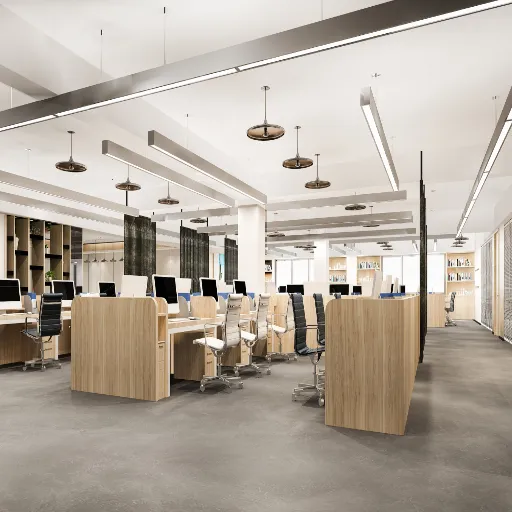
Ceiling baffles are the top choice for open plan offices because they intercept upward-traveling sound before it reflects across the floor plate.
Performance: NRC 0.85-1.00
Coverage target: 50-60% of total ceiling area
Cost: $5-12 per square foot installed
Best for: Offices with 9-foot+ ceilings, large floor plates over 1,000 sq ft
Baffles come in standard lengths of 24 to 96 inches and widths of 6 to 24 inches. A typical open office layout spaces baffles 12-18 inches apart across the ceiling grid. The vertical orientation means both faces absorb sound, making them roughly twice as efficient per square foot as flat ceiling panels.
When the design team at a Chicago marketing agency renovated their 2,200-square-foot open office, they specified charcoal-gray baffles in alternating lengths. The baffles covered 55% of the ceiling and reduced the room’s RT60 (reverberation time) from 1.4 seconds to 0.7 seconds. Employees reported they could hold phone conversations at their desks without raising their voices — something that was impossible before treatment.
NRC ratings for ceiling baffles by material:
- Fiberglass baffles: NRC 0.95-1.00
- Mineral wool baffles: NRC 0.90-0.95
- PET felt baffles: NRC 0.80-0.90
Acoustic Ceiling Clouds (Best for Collaboration Zones)
Ceiling clouds are flat panels that suspend horizontally below the ceiling deck, typically over specific zones like meeting areas or breakout spaces.
Performance: NRC 0.80-0.95
Coverage target: 30-40% of the ceiling area in defined zones
Cost: $6-15 per square foot installed
Best for: Breakout areas, hot-desking zones, spaces under 1,000 sq ft
Clouds create a visual canopy that defines spaces within an open floor plate. They install on adjustable cables, allowing you to set the height based on ceiling clearance. The air gap between the cloud and the structural ceiling improves low-frequency absorption — critical for reducing the rumble of HVAC systems and deep voices.
Clouds work best as a complement to baffles, not a replacement. Use clouds over collaboration tables and baffles across the general workspace.
Wall-Mounted Acoustic Panels (Secondary Coverage)
Wall panels treat the perimeter and create privacy barriers between functional zones.
Performance: NRC 0.80-0.95
Coverage target: 20-30% of available wall area
Cost: $4-8 per square foot installed
Best for: Perimeter walls, spaces adjacent to conference rooms, branding walls
In open offices, wall panels serve two purposes. First, they absorb sound that hits perimeter walls before bouncing back into the workspace. Second, they create visual separation between zones — reception, workstations, and break areas — without physical partitions.
Standard 2-by-4-foot fabric-wrapped panels install with impaling clips or z-clips. For offices that reconfigure regularly, magnetic or Velcro mounting systems allow panels to move with the furniture layout.
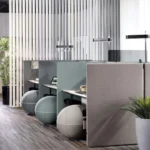
Desk-Mounted Acoustic Screens (Best for Immediate Workstation Relief)
Desk screens attack noise at the source — the space between workstations where conversations overlap.
Performance: NRC 0.60-0.80
Coverage: One screen per 2-4 workstations
Cost: $80-200 per screen
Best for: Call centers, focus work areas, dense workstation layouts
Desk screens mount on clamps or sit freestanding on the worksurface. They block direct sound paths between neighbors and reduce the “cocktail party effect” where every conversation in the room becomes audible. Heights of 18-24 inches above the desktop provide privacy without blocking sight lines or natural light.
The limitation of desk screens is coverage. A screen only treats sound in its immediate vicinity. In a 50-workstation open office, you need 15-25 screens for meaningful impact. They work best as part of a combination approach alongside ceiling and wall treatment.
Wood Slat Panels with PET Felt Backing (Best for Client-Facing Spaces)
Wood slat panels are the premium choice for open offices where design carries equal weight with performance.
Performance: NRC 0.55-0.80
Coverage target: 20-30% of wall area
Cost: $12-20 per square foot installed
Best for: Reception areas, executive floors, branded feature walls
The visible wood slats create an architectural feature while the hidden PET felt backing absorbs sound. NRC varies significantly with slat spacing — tight spacing with thick backing achieves NRC 0.75-0.80, while wide spacing drops to NRC 0.50-0.60.
For open offices, specify tight spacing (1/4-inch gaps) and 9mm+ PET backing to maximize absorption. The trade-off is clear: wood slat panels cost more and absorb less than fiberglass, but they transform a utilitarian acoustic treatment into an intentional design element.
WPC Perforated Panels (Best for Durability and Integrated Finishes)
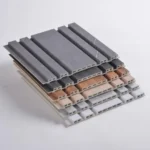
WPC (wood plastic composite) perforated or grooved panels combine acoustic function with finished wall surfaces.
Performance: NRC 0.50-0.75
Coverage target: 25-35% of wall area
Cost: $8-15 per square foot installed
Best for: High-traffic walls, humid climates, spaces needing integrated finishes
WPC panels install as permanent wall finishes, replacing drywall and paint while adding acoustic absorption. They resist moisture, impact, and fading — advantages over fabric-wrapped panels in high-traffic or humid environments. Perforations or grooves allow sound to reach the acoustic backing behind the panel surface.
The lower NRC means you need 25-35% more coverage than fiberglass for equivalent results. In design-forward open offices, WPC panels work best on feature walls where the material itself contributes to the aesthetic.
NRC Ratings: What Open Offices Actually Need
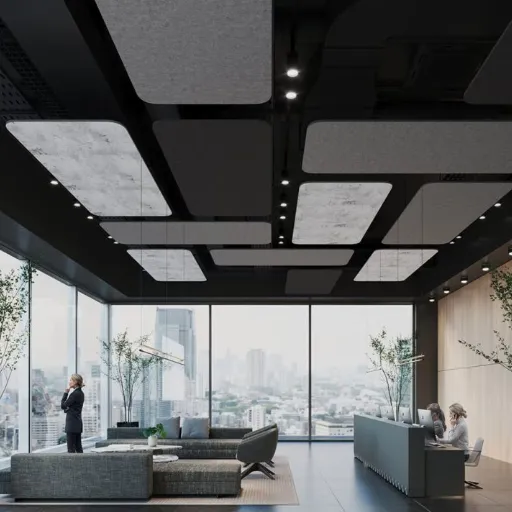
NRC (Noise Reduction Coefficient) measures how much sound a material absorbs on a scale of 0 to 1. A panel with NRC 0.90 absorbs 90% of the sound that hits it.
For open plan offices, the NRC target is higher than for private offices or conference rooms. Shared spaces have multiple simultaneous sound sources — conversations, phone calls, keyboard noise, printer activity. Each source compounds the others. A panel that works in a private office may be insufficient in an open floor plate.
NRC recommendations for the open office zone:
| Zone Type | Minimum NRC | Recommended NRC |
|---|---|---|
| General workstation area | 0.80 | 0.90+ |
| Call center / high-density | 0.85 | 0.95+ |
| Breakout/collaboration area | 0.75 | 0.85+ |
| Reception / client-facing | 0.60 | 0.70+ |
| Executive open area | 0.70 | 0.80+ |
NRC ratings are determined by ASTM C423 testing standards, which measure absorption across the frequency range of human speech (250-4,000 Hz). When comparing products, verify that the NRC rating comes from independent lab testing rather than manufacturer estimates.
Higher NRC values matter most in the general workstation area, where the density of sound sources is highest. In reception or executive areas, lower NRC panels may be acceptable if design considerations take priority.
Speech Privacy: The Metric Nobody Talks About
Most acoustic panel discussions focus on NRC — how much sound a panel absorbs. In open offices, there is a second metric that matters just as much: speech privacy.
NRC measures absorption. Speech privacy measures whether your neighbor can understand your conversation. These are different problems. A room can have excellent absorption (high NRC) and still offer zero speech privacy if sound travels freely between workstations.
Speech privacy in open offices is measured by the Articulation Index (AI) or Privacy Index (PI). A PI below 80% means conversations are partially intelligible to nearby coworkers. Most untreated open offices measure PI 40-60%, meaning colleagues understand roughly half of what you say.
Why this matters: Acoustic panels alone cannot create speech privacy in open offices. They reduce overall noise levels, but they do not block sound transmission between desks. For true speech privacy, you need a combination approach:
- Ceiling baffles — reduce overall reverberation and ambient noise
- Desk screens — block direct sound paths between neighbors
- Sound masking — add low-level background sound to cover conversation details
- Layout design — position noisy activities (printers, collaboration zones) away from focus work
When David, an IT manager in Seattle, treated his company’s open office with ceiling baffles alone, employees loved the reduced echo. But complaints about overhearing phone calls persisted. He added desk screens between every second workstation and installed a sound masking system. The combination pushed the Privacy Index from 55% to 82% — the threshold where conversation becomes unintelligible beyond one workstation.
The lesson: do not expect ceiling baffles to solve speech privacy. They solve reverberation. For privacy, you need the full combination.
Coverage Calculator: How Much You Need
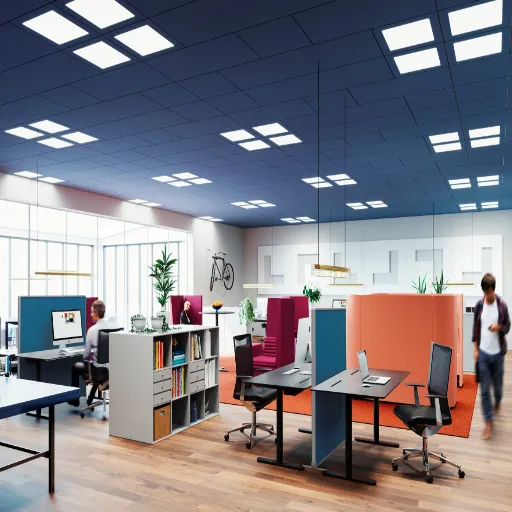
Use this table to estimate coverage for your open office. Numbers assume standard ceiling baffles for ceiling coverage and 2-by-4-foot wall panels.
| Office Size | Ceiling Baffles | Wall Panels | Desk Screens | Est. Material Cost |
|---|---|---|---|---|
| 500 sq ft | 250-300 sq ft | 60-100 sq ft | 3-5 screens | $3,000-5,500 |
| 1,000 sq ft | 500-600 sq ft | 120-200 sq ft | 6-10 screens | $6,000-11,000 |
| 2,500 sq ft | 1,250-1,500 sq ft | 300-500 sq ft | 15-25 screens | $15,000-28,000 |
| 5,000 sq ft | 2,500-3,000 sq ft | 600-1,000 sq ft | 30-50 screens | $30,000-55,000 |
Adjustments:
- Ceilings over 10 feet: add 15% to ceiling coverage
- High-density layouts (call centers): add 20% to all coverage
- Hard flooring (concrete, tile): add 10% to ceiling and wall coverage
- Wood slat or WPC (lower NRC): add 25-30% to panel counts
These figures cover materials only. Installation costs vary by region and ceiling type but typically add $2-4 per square foot for suspended systems and $1-2 per square foot for wall-mounted panels.
For a detailed room-by-room breakdown with panel counts and budget tiers, see our acoustic panel coverage calculator.
Budget Tiers: Good, Better, Best
Good: $3-6 per sq ft
- Fiberglass ceiling baffles (NRC 0.90+)
- Basic fabric wall panels
- Minimal desk screens
- Functional appearance, maximum performance per dollar
- Best for: Back-of-house areas, budget-conscious renovations, phased projects
Better: $6-12 per sq ft
- PET felt baffles in custom colors
- Fabric wall panels with z-clip mounting
- Standard desk screens
- Balanced performance and appearance
- Best for: Standard commercial offices, professional services, co-working spaces
Best: $12-20 per sq ft
- Designer baffles with integrated lighting
- Wood slats or WPC panels on feature walls
- Premium desk screens with fabric wraps
- Architectural-grade appearance with full acoustic performance
- Best for: Client-facing spaces, executive floors, branded environments
A note on ROI: Leesman Index workplace research reports that 70% of employees in open offices are dissatisfied with acoustic conditions. A University of California, Irvine study found that noise distractions cost knowledge workers an estimated 86 minutes of productive time per day. For a 50-person office, that equals over 70 hours of lost productivity daily. A $15,000 acoustic treatment that reduces distractions by 40% pays for itself in under six months through productivity gains alone.
Fire Ratings and Commercial Compliance
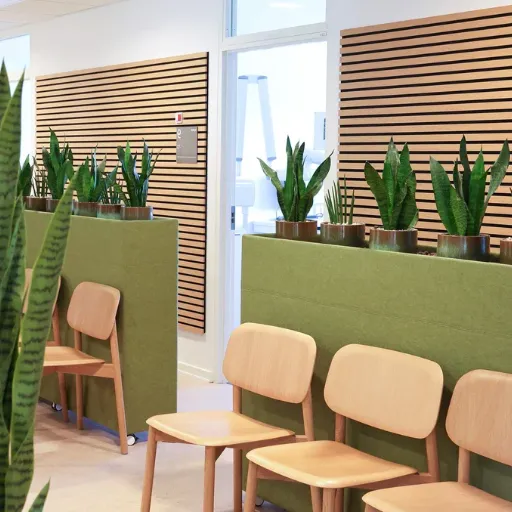
Every acoustic panel in a commercial building must meet fire safety standards. This is non-negotiable for insurance, building inspections, and occupant safety.
Key standards:
- ASTM E84: Measures flame spread and smoke development. A Class A rating (flame spread 0-25) is required for most commercial interiors.
- EN 13501-1: European classification system. A B1 rating is the commercial standard for offices.
- NFPA 255: Alternative flame spread test used in some jurisdictions.
Most fiberglass and mineral wool panels achieve Class A naturally due to the non-combustible core. Fabric wraps must also be fire-rated — look for panels with Class A fabric as a complete assembly, not just the core.
PET felt and WPC panels vary by formulation. Some PET products achieve Class A; others are Class B. WPC panels typically require fire-retardant additives to reach Class A. Always request a current test report or certificate from the manufacturer before specifying panels for a commercial project.
When specifying for a project, include the fire rating requirement in your purchase order. Factory-direct suppliers can typically provide certification documentation faster than distributors.
Installation: What Facilities Managers Should Know
Ceiling Baffle Installation
Ceiling baffles are suspended on aircraft cable, chain, or rigid drop rods. The system attaches to the structural ceiling or existing ceiling grid. A standard 2-by-4-foot baffle weighs 3-5 pounds, so most ceilings can support a full baffle field without reinforcement.
Installation proceeds in zones, allowing you to treat half the office while the other half works. Most 2,000-square-foot open offices can be fully treated over a single weekend.
Wall Panel Installation
Wall panels mount with impaling clips (permanent), z-clips (removable), or magnetic systems (repositionable). Standard drywall supports panels up to 24 by 48 inches without additional blocking. Larger panels or WPC systems may require furring strips or a keel framework.
Desk Screen Installation
Desk screens clamp to the worksurface edge or sit in freestanding bases. Clamp systems work on desks 0.75-1.5 inches thick. No tools are required for most clamp installations, making them ideal for quick deployment.
Measuring Results: Before and After
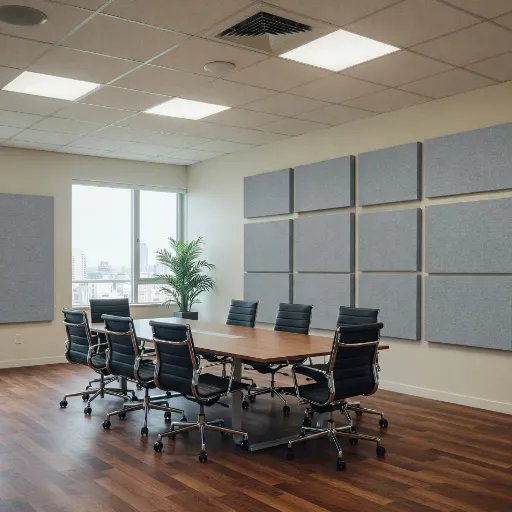
Acoustic improvement in open offices is measurable without expensive equipment.
The Clap Test
Stand in the center of the open office and clap sharply. In an untreated space, you will hear a distinct ringing “tail” as sound bounces off hard surfaces. In a properly treated space, the clap stops almost immediately. The difference is dramatic even to untrained ears.
RT60 Measurement
RT60 measures how long sound takes to decay by 60 decibels. Target RT60 values for open offices:
- Untreated open office: 1.2-1.8 seconds
- Treated open office: 0.6-0.9 seconds
- Call center / high-density: 0.4-0.6 seconds
Several smartphone apps measure RT60 using the phone’s microphone. Results are approximate but sufficient to document improvement.
Employee Feedback
The most meaningful metric is whether employees notice. Run a brief survey before and 30 days after treatment. Ask: “How satisfied are you with the noise level in the office?” and “Can you concentrate at your desk without distraction?” A 30-point improvement in satisfaction scores is typical after proper treatment.
When Lisa, an operations manager in Denver, treated her 1,800-square-foot open office, she measured RT60 before and after. The untreated space measured 1.3 seconds. After installing ceiling baffles covering 55% of the ceiling and wall panels on two feature walls, RT60 dropped to 0.65 seconds. Her post-treatment survey showed 82% of employees were satisfied with the noise level, up from 31% before treatment.
Frequently Asked Questions
Do acoustic panels really work in open-plan offices?
Yes — when deployed as a system. Ceiling baffles covering 50-60% of the ceiling area typically reduce reverberation time by 40-60%. Adding wall panels and desk screens improves results further. Panels do not create total silence; they reduce echo and lower ambient noise to comfortable levels.
What is better for open offices: ceiling baffles or wall panels?
Ceiling baffles are the priority in open offices because the ceiling is the largest reflective surface and the primary sound transmission path. Start with 50-60% ceiling coverage, then add wall panels for 20-30% of the available wall area. Wall panels alone cannot address the overhead sound paths that dominate open floor plates.
How much do acoustic panels cost for an open office?
A 1,000-square-foot open office costs $6,000-11,000 for materials, depending on panel types and coverage. Ceiling baffles range from $5-12 per square foot. Wall panels range from $4-8 per square foot. Desk screens cost $80-200 each. Installation adds $2-4 per square foot for suspended systems.
Can I install acoustic panels myself?
Ceiling baffles require basic tools (drill, level, ladder) and take 1-2 hours per baffle for a two-person team. Wall panels with impaling clips are straightforward for anyone comfortable with a drill. Desk screens require no tools for clamp-mounted versions. For large offices or complex ceiling systems, professional installation ensures proper spacing and secure mounting.
How long do acoustic panels last?
Fiberglass and mineral wool panels last 15-20 years with minimal degradation. PET felt panels last 10-15 years. WPC panels last 20+ years due to their rigid construction. Fabric wraps may show wear in high-traffic areas after 7-10 years, but can be replaced without replacing the core panel.
Do wood slat panels work as well as fabric panels in open offices?
Wood slat panels with tight spacing and thick PET backing achieve NRC 0.70-0.80 — sufficient for most open office applications. They absorb less than fabric panels (NRC 0.85-0.95) but serve as architectural features. In client-facing or executive areas, the design value often justifies the lower NRC. Supplement wood slat walls with high-NRC ceiling baffles for balanced performance.
Conclusion
The best acoustic panels for open plan offices are not a single product — they are a system. Start with ceiling baffles covering 50-60% of the ceiling area. Add wall panels on perimeter walls for 20-30% coverage. Finish with desk screens in high-density or call center areas. Choose NRC 0.90+ materials for workstation zones and NRC 0.70+ for client-facing spaces.
The open office is not going away. But the noise problem does not have to stay either. With the right combination of panel types, coverage, and materials, you can transform an echo chamber into a productive workspace where employees actually want to work.
Planning an open office acoustic upgrade? Send us your floor plan and room dimensions and we will recommend the right panel combination, calculate exact coverage, and provide a factory-direct wholesale quote with material samples.
Categories:
Blog
Related Articles