Conference Room Acoustic Panels: Complete Treatment Guide for Hybrid Meetings (2026)
The best conference room acoustic panels are fiberglass or mineral wool panels with NRC 0.80+ for standard meeting rooms, and wood slat or WPC panels for boardrooms where design matters. For a 200-square-foot conference room, you need 25-35% wall coverage and 25-35% ceiling coverage — roughly 18-24 wall panels and one ceiling cloud above the table.
Here’s what most facilities managers discover too late: the conference room that sounds fine when you’re sitting in it sounds terrible on a video call. Local participants hear clear speech. Remote participants hear echo, room rumble, and every chair scrape amplified by the microphone. A room that passes the “walk-in test” often fails the “Zoom test” by a wide margin.
This guide covers conference room acoustic treatment from the hybrid meeting perspective. You’ll see room-size-specific coverage calculations, placement strategies that prioritize speech intelligibility, material comparisons for different conference room types, and measurable targets that let you prove acoustic improvement to leadership.
For the complete picture on materials, NRC ratings, and installation methods, see our office acoustic panels buyer’s guide.
Key Takeaways
- Conference rooms need 25-35% wall coverage and 25-35% ceiling coverage for optimal speech intelligibility
- The rear wall is always the highest priority surface — it accounts for 40-50% of problematic reflections
- Hybrid meetings require acoustic treatment designed for microphone pickup, not just human ears
- Wood slat and WPC panels serve as architectural features in boardrooms while adding acoustic function
- Target STI (Speech Transmission Index) of 0.60+ for good intelligibility, 0.75+ for premium conference rooms
Why Conference Room Acoustics Matter for Hybrid Meetings
Conference room acoustics have changed. Before 2020, the goal was simple: reduce echo enough that people in the room could hear each other. Today, the microphone hears everything — and broadcasts it to remote participants who have no visual context to fill in the gaps.
The Hybrid Meeting Acoustic Challenge
A human listener uses visual cues, context, and subconscious prediction to understand speech in a reverberant room. A microphone has none of these advantages. It captures raw sound — direct speech plus every reflection, every HVAC rumble, every paper shuffle — and sends it straight to remote participants’ headphones.
When Sarah, an IT director in Boston, upgraded her company’s video conferencing system in 2025, she spent $12,000 on cameras, microphones, and a 75-inch display. The first all-hands hybrid meeting was a disaster. Remote employees complained they could hear the presenter and the presenter’s echo simultaneously, creating a confusing double-voice effect. The problem wasn’t the microphone — it was the room. Untreated drywall and glass reflected sound with an RT60 (reverberation time) of 1.2 seconds, well above the 0.6-second target for video conferencing.
Speech Intelligibility: The Metric That Matters
Speech intelligibility in conference rooms is measured by STI (Speech Transmission Index), a 0-to-1 scale where:
- STI below 0.45: Poor — significant effort required to understand speech
- STI 0.45-0.60: Fair — acceptable for casual conversation, challenging for video calls
- STI 0.60-0.75: Good — clear speech for most listeners and microphones
- STI above 0.75: Excellent — professional-grade intelligibility for all participants
Untreated conference rooms typically measure STI 0.40-0.55. Proper acoustic treatment raises this to 0.65-0.80 — the difference between remote participants asking “can you repeat that?” and following every word. Federal facilities standards such as GSA Sound Matters establish acoustic criteria that align with these STI targets for government meeting rooms.
For a room-by-room breakdown of how many panels you need, see our guide on how many acoustic panels you need for your office.
Conference Room Types: Treatment by Size
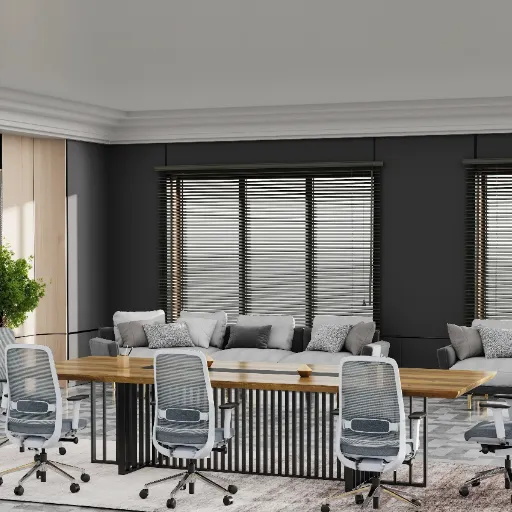
Not all conference rooms are the same. A huddle room for four people has completely different acoustic needs than a boardroom for twenty. The coverage percentages and treatment priorities change with room size, ceiling height, and usage pattern.
Huddle Rooms (4-6 People, 60-120 Square Feet)
Huddle rooms are small but acoustically challenging because the short distances between surfaces create fast, hard reflections. Speech sounds harsh and “boxy” in untreated huddle rooms.
Coverage target: 20-30% walls, 20-30% ceiling
An 80-square-foot huddle room with 9-foot ceilings needs 6-8 wall panels and 2-4 ceiling panels. Because these rooms are small, even modest treatment produces dramatic improvement. One fully treated rear wall often makes the room usable.
Priority: Rear wall first, then ceiling above the table. Side walls are a lower priority in rooms this small because participants sit close together.
Standard Conference Rooms (8-12 People, 150-300 Square Feet)
This is the most common conference room size in commercial offices. These rooms balance in-person collaboration with hybrid meeting demands.
Coverage target: 25-35% walls, 25-35% ceiling
A 200-square-foot conference room with 9-foot ceilings needs roughly 18-24 wall panels and 6-8 ceiling panels (or one ceiling cloud). The rear wall should be fully treated. Side walls receive panels at first reflection points. The ceiling gets a cloud or baffles above the conference table.
When Marcus, a facilities manager in Denver, treated his company’s six standard conference rooms, he started with the rear walls only. STI improved from an average of 0.52 to 0.64 — enough to eliminate most “can you repeat that?” moments on video calls. Six months later, he added ceiling clouds and side wall panels, pushing STI to 0.76. The phased approach cost $4,200 total per room and let him validate the improvement before committing the full budget.
Boardrooms (16-24 People, 400-800 Square Feet)
Boardrooms serve dual purposes: functional meeting space and a statement of company professionalism. Acoustic treatment must be performed while looking intentional.
Coverage target: 30-40% walls, 30-40% ceiling
Boardrooms benefit from design-forward materials. Wood slat panels on the rear wall, WPC feature walls, and custom ceiling clouds with integrated lighting treat acoustics while elevating the room’s aesthetic. Coverage percentages run higher because boardrooms have more volume and longer reflection paths.
Video Conferencing Suites (Dedicated VC Rooms)
Dedicated video conferencing rooms have the highest acoustic standards because every meeting is hybrid.
Coverage target: 35-45% walls, 35-45% ceiling
These rooms need comprehensive treatment on all surfaces. The microphone picks up everything, so there’s nowhere to hide untreated reflections. NRC 0.85+ materials are essential. Hard surfaces — glass whiteboards, exposed concrete, large windows — must be minimized or treated.
Conference Room Acoustic Panel Placement Strategy
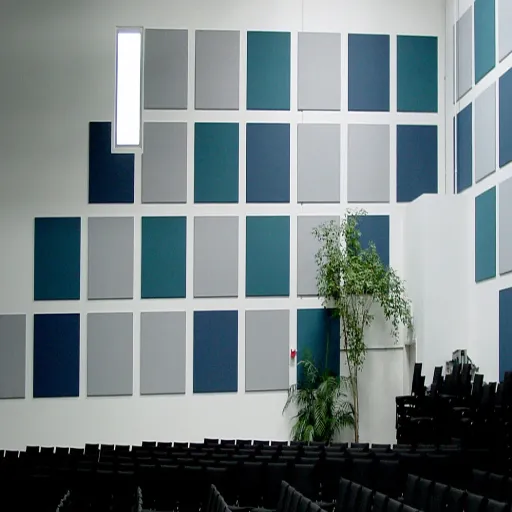
Where you place panels in a conference room matters more than how many you install. A room with 20 panels in the wrong locations performs worse than a room with 12 panels placed strategically.
The Rear Wall Rule
The rear wall is always priority number one. Here’s why: when someone speaks at the head of the conference table, their voice travels forward to listeners, backward to the rear wall, and then reflects toward the microphone and participants. That reflected sound arrives milliseconds after the direct sound, creating the echo that destroys clarity.
In a typical conference room, the rear wall accounts for 40-50% of all problematic reflections. Treat it fully before adding panels anywhere else. A rear wall with 100% coverage (full treatment from floor to ceiling, edge to edge) delivers more intelligibility improvement than four partially treated walls combined.
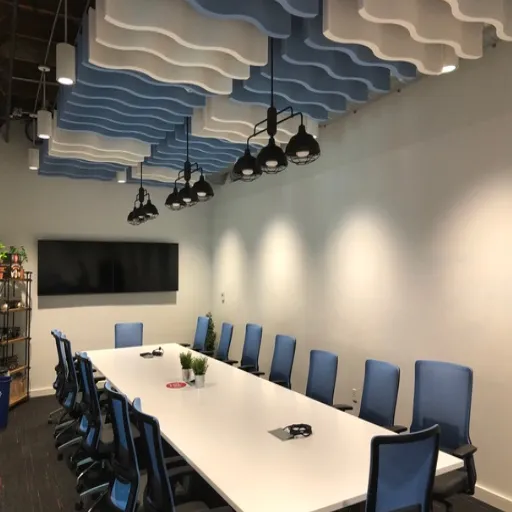
Ceiling Clouds Above the Table
The conference table is where speech happens. A ceiling cloud suspended directly above the table intercepts upward-traveling sound before it reflects off the ceiling deck and returns as an echo.
For standard conference rooms, a single 4-by-8-foot ceiling cloud (32 square feet) centered above the table treats the primary reflection path. For larger boardrooms, use multiple clouds or a continuous cloud that covers the table area plus 2-3 feet of perimeter.
Ceiling clouds should suspend 12-18 inches below the structural ceiling. This creates an air gap that significantly improves low-frequency absorption — critical for male voices and video conferencing microphones that emphasize low-mid frequencies.
For a complete guide to ceiling treatments, including baffles, clouds, and tiles, see our office acoustic ceiling panels guide.
For detailed installation methods for ceiling clouds and wall panels, see our office acoustic panel installation guide.
Side Wall First Reflection Points
After the rear wall and ceiling, treat the side wall first, reflection points. These are the spots where sound from the speaker’s position bounces off the side wall and reaches listeners’ ears (and microphones).
Use the mirror trick: sit at the head of the table where the primary speaker sits. Have someone slide a mirror along each side wall. Wherever you see the reflection of the microphone or the opposite wall, that’s a first reflection point. Place a panel there.
In most conference rooms, this means one panel on each side wall, roughly midway along the room’s length, at seated head height (3-5 feet from the floor).
Floor Treatment (When Needed)
Hard flooring — polished concrete, tile, or hardwood — adds to reverberation. In conference rooms with hard floors, add an area rug under the conference table. This treats the floor reflection path without requiring permanent installation. For boardrooms with existing carpet, floor treatment is already addressed.
Materials Compared for Conference Rooms
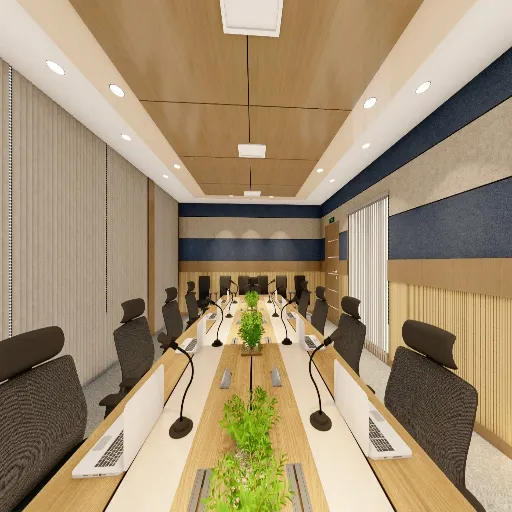
The material you choose affects acoustic performance, visual appearance, durability, and cost. Conference rooms are high-visibility spaces, so material selection carries more weight than in back-of-house areas.
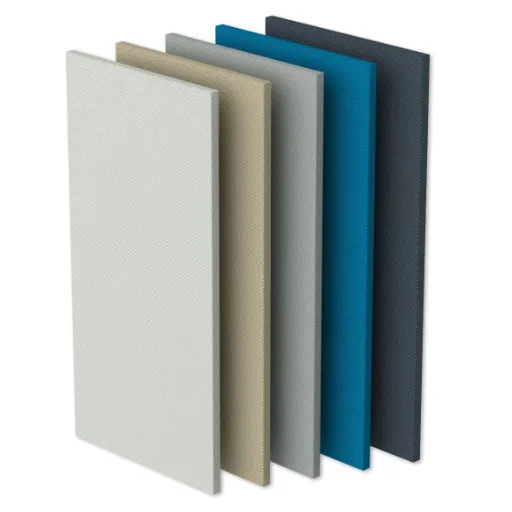
Fiberglass Panels (NRC 0.85-0.95)
Fiberglass remains the performance leader. A 2-inch fabric-wrapped fiberglass panel absorbs 85-95% of the sound that hits it. NRC ratings are determined by ASTM C423 testing standards, which measure sound absorption across the speech frequency range. For conference rooms where speech intelligibility is the only priority, fiberglass delivers the best results per dollar.
Best for: Standard conference rooms, video conferencing suites, rooms where function outweighs aesthetics
Cost: $4-8 per square foot
Visual impact: Neutral; looks like acoustic treatment
WPC Perforated Panels (NRC 0.50-0.75)
WPC (wood plastic composite) perforated or grooved panels with acoustic fabric backing absorb 50-75% of incident sound. The lower NRC means you need 25-35% more coverage than fiberglass for equivalent results.
But WPC panels serve as finished wall surfaces. In conference rooms where the panel must look intentional rather than utilitarian, WPC replaces drywall and paint while adding acoustic function.
Best for: Conference rooms that need integrated wall finishes, humid climates, high-traffic walls
Cost: $8-12 per square foot
Visual impact: Architectural; available in wood-grain, solid colors, and custom finishes
Wood Slat Panels with PET Felt Backing (NRC 0.50-0.80)
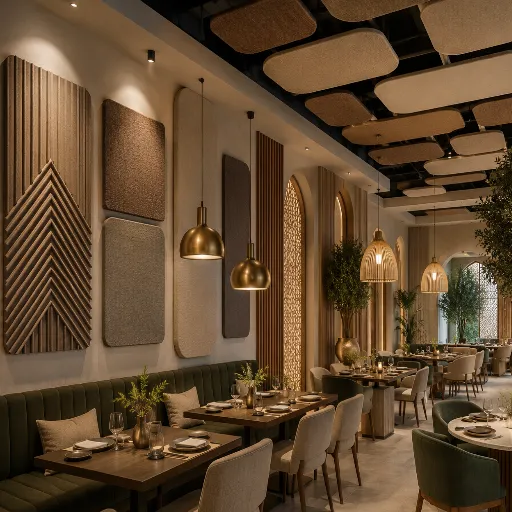
Wood slat acoustic panels are the premium choice for boardrooms and client-facing conference rooms. The visible wood slats create an architectural feature while the hidden PET felt backing absorbs sound.
NRC varies significantly with slat spacing. Tight spacing (1/4-inch gaps) with thick backing achieves NRC 0.75-0.80. Wide spacing (1-inch gaps) with thin backing drops to NRC 0.50-0.60. For conference rooms, specify tight spacing and 9mm+ backing thickness.
Best for: Boardrooms, executive meeting rooms, reception-adjacent conference spaces
Cost: $10-15 per square foot
Visual impact: Premium architectural feature; replaces artwork and wallcovering
PET Felt (NRC 0.75-0.85)
PET felt offers design flexibility with strong acoustic performance. CNC-cut geometric patterns, dimensional shapes, and custom colors let you brand the conference room while treating acoustics.
Best for: Design-forward spaces, companies with strong brand identity, sustainability-focused projects (50-60% recycled content)
Cost: $5-10 per square foot
Visual impact: Modern and customizable
| Material | NRC | Coverage Needed | Cost/sq ft | Best For |
|---|---|---|---|---|
| Fiberglass | 0.85-0.95 | Standard (25-35%) | $4-8 | Maximum absorption, budget priority |
| PET Felt | 0.75-0.85 | +10-15% | $5-10 | Design flexibility, sustainable projects |
| WPC Perforated | 0.50-0.75 | +25-35% | $8-12 | Integrated wall finish, durability |
| Wood Slat + Felt | 0.50-0.80 | +25-30% | $10-15 | Boardroom design, architectural impact |
How Many Panels for Your Conference Room
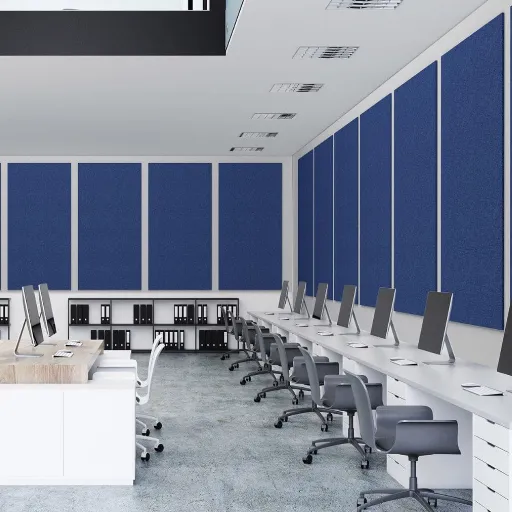
Use this calculator to estimate panel quantities by room size. Coverage assumes standard 2-by-4-foot panels (8 square feet each).
| Room Size | Room Type | Wall Panels | Ceiling Panels | Total Sq Ft Treated |
|---|---|---|---|---|
| 80 sq ft | Huddle room | 6-8 | 2-4 | 64-96 sq ft |
| 150 sq ft | Small conference | 12-16 | 4-6 | 128-176 sq ft |
| 200 sq ft | Standard conference | 18-24 | 6-8 | 192-256 sq ft |
| 300 sq ft | Large conference | 28-36 | 10-14 | 304-400 sq ft |
| 500 sq ft | Boardroom | 50-65 | 18-25 | 544-720 sq ft |
Adjustments:
- For WPC or wood slat (lower NRC): increase panel counts by 25-30%
- For rooms with over 10-foot ceilings: add 10-15% to the ceiling panel count
- For video conferencing suites: use the high end of the range
A more detailed breakdown with three budget tiers and material-specific calculations is available in our office acoustic panel coverage guide.
Design-Forward Acoustic Treatment
Conference rooms are high-visibility spaces. Clients, investors, and leadership see them regularly. Acoustic panels that look like an afterthought undermine the room’s professionalism. The best conference room acoustic treatment looks intentional — like part of the design, not a Band-Aid.
Making Acoustic Panels Look Intentional
The key is integration, not addition. Instead of mounting utilitarian panels on finished walls, choose materials that replace the wall finish entirely.
Wood slat panels spanning a full rear wall read as architectural millwork, not acoustic treatment. WPC panels in a custom color match the company branding signal intentionality. Ceiling clouds with integrated LED lighting serve dual purposes — acoustic treatment and ambient lighting.
When the design team at a San Francisco tech company renovated their main boardroom, they specified walnut wood slat panels for the rear wall and charcoal WPC panels for the side walls. The acoustic treatment absorbed enough reflections to raise STI from 0.48 to 0.71. More importantly, visitors commented on the “warm, designed space” without realizing the panels were primarily acoustic.
When Acoustic Treatment Becomes Interior Design
In premium conference rooms, the line between acoustic treatment and interior design disappears. Consider these integrated approaches:
- Wood slat panels as feature walls: Full-wall installation behind the presenter creates a branded backdrop for video calls
- Ceiling clouds with lighting: Suspended clouds with recessed LED strips provide task lighting and acoustic absorption
- WPC panels with integrated whiteboards: Some WPC systems accept magnetic whiteboard panels, combining function and finish
- Custom colors and finishes: WPC and PET felt panels can match Pantone colors for brand consistency
Measuring Results: Before and After
Acoustic improvement is measurable. You don’t need expensive equipment to prove that treatment worked.
The Clap Test
Stand in the center of the conference room and clap sharply. In an untreated room, you’ll hear a distinct “tail” — the sound lingering for half a second or more as it bounces around the room. In a properly treated room, the clap stops almost immediately. The difference is obvious even to untrained ears.
Speech Recording Comparison
Record yourself reading a paragraph of text in the conference room before and after treatment. Play both recordings through headphones. The untreated recording will sound distant, hollow, and slightly muffled. The treated recording will sound direct and clear, as if you’re speaking close to the microphone.
STI Targets by Room Type
| Room Type | Untreated STI | Target STI (Treated) | Improvement |
|---|---|---|---|
| Huddle room | 0.45-0.55 | 0.65-0.75 | Good to excellent |
| Standard conference | 0.40-0.55 | 0.60-0.75 | Fair to good/excellent |
| Boardroom | 0.35-0.50 | 0.60-0.70 | Fair to good |
| Video conferencing suite | 0.40-0.50 | 0.70-0.80 | Fair to excellent |
RT60 Measurement with Smartphone Apps
RT60 (reverberation time) measures how long sound takes to decay by 60 decibels. For conference rooms, target RT60 of 0.4-0.6 seconds. Smartphone apps like “Room EQ Wizard” or “ClapIR” provide approximate RT60 measurements adequate for before/after comparison.
Untreated conference rooms typically measure RT60 of 0.8-1.5 seconds. Proper treatment cuts this in half.
When to Hire an Acoustic Consultant
For boardrooms over 500 square feet, rooms with unusual geometry, or spaces where speech privacy between adjacent rooms is required, hire an acoustic consultant. They’ll measure STI, RT60, and background noise levels, then specify exact panel quantities and locations. Consultant fees range from $800-2,500 but prevent costly trial-and-error.
Frequently Asked Questions
How many acoustic panels do I need for a conference room?
A standard 200-square-foot conference room needs 18-24 wall panels and 6-8 ceiling panels for 25-35% coverage on both surfaces. A huddle room needs 6-8 wall panels and 2-4 ceiling panels. A boardroom needs 50-65 wall panels and 18-25 ceiling panels. Use lower-NRC materials like WPC or wood slats? Add 25-30% to these counts.
Do acoustic panels work in conference rooms?
Yes. Proper acoustic treatment raises Speech Transmission Index (STI) from 0.40-0.55 (untreated) to 0.60-0.80 (treated). This translates to measurable improvements in speech clarity, reduced listener fatigue, and significantly better audio quality on video calls. Most treated conference rooms show a 40-60% reduction in reverberation time.
Where should acoustic panels be placed in a conference room?
Priority order: (1) Rear wall — fully treat from floor to ceiling; (2) Ceiling cloud above the conference table; (3) Side walls at first reflection points. The rear wall alone accounts for 40-50% of problematic reflections. Never treat only side walls while leaving the rear wall bare.
What is the best acoustic treatment for a conference room?
Fiberglass or mineral wool panels (NRC 0.85-0.95) deliver the best speech intelligibility for standard conference rooms. For boardrooms and client-facing spaces, wood slat panels with PET felt backing or WPC perforated panels, provide acoustic performance while serving as architectural features. Video conferencing suites need the highest NRC materials on all surfaces.
How do I reduce echo in my conference room?
Add acoustic panels to the rear wall first — this single step often reduces echo by 50% or more. Then add a ceiling cloud above the table. Finally, treat the side wall first reflection points. For rooms with hard floors, add an area rug under the table. Target 25-35% coverage on walls and ceiling for standard conference rooms.
Are wood slat panels good for conference rooms?
Yes, for boardrooms and client-facing conference rooms where design matters. Wood slat panels with tight spacing and thick PET felt backing achieve NRC 0.65-0.80 — sufficient for most conference rooms. They function as architectural features while adding acoustic absorption. For video conferencing suites or rooms where maximum absorption is critical, supplement wood slats with hidden high-NRC backing or additional fiberglass panels.
How much does conference room acoustic treatment cost?
A standard 200-square-foot conference room costs $2,000-3,500 for materials and basic installation. A boardroom runs $5,000-12,000, depending on material choice (fiberglass vs. wood slats). Huddle rooms cost $800-1,500. Costs scale with room size, material selection, and coverage percentage. Factory-direct sourcing reduces material costs 25-40%.
Do I need acoustic panels for video conferencing?
Yes — arguably more than for in-person-only meetings. Video conferencing microphones capture every reflection, HVAC rumble, and room resonance, then broadcast it to remote participants who have no visual context. Untreated rooms create echo, double-voice effects, and fatigue for remote listeners. Target STI 0.70+ and RT60 under 0.5 seconds for dedicated video conferencing rooms.
Conclusion
Conference room acoustic panels aren’t just about reducing echo. They’re about making sure every word spoken in your meeting room reaches every participant — in the room and on the screen — with clarity and precision.
The strategy is straightforward: treat the rear wall first, add a ceiling cloud above the table, then address side wall reflection points. Choose fiberglass for maximum acoustic performance, or wood slats and WPC for boardrooms where design carries equal weight. Measure your results with simple before/after tests so you can prove the improvement.
The hybrid work era has raised the stakes for conference room acoustics. A room that sounds acceptable for in-person meetings can fail for hybrid calls. The microphone is unforgiving — it captures exactly what the room gives it. Give it a treated room, and your remote participants will hear every word. Give it an echo chamber, and they’ll struggle to follow the conversation.
Planning a conference room acoustic upgrade? Send us your room dimensions and photos, and we’ll recommend the right panel types, calculate exact quantities, and provide a factory-direct wholesale quote with material samples for your review.
Categories:
Blog
Related Articles