How Many Acoustic Panels Do You Need for Your Office? Room-by-Room Calculator (2026)
You need 10-20% wall coverage and 50-60% ceiling coverage for most offices. A 2,000-square-foot open plan with 10-foot ceilings needs roughly 25-50 wall panels and 125-150 ceiling baffles for standard treatment. A 200-square-foot conference room needs 6-10 wall panels and a single ceiling cloud above the table.
Here’s the problem: most online calculators were built for home recording studios. They ask for room dimensions and spit out a number based on studio acoustics, not workplace noise. A 12-by-15-foot home studio needs different coverage than a 12-by-15-foot conference room because the noise sources, ceiling heights, and usage patterns are completely different.
This guide gives you office-specific calculations. You’ll see exact panel counts for six common office room types, a three-tier coverage framework that lets you phase your budget, and the material-specific adjustments most calculators ignore. By the end, you’ll know exactly how many panels to order — and how to space them.
For the complete picture on materials, NRC ratings, and installation methods, see our office acoustic panels buyer’s guide.
Key Takeaways
- Open-plan offices need 10-20% wall coverage and 50-60% ceiling coverage for effective noise control
- Conference rooms need 25-35% coverage on both walls and ceiling for speech intelligibility
- WPC and wood slat panels (NRC 0.50-0.80) require 20-30% more panels than fiberglass (NRC 0.85-0.95) for equivalent absorption
- The three-tier framework (minimum/standard/comprehensive) lets you phase treatment across budget cycles
- Space wall panels 2-4 inches apart and ceiling baffles 2-3 feet apart in rows for even distribution
The Simple Formula: Coverage Percentage by Surface
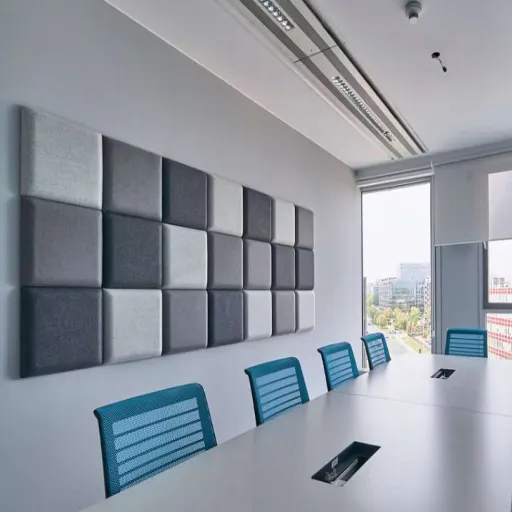
Calculating acoustic panel quantity comes down to three steps: measure your surfaces, apply the right coverage percentage, and divide by your panel size. The coverage percentage is what changes by room type.
Step 1: Calculate Surface Area
For walls, multiply the perimeter by the ceiling height, then subtract doors and windows. For ceilings, use the floor area unless you have exposed beams or soffits that reduce the treatable surface.
Wall surface area = (Room length × 2 + Room width × 2) × Ceiling height − Door/window area
Ceiling surface area = Room length × Room width
Ceiling height matters more than most people realize. A room with 12-foot ceilings has 33% more volume than the same floor plan with 9-foot ceilings. That extra volume means more sound energy bouncing around — and more absorption needed to control it.
Step 2: Apply the Coverage Percentage
Multiply each surface area by the coverage percentage for your room type. Here are the standard percentages for commercial offices:
| Room Type | Wall Coverage | Ceiling Coverage |
|---|---|---|
| Open plan office | 10-20% | 50-60% |
| Conference room | 25-35% | 25-35% |
| Private office | 15-20% | 20-30% |
| Call center | 15-20% | 50-60% |
| Reception/lobby | 30-40% | 20-30% |
| Huddle/breakout room | 20-30% | 20-30% |
The wide ranges account for room acoustics, noise source intensity, and budget. A call center with 200 agents on headsets needs the high end of the range. A quiet accounting department can get away with the low end. These coverage percentages align with GSA Sound Matters federal acoustic standards for commercial workspaces.
Step 3: Divide by Panel Size
Standard acoustic panels are 2 feet by 4 feet (8 square feet each). Divide your covered surface area by 8 to get the number of panels. For ceiling baffles, the same math applies — a 2-by-4-foot baffle covers 8 square feet of ceiling.
Quick example: A 20-by-30-foot open plan (600 sq ft floor) with 10-foot ceilings has 1,000 square feet of wall surface. At 15% wall coverage, that’s 150 square feet of panels. Divided by 8 square feet per panel = 19 wall panels. The ceiling is 600 square feet. At 55% coverage, that’s 330 square feet = 42 ceiling baffles or clouds.
How NRC Rating Affects Quantity
A panel with an NRC (Noise Reduction Coefficient) of 0.85 absorbs 70% more sound than a panel with an NRC of 0.50, according to ASTM C423 standard test methodology. This means material choice directly impacts how many panels you need.
If you choose high-NRC fiberglass (0.85-0.95), use the standard coverage percentages in the table above. If you choose WPC or wood slat panels (NRC 0.50-0.80), add 20-30% to the panel count for the same acoustic result. We’ll cover this in detail later.
Office Room Types: Panel Quantities and Coverage
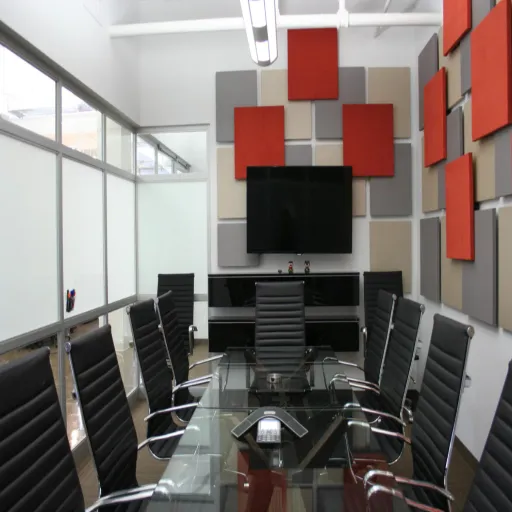
Every office space has different acoustic demands. A conference room needs speech clarity. An open plan needs echo control across a wide floor plate. A call center needs to contain 200 simultaneous conversations. The coverage percentages reflect these differences.
Open-Plan Offices
Open plans are the most common office acoustic project. They’re also the most acoustically challenging because sound travels freely across the floor plate with no walls to block it.
Coverage target: 10-20% walls, 50-60% ceiling
The ceiling is your primary treatment surface. Sound travels upward from conversations, bounces off the ceiling deck, and scatters across the floor. Ceiling baffles intercept that upward-traveling sound before it reflects. Wall panels treat the perimeter and first reflection points where sound bounces from the center of the room to the outer walls.
Example — 2,000 sq ft open plan, 10 ft ceilings:
- Wall surface: ~1,600 sq ft (perimeter walls, subtracting windows/doors)
- Wall panels at 15% coverage: 240 sq ft ÷ 8 = 30 wall panels
- Ceiling surface: 2,000 sq ft
- Ceiling baffles at 55% coverage: 1,100 sq ft ÷ 8 = 138 ceiling baffles
When David, a facilities manager in Chicago, treated his 4,500-square-foot marketing floor, he started with the ceiling. His contractor installed 300 ceiling baffles in rows across the open plan, then added 45 WPC wall panels at first reflection points along the perimeter. The result: ambient noise dropped from 68 dB to 54 dB, and his team’s internal survey showed a 34% improvement in ability to concentrate during calls. For help choosing the right panel types for open-plan spaces, see our guide to the best acoustic panels for open-plan offices.
Conference Rooms
Conference rooms have different priorities than open plans. Speech intelligibility matters more than overall noise reduction. You need clear audio for in-person conversations and for remote participants on video calls.
Coverage target: 25-35% walls, 25-35% ceiling
The rear wall is the highest priority. Sound from the presenter reflects off the back wall and arrives at listeners’ ears milliseconds after the direct sound, creating an echo that reduces clarity. Treat the rear wall first, then add side wall panels at first reflection points. A ceiling cloud above the conference table rises upward.
Example — 200 sq ft conference room, 9 ft ceilings:
- Wall surface: ~560 sq ft
- Wall panels at 30% coverage: 168 sq ft ÷ 8 = 21 wall panels
- Ceiling surface: 200 sq ft
- Ceiling cloud at 30% coverage: 60 sq ft ÷ 8 = 8 ceiling panels (or one large cloud)
For a complete guide to conference room acoustic treatment, including panel placement, material selection, and hybrid meeting optimization, see our conference room acoustic panels guide.
Private Offices
Private offices need less treatment than open plans because the walls already contain sound. The goal is to control the echo within the room for phone calls and video meetings.
Coverage target: 15-20% walls, 20-30% ceiling
Focus on the wall behind the desk (the rear wall from the occupant’s perspective when facing the door) and the ceiling above the workspace. A 120-square-foot private office with 9-foot ceilings typically needs 4-6 wall panels and 3-5 ceiling panels for comfortable acoustics.
Call Centers
Call centers are the most demanding office acoustic environment. High talk time, dense seating, and the need for speech privacy between agents create a triple challenge.
Coverage target: 15-20% walls, 50-60% ceiling
Ceiling treatment is non-negotiable. Without 50%+ ceiling coverage, sound from one agent’s conversation reflects off the ceiling and reaches adjacent workstations. Desk dividers with acoustic absorption add a third treatment surface between the ceiling and walls.
Example — 3,000 sq ft call center, 10 ft ceilings:
- Wall surface: ~2,400 sq ft
- Wall panels at 15% coverage: 360 sq ft ÷ 8 = 45 wall panels
- Ceiling surface: 3,000 sq ft
- Ceiling baffles at 55% coverage: 1,650 sq ft ÷ 8 = 207 ceiling baffles
- Desk dividers (80 stations): 80 screens at ~3 sq ft each = 240 sq ft additional absorption
Reception and Lobby Areas
Reception areas serve two acoustic purposes: they control echo for conversation at the desk, and they signal professionalism to visitors. This is where design-forward panels — wood slat systems, custom WPC, or patterned PET felt — make sense even at higher cost.
Coverage target: 30-40% walls, 20-30% ceiling
The higher wall coverage reflects the need for visual impact as much as acoustic function. A feature wall behind the reception desk can be fully covered with wood slat panels, serving as branding and acoustic treatment simultaneously.
Huddle and Breakout Rooms
Small meeting rooms (60-120 square feet) need concentrated treatment because the small volume creates fast, hard reflections that make conversations sound harsh.
Coverage target: 20-30% walls, 20-30% ceiling
An 80-square-foot huddle room with 9-foot ceilings typically needs 6-8 wall panels and 2-4 ceiling panels. Because these rooms are small, even modest treatment produces noticeable improvement.
Coverage Calculator: Three Tiers by Room Size
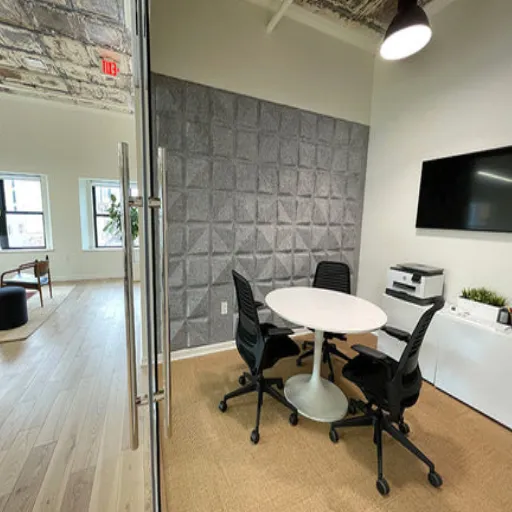
Not every project has the budget for full coverage on day one. This three-tier framework lets you phase acoustic treatment across budget cycles while still achieving measurable results at each stage.
| Room Size | Room Type | Ceiling Height | Minimum Tier | Standard Tier | Comprehensive Tier |
|---|---|---|---|---|---|
| 200 sq ft | Conference room | 9 ft | 12 wall / 4 ceiling | 18 wall / 6 ceiling | 24 wall / 8 ceiling |
| 400 sq ft | Reception/lobby | 12 ft | 24 wall / 8 ceiling | 36 wall / 12 ceiling | 48 wall / 16 ceiling |
| 600 sq ft | Open plan section | 10 ft | 20 wall / 42 ceiling | 30 wall / 62 ceiling | 40 wall / 83 ceiling |
| 1,200 sq ft | Open plan | 10 ft | 40 wall / 83 ceiling | 60 wall / 125 ceiling | 80 wall / 167 ceiling |
| 2,000 sq ft | Open plan | 10 ft | 67 wall / 138 ceiling | 100 wall / 208 ceiling | 133 wall / 277 ceiling |
| 3,000 sq ft | Call center | 10 ft | 90 wall / 188 ceiling | 135 wall / 281 ceiling | 180 wall / 375 ceiling |
| 5,000 sq ft | Open plan | 10 ft | 167 wall / 348 ceiling | 250 wall / 521 ceiling | 333 wall / 695 ceiling |
Assumptions: 2-by-4-foot panels (8 sq ft each), fiberglass/mineral wool at NRC 0.80-0.95. If using WPC or wood slat (NRC 0.50-0.80), increase panel counts by 20-30%.
Minimum tier: Delivers measurable improvement. Reduces echo by 6-8 dB. Best for budget-constrained first phases.
Standard tier: Delivers professional-grade acoustic control. Reduces echo by 10-12 dB. Suitable for most commercial offices.
Comprehensive tier: Maximum treatment for noise-sensitive environments. Reduces echo by 14-16 dB. Ideal for call centers, recording studios, and premium office builds.
When Maria, a project manager in Austin, renovated her startup’s 2,000-square-foot office, she chose the minimum tier for phase one. Her $8,000 budget covered 67 wall panels and 138 ceiling baffles in fiberglass. Six months later, after a funding round, she added the remaining panels to reach the standard tier. The phased approach let her validate the acoustic improvement before committing the full budget.
Material choice significantly affects total project cost — fiberglass runs $4-8 per square foot while wood slat systems range $10-15 per square foot.
How Panel Material Affects Quantity
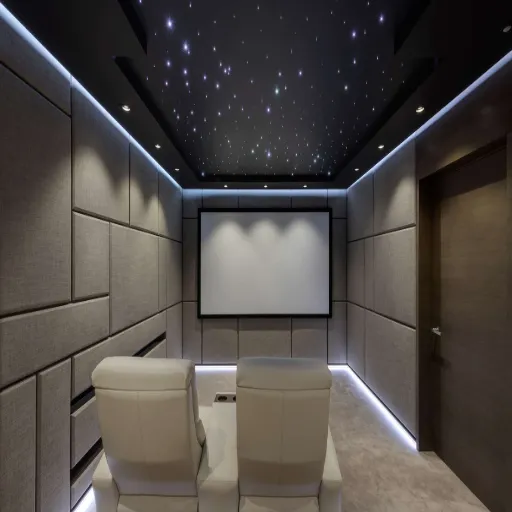
The coverage percentages above assume standard fiberglass or mineral wool panels with NRC ratings of 0.80-0.95. If you’re considering WPC, wood slats, or PET felt, the panel count changes.
Fiberglass and Mineral Wool (NRC 0.85-0.95)
These are the reference standards. Use the coverage percentages and panel counts in the tables above exactly as written. A 2-inch fiberglass panel with fabric facing absorbs 85-95% of the sound that hits it. This high efficiency means you need fewer panels to achieve the target absorption.
PET Felt (NRC 0.75-0.85)
PET felt panels absorb slightly less sound per square foot than fiberglass. For equivalent acoustic performance, add 10-15% to the panel count. A standard-tier open plan that needs 100 wall panels in fiberglass needs roughly 115 in PET felt.
Many buyers accept this trade-off because PET felt offers design flexibility — CNC-cut patterns, dimensional shapes, and 50-60% recycled content for green building certifications.
WPC Perforated Panels (NRC 0.50-0.75)
WPC (wood plastic composite) perforated or grooved panels absorb 50-75% of incident sound, depending on perforation density and backing material. For equivalent echo reduction to fiberglass, you need 25-35% more WPC panels.
Example: A conference room needing 21 wall panels in fiberglass needs roughly 28 WPC panels for the same result.
But WPC panels serve a dual purpose. They’re finished wall surfaces, not just acoustic treatment. In reception areas and boardrooms, the WPC panel replaces drywall, paint, and wall covering while adding acoustic function. The “extra” panels aren’t waste — they’re architectural finishes.
Wood Slat with PET Felt Backing (NRC 0.50-0.80)
Wood slat systems have the widest NRC range because slat spacing and backing thickness vary significantly. Tight slat spacing (1/4-inch gaps) with thick PET felt backing achieves NRC 0.75-0.80. Wide spacing (1-inch gaps) with thin backing drops to NRC 0.50-0.60.
For typical commercial wood slat systems (NRC 0.60-0.70), add 25-30% to the fiberglass panel count. Like WPC, wood slat panels function as architectural features. The visual value often justifies the higher quantity in client-facing spaces.
| Material | Typical NRC | Quantity Multiplier vs. Fiberglass | Best Use Case |
|---|---|---|---|
| Fiberglass | 0.85-0.95 | 1.0x (baseline) | Maximum absorption, budget priority |
| Mineral wool | 0.80-0.90 | 1.05-1.15x | Humid environments, high impact |
| PET felt | 0.75-0.85 | 1.10-1.20x | Design-forward, sustainable projects |
| WPC perforated | 0.50-0.75 | 1.25-1.40x | Integrated wall finish, moisture resistance |
| Wood slat + felt | 0.50-0.80 | 1.25-1.35x | Architectural feature, premium spaces |
Panel Spacing and Distribution Guidelines
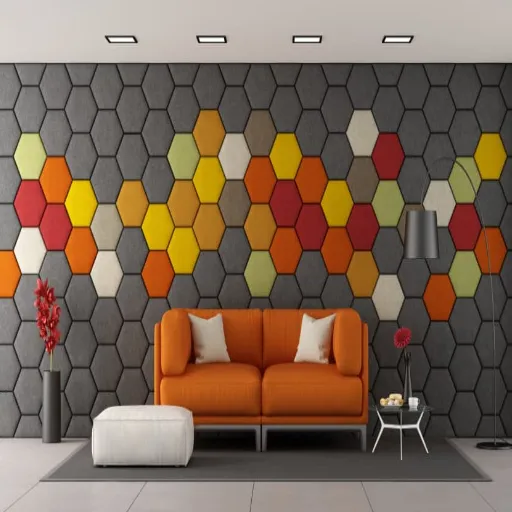
Knowing how many panels you need is only half the battle. Where you put them determines whether the treatment works.
Wall Panel Spacing
For a structured, grid-like appearance, space panels with 2-4 inch gaps between edges. For a more organic look, use staggered placement with consistent spacing both horizontally and vertically.
The critical rule: priority surfaces first. Don’t distribute panels evenly across all walls. In an open plan, treat the rear walls (where sound from the center of the room reflects) before the side walls. In a conference room, cover the rear wall fully before adding side wall panels.
First reflection points matter. Sit at a workstation or conference seat. Have someone slide a mirror along the wall. Wherever you see the reflection of a noise source (a colleague’s desk, a speaker, a hallway), place a panel. One panel at a first reflection point outperforms three panels on random walls.
Ceiling Baffle Spacing
Ceiling baffles should hang in parallel rows, 2-3 feet apart, perpendicular to the primary noise sources. In open plans, this typically means rows running perpendicular to the long dimension of the space.
Each baffle covers 8 square feet, but because they’re suspended, they absorb sound from both sides. A row of baffles spaced 2.5 feet apart provides roughly 50% ceiling coverage — right in the standard tier sweet spot.
For ceiling clouds above conference tables or workstations, center the cloud directly above the collaboration zone. A single 4-by-8-foot cloud (32 square feet) above a 6-person conference table treats the primary reflection path for everyone seated.
Common Layout Mistakes
- Clustering panels on one wall: Spread treatment across the room for even absorption
- Ignoring the ceiling in open plans: Wall panels alone won’t control noise in large open spaces
- Blocking light fixtures or sprinklers: Always coordinate layout with MEP systems before ordering
- Forgetting about expansion gaps: WPC and wood slat panels need 3-5mm gaps at edges for thermal movement
Common Mistakes When Calculating Panel Quantities
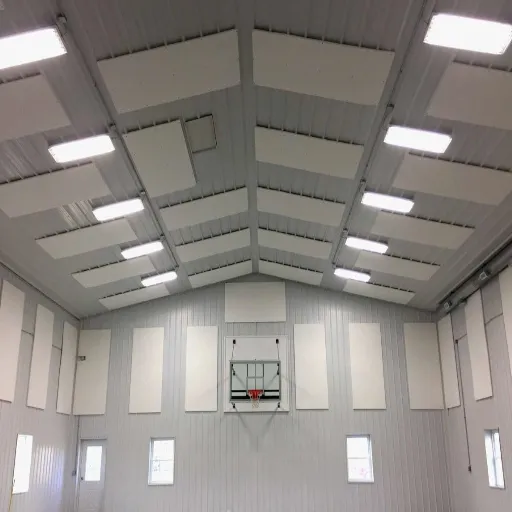
Even experienced contractors make these errors. Avoiding them saves money, time, and acoustic performance.
Ignoring Ceiling Height
Room volume matters more than floor area. A 1,000-square-foot room with 8-foot ceilings has 8,000 cubic feet of volume. The same floor plan with 12-foot ceilings has 12,000 cubic feet — 50% more air for sound to travel through. Higher ceilings need more ceiling coverage, not just more wall panels.
Treating All Materials the Same
A calculator that asks for “room size” without asking “panel material” is giving you a generic answer. WPC panels need 25-35% more coverage than fiberglass for the same result. If you order based on a fiberglass calculation and install WPC, you’ll under-treat the space and wonder why the echo persists.
Forgetting Subtractive Surfaces
Doors, windows, built-in cabinets, whiteboards, and existing artwork reduce the available wall surface. Don’t calculate panel quantities based on gross wall area. Measure the actual treatable surface after subtracting these elements. In offices with floor-to-ceiling glass, the available wall surface can be 40-60% less than the gross calculation.
Over-Covering One Surface While Ignoring Others
A conference room with 40% wall coverage and 5% ceiling coverage performs worse than one with 25% on both surfaces. Sound reflects off untreated surfaces and undermines the treated ones. Balance matters more than extremes.
Ordering Without Accounting for Panel Size
Standard 2-by-4-foot panels don’t always fit your wall dimensions evenly. A 14-foot wall needs four panels (8 feet of coverage) with 6 feet of untreated space — unless you use custom sizes or accept partial panels. Custom sizing from the manufacturer eliminates cutting waste and improves visual consistency.
Frequently Asked Questions
How many acoustic panels do I need for my office?
For a standard office, calculate 10-20% wall coverage and 50-60% ceiling coverage. A 2,000-square-foot open plan with 10-foot ceilings needs roughly 25-50 wall panels and 125-150 ceiling baffles. A 200-square-foot conference room needs 6-10 wall panels and one ceiling cloud. Exact counts depend on room type, ceiling height, and panel material.
What percentage of a room should be covered with acoustic panels?
Open-plan offices need 50-60% ceiling coverage and 10-20% wall coverage. Conference rooms need 25-35% on both walls and the ceiling. Private offices need 15-20% walls and 20-30% ceiling. Call centers need 50-60% ceiling coverage and 15-20% wall coverage. Reception areas need 30-40% wall coverage for both acoustic and visual impact.
How far apart should acoustic panels be spaced?
Space wall panels with 2-4 inch gaps between edges for a structured grid look. Ceiling baffles should hang in rows 2-3 feet apart. Prioritize first reflection points over even distribution — a panel at the exact reflection point of a noise source outperforms three panels placed randomly.
Do I need acoustic panels on the ceiling or just the walls?
In open-plan offices and call centers, ceiling treatment is essential. Wall panels alone cannot control sound that travels upward and reflects across the floor plate. In private offices and small conference rooms, wall panels may be sufficient if the ceiling height is under 10 feet. For any space over 1,000 square feet, plan for both wall and ceiling treatment.
Can you have too many acoustic panels?
Yes, but the threshold is high. Over-treatment makes a room sound unnaturally dead — conversations feel muffled, and audio from speakers sounds flat. Most offices never reach this point because budget constraints limit coverage before over-treatment occurs. If you’re exceeding 80% ceiling coverage or 50% wall coverage, consult an acoustic engineer.
How many ceiling baffles do I need per square foot?
One 2-by-4-foot ceiling baffle covers 8 square feet. For 50% ceiling coverage, you need one baffle per 16 square feet of ceiling. For 60% coverage, one baffle per 13.3 square feet. In a 2,000-square-foot open plan, that’s 125 baffles at 50% coverage or 150 baffles at 60% coverage.
Do I need fewer panels if I choose higher-NRC materials?
Yes. A panel with NRC 0.90 absorbs roughly twice as much sound as a panel with NRC 0.50. If you use high-NRC fiberglass (0.85-0.95), you can use the standard coverage percentages. If you use lower-NRC materials like WPC or wood slats, increase panel counts by 20-30% to achieve equivalent echo reduction.
How do I calculate panels for an irregular-shaped office?
Break the space into rectangular sections. Calculate surface area and coverage for each section separately, then add the panel counts together. For L-shaped offices, treat each leg as its own open plan. For offices with mezzanines or varying ceiling heights, calculate each zone independently because volume — not just floor area — drives absorption needs.
Conclusion
Calculating how many acoustic panels you need for your office isn’t guesswork. It’s a simple formula applied with room-specific knowledge: measure your surfaces, apply the right coverage percentage for your room type, adjust for your panel material’s NRC rating, and divide by your panel size.
The three-tier framework lets you start with minimum coverage and expand as the budget allows. A minimum-tier treatment still delivers measurable noise reduction — often 6-8 dB — which is enough for many offices to notice the difference. The standard tier brings professional-grade control. The comprehensive tier addresses the most demanding environments.
Remember that material choice changes the math. WPC and wood slat panels need 20-30% more coverage than fiberglass for equivalent absorption, but they also serve as finished wall surfaces. In client-facing spaces, the dual function often justifies the extra panels.
And distribution matters as much as quantity. Priority surfaces — rear walls in conference rooms, ceilings in open plans, first reflection points everywhere — should receive panels before you worry about even spacing across every wall.
Planning an office acoustic treatment project? Send us your floor plan and ceiling height, and we’ll calculate exact panel quantities for every room, recommend the right material for your budget, and provide a factory-direct wholesale quote within 48 hours.
Categories:
Blog
Related Articles